 The following content is from phys.org, original paper DOI: 10.1038/s41467-025-63535-7The world of quantum physics is inherently mysterious, but what happens when subatomic particles are subjected to extreme pressure? It turns out that observing quantum effects in a high-pressure environment is not an easy task, and the reason is simple: designing sensors that can withstand extreme forces is highly challenging.Now, a team of physicists at Washington University in St. Louis has made a significant breakthrough—they have developed a quantum sensor embedded in robust crystalline boron nitride sheets. This sensor can measure the stress and magnetism of materials in extreme pressure environments (pressures exceeding 30,000 times atmospheric pressure).
 Chong Zu, an assistant professor of physics and a member of the university’s Quantum Leap Center, stated: “We are the first team to develop such high-pressure sensors. They have broad application prospects in various fields, including quantum technology, materials science, astronomy, and geology.”The team published their research findings in the journal Nature Communications. To fabricate this sensor, the team used a neutron radiation beam to bombard boron atoms in the boron nitride sheets. The resulting vacancies immediately capture electrons. Due to quantum-level interactions, the spin energy of these electrons changes with the magnetism, stress, temperature, and other properties of the surrounding materials. By tracking the spin states of each electron, researchers can gain insights into the quantum-level characteristics of the materials being studied.Chong Zu and his colleagues had previously developed quantum sensors by creating vacancies in diamonds, which provided technical support for two quantum diamond microscopes at Washington University. Although diamond sensors perform well, they have a drawback: because diamonds have a three-dimensional structure, it is difficult to place the sensor close to the material being studied.In contrast, boron nitride sheets can be less than 100 nanometers thick, about 1/1000 the thickness of a human hair. Chong Zu noted: “Since the material where the sensor is located is essentially two-dimensional, the distance between the sensor and the material being measured is less than 1 nanometer (one billionth of a meter).”However, diamonds still play a crucial role. Guanghui He explained: “To measure materials in a high-pressure environment, we need to place the materials on a platform that won’t be damaged.” As the hardest material in nature, diamonds are perfectly suited for this requirement.Guanghui He and other members of the lab created a “diamond anvil”—two flat diamond surfaces, each about 400 micrometers wide, roughly the width of four dust particles, which compress against each other in a high-pressure chamber.Guanghui He explained: “The simplest way to create high pressure is to apply enormous force over a small area.”Tests have shown that this new type of sensor can detect subtle changes in the magnetic field of two-dimensional magnets. Next, the researchers plan to test other materials, including rock samples that exist in high-pressure environments similar to those in the Earth’s core.Chong Zu stated: “Measuring how these rocks respond to pressure will help us better understand earthquakes and other large geological activities.”
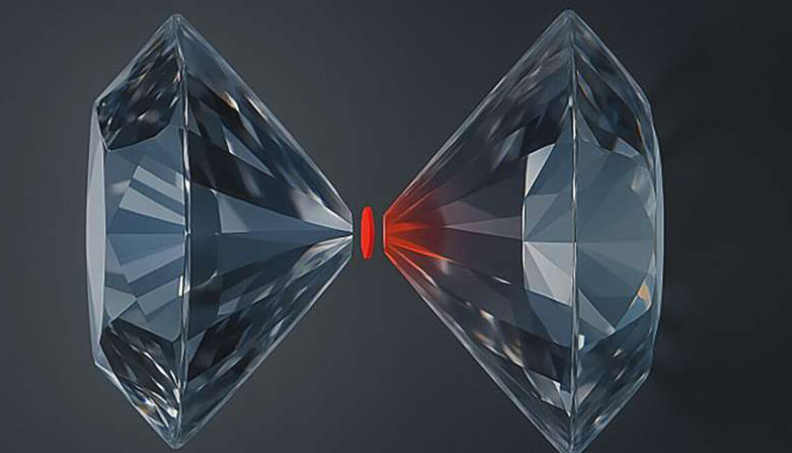 Figure: A 2D sensor compressed between two diamond anvilsSource: Chong ZuThis sensor may also advance superconductivity research—superconductivity is the property of materials to conduct electricity without resistance. Currently, known superconductors require extremely high pressures and low temperatures to achieve superconductivity. There have been claims that certain materials can achieve superconductivity at room temperature, but this view is highly controversial. Ruotian Gong, the co-first author of the paper, stated: “With this type of sensor, we can collect the necessary data to settle this controversy.”Chong Zu remarked: “Now that we have this type of sensor, high-pressure chambers, and diamond anvils, we will have more opportunities for exploration in the future.”Reference link
https://phys.org/news/2025-09-quantum-sensors-extreme-pressure.html
 Related ArticlesResearch Progress | Nature Top Journal! Google’s Quantum Processor Achieves Observation of Non-Equilibrium Topological Order for the First TimeSingapore Quantum Software Company Races for NASDAQ!Nature Journal! Neutral Atom Quantum Computer Simulates Kitaev Honeycomb Model for the First TimeResearch Progress | Google Quantum AI, etc.: Validating Almost All Quantum States through a Small Number of Single Qubit Measurements