Org. Process Res. Dev. 2022, 26, 347. DOI: 10.1021/acs.oprd.1c00414
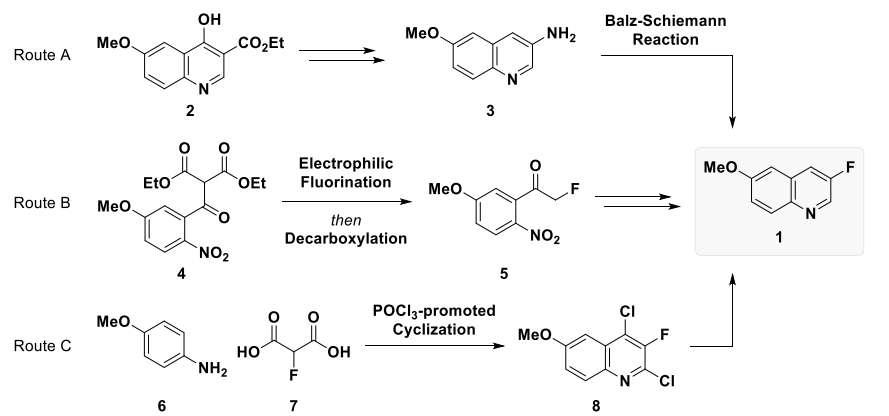
Route A
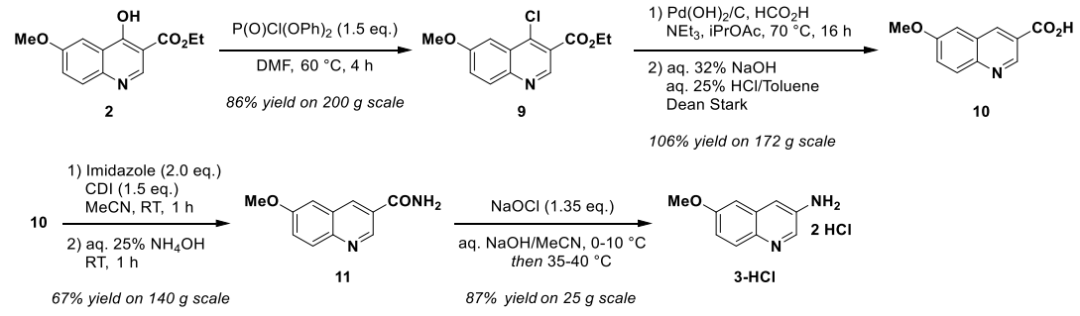
◆During the aqueous quench, a certain degree of back-hydrolysis to 2 occurred, which contaminated the initial crude product. The problem was solved by performing the chlorination with diphenylphosphoryl chloride (1.5 equiv) in DMF (5.5 vol).
◆For the Hofmann rearrangement of 11, the conditions reported in the literature, that is, use of aq NaOH, pyridine, and Br2 was avoided.
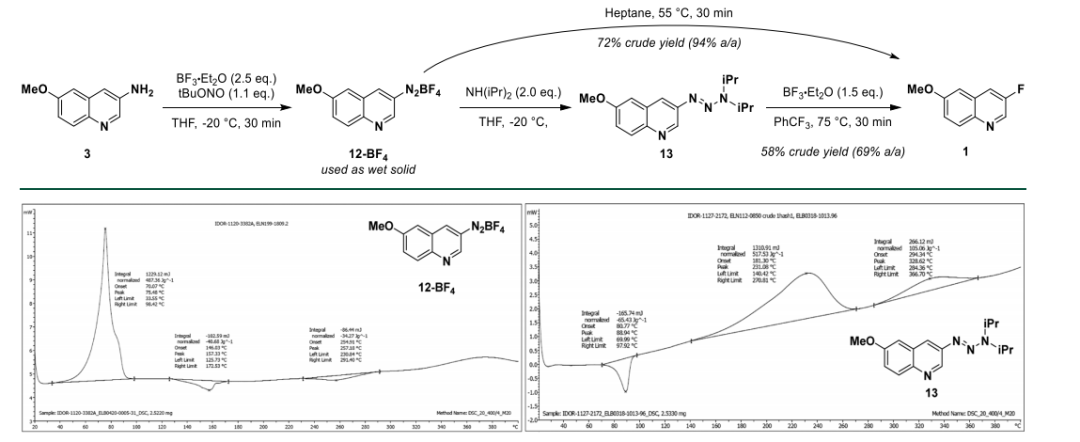
◆A DSC analysis of the heptane-wet diazonium salt 12-BF4 showed a highly exothermic degradation (487 J/g) at already 33 °C.
◆Only traces of the desired product 1 were formed by directly heating the slurry of diazonium salt.
◆A further idea—and inspired by a recent publication on the increased thermal stability of triazenes compared to diazonium salts—the transformation of 12-BF4 into its corresponding triazene derivative 13 resulted in a moderate 58% yield and low purity (69% a/a).
Route B
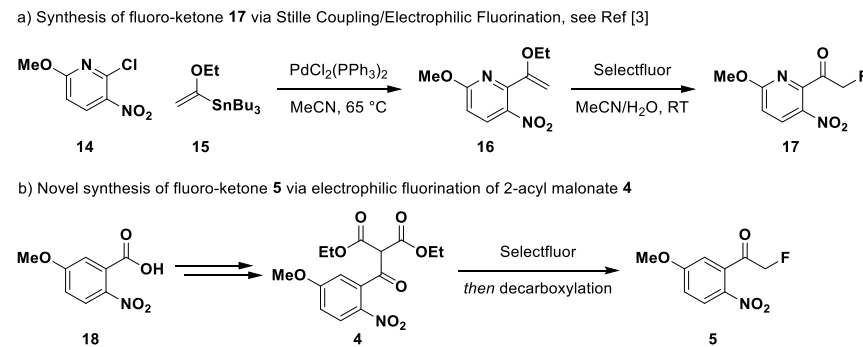
◆The use of stannane 15 is not desirable on scale and a novel approach to access fluoroketone 5 needed to be explored.

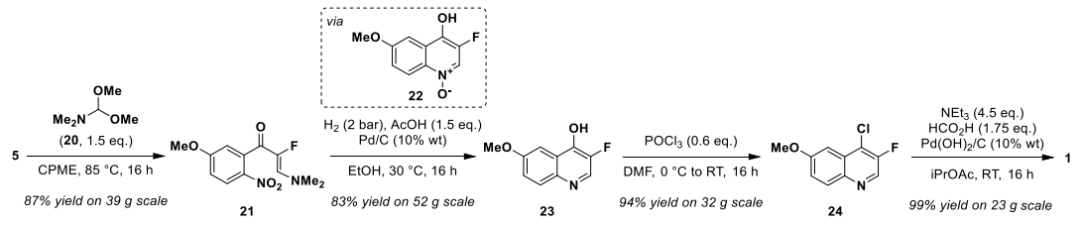
◆Ultimately, we decided against the further development of this route due to its multistep nature which would have translated into a long production time and reactor occupancy, unfavorable atom economy, and the relatively high costs of Selectfluor on scale.
Route C

◆Therefore, a third approach was developed, in which the desired heterocycle was formed via condensation of p-anisidine with 2-fluoromalonic acid, two inexpensive and commercially available starting materials.

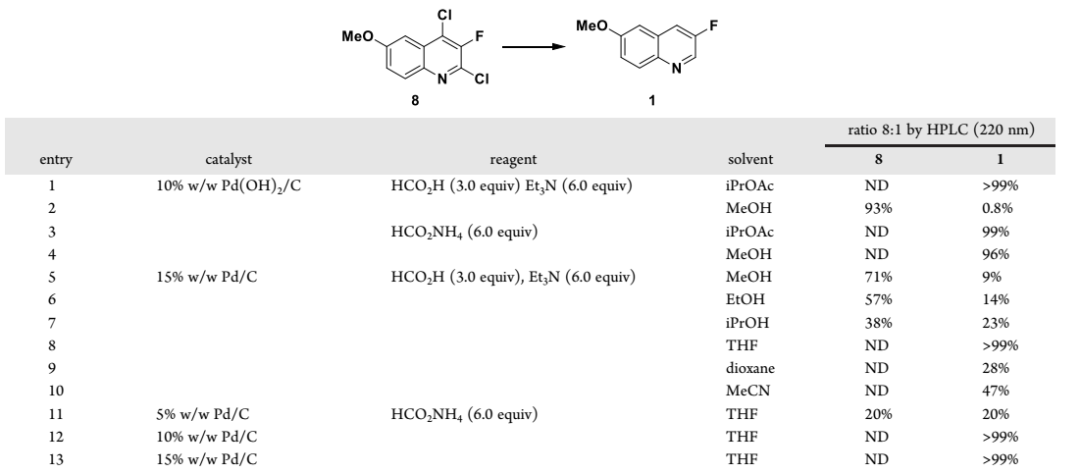
◆Since the Raney nickel-catalyzed hydrogenolysis was very slow and the multiple additions of Raney nickel posed a severe safety hazard, it was decided to develop an improved hydrodechlorination system. Pd/C was reported to be effective in this reaction, but intermediate 8 had to be pretreated by stirring with 10% Pd/C (5% w/w) in MeOH to remove an unidentified catalyst poison.
◆Therefore, it was decided to explore transfer hydrogenations since these conditions are often less sensitive to catalyst poisons.
Recruitment: Synthetic Process Researcher in Shanghai
Design and optimize synthetic routes for class I new drugs, including various reaction conditions and parameters, write reports, and track and solve GMP production technical issues.
Attractive salary, please contact me directly if interested! 18521511651 (WeChat same number)