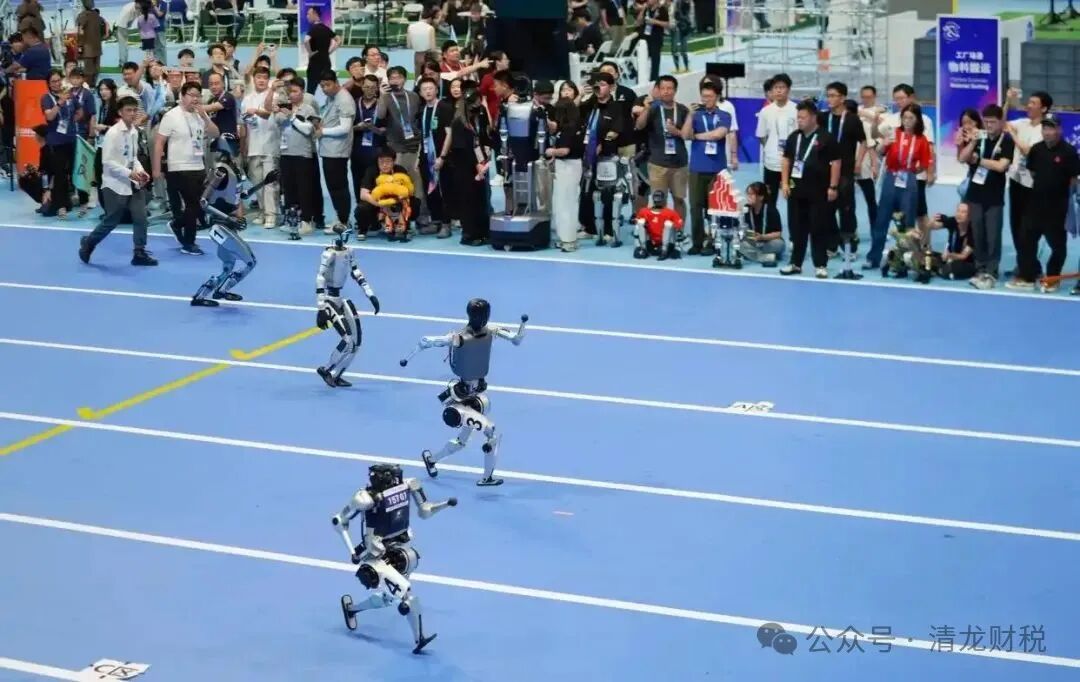
(Image source: Xinhua News Agency)
Recently, at the National Speed Skating Hall, during the finals of the 100-meter sprint event at the 2025 World Humanoid Robot Games, the “Embodied Tian Gong Ultra” from the Beijing Humanoid Robot Innovation Center won the championship with a time of 21.50 seconds, marking the birth of the first humanoid robot “100-meter sprinter”.
This is not only a breakthrough in competition but also signifies a solid step forward in human technological exploration in the field of humanoid robots. This event, which gathered numerous teams, showcased the infinite possibilities of the integration of artificial intelligence, mechanical control, and sensing technology through sports, as well as the changes in the future labor market.
The competition for the “100-meter sprinter” is not just about the word “speed”. According to the official competition rules, in the 100-meter race, teams compete using remote-controlled robots, with the final time multiplied by a weight coefficient of 1; for fully autonomous competition, the final time is multiplied by a weight coefficient of 0.8 to determine the final score. This conceals a consideration of the core technology. Compared to remote control, fully autonomous navigation better reflects the robot’s “intelligent decision-making” capabilities.
The “Embodied Tian Gong Ultra” did not cross the finish line first, but won the championship by running autonomously without any human intervention throughout the race. This confirms that the competitiveness of humanoid robots has surpassed mere mechanical movement precision, advancing towards a complete closed loop of “perception-judgment-execution”. From half-marathon champions to 100-meter winners, the breakthroughs behind this are continuous advancements in algorithm iteration, power system optimization, and balance control technology, with every second of progress embodying the wisdom of interdisciplinary collaboration.
The significance of the World Humanoid Robot Games lies in establishing a technical testing ground. Competing teams showcase their results while also identifying problems: how to maintain balance during high-speed movement? How to cope with slight ground changes on the field? How to make the robot’s movements closer to human flexibility? Effectively addressing these challenges encountered in competition will help promote technological refinement and implementation.
This event aims to “promote the application of products”. Breakthroughs in capabilities such as running will lay the foundation for the application of humanoid robots in labor scenarios such as home services, industrial assistance, and emergency rescue. This means that the expansion of robot capabilities will impact the job content of some workers. At the same time, new professions related to humanoid robots will emerge.
Through the World Humanoid Robot Games, we see not just a series of competitions but also the acceleration of technological development. Every step and sprint of the robots is an exploration of the proposition of “machines imitating humans”. This exploration will ultimately benefit human life, allowing technology to better meet needs.
The 100-meter showdown of humanoid robots is just a new beginning. As humanoid robots run and are utilized in more fields, the picture of technology changing life will become increasingly clear.
Author: Guo Yuanpeng
Editor: Qiu Man