
By | Nandu Reporter Cheng Yang
On September 18 at the Huawei Connect Conference, Huawei’s Vice Chairman and Rotating Chairman Xu Zhijun revealed that over the next three years, Huawei has planned multiple Ascend chips, including the 950PR, 950DT, 960, and 970 chips.
Among them, the Ascend 950PR will be launched in the first quarter of 2026, the Ascend 950DT in the fourth quarter, the Ascend 960 chip in the fourth quarter of 2027, and the Ascend 970 chip in the fourth quarter of 2028.
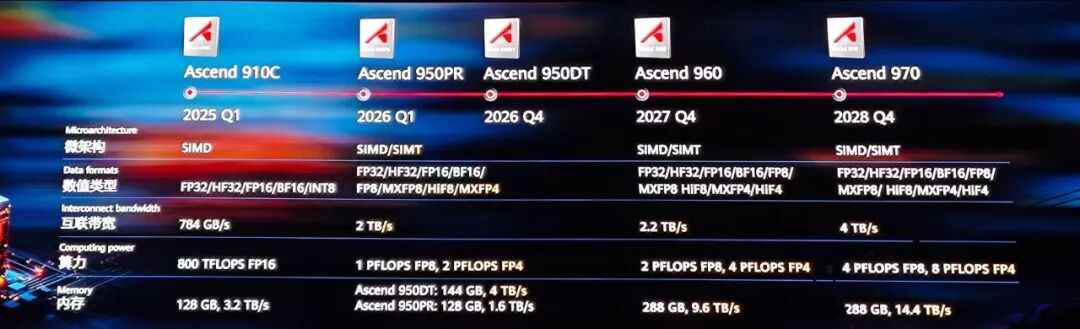
Huawei’s roadmap for multiple Ascend chips
According to public information, Huawei’s Kunpeng and Ascend ecosystems have over 3.5 million developers and more than 5,600 partners, with over 15,500 certified solutions. Additionally, in the established computing centers in China, the Ascend solutions account for about 85% of domestic solutions. However, Huawei has not publicly confirmed the total installed capacity or market share statistics for Ascend chips, super nodes, and clusters.
Xu Zhijun stated that while Huawei’s single chip still lags behind NVIDIA, the long-term investment in connectivity technology and the construction of super nodes and clusters can provide a solid guarantee for meeting computing demands in China and worldwide.
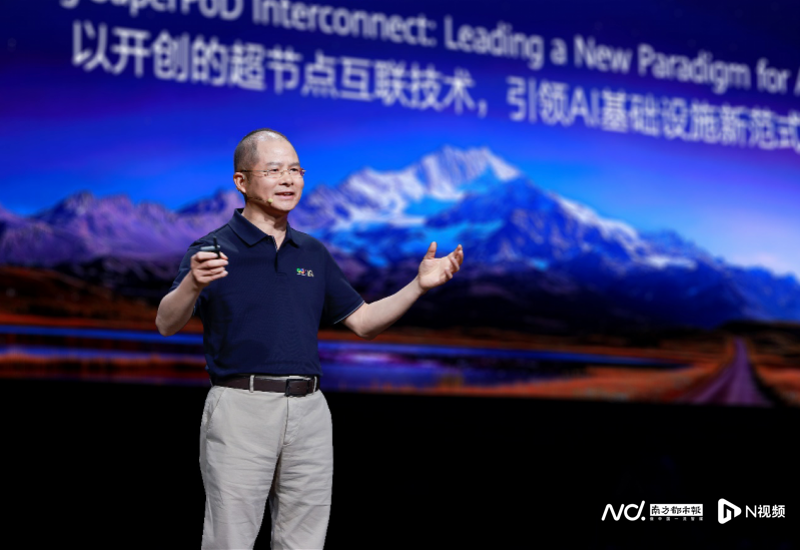
Huawei’s Rotating Chairman Xu Zhijun delivers a keynote speech
A super node is physically composed of multiple machines but logically functions as a single machine for learning, thinking, and reasoning. At this conference, Huawei launched the latest super node products, the Atlas 950 SuperPoD and Atlas 960 SuperPoD, which support 8192 and 15488 Ascend cards respectively, leading in key metrics such as card scale, total computing power, memory capacity, and interconnect bandwidth. Based on the super nodes, Huawei also released super node clusters, namely the Atlas 950 SuperCluster and Atlas 960 SuperCluster, with computing scales exceeding 500,000 cards and reaching one million cards.
Xu Zhijun expressed confidence that based on the computing super nodes and clusters, Huawei can provide sustainable and ample computing power for the long-term rapid development of artificial intelligence.
At the same time, Huawei is the first to introduce super node technology into the general computing field, launching the world’s first general computing super node, the TaiShan 950 SuperPoD, which, combined with the GaussDB distributed database, can completely replace large and small machines as well as Exadata database integrated machines in various application scenarios, becoming the terminator of all types of large and small machines.
Xu Zhijun pointed out: “Computing power has been, and will continue to be, the key to artificial intelligence, and it is also crucial for China’s artificial intelligence.” He stated that based on the chip manufacturing processes available in China, Huawei is striving to create a “super node + cluster” computing solution to meet the continuously growing demand for computing power.