According to foreign media Tom’s Hardware, researchers at MIT’s Lincoln Laboratory are demonstrating that 3D printing technology is still full of innovative potential — using glass as a raw material for 3D printing.
Traditionally, manufacturing glass requires extremely high temperatures, not only for shaping but also for annealing the finished product. One major challenge is feeding the molten glass into the machine. Therefore, the MIT research team has developed a new method that can produce glass structures at lower temperatures.
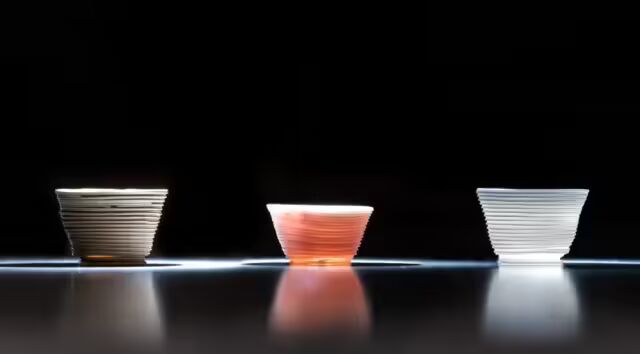
MIT states that this new technology breaks the limitations of traditional processes, making many previously difficult-to-achieve glass structures possible. The team hopes this advancement will facilitate the production of various glass devices, such as electronic components used in high-temperature environments or microfluidic systems.
Reportedly, the research team refers to this material as “inorganic composite glass,” and the entire process is named “low-temperature additive manufacturing.” This new type of glass filament not only addresses stability issues present in other materials but also possesses good structural adaptability.
It is introduced that inorganic composite glass is composed of nanoparticles and inorganic substances such as silicate solutions. After printing, these glass materials are placed in an oil bath, heated to 250°C, and the surface residues are removed using organic solvents.
The breakthrough in 3D printing with glass by the MIT research team provides new development directions for other companies. In terms of patent strategy, companies need to keep pace with technological trends and proactively position themselves in key technology areas. In terms of materials, patent applications can focus on optimizing the composition of inorganic composite glass and methods for performance enhancement, such as developing new combinations of nanoparticles or improving silicate solution formulations. In terms of processes, patents can be laid out for innovations in low-temperature additive manufacturing equipment and precise control of printing parameters, such as designing more efficient print head structures. Additionally, post-processing techniques should not be overlooked, such as optimizing oil bath heating parameters, developing new organic solvents, and methods for residue removal, all of which can be patented. Through comprehensive and precise patent strategies, companies can build strong technological barriers and gain a competitive edge in the market.
Source: IT Home and others
▼ Previous Hot Articles Recommended ▼
MIT Develops New AI Repair Technology: Reviving a 15th Century Oil Painting in Three and a Half Hours
Can Generate Power from Body Heat! New Flexible Power Generation Film Material Developed in China
New Breakthrough! Chinese Research Team Completes Module-Level Verification of Star-Ground Quantum Direct Communication System for the First Time
New Sensor System Released! Can Detect Obstacles 200 Meters Away in Extremely Poor Visibility Conditions
Sichuan High Court Releases Typical Cases of Judicial Protection of Intellectual Property
German Scientists Breakthrough Battery Technology Bottleneck: Metal Velvet Electrode Achieves 85% Energy Density Leap
In Cases Where the Font Used Conflicts with Later Registered Trademarks, Does It Constitute Infringement?
Beijing Intellectual Property Court Releases Annual Cases for 2024
The White Paper on the Status of Intellectual Property Protection in China for 2024 is Officially Released
New Breakthrough in Fast Charging Technology! Korean Scientists Develop New Battery Material, Achieving 1500 Cycles of Fast Charging in 20 Minutes
Stanford’s Latest AI Research Report Released: Performance Gap Between Top AI Models in China and the US Narrowed to 0.3%
Major Breakthrough! Fudan University Team Successfully Develops “Wujing” Two-Dimensional Semiconductor Chip
Increased by 15 Times! New Breakthrough in China’s Solar Water Splitting Hydrogen Research
World’s First: New Type of Smartphone OLED Panel That Can Make Sounds and Change Shape Released
Why Are Product and Patent Designs Different Yet Still Judged as Infringement?
Say Goodbye to Manual Window Breaking! Seris Automatic Window Explosion Patent Enhances Safety
Enjoying a Fifteen-Year Patent Protection Period! Xiaomi SU7 Vehicle Appearance Patent Granted
[Warm Reminder] Some images in the article are sourced from the internet, and the copyright belongs to the original authors. If there are any issues, please contact us to modify or delete.