In the context of Japan’s aging agricultural workforce and labor shortages, outdoor autonomous walking robots designed for orchard scenarios are finally experiencing their “moment of realization”. Recently, Kisui Co., Ltd. announced that its developed off-road autonomous walking AI robot “Adam” has sold out its first batch after officially launching for general users in April 2025, and has initiated an expansion plan to meet next year’s demand. This progress not only reflects the strong market demand for intelligent agricultural machinery but also confirms the urgent expectation for specialized transport robots in complex terrain scenarios like orchards.
Kisui Co., Ltd. is an agricultural robotics startup established in 2021, headquartered in Sendai City, Miyagi Prefecture, Japan, originating from a technology transfer project at Tohoku University. The representative director is Tamir Blum. The company focuses on AI agricultural robots, image recognition, and data science, aiming to create a more sustainable labor environment and business model for frontline agricultural producers through technological innovation. Its brand name “Kisui” embodies the concept of “making green agriculture shine with the support of technology”.
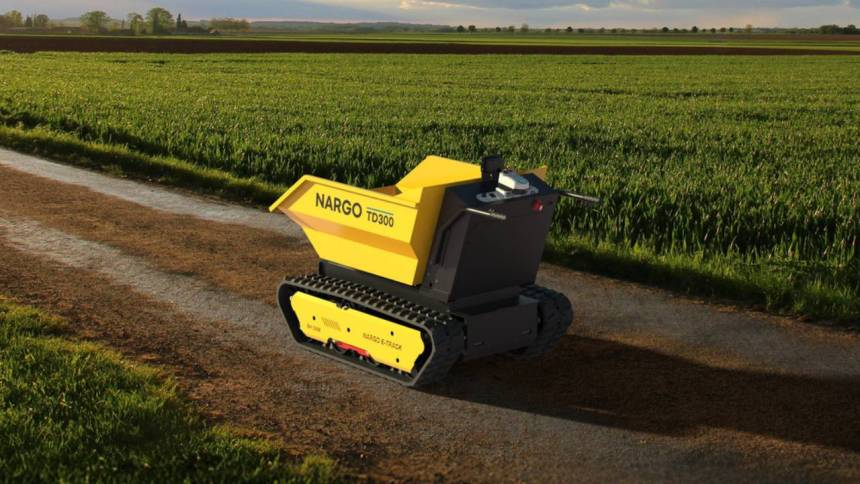
“Adam” is an autonomous walking AI robot specifically developed for orchards. Unlike traditional large agricultural machinery that operates in open fields, orchards often have uneven terrain, narrow pathways, and dense trees, making mechanization challenging. For a long time, manual labor has been relied upon to carry fruits, fertilizers, and agricultural materials.Adam is based on an electric chassis and can stably navigate uneven forest paths, responsible for heavy physical tasks such as transporting harvested fruits, fertilizers, pruning branches, and various agricultural supplies, significantly reducing the burden on farmers and improving operational efficiency.
According to public information, Adam was optimized from the outset for the orchard scenario, which is considered the “most difficult to mechanize” environment. Under typical working conditions, it can achieve automatic transport of up to approximately 300 kilograms of goods, capable of maneuvering between fruit trees and maintaining stable operation on uneven terrain, making it a highly significant “mid-sized transport robot” that fills the gap between manual labor and large agricultural machinery.
From a market perspective, after Kisui Co., Ltd. officially launched general sales of Adam in April 2025, it quickly received positive feedback from agricultural corporations and fruit producers across Japan. Within just a few months, the first batch of production models was fully booked. The company also disclosed that not only domestic orchard users in Japan responded enthusiastically, but as the labor shortage issue in agriculture intensifies globally, inquiries and cooperation intentions from regions such as Europe, Australia, and Southeast Asia are also increasing. This has prompted the company to build a more comprehensive large-scale production and overseas supply system to meet the growing international demand.
On the manufacturing side, Kisui Co., Ltd. is continuously expanding production capacity at its manufacturing base in Kashiwa City, Chiba Prefecture, and is publicly recruiting assembly and debugging personnel and part-time employees, hoping to attract talents interested in manufacturing and robot development who have a certain understanding of machinery or production processes. This approach not only alleviates the company’s capacity bottleneck but also promotes employment and skill development related to robot manufacturing and smart agriculture at the regional level.
In terms of product technology direction, Kisui Co., Ltd. has not simply positioned Adam as a single-function “electric cart”, but rather as a “multi-scenario outdoor autonomous transport platform”. With the continuous improvement of the hardware and software platform, Adam can not only perform autonomous walking and follow human operations in orchards but also plans to extend to more outdoor primary industries by developing various operational units and additional devices (such as adapting to different cargo boxes, spraying equipment, etc.), including material transport in some agricultural lands and civil engineering and construction sites, as well as ICT construction support, evolving from a “orchard-specific machine” to a “multi-purpose outdoor transport robot”.
From an industry perspective, the rapid sell-out of the first batch of production models of Adam is of significant symbolic importance. On one hand, it indicates that autonomous walking robots have moved from “concept validation” to “mass delivery” in traditional human-centric scenarios like orchards, validating the product design approach aimed at addressing the pain points of high-intensity physical labor; on the other hand, it also shows that capital and industry see the considerable commercialization potential of specialized robots aimed at specific crops and terrains, rather than just extensions of large general agricultural machinery or indoor AGVs/AMRs.
As a technology startup originating from Tohoku University, Kisui Co., Ltd. is entering the niche market of orchards with Adam, meeting actual operational needs while building a replicable technology and business model: based on a highly mobile electric chassis, empowered by vision and AI algorithms for autonomous walking and human-machine collaboration, and adapting modular operational units to meet multi-scenario demands, while completing the closed loop from R&D, testing to small-scale production locally. This practical path provides a valuable reference for autonomous walking robot companies focusing on outdoor complex environments.
It is foreseeable that with the improvement of mass production capabilities and the expansion of overseas cooperation channels, Adam and similar autonomous walking AI robots aimed at specialized scenarios like orchards are expected to become one of the “infrastructures” in agricultural production systems in the coming years. For Kisui Co., Ltd., the sell-out of the first batch of production models is just a starting point; how to accelerate iteration while ensuring reliability and continuously expand application boundaries will determine its long-term competitiveness in the global smart agriculture and outdoor robot market.
Recommended Reading
Collaborative Change in Material Handling — Heli • China Forklift Network | The “2025 China Forklift and Mobile Robot High-Quality Development Journey” event kicks off at Heli Headquarters
Product Launch | Weimar VMR releases hidden fork products — Submerged Fork Robot FR31201P
Tracking Intelligent Transportation showcases at Chengdu Industrial Expo, contributing to the high-quality development of industrial warehousing logistics in the West
Hefei Manyi Tong MiMA 6-ton towing AGV body batch delivery, assisting logistics companies in achieving intelligent handling upgrades!

|
|