# Empowering Future Mobility with Chips #
BEST TECH BEST LIFE

This article discusses the trend of automotive electronic architecture evolving from distributed to centralized systems, analyzes the key challenges brought by centralization such as safety isolation and real-time performance, and points out that automotive virtualization technology is the core solution for achieving domain control integration. This technology can optimize resource allocation and ensure functional safety, effectively promoting the intelligent transformation of automobiles.

Centralization Trend of Automotive Electronic and Electrical Architecture
In recent years, the automotive electronic and electrical architecture has been undergoing a profound transformation from distributed to centralized systems. In traditional vehicles, various functional modules (such as instrument clusters, entertainment systems, ADAS, etc.) are typically implemented by independent electronic control units (ECUs), leading to complex systems, numerous wiring harnesses, and high costs. With the development of automotive intelligence, this distributed architecture can no longer meet the demands, making controller integration an inevitable choice.
The evolution of modern automotive electronic and electrical architecture can be divided into three typical stages, driven by the explosion of intelligent demand and the realization of the “software-defined vehicle” concept:
Distributed Architecture Stage (2000-2015)
During the distributed architecture stage, each functional module of the vehicle corresponds to an independent ECU, with the total number of ECUs in the vehicle exceeding 100. For example, the 2015 BMW 7 Series has approximately 140 ECUs. Although this architecture achieves modular design of functions, it also brings a series of challenges:
-
Wiring Harness Issues: The total length of wiring harnesses exceeds 5 kilometers, weighing up to 70 kilograms, which not only increases the overall vehicle weight but also complicates assembly.
-
Fragmentation of Communication Protocols: Different suppliers’ ECUs use different communication protocols (such as CAN, LIN, FlexRay), making system integration difficult.
-
High Costs: The increase in the number of ECUs directly raises hardware and maintenance costs.
-
Difficult Upgrades: Function upgrades rely on hardware iterations, making it difficult to achieve through software OTA.
Domain Control Architecture Stage (2015-2025)With the emergence of high-performance automotive-grade SoCs, multi-system coexistence has become possible, and the automotive electronic and electrical architecture has entered the domain control stage. Multiple functional modules are integrated into the same SoC, forming regional controllers. Typical domain controllers include:
- Intelligent Cockpit Domain: Integrates instrument clusters, HUDs, and in-vehicle entertainment systems.
- Intelligent Driving Domain: Integrates data processing functions of cameras, radars, and LiDAR.
- Body Domain: Integrates body control modules (BCM), air conditioning, and lighting control functions.
The domain control architecture not only reduces the number of ECUs but also enhances system integration and resource utilization.Central Computing +Regional Control Stage (2023-)With further technological development, the automotive electronic and electrical architecture is evolving towards a two-tier architecture of “central computing + regional control.” The central computing platform is responsible for high-computational tasks, while regional controllers execute specific control functions. On the hardware level, the Wudang C1200 family of chips released by Black Sesame Intelligence in 2023 is the first automotive-grade intelligent vehicle cross-domain multifunctional integrated computing platform, providing strong hardware support for central computing and regional control.
Technical Challenges Brought by Centralization
Although the centralized architecture significantly enhances system integration and resource utilization, it also introduces the following key technical challenges:Safety Isolation RequirementsIn mixed-criticality systems, functions with different safety levels (such as ASIL-B instrument systems and QM-level entertainment systems) need to coexist on the same hardware platform. The core of safety isolation is to ensure that high-safety functions are not interfered with by low-safety functions, covering both functional safety and information security. For example, the failure of low-safety functions should not affect the execution of high-safety functions, while also preventing side-channel attacks and other security threats.Real-Time Performance ConflictsVehicle control has very high real-time requirements, while entertainment systems focus more on user experience. Coordinating the needs of real-time systems and non-real-time systems becomes a major challenge. Solutions include achieving isolation through system separation, using time-sensitive networks for unified time tagging, and employing mixed-criticality scheduling strategies to optimize system collaboration.Resource Utilization OptimizationDifferent functions have varying peak load times, and static resource allocation can lead to computational power waste. Especially in the fields of assisted driving and intelligent cockpits, the demand for computational power is increasing. Dynamic scheduling of computational resources and achieving load balancing are key to enhancing hardware performance.Bandwidth ChallengesThe in-vehicle communication architecture is shifting from signals to services, leading to a sharp increase in bandwidth demand. The introduction of LiDAR and high-precision maps further exacerbates communication loads. Gigabit Ethernet has become standard in mass-produced vehicles, while 10 Gigabit Ethernet is also about to become widespread. Additionally, assisted driving algorithms significantly increase memory bandwidth requirements, and future central computing platforms need to support communication bandwidth exceeding 100Gbps. To this end, new technologies such as silicon photonic interconnects and coherent memory sharing protocols are being explored and applied.
Automotive Virtualization Technology
Automotive virtualization technology is one of the core solutions to address the above challenges. It can achieve safety isolation, build mixed-criticality systems, coordinate multi-system scheduling, and optimize resource allocation. The following are specific classifications and characteristics of virtualization technology:Overview of Safety Isolation TechnologiesBased on the degree of isolation, safety isolation technologies can be divided into the following four levels:Chip Separation
- Implementation Method: Different SoCs independently run different systems.
- Characteristics: Highest degree of physical isolation, with completely independent resources.
- Typical Applications: In early intelligent cockpits, instruments and entertainment systems belonged to different chips.
Hard Isolation
- Implementation Method: Divides CPU, memory, and IO resources through SoC hardware partitioning.
- Characteristics: Hardware-level isolation, with each partition running independent systems.
- Typical Applications: In current mainstream domain controllers, instruments and entertainment systems share chips but are hardware-isolated.
IO Pass-Through
- Implementation Method: Virtualizes CPU and memory, with IO devices directly passed through to the guest.
- Characteristics: IO performance is close to native, but requires hardware support for technologies like SR-IOV.
- Typical Applications: Scenarios requiring high-performance IO, such as direct transmission of camera data to ADAS systems.
Full Virtualization
- Implementation Method: Fully virtualizes CPU, memory, interrupts, and IO.
- Characteristics: Most flexible resource scheduling, but with the highest virtualization overhead.
- Typical Applications: Dynamic resource allocation scenarios in central computing platforms.
Comparison and Trade-offs of Safety Isolation Technologies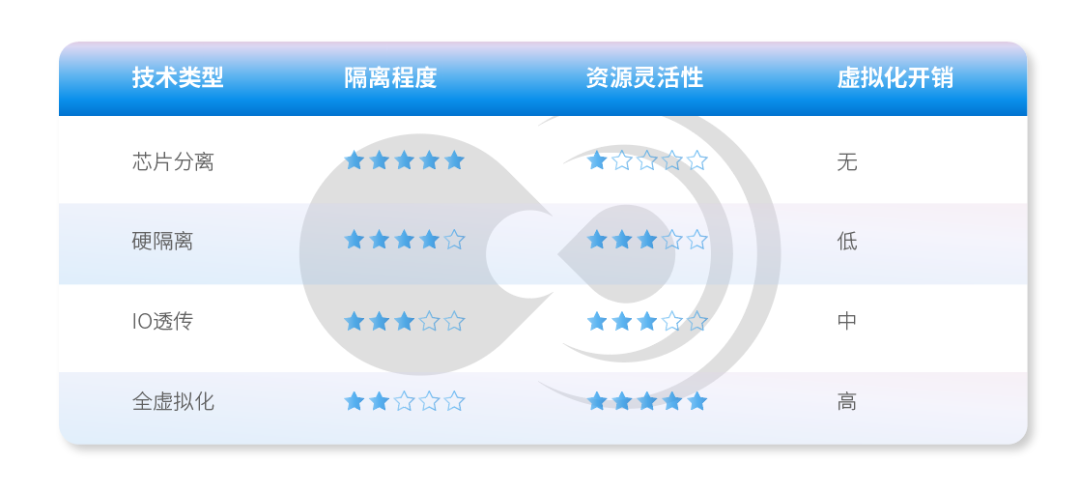 As the degree of isolation decreases, the resource reuse rate and dynamic adjustment capability of the system increase, but virtualization overhead and security risks also rise. Modern automotive SoCs typically adopt a hybrid approach, using hard isolation for safety-critical functions and full virtualization for general functions.Core Advantages of Virtualization ArchitectureVirtualization technology has the following significant advantages in building mixed-criticality systems:
- Enhanced Deployment Flexibility: Supports coexistence of heterogeneous OS (such as QNX and Android), enabling dynamic allocation of computing resources, facilitating hot upgrades and OTA.
- Improved Functional Safety: Ensures that the failure of a single virtual machine does not affect other functions through fault isolation, and resource monitoring can intercept illegal memory access, while secure boot guarantees the integrity of each virtual machine.
- Strengthened Information Security: Inter-VM communication is controllable, critical data is encrypted and isolated, and fine-grained access control is supported.
- Mixed-Criticality Scheduling: Coordinates the execution of real-time and non-real-time tasks, optimizing system performance.
- Zero-Copy Inter-Process Communication: Achieves efficient data transmission through shared memory, reducing latency.
For example, in intelligent cockpits, virtualization technology ensures the real-time and safety of the instrument system (ASIL-B) while providing rich ecological support for the entertainment system, and prevents illegal access to critical resources by the entertainment system through Hypervisor monitoring.
Virtualization: The Essential Path to Domain Control Integration
As the electronic and electrical architecture evolves towards “central computing + regional control,” virtualization technology has become an irreplaceable solution for domain control integration. It effectively resolves the contradictions between functional safety and information security, achieves coexistence of real-time systems and general systems, and optimizes the balance between resource utilization and isolation requirements. In the future, with the improvement of chip computing power and the development of virtualization technology, full virtualization solutions will gradually become the mainstream choice for central computing platforms.Additional Virtualization Technology Notes:
- Type II Virtualization (Host-based Virtualization): Runs on top of general OS (such as VirtualBox), mainly used for development and testing environments, but due to performance and security limitations, it is not suitable for mass-produced vehicles.
- Container Technology: Lightweight virtualization that shares the kernel, suitable for application-level isolation (such as multiple entertainment applications), but cannot meet ASIL requirements and is often used in conjunction with Type I virtualization.
Automotive virtualization technology continues to develop alongside the evolution of electronic and electrical architecture. From the current dominance of hard isolation in domain controllers to the future application of full virtualization in central computing platforms, this technology will continue to drive the intelligent transformation of automobiles, maximizing the utilization of computing resources while ensuring safety. Automotive manufacturers and suppliers need to choose appropriate virtualization solutions based on specific functional requirements to build safe, efficient, and flexible in-vehicle computing platforms.
Further Reading