This article is a comprehensive overview by Embedded Vertical.
On September 10, Arm launched its new Compute Subsystem (CSS) platform—Arm Lumex. This platform integrates the latest generation Armv9.3 CPU, Mali GPU, system IP, and production-ready 3nm physical implementation, aiming to meet the increasingly stringent demands for AI experiences on flagship smartphones and PCs. It helps chip partners and OEM manufacturers to launch innovative products with industry-leading performance more quickly and with lower risk within accelerated product cycles.

Addressing Industry Challenges in the AI Era
Currently, mobile devices are rapidly evolving from function-driven tools to AI-driven intelligent companions that can actively adapt, predict, and optimize user experiences. As AI models on devices become increasingly complex and mature, they pose unprecedented challenges to the underlying mobile chips in terms of computing power, energy efficiency, and thermal management.
At the same time, the smartphone industry is facing an accelerating product iteration cycle, which requires chip suppliers and OEM manufacturers to complete technological innovations within extremely tight timelines, leaving little room for error. Achieving advanced packaging technologies to support AI performance within the limited physical area and thermal budget of mobile devices, and advancing to more precise process nodes like 3nm, has become an extremely complex system-level design challenge.
Chris Bergey, Senior Vice President and General Manager of Arm’s Client Line of Business, stated: “Mobile computing is entering a new era defined by AI. The ways we build, scale, and deliver intelligence are reshaping our digital lives. To address this trend, we can no longer view IP in isolation; we need an integrated platform for collaborative design and optimization. Arm Lumex is designed as a solution based on this future vision, helping our ecosystem partners to more easily create differentiated AI-first platforms and experiences, achieving faster large-scale deployments with smarter performance.”

Redesigned Computing Core for the AI-First Era
Arm Lumex is a modular and highly configurable platform, with its core being the collaboratively optimized latest Arm computing IP, specifically designed to accelerate AI workloads.
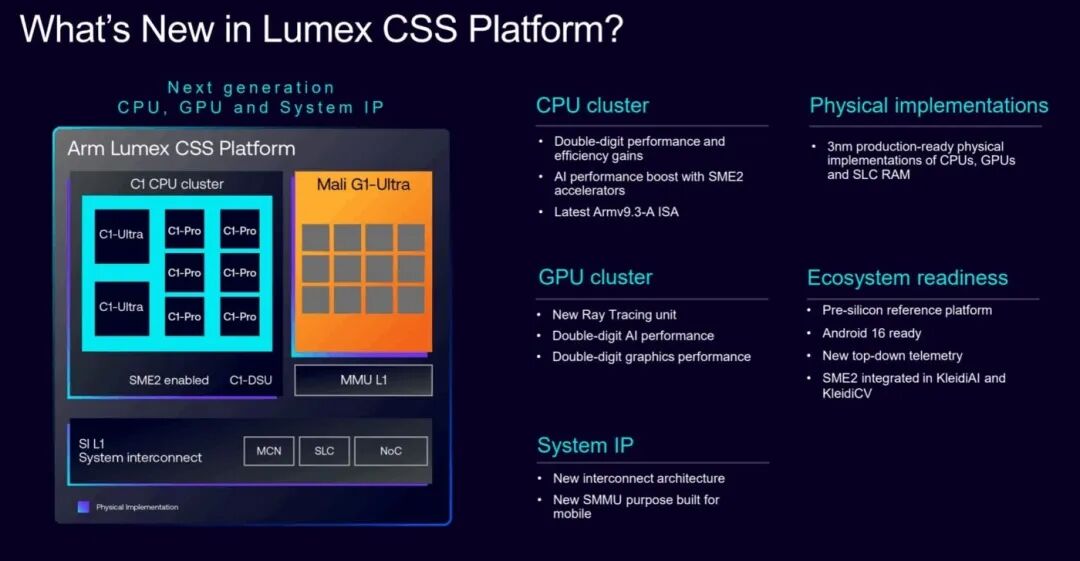
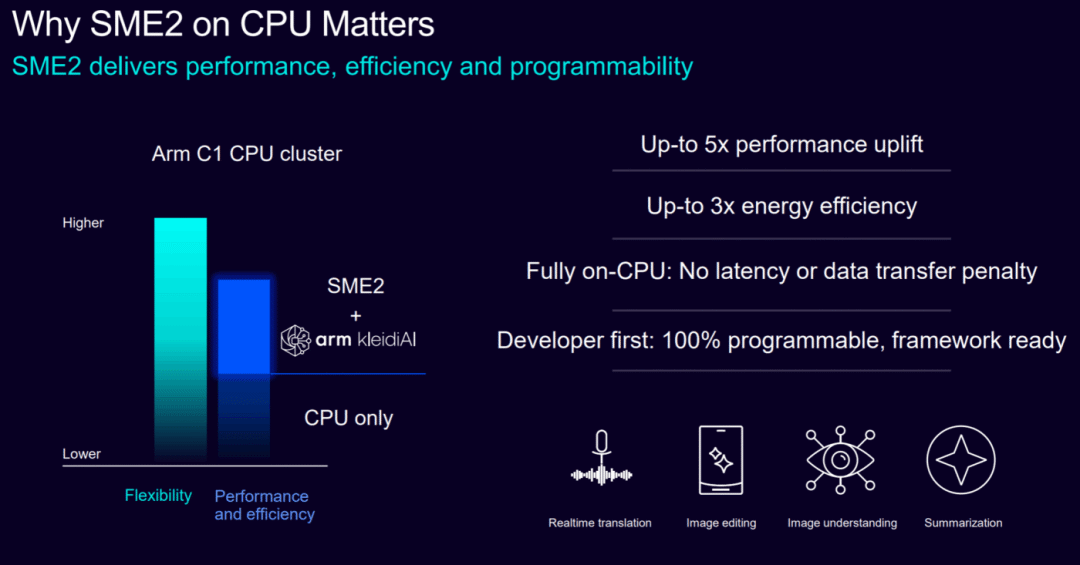
- New Armv9.3 C1 CPU Cluster: As the brain of Lumex, the C1 CPU cluster provides industry-leading instructions per clock cycle (IPC) performance. Its key innovation is the built-in Scalable Matrix Extension 2 (SME2) unit. Combined with native support from the Arm KleidiAI software library, SME2 enables the CPU cluster to efficiently handle matrix operations, achieving up to 5 times AI performance improvement and 3 times energy efficiency optimization in a wide range of workloads such as machine learning inference, speech recognition, and generative AI compared to previous generations. This means users will enjoy smoother AI interactions in daily use, while device battery life is extended. In addition to the leap in AI capabilities, the microarchitecture of the C1 CPU cluster has also been deeply optimized, achieving an average performance improvement of 30% across six industry-leading performance benchmarks; a 15% speed increase in mainstream applications like gaming and video streaming; and an average power reduction of 12% in everyday mobile tasks. Notably, the flagship Arm C1-Ultra CPU has achieved double-digit IPC performance growth compared to the previous Cortex-X925.
- New Arm Mali G1-Ultra GPU: To meet the demands of AI applications and high-end mobile gaming, the Mali G1-Ultra has made significant breakthroughs in both graphics and compute. In terms of AI performance, its inference speed has increased by 20% compared to the previous Immortalis-G925 GPU. In gaming experience, thanks to the new second-generation ray tracing unit (RTUv2), its ray tracing performance has doubled, bringing high-end desktop-level cinematic visuals to mobile for the first time. In mainstream games and benchmarks such as “Escape from Tarkov,” “Genshin Impact,” and “Honkai: Star Rail,” the Mali G1-Ultra has achieved a 20% overall image performance improvement.

Scalable System Backbone: Eliminating AI Data Bottlenecks
An excellent AI experience relies not only on powerful CPUs and GPUs but also on an efficient system architecture to ensure smooth data transmission. The Lumex platform introduces a new system IP that builds a system backbone capable of handling demanding AI workloads.
The new Scalable Interconnect SI L1 is optimized to meet high bandwidth and low latency requirements, ensuring rapid system response when running AI applications without performance bottlenecks. Its system-level cache (SLC) utilizes advanced technology, achieving high area efficiency, and reducing leakage power by 71% compared to standard compiled RAM, significantly lowering the device’s standby power consumption. Additionally, this interconnect technology supports Arm Memory Tagging Extension (MTE) features, providing top-notch hardware-level security protection.

Accelerating Time to Market: Production-Ready 3nm Physical Implementations
To help partners navigate the complexities and risks of transitioning to advanced nodes like 3nm, the Lumex platform provides a set of production-ready CPU and GPU physical implementations validated by multiple foundries. These optimized implementations enable chip design teams to:
- Reduce Design Risks: As flexible building blocks, they allow partners to focus on differentiating top-level designs without worrying about the complexities of underlying implementations.
- Achieve Excellent PPA: Ensuring outstanding frequency, power, and area performance on the latest 3nm process.
- Accelerate Product Launch: Significantly shorten design cycles, helping partners achieve “First-time Tape-out Success.”

Empowering the Developer Ecosystem: Unlocking Lumex Potential Immediately
To ensure developers can fully leverage the powerful performance of Lumex, Arm has launched a series of new software and tools that allow them to start application development and optimization even before hardware devices hit the market. This includes a complete Android 16-ready software stack, from low-level trusted firmware to application layer; a complete and free SME2-supported KleidiAI software function library; and a new set of telemetry and observability tools, such as RenderDoc, Streamline, and Perfetto, to help developers analyze workloads in real-time and fine-tune performance and power.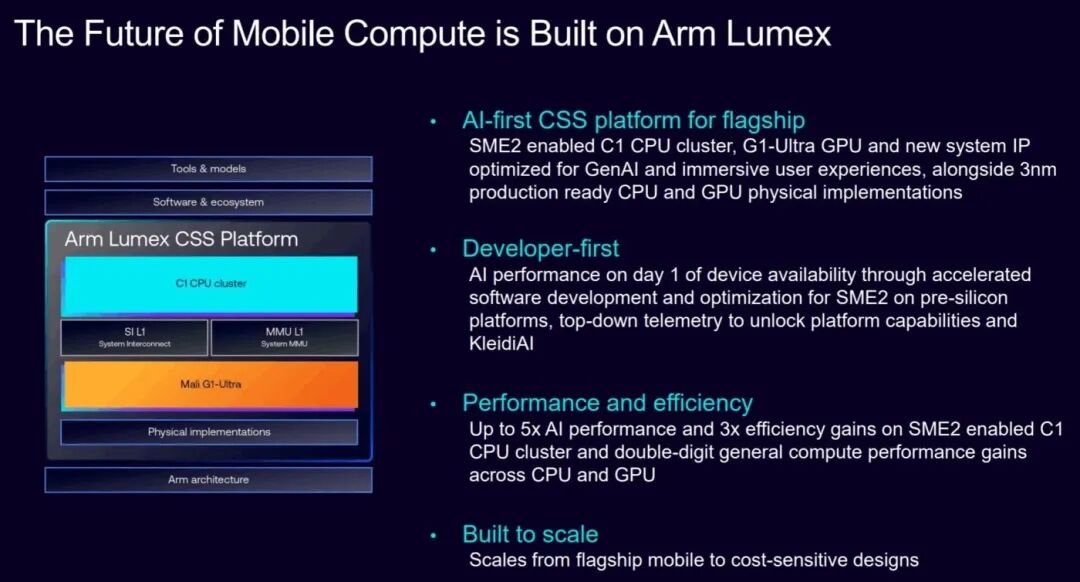
As devices based on the Lumex platform are set to launch in the coming months, thanks to this early software support, a wide range of applications will be able to achieve significant performance and efficiency improvements on AI workloads immediately.
-More Exciting Content-