In the challenging and discovery-driven field of laboratories, every subtle detail of experimental operations may conceal potential risks. Taking biochemical experiments as an example, accidental splashes of chemical reagents, the release of toxic gases, and the operation of high-temperature and high-pressure special equipment all require laboratory personnel to possess solid professional skills and a rigorous safety awareness. As the first line of defense for ensuring the safety of laboratory personnel, the importance of personal protective equipment (PPE) is particularly prominent, and its proper use directly relates to the safety baseline of scientific research work.
The Importance of Personal Protective Equipment in Laboratories

1
Ensuring Personal Safety
The chemicals in a chemical laboratory may be corrosive, toxic, or flammable/explosive, and direct contact with the human body can cause serious injuries, such as skin burns, eye injuries, or even life-threatening situations. Protective equipment such as lab coats, gloves, masks, and goggles can reduce these risks.
2
Preventing Occupational Diseases
Long-term exposure to certain chemicals may lead to occupational diseases such as dermatitis and respiratory diseases. Properly wearing protective equipment can reduce the harm of chemicals to the body and lower the risk of occupational diseases.
3
Enhancing Experimental Efficiency
When laboratory personnel’s safety is fully ensured, and safety risks are minimized, they can focus more on the experimental process, thereby enhancing experimental efficiency.
Selection and Standards of Personal Protective Equipment
1
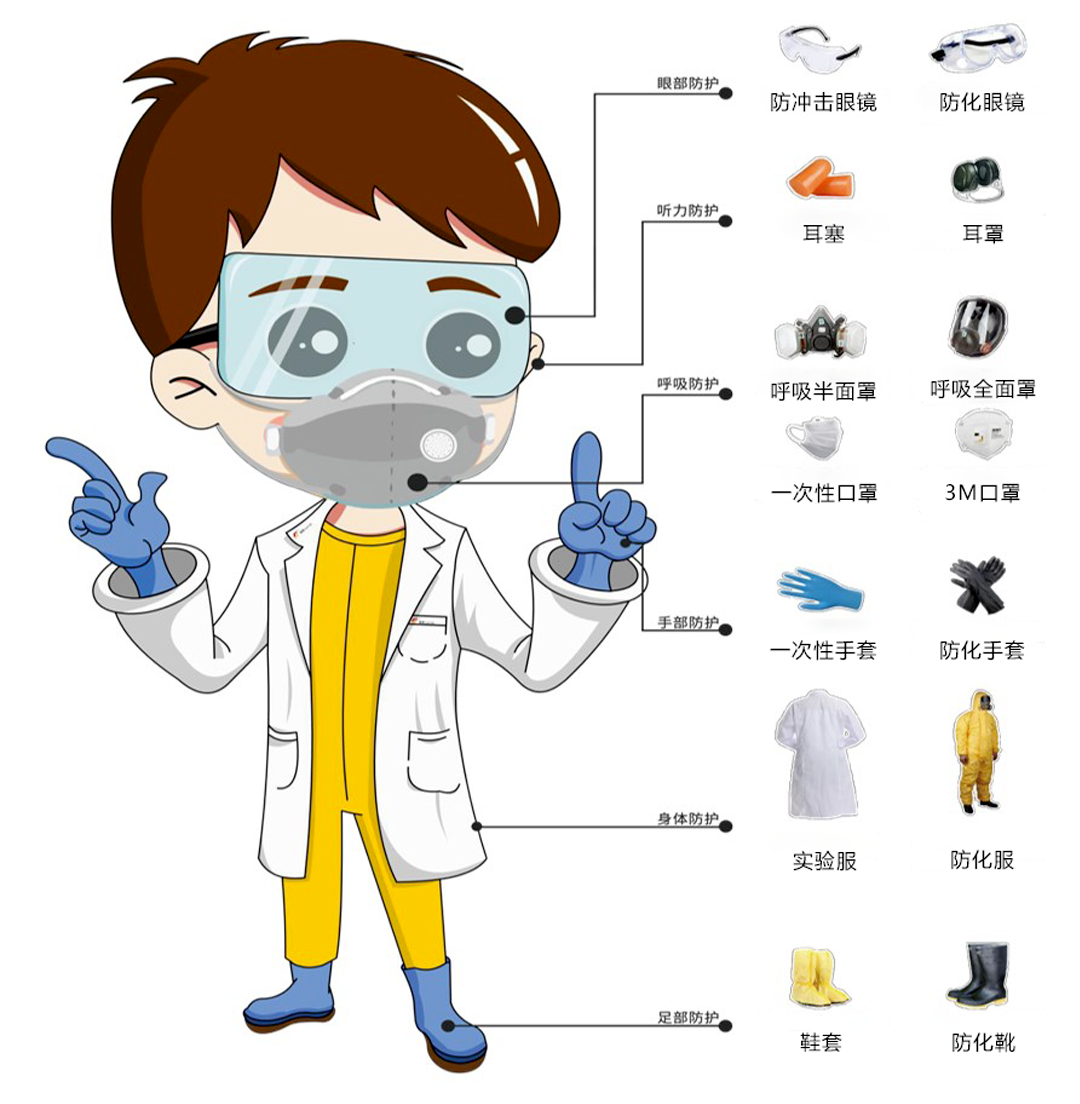
Body Protection
-
Dress Code: Skirts, shorts, or sandals are prohibited in the laboratory; long pants and closed shoes should be worn to minimize skin exposure.
-
Lab Coat Selection: Preferably choose materials that are breathable and resistant to chemical corrosion, ensuring that the clothing covers the entire body, with cuffs and collars fitting tightly to prevent chemical penetration. For high-risk experiments (such as those involving highly corrosive substances or high-temperature and high-pressure operations), higher-level protective equipment such as chemical protective suits should be added.
-
Head Management: Laboratory personnel with long hair should tie their hair up and wear protective caps when necessary to avoid hair getting caught in equipment or coming into contact with chemicals.
2
Hand Protection
-
Glove Matching: Choose glove materials (such as latex, nitrile, PVC, etc.) based on the type of experiment and the characteristics of the chemicals, ensuring a proper fit—neither too tight to affect operational flexibility nor too loose to create protective gaps.
-
Replacement Requirements: Gloves should be replaced regularly, and immediately when damaged or aged, to avoid prolonged use of the same pair of gloves.
3
Respiratory Protection
Equipment Selection: When in contact with toxic gases or vapors, a gas mask or specialized respiratory protective equipment should be worn. The filter box/filter canister must be matched according to the type and concentration of chemicals, ensuring that the mask fits tightly to the face to prevent gas leakage.
4
Eye Protection
Goggles Standards: Choose goggles with splash protection, anti-fog, and scratch-resistant features, ensuring they fit seamlessly with the face. For experiments involving highly corrosive chemicals or high-temperature and high-pressure operations, goggles with side protection or full-face shields should be upgraded.
Laboratory AI Super Brain Detection System
1
Automatic Monitoring and Rapid Response
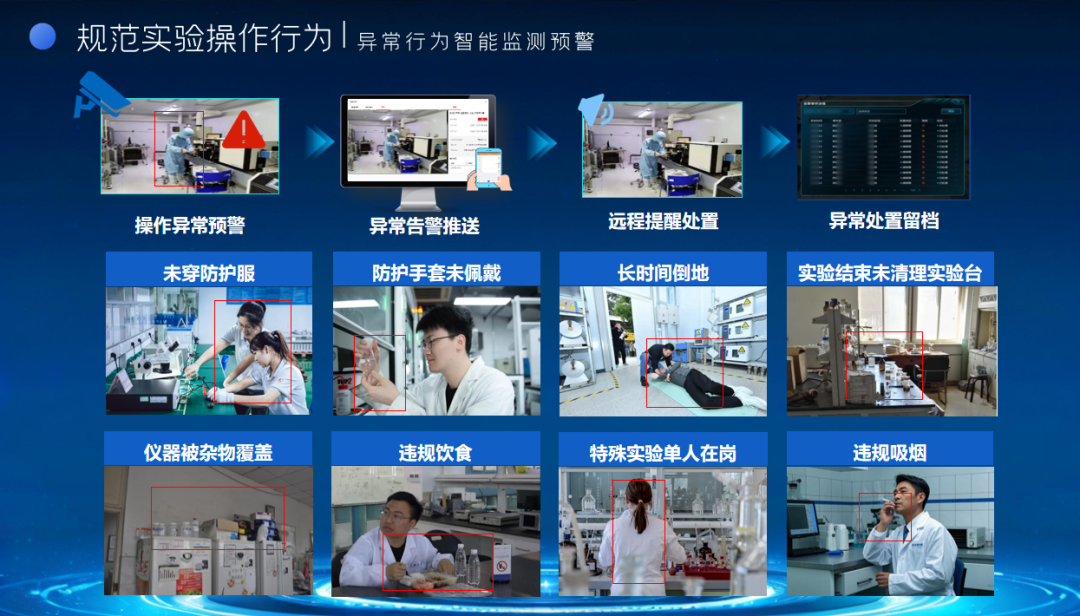
Using edge AI and computer vision technology to build an automatic monitoring system that covers all laboratory processes in real-time, with a very fast response speed. The system completes most calculations on local devices without relying on the cloud, is compatible with existing monitoring equipment, and reduces retrofit costs by 65%, forming a low-latency, high-reliability monitoring network.
2
Multi-Method Early Warning and Automatic Handling
Can accurately identify over 38 types of risky actions (such as not wearing protective equipment or violating operational protocols), triggering dual-channel early warnings through sound and light alarms and mobile notifications, with a response time of less than 200 milliseconds. Supports device linkage for handling (such as automatic power cut-off or locking dangerous equipment), forming a closed loop of “identification-warning-handling,” improving emergency efficiency by ten times.
3
Complete Process Recording and Traceability
Dynamic behavior digital twin technology restores operational details 1:1, automatically generating structured analysis reports that include time, location, and responsible persons. The platform records all operational data in real-time, supports intelligent comparison and visualization of violations against standard procedures, providing a complete evidence chain and data support for safety management.
4
Closed-Loop Management Upgrade and Efficiency Improvement
Administrators can set notification rules (such as hierarchical push notifications based on responsible persons or equipment types), receiving early warning information in real-time, achieving full-cycle management of prevention before incidents, handling during incidents, and traceability after incidents. The system promotes the transformation of laboratory safety models, improving risk prediction capabilities by 80% and reducing accident rates by 72%, with significant advantages over traditional solutions in response speed, completeness of records, and notification coverage.