
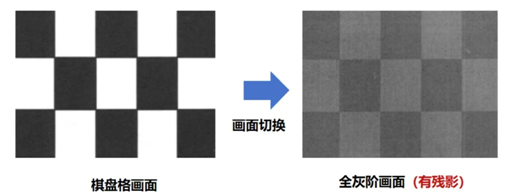
Ghosting is generally divided into two types: short-term ghosting (temporary ghosting) and long-term ghosting (permanent ghosting, also known as “burn-in”). They have different causes and properties, and understanding their differences helps us respond more scientifically.
Short-term ghosting: a reversible ion accumulation phenomenon, is a normal physical occurrence that can happen on all LCD screens and is not a quality issue. Its cause mainly stems from the physical characteristics of the liquid crystal display: there are trace ionic impurities in the liquid crystal box of the LCD screen, which are difficult to completely avoid during production; when the screen displays a static image for a long time, it is equivalent to applying a DC voltage component, causing ions to accumulate near the transparent electrode (such as ITO); the accumulation of ions forms an internal electric field, interfering with the response of liquid crystal molecules to subsequent signals, resulting in a temporary residual image of the previous display.
Long-term ghosting usually occurs due to the screen continuously displaying the same static image for an extended period, leading to chemical changes in the internal materials: the DC voltage component triggers electrochemical degradation of the alignment layer (such as polyimide PI); the ability of the alignment layer surface to guide liquid crystal molecules undergoes permanent changes; resulting in differences in pretilt angle and threshold voltage in certain areas, forming permanent ghosting.
Huazhi Crystal recommends users take the following measures:
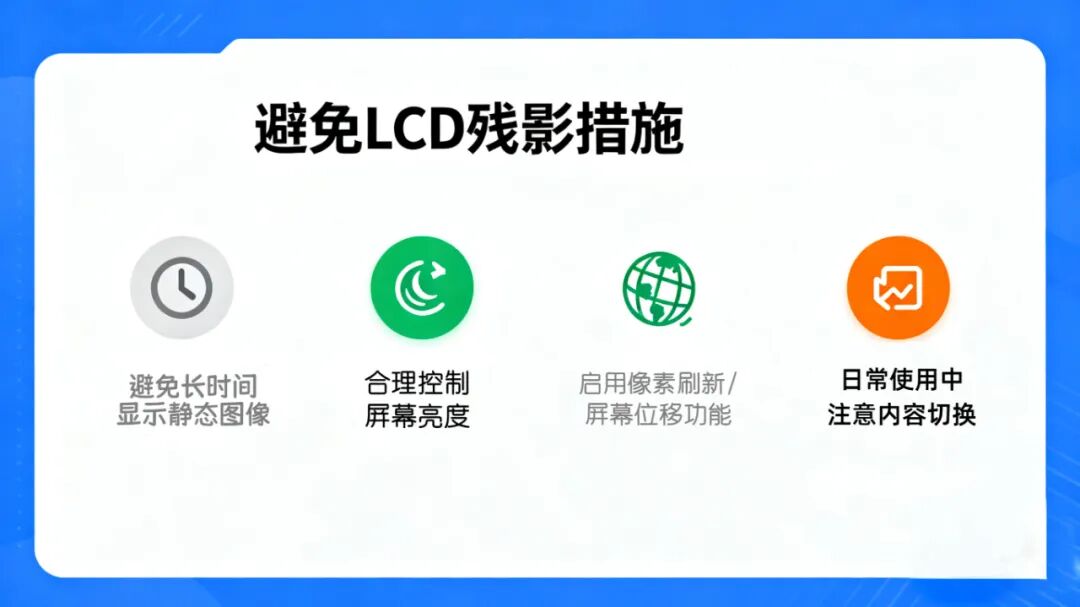
1. Avoid displaying static images for long periods; set the screen to automatically sleep or use a screensaver; use dynamic wallpapers or regularly change wallpapers to balance pixel usage; for applications that require long-term display of fixed elements (such as menus or status bars), it is recommended to intermittently switch display content or use full-screen mode to alternate displays.
2. Reasonably control screen brightness; excessive brightness can accelerate ion movement and material aging. Reducing screen brightness appropriately, while ensuring comfortable viewing, can help extend the screen’s lifespan.
3. Enable pixel refresh or screen shift functions (if supported); some high-end display devices provide such functions, which can help alleviate ion accumulation.
4. In daily use, try to avoid displaying the same static image for several consecutive hours.

Huazhi Crystal is committed

Huazhi Crystal understands the troubles that ghosting phenomena may bring. Therefore, we strictly implement high standards of quality control during product research and manufacturing:
Selecting materials with superior aging resistance (such as high-performance polyimide);
Optimizing driver circuit design to reduce DC voltage components;
Implementing strict aging tests to screen for potential long-term ghosting risks.
We promise to provide users with reliable and durable display products. Ghosting is a manageable physical phenomenon, and through correct usage methods and daily maintenance, users can maximize their enjoyment of the high-quality visual experience provided by Huazhi Crystal screens.