Appropriate humidity is crucial for biological processes, human life, and production. Excessive humidity can lead to the spoilage of materials such as fabrics, paper, tobacco, and food; it can reduce the sensitivity of precision instruments, and even cause damage due to insulation mold; mechanical equipment, weapons, and devices may rust, and ammunition may become ineffective. Conversely, excessively low humidity can create a dry environment that causes wood to crack, products to become brittle, and cultivated bacteria and other microorganisms to die. Therefore, scientifically measuring and controlling humidity is of great significance for industrial production, meteorology, environmental protection, healthcare, the food industry, goods storage, and national defense.
In the field of humidity measurement, early devices included hair hygrometers and wet-dry bulb hygrometers. Later, resistive hygrometers emerged, but they had limitations such as low sensitivity and restricted applicability, failing to meet the demands of modern scientific and technological development. The advent of ceramic humidity sensors has effectively overcome these issues, paving new avenues for modern humidity detection and control.
Humidity-sensitive resistors can be roughly classified into three categories based on the measured environmental humidity:1. High humidity type.Suitable for environments with relative humidity (RH) greater than 70%. One specific case is condensation sensors, which operate at 100% humidity.2. Low humidity type.Suitable for environments with RH less than 40%.3. Full humidity type.Suitable for the entire range of RH from 0% to 100%.The main characteristic indicators of humidity-sensitive ceramics include:① Sensitivity (humidity sensitivity).Typically expressed as the percentage change in resistance for a 1% change in relative humidity, denoted as %/%RH. Humidity-sensitive resistors require high sensitivity, but excessive sensitivity can narrow the instrument’s measurement range, causing inconvenience.② Response rate.The response rate refers to the time required for the component’s resistance to change after the environmental conditions change, with the fastest being less than 1 second and the slowest taking several minutes. From a usage perspective, faster response is preferable.③ Resolution.Resolution is related to sensitivity and response rate, expressed as a percentage of relative humidity.④ Temperature characteristics.Temperature characteristics refer to the change in component resistance corresponding to a 1°C change in temperature, expressed in terms of how much it equates to a change in %RH.
Composition of Ceramic Humidity Sensors
Ceramic humidity sensors are composed of metal oxide ceramics, which can be categorized into ionic and electronic types.
①Ionic humidity-sensitive elementsare porous ceramic components made from insulating materials. Due to the physical adsorption of water molecules in the micropores, they exhibit H+ in humid air, increasing the component’s conductivity. The main components are two types: α-Fe2O3 and K2CO3 and ZnO.V2O5.LI2O. Ceramic humidity sensors exhibit significant resistance changes in low humidity ranges, with good linearity between 40%-80% RH, while changes in high humidity ranges are minimal. This indicates that ceramic humidity sensors have good characteristic curves in normal humidity conditions, but the curves in high and low humidity ranges become distorted, showing significant non-linearity. The humidity sensitivity characteristics of ceramic elements are also affected by temperature changes, making temperature compensation important for measurement accuracy.②Electronic humidity sensorsprimarily consist of aluminum oxide and magnesium oxide composite ceramic humidity sensor elements, where conductivity increases and decreases due to the chemical adsorption of molecules on the oxide surface, resulting in positive and negative humidity characteristics from N-type and P-type semiconductor oxides. Aluminum oxide and magnesium oxide humidity sensors can perform stable humidity measurements below 700°C. However, their complex structure requires heating the grating to 700°C, leading to high power consumption and harsh operating conditions, making them expensive and difficult to popularize in industrial applications.Ceramic humidity sensors are a new type of sensor that has been vigorously developed in recent years. Their advantages include low humidity hysteresis, strong water vapor adsorption capacity, high sensitivity, stable physicochemical properties, fast response speed, small size suitable for mass production, and the ability to be heated and cleaned, which is beneficial for operation in harsh environments. However, due to their porous material, they are significantly affected by dust, requiring frequent maintenance, often needing electric heating for cleaning, which can impact product quality. They are also sensitive to humidity, exhibiting poor linearity in low humidity and high-temperature environments, and particularly short lifespan and reliability issues are urgent problems to be addressed for this type of humidity sensor.
Applications of Ceramic Humidity Sensors
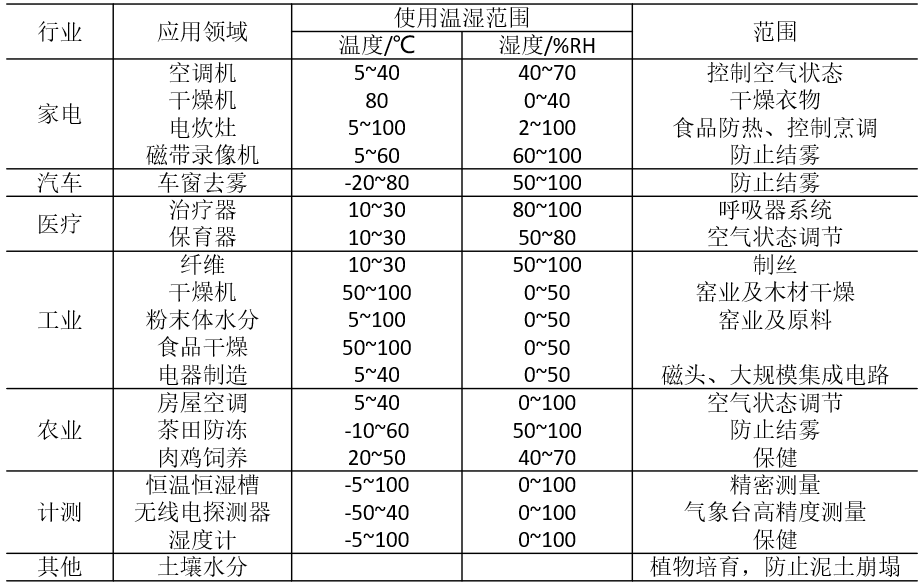
Ceramic humidity sensors have been widely used in various devices, such as hygrometers, air conditioners, humidifiers, dehumidifiers, and microwave ovens. Their application fields and purposes are shown in Table 1.
Table 1. Main Application Fields and Purposes of Ceramic Humidity Sensors
This article is organized by CERADIR Advanced Ceramics Online.
ABOUT CERADIR
“CERADIR™ Advanced Ceramics Online” is a vertical service platform for the advanced ceramics industry, dedicated to providing users with one-stop B2B solutions, professionally serving the upstream and downstream factories, traders, and service providers of the global advanced ceramics supply chain through a self-developed B2B industry platform, attracting suppliers and buyers from around the world.
 Share
Share Like
Like View
View