Click👆Seize the Opportunity👇Follow me and★Star Mark ★

NVIDIA, the global AI benchmark, has once again delivered impressive results, with its revenue, profit, and outlook for the next quarter in the third quarter of fiscal year 2025 significantly exceeding market expectations.
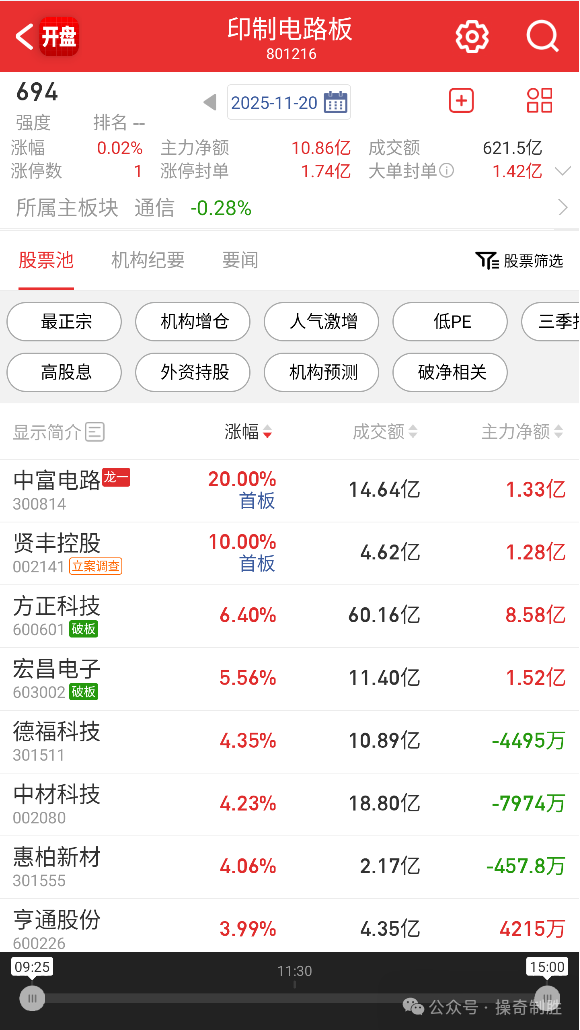
Stimulated by this news, on November 20, sectors such as PCB and CPO opened high. Among them, the PCB concept saw significant gains, with Hongchang Electronics (603002.SH) hitting the daily limit first, followed by Guanghua Technology (002741.SZ) and Dongcai Technology (601208.SH) also rising to their limits.

The High Demand for Computing Power Continues, and the PCB Industry Welcomes a New Growth Cycle
According to the financial report, NVIDIA achieved revenue of $57 billion in the third quarter of fiscal year 2026, a 62% year-on-year increase; net profit was $31.9 billion, a 65% year-on-year surge; and the adjusted earnings per share were $1.30, exceeding the market expectation of $1.25.
NVIDIA’s financial report continues to validate the prosperity of computing power, and the A-share market related to computing hardware is once again receiving significant catalysts. Industrial Securities previously stated that for the AI hardware sector, which is expected to be highly prosperous and accelerating next year, it is also a direction that has seen significant adjustments recently under overseas influences. If subsequent NVIDIA financial reports and expectations of overseas interest rate cuts provide catalysts, potential valuation recovery opportunities can be observed, including overseas computing (PCB, optical modules) and domestic computing (semiconductors, storage), etc.
From a medium to long-term perspective, strong demand for artificial intelligence, high-speed networks, and automotive systems will continue to support the growth of high-end HDI, high-speed multilayer, and packaging substrates, bringing a new growth cycle to the PCB industry. The global PCB industry is expected to maintain a growth trend in the future.
According to data from Sullivan Research, the global PCB market size is expected to grow from $62 billion in 2020 to $75 billion in 2024, with a compound annual growth rate of 4.9%, and is projected to exceed 1.2 trillion yuan in 2025. Among them, AI-related PCB products are becoming the core driving force for growth. CICC predicts that by 2027, the market size of NVIDIA’s AI PCBs will reach $6.96 billion, a 142% increase compared to 2026.
New Industry Policies Accelerate Capacity Structure Upgrades
Domestically, the introduction of favorable policies is safeguarding the healthy development of the industry.
The Ministry of Industry and Information Technology’s Electronic Information Department recently released two drafts for public comment: “Regulatory Conditions for the Printed Circuit Board Industry (2025 Edition)” and “Management Measures for the Announcement of Regulatory Conditions for the Printed Circuit Board Industry (2025 Edition)”, directly addressing the industry’s pain point of “large scale but weak technology”. Through multiple hard requirements, it accelerates the elimination of backward production capacity and concentrates resources on developing high-end products, pointing the way for high-quality development in the core segments of the electronics industry.
Printed Circuit Boards (PCBs) are the “skeleton” of electronic components, and the performance requirements for them are becoming increasingly stringent in the era of artificial intelligence—requiring thinner thickness, higher component density, and stronger heat dissipation capabilities. Especially for PCBs used in AI servers, the number of layers has increased from the traditional maximum of 10 layers to 20-30 layers, which not only significantly increases processing difficulty but also correspondingly raises the demand for high-end equipment.
This policy sets hard standards from the dimensions of capacity control, technological research and development, and green production, with specific implementation methods and regulatory measures for each requirement, forming a closed-loop management system.
Analysts indicate that this policy accurately guides the direction of industrial development, preventing low-end production capacity from driving out high-quality production. The stringent demand for multilayer boards with more than 20 layers for AI servers reveals the enormous potential and urgency of the entire industry in high-end fields. The clear guidance of the policy will accelerate the filling of high-end production capacity in a “targeted demolition” manner.
PCB Companies Cluster to Layout High-End Production Capacity
Industry insiders believe that the policy will accelerate the “reshuffling” of the industry, benefiting companies with strong technology and those producing high-end products, particularly in key segments of the supply chain covering circuit board manufacturing, upstream materials, and production equipment.
Wanlian Securities pointed out in a research report that domestic mainstream PCB manufacturers are accelerating the expansion of high-end PCB production capacity. For instance, Dongshan Precision (002384.SZ) announced in July this year an investment to build a high-end printed circuit board project, with an investment amount expected to not exceed $1 billion, mainly for upgrading existing capacity and constructing new capacity; Shenzhen South Circuit (002916.SZ) is adding PCB capacity mainly from two aspects: on one hand, the company is upgrading and transforming existing mature PCB factories, and on the other hand, it is also promoting the construction of factories in multiple locations.
Shenghong Technology (300476.SZ) disclosed in October the listing announcement for its private placement of shares, which proposed to raise no more than 1.9 billion yuan for projects such as the Shenghong AI HDI project in Vietnam and the high multilayer printed circuit board project in Thailand, aiming to create leading innovative flagship products in the industry to meet the high-level requirements of AI servers and terminals, enhancing core competitiveness.
Shengyi Electronics (688183.SH) also recently disclosed a private placement plan, intending to raise no more than 2.6 billion yuan for the construction of an AI computing HDI (High-Density Interconnect Technology) production base, smart manufacturing high multilayer circuit board projects, as well as to supplement working capital and repay bank loans. Shengyi Electronics stated that it expects AI HDI boards to become one of the fastest-growing subcategories in the PCB market over the next five years. In 2024, Shengyi Electronics’ PCB sales area is expected to reach 1.4569 million square meters, a year-on-year increase of 15.24%.
Additionally, Fujia Co., Ltd. (603219.SH) has a controlling subsidiary, Ningbo Yijia Electronics Co., Ltd., which manufactures various circuit boards (PCBs) for Leju Robotics. The company previously stated on the interactive platform that it excels in lean manufacturing, has a vertical supply chain advantage, and possesses design and manufacturing capabilities for core components such as motors and PCBA. With the growth of subsequent orders, the company is also expected to benefit from this.
The above analysis does not constitute specific trading advice; the stock market carries risks, and investments should be made cautiously.
If you enjoycuriousarticles and want to see more valuable investment research information, please click the business card below to follow:
Give a thumbs up if you find this article helpful!
Not receiving notifications? Due to the new WeChat mechanism, set“Curious” as a star mark to receive our articles more promptly!