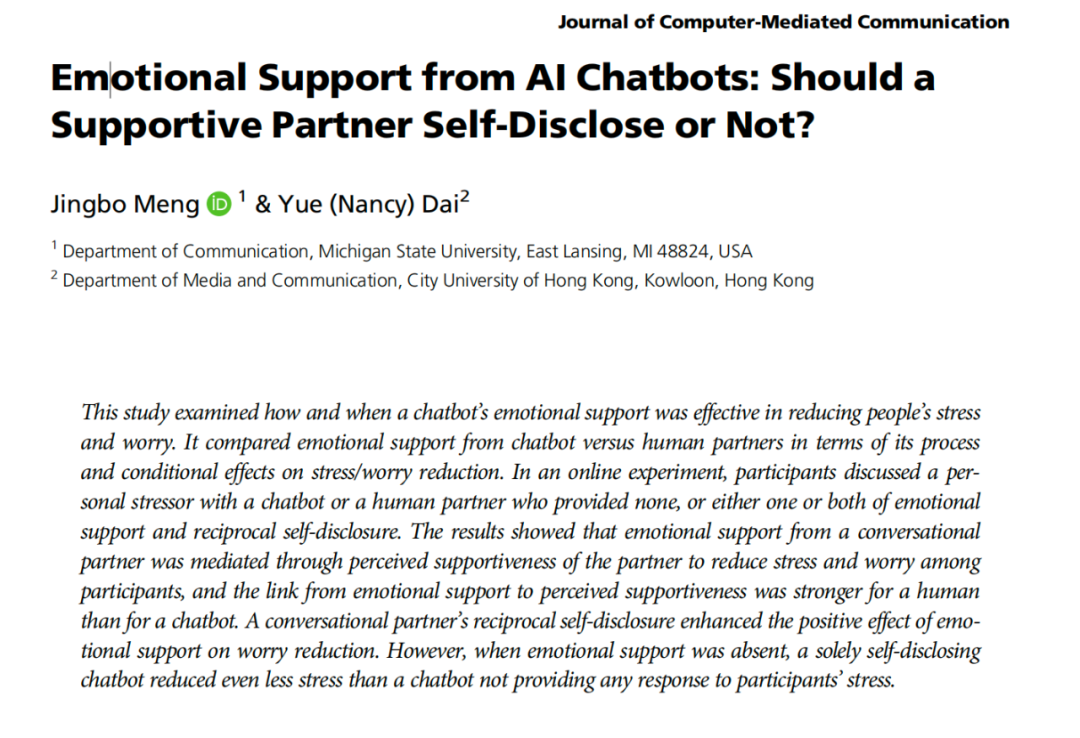
This study aims to explore how and when emotional support from chatbots can effectively alleviate people’s stress and worries. The research compares the differences in stress reduction processes and conditional effects between emotional support from chatbots and human partners. Through an online experiment, the study found that emotional support from conversational partners (whether human or AI) reduces participants’ stress and worries through the mediating variable of “perceived supportiveness.” The study points out that reciprocal self-disclosure can enhance the positive effect of emotional support in reducing worries. However, for chatbots, if they only engage in self-disclosure without providing emotional support, their stress-reducing effect may be worse than not responding at all.
Research Background
With the rapid development of artificial intelligence technology, chatbots are increasingly being applied in the field of mental health services, aiming to provide empathetic conversations and emotional support to non-clinical populations. Although interpersonal communication research has long confirmed that receiving emotional support from others can significantly improve individual mental health when facing stress, the effectiveness of such support when the source changes from human to machine remains controversial. There are two distinctly different theoretical perspectives in this field: on one hand, the “Computers as Social Actors” (CASA) paradigm suggests that people subconsciously apply human social interaction scripts to computers, treating machines as they would humans; on the other hand, the “machine heuristic” theory points out that people hold a stereotype of machines as “cold and unfeeling,” which may lead them to believe that machines cannot provide genuine empathy like humans, thus weakening the effect of AI support.
To explore how to enhance the effectiveness of AI emotional support, this study introduces the key variable of “reciprocal self-disclosure,” which refers to conversational partners sharing similar personal experiences while listening. In interpersonal communication, this reciprocal behavior can establish trust and likability, thereby enhancing the effect of emotional support; the study attempts to verify whether this human social cue can similarly translate into a “social cue” that enhances the effectiveness of chatbots. By comparing the differences in support sources between humans and chatbots, the study aims to clarify the boundary conditions under which AI can play a role, specifically in what situations the self-disclosure of chatbots can amplify or weaken the positive effects of emotional support in alleviating users’ stress and worries.
Research Methodology
The study employed an online experimental method to collect participant data in simulated real-life stress disclosure situations. The experiment utilized a three-factor between-subjects design: 2 (support source: AI chatbot vs. human partner) × 2 (emotional support: provided vs. not provided) × 2 (reciprocal self-disclosure: conducted vs. not conducted). Participants were randomly assigned to one of the eight experimental conditions to ensure comparability and internal validity between conditions.
Participants: The final effective sample consisted of 211 American college students, with an average age of 20.4 years, of which 61.6% were female. The sample screening excluded participants who did not complete the conversation, did not follow instructions, or attempted to test the chatbot.
Experimental Procedure and Manipulations:Context Activation: Participants first recalled and described a recent stressful event and measured baseline levels of stress and worry.Interaction Process: Participants engaged in six rounds of conversation via Facebook Messenger. In reality, whether “human” or “AI,” the responses were controlled by a preset script (implemented using the Chatfuel tool).Source Manipulation: To distinguish identities, in the “human” condition, the system intentionally set a 5-second delay longer than AI and displayed a “typing…” prompt to simulate human typing behavior; AI responded more quickly.Content Manipulation: Emotional support: providing comfort, affirming emotions (e.g., “That sounds really tough”) vs. only neutral responses. Self-disclosure: the counterpart shares their similar stressful experiences (e.g., “I also felt stressed about exams”) vs. not disclosing personal information.
Measurement Indicators: Independent variables: source, emotional support, reciprocal self-disclosure. Mediating variable: perceived supportiveness, consisting of 9 items (e.g., “The counterpart is a real source of comfort for me”). Dependent variables: stress reduction amount (Stress Reduction, measured by the difference in perceived stress scale before and after) and worry reduction amount (Worry Reduction, measured by the difference in single-item before and after). Control variable: neuroticism personality trait, as individuals with high neuroticism respond more strongly to stress.
Research Findings
The research results reveal the psychological mechanisms of AI providing emotional support and its unique boundary conditions, particularly discovering the “counterproductive” effect of AI in certain situations.
First, the study reveals the psychological mechanism through which emotional support operates, confirming the key mediating role of “perceived supportiveness.” Whether from humans or AI chatbots, the emotional support information provided does not directly and significantly reduce users’ stress; rather, it must enhance users’ perception of their partner’s “perceived supportiveness” to achieve this. This means that emotional support can only translate into actual psychological relief when users subjectively believe that their conversational partner is a real, reliable, and helpful source of support, effectively lowering users’ stress and worry levels.
Second, although the mechanisms of action are similar, human partners still outperform AI chatbots in terms of effect strength. The study found that when providing exactly the same emotional support content, the “perceived supportiveness” elicited by human partners is significantly higher than that of chatbots, leading to stronger stress reduction effects. This validates the existence of the “machine heuristic,” indicating that people subconsciously still tend to stereotype machines as lacking emotional and empathetic capabilities, resulting in AI, even when saying the same comforting words, being perceived as less sincere and effective than humans.
Finally, reciprocal self-disclosure has a complex moderating effect on the emotional support effectiveness of AI, presenting a “double-edged sword” characteristic. On one hand, when alleviating specific “worry” emotions, if AI can share similar experiences while providing emotional support (self-disclosure), it can significantly enhance the effect, as this helps build trust and distract users from negative attention. On the other hand, when alleviating “stress,” AI faces a unique risk: if the chatbot only engages in self-disclosure without providing emotional support (for example, only discussing its own stress without comforting the user), its stress-reducing effect may backfire, even worse than not responding at all. This “backfire effect” occurs only with AI, as machines discussing their own stress without soothing is perceived as false and absurd, while similar behavior from humans is seen as an attempt to understand.
Research Highlights and Limitations
Research Highlights:
1. Revealed the boundary conditions of AI support: Reciprocal self-disclosure as a social cue can help reduce worries, but if chatbots focus solely on “talking about themselves” without providing emotional support, it will appear false and irrelevant, leading to counterproductive effects.
2. Verified and expanded the CASA framework: The study found that people’s basic response patterns to AI and humans are similar (both operate through perceived supportiveness), but the specific interaction effects are influenced by the “machine heuristic,” indicating that people still tend to perceive humans as more sincere and empathetic in initial interactions.
Research Limitations:
1. Uniqueness of mechanism measurement: The study failed to disentangle the independent effects of actual interaction experience and perceived supportiveness on outcomes, nor did it test potential alternative mechanisms such as emotional validation or cognitive reappraisal. Future research could introduce more mechanisms (such as emotional validation, cognitive reappraisal) for testing.
2. Limitations of measurement tools: The dependent variable “worry” was measured using a single-item scale, which has a weaker ability to resist random measurement error compared to multi-item scales. Future studies should use multi-item scales to improve reliability.
3. Lack of control over individual differences among users: The study did not account for or control participants’ AI usage experience and beliefs about AI functions, which may moderate the effects of human-machine interaction. Future research should consider controlling or exploring the moderating effects of individual prior chatbot usage experience and beliefs about AI.
Original Article: Meng, J., & Dai, Y. (2021). Emotional support from AI chatbots: Should a supportive partner self-disclose or not?. Journal of Computer-Mediated Communication, 26(4), 207-222. Translated by: Zhang RuqiEdited by: Chen Yutong