Author: Joey Prebys
If DeFi aims to fundamentally change the financial system, why does it still have a high barrier to entry for users? As the number of wallets and TVL data continues to rise, DeFi remains a confusing experiment for many, is this meaningful adoption?
True adoption goes beyond charts and statistics; it is about usability, trust, and the capabilities of users. Users, regardless of background or skill, should have access to financial tools that genuinely serve them. If DeFi is to fulfill this promise, it must make some changes.

In the first article about DeFAI, we explored what AI Agents are and how they work. Now we need to ask a bigger question: Can they help reach a whole new level of adoption, and will DeFi ultimately fulfill its promise?
In this article, we will explore how decentralized AI can help DeFi overcome its biggest obstacles, from complex user experiences to limited inclusivity, and why the modular design of the Polkadot ecosystem makes it a powerful foundation for transitioning to a human-centered infrastructure.

Why Is DeFi Still Difficult for Most People to Use?
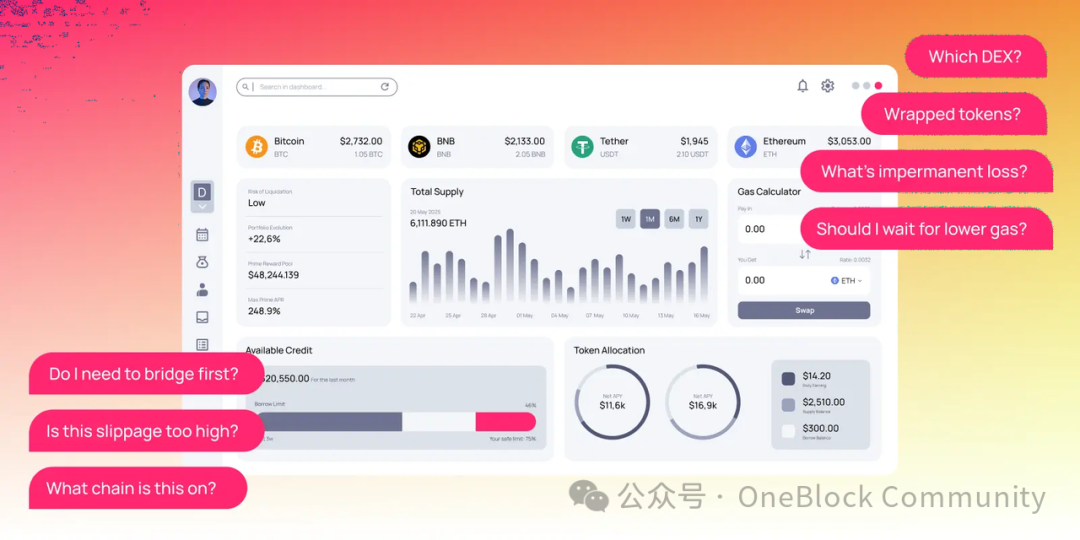
Before we delve into how AI can usher in a new era for DeFi, we need to honestly assess the current situation.
Despite the growth of DeFi development data over the years, for some crypto natives (let alone mainstream users), DeFi is still too complex. Jargon, risks, and cognitive overload leave most crypto users on the relative fringes. From setting up wallets, navigating bridging processes, to comparing protocols and understanding concepts like impermanent loss, the learning curve is steep. Users often need to know if their assets are on the right chain, whether they are wrapped, which DEX to use, how to evaluate APY, and whether the gas fees are reasonable based on yield returns. Participants not only need technical literacy but also sustained attention and the ability to switch contexts— this is a part that most average users simply do not have time to fully achieve.
This is a user experience issue, not a user issue, and it is one of the biggest reasons why adoption rates still lag behind potential.
How DeFAI Simplifies User Participation Paths
In this context, DeFAI provides a clear path forward. By pairing crypto automation with intelligent infrastructure, decentralized AI agents can help everyday participants easily use DeFi, rather than just existing as a theoretical possibility. These AI Agents can scan for opportunities to rebalance portfolios and continuously optimize cross-protocol yield strategies, minimizing the manual overhead that hinders users.
DeFAI can identify when better reward pools are available and automatically move funds to achieve compound growth for users without chasing APY dashboard changes; it can also identify risky positions and adjust your public disclosures before a downturn occurs. This shift is not about relinquishing user control but choosing security over micromanagement; you can choose agents that align with your risk tolerance and financial goals, rather than repeatedly switching between interfaces or re-reading liquidity guides.
Over time, the ability to customize AI Agents for your DeFi strategy can unlock a smoother, safer, and more intuitive entry into decentralized finance, especially for those who have until now been on the fringes of on-chain finance.
How AI Agents Improve DeFi UX
(And Not Just Automating Tasks)
Robots have been used in DeFi for years, but until now, they have mostly been for extracting value rather than expanding access. They scan for arbitrage, chase rewards, and execute predefined scripts. Is this really useful? The answer is indeed yes; but does it have a transformative impact on everyday users? The answer is no.
Because they are not designed to solve user experience issues.
To this end, Agentic DeFi shifts from system-level efficiency to intent-driven design, which is an experience-driven model defined by user-defined outcomes, where agents handle complexity behind the scenes, not just automating operations but rethinking participation.
Today, using DeFi often means bridging assets across chains, checking if tokens are wrapped, comparing APY, and making decisions on dashboard interfaces. DeFAI agents reduce operational complexity by managing tasks in the background, making participation feel more seamless without stripping away user choice.
Imagine a system with intent-driven design where you input agent instructions—”I want low-risk stable returns,” and it selects and manages strategies across multiple protocols without switching and homework. Meanwhile, there is a personalized dashboard reflecting user goals rather than raw protocol data, making DeFi a highly usable operational tool.
When building open modular infrastructures like Polkadot, DeFAI is inherently composable and interoperable, thus promoting smarter defaults, easier technical steps, and more confident participation paths. AI Agents will not solve the experience issues of crypto users alone, but they can transform usability from an afterthought into a system-level feature. By aligning with user intent and abstracting complexity without obscuring control, AI Agents provide a scalable, human-centered way to achieve intuitiveness and accessibility in DeFi.
User-Centric DeFAI Running Real Examples
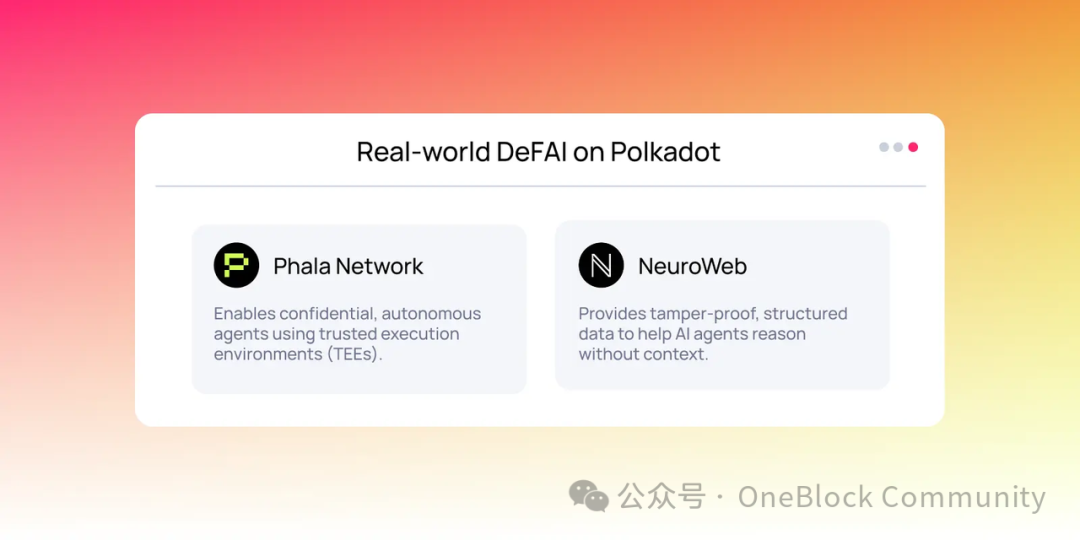
In the Polkadot ecosystem, projects like Phala Network and NeuroWeb (formerly OriginTrail) are pushing DeFAI forward in a practical, user-centric way:
– Phala Network enables confidential, autonomous agents using Trusted Execution Environments (TEE); these agents can privately handle sensitive tasks while producing verifiable results to balance privacy and transparency.
– NeuroWeb provides structured, linked, and tamper-proof data through a decentralized knowledge graph; this offers the technical background needed for AI Agents to perform effective reasoning and make better decisions.
These application tools are not isolated; they are modular, composable, and have already addressed key challenges regarding privacy, data quality, and usability.
Since they are built on the Polkadot ecosystem, they can operate smoothly in an ecosystem that starts with interoperability. These ecological projects demonstrate that DeFAI is no longer a distant promise. When finance is designed for user experience rather than just protocols, it has already reshaped the overall landscape of finance.

How AI Agents Expand DeFi Accessibility
Today’s DeFi applications are designed for a select few, and even with improved tools, they still primarily cater to industry insiders who have time, technical literacy, and a willingness to take risks. The emergence of DeFAI has the potential to change this. By acting as personalized financial agents, it can make DeFi more intuitive and require no decoding, DeFAI does not adapt users to DeFi; it makes DeFi adapt to them.
For ecosystems like Polkadot, this is not just about improving the DeFi user experience but aligning infrastructure with values and achieving open access. A community-led governance system can empower without relinquishing control, and DeFAI reflects these principles in action, making it easier for users to participate in governance on their own terms.
Unlike traditional financial operating rules, where smart tools are often hidden behind institutional walls, DeFAI is built on open-source foundations, meaning the benefits of automation are not necessarily exclusive but can be extended to anyone with a wallet and financial goals. This is a radically different vision of inclusivity that only the Web3 world can realize.

The Future of DeFAI: Building Empowering Rather Than Controlling Systems
AI in finance is not neutral; it can drive centralization or accelerate decentralization. In the world of DeFi applications, the distinction lies in how we design it. DeFAI creates a space where users can understand their asset situations, agents align with their goals, and system defaults remain transparent, allowing users to design automated processes that make intentions clearer and invite input, rather than hiding decisions behind a black box.
Indeed, the open governance and modular infrastructure of the Polkadot ecosystem support this shift. Through on-chain governance via OpenGov, the community can help decide on cross-ecosystem builds, funding, and AI Agent management. This means DeFAI can grow without losing sight of its purpose— giving users more control over their financial lives rather than relinquishing autonomy.
Want to learn how Polkadot supports decentralized AI in DeFi and beyond? Explore Polkadot AI Use Cases (https://polkadot.com/use-cases/ai/) to see how builders are unlocking smarter, more autonomous ecosystems.
👇 Click to Unlock Previous Highlights 👇




About Us
About Us
OneBlock+, as a talent hub for blockchain, is a leading global Substrate developer community. We provide professional technical articles and development courses, and organize workshops, hackathons, and other practical exchange activities to help developers master Substrate technology and explore the Web3 field in depth. At the same time, OneBlock+ also provides multiple entrepreneurial supports such as technical guidance and talent resources for high-quality Web3 projects, promoting more development teams to use the Substrate technology framework to build the future open network.
Twitter: https://twitter.com/OneBlock_Medium: https://medium.com/@OneBlockplusTelegram: https://t.me/oneblock_devDiscord: https://discord.gg/fE8deY4UbPBilibili: https://space.bilibili.com/1650224419YouTube: https://www.youtube.com/channel/UCWo2r3wA6brw3ztr-JmzyXA