Introduction
Industrial robots are undoubtedly the most common equipment in future factories. If you are not familiar with this field, you are out of date! Today, the editor of metal processing will review the four major families of industrial robots that are often mentioned — FANUC, KUKA, ABB, and Yaskawa Electric, exploring their history and respective advantages!

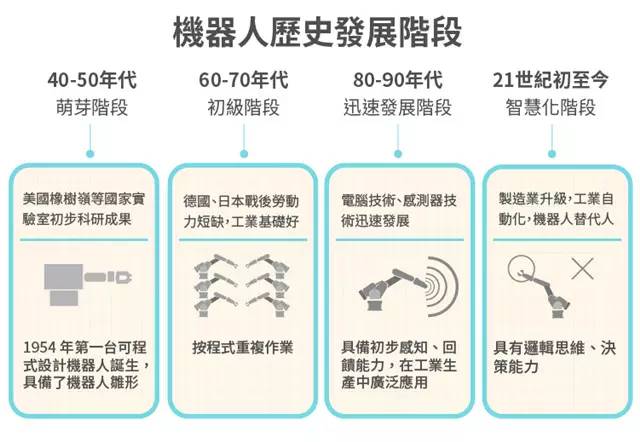
Among the global industrial robot industry, Switzerland’s ABB, Germany’s KUKA, Japan’s FANUC, and Yaskawa Electric are the most renowned, collectively known as the four major families of industrial robots. They also play a crucial role in the Asian market, commanding over 70% of China’s robot industry market share, almost monopolizing high-end fields such as robot manufacturing and welding. Let’s unveil the mystery of these four families.
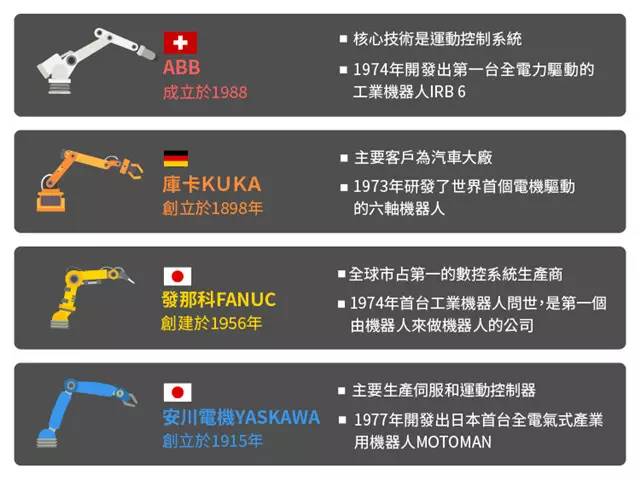
Switzerland’s ABB
ABB (Asea Brown Boveri) is a company formed by the merger of two international enterprises with over 100 years of history (Sweden’s ASEA and Switzerland’s BBC Brown Boveri) in 1988, ranked among the Fortune Global 500, with its headquarters located in Zurich, Switzerland. ABB’s business covers five major areas: power products, discrete automation, motion control, process automation, and low-voltage products, renowned for its power and automation technologies. ABB boasts the largest variety of robot products, technologies, and services today, being the largest supplier of industrial robots globally. ABB emphasizes the integrity of the robots themselves; for its six-axis robots, while the speed of a single axis may not be the fastest, the precision achieved when all six axes operate together is very high.
Core Areas
ABB’s core technology is the motion control system, which is also the biggest challenge for robots themselves. By mastering motion control technology, ABB can easily achieve path accuracy, movement speed, cycle time, and programmability in robot performance, significantly improving production quality, efficiency, and reliability.
Revenue Situation
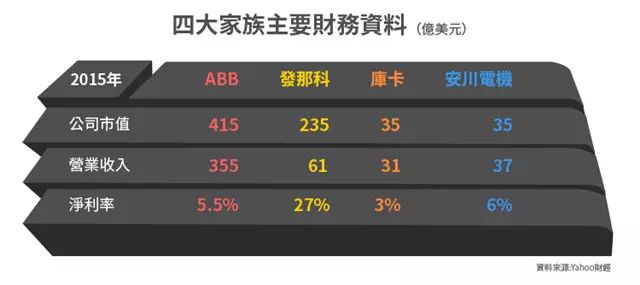
As of March 8, 2016, ABB’s market capitalization was approximately $41.5 billion (Yahoo Finance), with revenues of about $35.5 billion and a net profit of $1.9 billion. More than half of its revenue comes from the European market, one-fifth from Asia, the Middle East, and Africa, and one-quarter from North and South America.
Germany’s KUKA
KUKA (Keller und Knappich Augsburg) was established in 1898 in Augsburg, Germany, initially focusing on indoor and urban lighting before branching into other areas. In 1973, it developed the first industrial robot named FAMULUS. KUKA’s main clients come from the automotive manufacturing sector, and it also focuses on providing advanced automation solutions for industrial production processes, extending into neurosurgery and radiography in hospitals. Its orange-yellow robots distinctly represent the company’s color scheme.
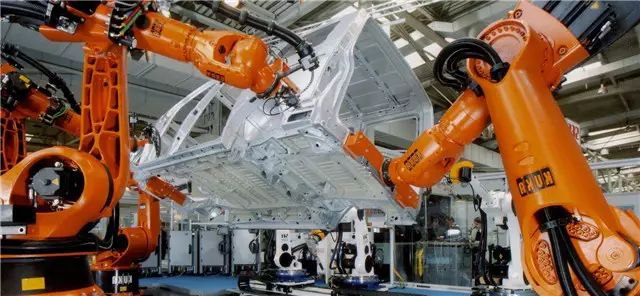
Fields of Involvement
KUKA robots can be used for material handling, processing, spot welding, and arc welding, spanning industries such as automation, metal processing, food, and plastics. Users of KUKA robots include renowned enterprises like General Motors, Chrysler, Ford, Porsche, BMW, Audi, Mercedes, Volkswagen, Ferrari, Harley, Boeing, Siemens, IKEA, Swarovski, Walmart, Budweiser, BSN Medical, and Coca-Cola. Moreover, KUKA’s robots are widely used in the food industry, logistics, construction, and glass manufacturing.
Revenue Situation
As of March 8, 2016, KUKA’s market capitalization was approximately $3.5 billion, with revenues of about $3.1 billion and a net profit margin of 3%. The revenue from the company’s system integration business and industrial robot business accounts for approximately 58% and 42%, respectively.
Japan’s FANUC
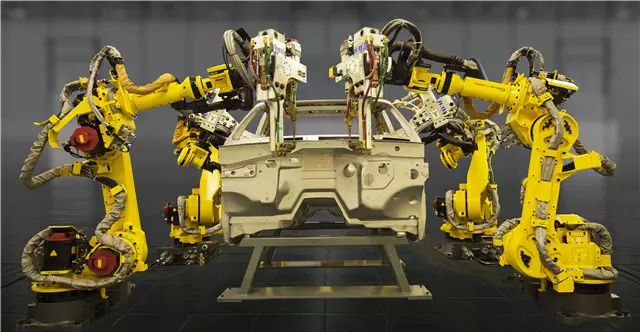
FANUC was founded in 1956, and three years later, it launched its first electric hydraulic stepping motor. In the 1970s, benefiting from rapid advancements in microelectronics, power electronics, and particularly computing technology, FANUC decisively abandoned the CNC products that had made it famous and began its transformation. In 1976, FANUC successfully developed a CNC system, later collaborating with SIEMENS to develop a high-level CNC system. Since then, FANUC’s products have been innovating year after year, becoming one of the world’s strongest companies in CNC systems, design, manufacturing, and sales.
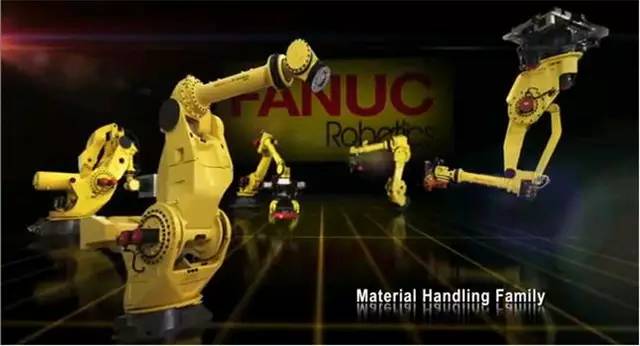
Core AreasFANUC is a global leader in CNC system production, and what sets FANUC industrial robots apart from others is: easier process control, smaller base sizes for similar robots, and unique arm designs.
Revenue SituationAs of March 8, 2016, FANUC’s market capitalization was approximately $23.5 billion, with revenues of about $6.1 billion and a net profit margin of approximately 27%. The company has maintained a high level of profitability, with a long-term gross margin exceeding 40%.
Japan’s Yaskawa Electric
Yaskawa Electric (Kabushiki-gaisha Yaskawa Denki) was founded in 1915 and is Japan’s largest industrial robot company, headquartered in Kitakyushu, Fukuoka Prefecture. In 1977, Yaskawa Electric developed Japan’s first fully electric industrial robot using its motion control technology, subsequently developing various automation robots for welding, assembly, painting, and handling, leading the global industrial robot market. As of September 2015, Yaskawa had sold over 280,000 robots, becoming the world’s top seller of robots!
Core Areas
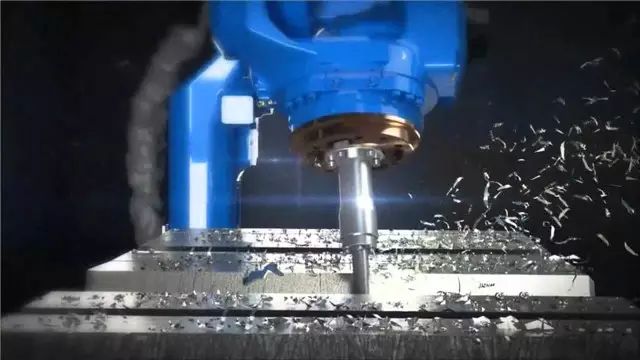
Yaskawa Electric primarily produces servo and motion controllers, which are key components for manufacturing robots. Yaskawa’s mastery of core technology is closely tied to its nearly century-long history in electrical engineering, giving it unique advantages in robot development. The company has developed various automation robots for welding, assembly, painting, and handling, with its core industrial robot products including spot welding and arc welding robots, painting and handling robots, LCD glass panel transfer robots, and semiconductor chip transfer robots, being one of the earliest companies to apply industrial robots in semiconductor production.
Revenue Situation
As of March 8, 2010, Yaskawa Electric’s market capitalization was approximately $3.5 billion, with revenues of about $3.7 billion and a net profit margin of approximately 6%. The company’s revenue from motion control, industrial robots, system engineering, and drive control accounted for approximately 47%, 36%, 12%, and 4%, respectively.
Collaborating with Well-Known Enterprises
The best industrial robots are undoubtedly European products, with KUKA being the top brand. However, when the four major families entered the Asian market, the quality of ABB robots domestically declined, while Yaskawa and FANUC provided better value-for-money options compared to European and American products, aligning more closely with the needs of customers in China. Nowadays, robot manufacturers often prefer to collaborate with well-known automotive brands; for example, Volkswagen exclusively uses KUKA, General Motors primarily uses FANUC, and European brands favor ABB, which is closely related to the strategic adjustments of the four major families.
All four families started from businesses related to the robot industry chain, such as ABB and Yaskawa Electric engaging in electric equipment motor business, FANUC researching CNC systems, and KUKA initially dealing with welding equipment. Their ability to become globally leading integrated industrial automation enterprises is due to their mastery of robot bodies and core component technologies, coupled with their commitment to research and achieving integrated development, which has led to the esteemed reputation of today’s four major families of industrial robots.
What Other Notable Companies Exist Beyond the Four Major Families?
The following are the top ten robot companies selected for RBR50:
NO.1 3D Robotics (3DR)
3DR is a non-public robot company located in Berkeley, California, focusing on the development of innovative, flexible, and reliable personal drones and related technologies. The company’s personal intelligent drone platform provides consumers with stunning aerial images and data analysis, as well as capabilities for mapping, measurement analysis, and 3D modeling.
NO.2 ABB Robotics (ABB)
ABB is a public company specializing in the development of industrial robots and robotic arms, located in Zurich, Switzerland. It holds a dominant position in the supply of industrial robots, modular production systems, and services, providing powerful solutions to manufacturers for improving production efficiency, product quality, and ensuring worker safety. As manufacturers increasingly seek new methods to enhance flexibility, agility, and competitiveness, ABB is also penetrating traditional industries while exploring new markets.
NO.3 Aethon
Aethon is a non-public company focused on developing mobile robots, located in Pittsburgh, Pennsylvania. Aethon is a leader among global suppliers of autonomous mobile transport robots. The TUG robot automates internal logistics transport tasks and can autonomously navigate in dynamic and complex environments, such as delivering goods in hospitals.
NO.4 Google
Google focuses on developing medical, assistive, humanoid, industrial, robotic arms, and mobile robots, located in California, USA. In 2013, Google rapidly acquired seven advanced and technologically diverse robotics companies — Boston Dynamics, Bot&Dolly, Holomni, Industrial Perception, Meka Robotics, Redwood Robotics, and Schaft, Inc., causing a significant stir in the robotics industry.
NO.5 Amazon
Amazon focuses on developing mobile robots, located in Seattle, Washington, USA. Amazon plays the role of an online retailer in North America and even internationally, serving consumers through its retail website, where products are primarily purchased from manufacturers and third-party distributors.
NO.6 Autonomous Solutions
ASI is a non-public company focused on developing mobile robots, headquartered in Murdock, Utah, USA. For fifteen years, ASI has provided customers with hardware and software systems for autonomous vehicles in mining, agriculture, automotive, industrial, security, and military markets. ASI has engaged in multi-million dollar robot product development projects with leading original equipment manufacturers in mining, agriculture, and security.
NO.7 CANVAS Technology
CANVAS Technology is a non-public company focused on developing industrial and mobile robots, located in Boulder, Colorado, USA. This industrial robotics startup is currently operating in stealth mode but has already attracted significant funding from investment firms like Visionnaire Ventures, AME Cloud Ventures, and Morado Venture Partners.
NO.8 Carbon Robotics
Carbon Robotics is a non-public company focused on developing robots, located in San Francisco, California, USA. The company manufactures low-cost robotic arms for the market, with KATIA being their first product, which has the functionality of an industrial robot but is priced and available like a laptop.
NO.9 Clearpath Robotics
Clearpath Robotics is a non-public company focused on developing industrial and mobile robots, located in Kitchener, Ontario, Canada. The company designs and manufactures solutions for unmanned vehicles for academic, industrial, and military applications.
NO.10 Cyberdyne
Cyberdyne is a non-public company focused on developing medical and assistive robots, located in Ibaraki Town, Japan. The company commercializes the inventions of Professor Sankai and his laboratory at Tsukuba University, with its flagship product being the Hybrid Assistive Limb (HAL), which can interpret neural signals through the skin, enabling or enhancing human motor functions.
The development momentum of China’s robot industry cannot be underestimated, with three companies making the list.
NO.12 DJI Innovations
DJI Innovations is a non-public company focused on mobile robots, located in Nanshan District, Shenzhen, China. The company manufactures drones and related camera systems for professional fields such as film and television, agriculture, environmental protection, search and rescue, and energy infrastructure.
NO.18 Foxconn Technology Group
Foxconn Technology Group is a public company focused on developing industrial robots, located in Taipei City, Taiwan, China. Founded by Terry Gou in 1974 with an initial investment of $7,500, it is the predecessor of Foxconn Technology Group.
NO.38 Siasun Robot Automation Co., Ltd.
Siasun Robot Automation Co., Ltd. is a public company focused on developing industrial robots, located in Shenyang, Liaoning Province, China. Its main business is the research and development of industrial robot applications and the assembly and testing of automated production lines. Its application fields cover automotive, motorcycle, engineering machinery, electronics, and electrical assembly.
Many internationally renowned automation equipment suppliers have provided equipment to Shanghai Siasun, such as Delphi, WEBSTO, ZF, CONTINENTAL, SDS, and more.
-End-
☞Source: Industrial Robot Training
☞Edited by: Joe
☞Submission Email:tougao1950@126.com. Accepted submissions or tips will be rewarded!
Recommended Hot Articles
☞Achieving Transparency and Visualization Across the Entire Production Process! How to Do It?
☞5 Hole Processing Tools That Will Eliminate Your “Hole” Anxiety!
☞Why Is His Precision and Efficiency Higher Than Mine in Machining?
☞Seven-Axis Five-Linkage! Have You Seen the Universal CNC Laser Processing Center?
☞Can School-Enterprise Cooperation Break Through the Bottleneck of Cultivating “Great Country Craftsmen” Talent????