
Source: Dongxing Securities
DSP stands for Digital Signal Processing technology, and DSP chips refer to chips capable of implementing digital signal processing technology. DSP chips are a type of fast and powerful microprocessor, uniquely designed to process data instantly. The internal structure of DSP chips employs a Harvard architecture that separates program and data, featuring dedicated hardware multipliers to quickly implement various digital signal processing algorithms. In today’s digital age, DSP has become a fundamental component in fields such as communications, computing, and consumer electronics.
The emergence of DSP chips was a necessity of the times. Since the 1960s, with the rapid development of computers and information technology, digital signal processing technology has emerged and developed rapidly. Before the advent of DSP chips, digital signal processing could only be accomplished using microprocessors. However, due to the relatively slow processing speed of microprocessors, they could not meet the increasing demands for high-speed real-time processing of large amounts of information. Therefore, the need for faster and more efficient signal processing methods became increasingly urgent.
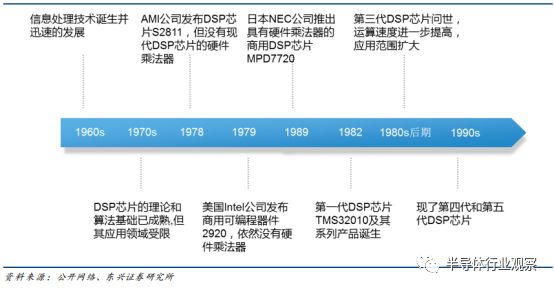
In the 1970s, the theoretical and algorithmic foundations of DSP chips matured. However, at that time, DSP was merely a concept in textbooks, and even the DSP systems developed were composed of discrete components, with applications limited to military and aerospace sectors.
In 1978, AMI released the world’s first single-chip DSP chip, the S2811, which lacked the hardware multipliers essential for modern DSP chips;
In 1979, Intel’s commercial programmable device 2920 marked a significant milestone for DSP chips, but it still lacked hardware multipliers;
In 1980, NEC of Japan launched the MPD7720, the first commercial DSP chip with hardware multipliers, thus considered the first single-chip DSP device.
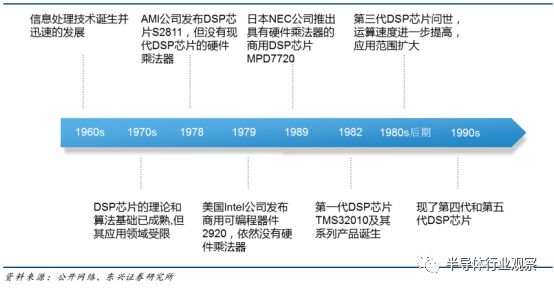
The birth process of DSP chips
In 1982, the first generation of DSP chips, TMS32010 and its series, was born. This DSP device was manufactured using micron technology NMOS, and although it had larger power consumption and size, its computation speed was dozens of times faster than that of microprocessors. The advent of DSP chips was a milestone, marking a significant step towards miniaturization of DSP application systems. By the mid-1980s, with the emergence of CMOS technology DSP chips, both storage capacity and computation speed were exponentially increased, becoming the foundation for voice processing and image hardware processing technologies.
In the late 1980s, the third generation of DSP chips emerged, further increasing computation speed and gradually expanding their application range to communications and computing fields;
In the 1990s, DSP development accelerated, leading to the emergence of fourth and fifth generation DSP chips. The fifth generation featured higher system integration, combining DSP cores and peripheral components into a single chip.
Entering the 21st century, the sixth generation of DSP chips emerged, outperforming the fifth generation in performance and developing various personalized branches based on different commercial purposes, gradually expanding into new fields.
Application Fields of DSP Chips
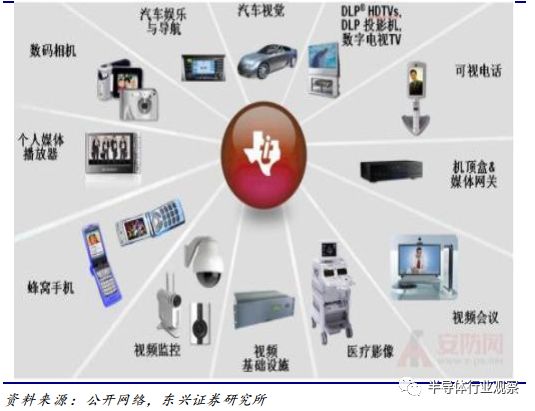
DSP chips emphasize the real-time nature of digital signal processing. As digital signal processors, DSPs convert analog signals into digital signals for high-speed real-time processing by dedicated processors. They feature high speed, flexibility, programmability, and low power consumption, playing an increasingly important role in fields such as graphics and image processing, voice processing, and signal processing in communications.
Market application status of DSP chips
The fields of DSP application are numerous, and new application areas are expected to emerge continuously in the future. According to statistics from authoritative information companies in the United States, the most common application of DSP chips in the market is in the communications field, accounting for 56.1%; followed by the computing field at 21.16%; consumer electronics and automatic control at 10.69%; military/aerospace at 4.59%; instrumentation at 3.5%; industrial control at 3.31%; and office automation at 0.65%.
Application fields of DSP chips
1) Application of DSP chips in multimedia communication.
The amount of information generated by media data transmission is enormous, and multimedia network terminals need to quickly analyze and process the information obtained throughout the process. Therefore, DSP is used in voice encoding, image compression, and reducing voice communication. Today, DSP has become a basic international standard for real-time effects in voice decoding calculations.
2) Application of DSP chips in industrial control.
In the industrial control field, industrial robots are widely used, and the performance requirements for robot control systems are increasing. The key to robot control systems is real-time performance, as completing an action generates a significant amount of data and computation. High-performance DSPs can be employed here. By applying DSP to robot control systems, the real-time computation speed characteristics can be fully utilized, allowing the robot systems to process problems quickly. With the continuous improvement of DSP digital signal chip speeds, it becomes easier to form parallel processing networks within the system, greatly enhancing the performance of control systems and enabling broader development of robot systems.
3) Application of DSP chips in instrumentation.
The rich on-chip resources of DSP can greatly simplify the hardware circuitry of instruments, achieving SOC design for instrumentation. Measurement accuracy and speed are important indicators for instruments, and using DSP chips to develop products can significantly improve these two indicators. For example, TI’s TMS320F2810 features an efficient 32-bit CPU core, a 12-bit A/D converter, abundant on-chip memory, and a flexible command system, providing a broad platform for high-precision instruments. High-precision instruments have now become an important application of DSP and are in a period of rapid dissemination, driving technological innovation in the industry.
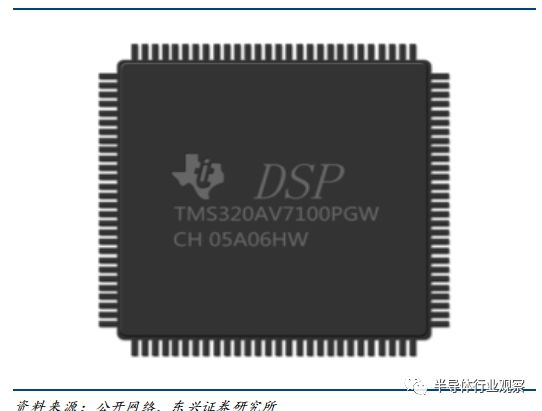
Texas Instruments’ TMS320 chip
4) Application of DSP chips in automotive safety and autonomous driving.
Automotive electronic systems are increasingly thriving, with infrared and millimeter-wave radar installations requiring DSP for analysis. Nowadays, with the increasing number of vehicles, collision avoidance systems have become a research hotspot. Moreover, image data captured by cameras needs to be processed by DSP to be displayed in driving systems for driver reference.
5) Application of DSP chips in the military field.
The low power consumption, small size, and real-time response speed of DSP are particularly needed in weaponry. For example, air-to-air missiles are equipped with infrared detectors and corresponding DSP signal processors within limited volumes to achieve automatic target locking and tracking. Advanced fighter jets are equipped with visual aiming devices, and infantry personal helmet-mounted night vision devices require DSP technology for image filtering and enhancement, as well as intelligent target search and capture. DSP technology is also used in automatic artillery control, cruise missiles, early warning aircraft, and phased array antenna radar digital signal processing.
High-end Market Dominated by Foreign Companies
Currently, there are three main DSP chip manufacturers in the world: Texas Instruments (TI), Analog Devices (ADI), and Motorola, with TI leading the market, holding a significant share of the international market, while ADI and Motorola also have a certain market presence.
Texas Instruments (TI) is recognized as the leader in the DSP industry, having successfully launched its first generation DSP chip, TMS32010, in 1982. The TMS320 series DSP chips are characterized by their low cost, ease of use, and powerful functionality, gradually becoming the most influential and successful DSP series processors today.
Among the three main series of TI, the C2000 series currently holds a smaller market share, while the DSP products on TI’s official website mainly focus on the C6000 and C5000 series. TI’s three main DSP product series are: the C2000 series, primarily used for digital control systems; the C5000 (C54x, C55x) series, mainly for low-power, portable wireless communication terminal products; and the C6000 series, primarily for high-performance complex communication systems. The TMS320C54x series DSP chips in the C5000 series are widely used in communications and personal consumer electronics.
The main products of the C6000 series include: C6000 DSP + ARM processor (12) – OMAP-L1x (5), 66AK2x (7); C6000 DSP (94) – C674xDSP (5), C66x DSP (11)
The main products of the C5000 series include: C55x ultra-low power DSP, providing efficient signal processing for ultra-low power compact embedded products.
TI’s DSP products are mainly applied in machine vision, avionics, defense, size, weight, and power (SWAP), audio, video encoding/decoding, and biometrics.
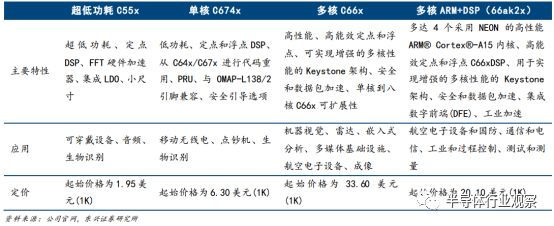
TI’s main DSP chip products on its official website
Currently, ADI has six main products, applied in voice processing, image processing, process control, measurement and control, and other fields.
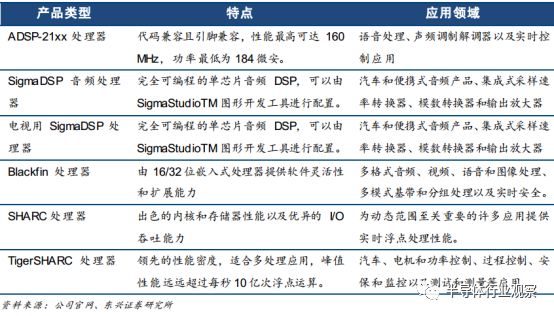
ADI’s main DSP products and application fields
Motorola is also one of the largest DSP chip manufacturers globally, with products including fixed-point and floating-point, dedicated and general-purpose, 16-bit, 24-bit, and 32-bit DSP chips. DSP chips are mainly applied in voice processing, communications, digital cameras, multimedia, control, and other fields. Main products include the DSP56000 series, DSP56800 series, DSP56800E series, MSC8100 series, DSP56300 series, etc.
In the future, DSP technology will continue to develop and update in the following aspects:
1) Increasing integration of DSP cores.
Reducing the size of DSP chips has always been a trend in DSP technology development. Currently, the most commonly used are based on RISC architecture. With the introduction of new process technologies, more manufacturers are beginning to improve DSP cores and integrate multiple DSP cores, MPU cores, and peripheral circuit units into a single chip, achieving system-level integration of DSP.
2) Programmable DSP chips will be the dominant product in the future.
With the need for personalized development, the programmability of DSP provides manufacturers with more flexibility, allowing them to develop a wider range of product series with different characteristics on the same DSP chip, and enabling users to upgrade their DSPs. For example, refrigerators and washing machines, which originally used microcontrollers, have now switched to programmable DSPs for high-power motor control.
3) Fixed-point DSPs dominate the mainstream.
Currently, among the DSP devices sold in the market, 16-bit fixed-point programmable DSP devices still dominate the mainstream products. As the cost of fixed-point DSP devices continues to decrease and their energy consumption becomes increasingly lower, the advantages of fixed-point DSPs are becoming more apparent, and they will continue to be the main players in the market.
FPGA Chips and DSP Chips: A Complex Relationship
FPGA, or Field-Programmable Gate Array, emerged as a semi-custom circuit in the ASIC field, addressing the shortcomings of custom circuits while overcoming the limitations of programmable devices with a limited number of gate circuits. With FPGA chips, it is possible to program a newly invented CPU core and embed it into the FPGA chip, allowing for multiple cores to be embedded.
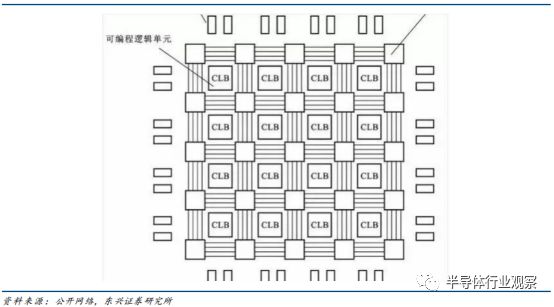
Basic architecture of FPGA
The international FPGA market is dominated by four giants: Xilinx, Altera, Microsemi, and Lattice. Altera and Xilinx are the inventors of FPGA, with Altera inventing the world’s first programmable logic device in 1983, and Xilinx launching the world’s first FPGA product, XC2064, in 1985. According to financial data from 2017, Xilinx had a revenue of $2.349 billion, Altera (acquired by Intel) had $1.902 billion, Microsemi’s FPGA business was $421 million, and Lattice had $386 million. Xilinx and Altera together account for nearly 90% of the entire international market.
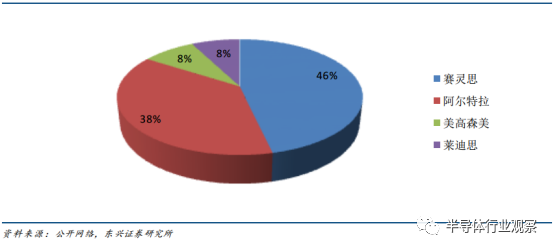
Market share of the four FPGA giants in 2017
FPGA chips and DSP chips are different. DSP is a specialized microprocessor suitable for conditional processes, particularly for complex multi-algorithm tasks. FPGA contains a large number of resources for implementing combinational logic, capable of completing large-scale combinational logic circuit designs, and also contains a considerable number of flip-flops, allowing FPGA to perform complex sequential logic functions.
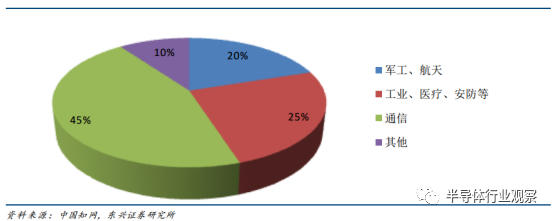
Application fields of FPGA chips in 2016
FPGA chips and DSP chips are different. DSP is a specialized microprocessor suitable for conditional processes, particularly for complex multi-algorithm tasks. FPGA contains a large number of resources for implementing combinational logic, capable of completing large-scale combinational logic circuit designs, and also contains a considerable number of flip-flops, allowing FPGA to perform complex sequential logic functions.
•
-
DSP chips have relatively weak versatility, while FPGA has stronger versatility;
-
DSP has software flexibility, while FPGA has hardware speed;
-
DSP executes lower-speed event sequences, but may have some latency before processing, while FPGA cannot process multiple events because each event has dedicated hardware, but this dedicated hardware implementation allows each event to execute simultaneously;
-
DSP is programmed in a sequential flow of instructions, while FPGA is programmed in a block diagram format, making it easier to visualize data flow.
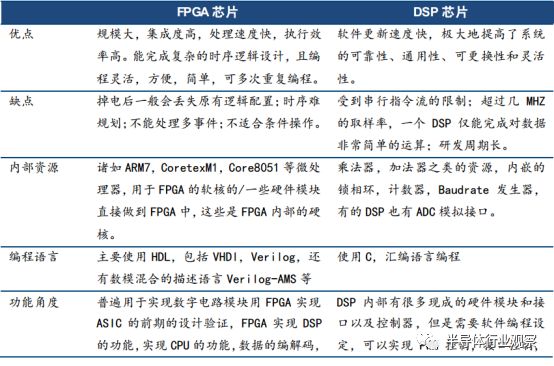
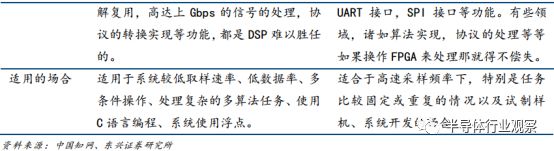
Comparison of FPGA chips and DSP chips
In emphasizing structural flexibility, versatility, and the need for processing complex algorithms, DSP and FPGA are often combined, adopting a DSP + FPGA structure, or embedding DSP modules within FPGA chips, which is also a trend for future designs.
Goodbye to the Pain of Lack of Chips: Breakthroughs in Domestic DSP
The “Core High Base” major project is vigorously promoting the research and development of domestic high-end chips at the national level. In 2006, the State Council issued the “National Medium- and Long-Term Science and Technology Development Plan Outline (2006-2020)”, with “core electronic devices, high-end general-purpose chips, and basic software products” (referred to as the “Core High Base Major Project”) ranking first among 16 major scientific and technological projects, also known as the “01 Project”.
The implementation of this project has greatly accelerated the development speed of China’s integrated circuit industry. From 2001 to 2016, China’s integrated circuit market size increased from 126 billion yuan to approximately 1.2 trillion yuan, accounting for nearly 60% of the global market share, with industry sales expanding over 23 times, from 18.8 billion yuan to 433.6 billion yuan. Domestic research on DSP started relatively late but has developed rapidly. The 14th Research Institute of China Electronics Technology Group is responsible for the R&D of DSP chips.
After ten years of hard work, the 14th Research Institute collaborated with Longxin Technology and Tsinghua University to develop the domestic DSP chip “Huarui No. 1”, which passed the acceptance of the Core High Base project group in 2012. Huarui No. 1 has been successfully applied in over ten types of radar products, creating three records for domestic multi-core DSP chip applications: the most application models in radar equipment, the highest number of applications per unit, and the total number of applications. Currently, Huarui No. 2 has been successfully developed, passed internal testing, and will soon be launched in the market. The next step for the 14th Research Institute is to adopt more advanced manufacturing processes for Huarui No. 3, further increasing the main frequency, enhancing general performance, and improving dedicated performance through stream processor methods while reducing power consumption.
“Huarui No. 1” represents the highest level of domestic DSP chip technology. In system design, it employs a multi-core architecture design technology for DSP and CPU. Test results show that “Huarui No. 1” has significant advantages in processing capability and energy consumption, running a multi-task real-time operating system very stably, with overall technical indicators reaching or exceeding the level of similar international products. Huarui No. 1 fills the gap in China’s multi-core DSP field, significantly enhancing China’s independent R&D capabilities for high-end chips, improving the development level of electronic equipment, and ensuring national information security.
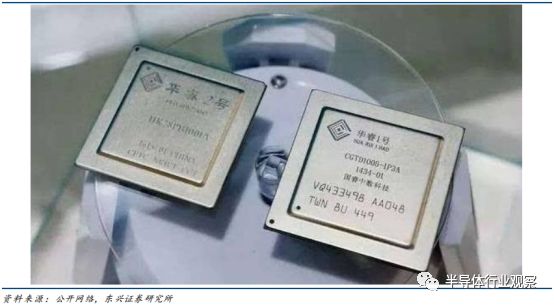
Huarui chip
“Hunxin No. 1” was successfully developed by the Wu Manqing team of the 38th Research Institute of China Electronics Technology Group, completing testing in 2012. “Hunxin No. 1” (BWDSP100) is a 32-bit static superscalar processor, belonging to the second development stage of DSP products. This chip is manufactured using 55nm technology and has complete independent intellectual property rights.
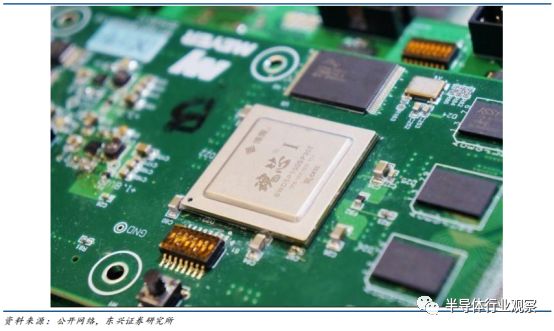
Hunxin No. 1
Hunxin No. 1 reaches the level of mainstream international DSP chips, comparable to the performance of ADI’s TS201 chip. TS201 is a mainstream DSP chip from ADI, integrating both fixed-point and floating-point computation capabilities. This processor is widely used in video, communication markets, and defense military equipment, suitable for applications requiring real-time processing of large data volumes.
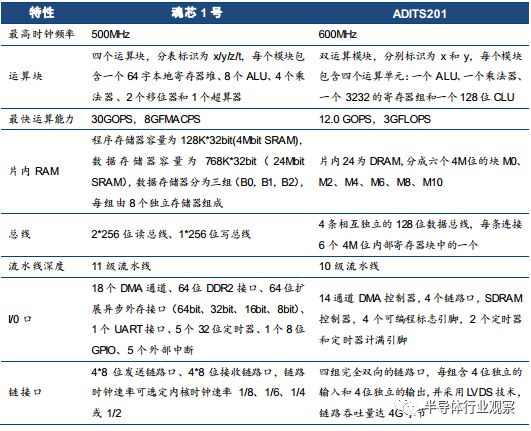

Comparison of Hunxin No. 1 and TS201 characteristics
Hunxin No. 1 is a high-performance general-purpose DSP, widely applicable in various high-performance signal processing fields, with typical equipment applications including radar, sonar, and electronic countermeasures.
Hunxin No. 2 A has just been released, with single-core performance exceeding that of current international similar chips by four times. On April 23, 2018, the 38th Research Institute of China Electronics Technology Group released Hunxin No. 2 A, which adopts a fully independent system architecture, developed over six years. Compared to Hunxin No. 1, Hunxin No. 2 A has improved performance by six times, achieving multi-core from single-core, expanding computational components, and upgrading the instruction system, allowing the device to perform one billion floating-point operations while maintaining a relatively good application environment and debugging methods; a single core can achieve 1024 floating-point FFT (Fast Fourier Transform) operations in just 1.6 microseconds, with computational efficiency three times higher than Texas Instruments’ TMS320C6678, and actual performance 1.7 times higher, with a data throughput rate of 240Gb per second.
Huge Market Space for DSP Chips in Civil Information Fields
DSP chips support the digital integration of communications, computing, and consumer electronics. In the wireless field, DSP is prevalent in wireless switching devices, base stations, and handheld terminals; in the network field, DSP encompasses everything from infrastructure to broadband access devices, including IP gateways, IP phones, and cable modems. With the significant growth in demand for digital consumer products in China, and the improvement in DSP’s high-speed computation and synchronous processing capabilities, the application fields of DSP will gradually expand from mobile phones to new digital consumer fields, thus spanning across 3C, with distribution becoming increasingly balanced.
DSP chips play an important role in smartphones. DSP chips can provide better voice, audio, and image experiences for mobile phones, significantly enhancing the capabilities of individual functions, allowing phones to operate faster. Due to the powerful computational capabilities of DSP, cellular phones for mobile communications have rapidly risen, creating a series of fully digital cellular networks such as GSM and CDMA. At the same time, DSP chips are crucial factors in the upgrading of electronic products such as mobile phones. According to data from the Ministry of Industry and Information Technology, in 2017, the net increase in mobile phone users was 95.55 million, bringing the total to 1.42 billion, with a mobile phone penetration rate of 102.5 units per hundred people, an increase of 6.9 units per hundred people compared to the previous year. The steady rise in mobile phone demand will lead to a significant demand for integrated circuits such as DSP chips.
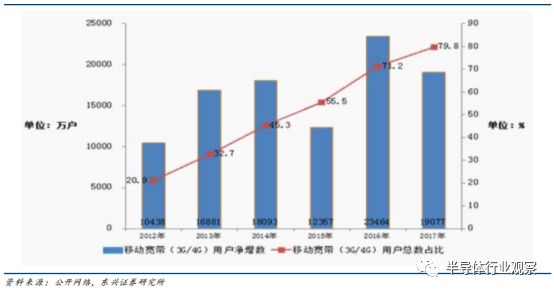
Development of fixed-line and mobile phone users from 2000 to 2017
The demand for mobile broadband is positively correlated with the demand for DSP. Based on DSP, ADSL and HFC are the two most commonly used broadband access technologies. At the same time, DSP-based general systems can achieve wireless access point communication systems, with good openness, flexible configuration, and strong scalability. Therefore, the demand for mobile broadband is positively correlated with the demand for DSP. By the end of 2017, the total number of fixed internet broadband access users among the three major telecommunications companies reached 349 million, with a net increase of 51.33 million users throughout the year. The total number of mobile broadband users (i.e., 3G and 4G users) reached 1.13 billion, with a net increase of 191 million users throughout the year, accounting for 79.8% of mobile phone users. With the popularization of mobile broadband, future demand for the DSP market is promising.
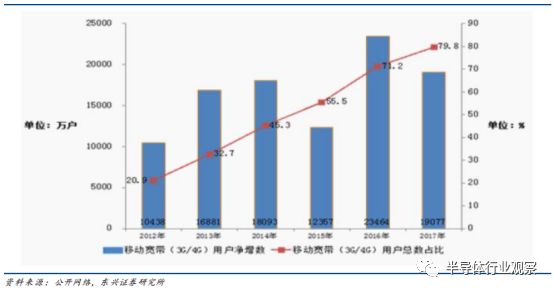
Development of mobile broadband users 3G and 4G from 2000 to 2017
The demand for digital consumer products such as IPTV is expanding, and the future market demand for DSP chips in new digital consumer fields is promising. The DSP + FPGA gateway implementation scheme can convert digital television signals into multicast signals, achieving the integration of cable television services with telephone voice services and internet services. In recent years, the state has vigorously introduced supportive policies to accelerate the cultivation of emerging businesses such as IPTV, the Internet of Things, and smart homes. By the end of 2017, the number of IPTV users reached 122 million, with a net increase of 35.45 million users throughout the year.
Long press the QR code to follow Wangcai Chips

Get the “2019 China Chip Industry Chain Distribution Map”
Long press to recognize the QR code below


【Disclaimer】 The article represents the author’s independent viewpoint and does not reflect the position of Wangcai Chips. If there are issues regarding the content or copyright of the work, please contact Wangcai Chips within 30 days of publication for deletion or negotiation of copyright usage.