Cu-Catalyzed Ullmann Coupling with Anionic o-Phenylenediamine Ligands
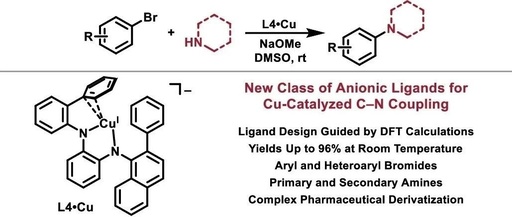
Cu-Catalyzed Ullmann Coupling with Anionic o-Phenylenediamine Ligands

from J. Am. Chem. Soc. Hello, everyone! Those who often work in medicinal chemistry know that Cu-catalyzed Ullmann coupling, while a substitute for Buchwald coupling, has not been as effective due to the difficulty of Cu oxidation addition. Upon reflection, electron-rich ligands are beneficial for oxidation addition, and previous neutral ligands were clearly insufficient. So … Read more
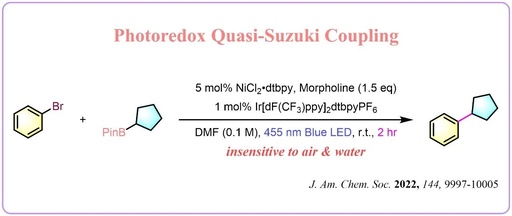
The Perfect Flawless Quasi-Suzuki Coupling Mechanism

The Perfect Flawless Quasi-Suzuki Coupling Mechanism

From J. Am. Chem. Soc. Hi, everyone! As chemists, what does your ideal coupling reaction look like? I believe it should be like this: first, the reaction should have a simple system; second, the reagents should have no absorption and not interfere with monitoring; then, the reaction should not be sensitive to water or oxygen; … Read more

Goodbye Morpholine Radical

Goodbye Morpholine Radical

From J. Am. Chem. Soc. Hi, everyone! I wonder if you still remember that I shared an article titled 【J. Am. Chem. Soc.】Me₃N•BH₃—— Cu Catalyzed Halogenated Alkane + Primary Amide N-Alkylation, which achieved amide N-alkylation by generating alkyl radicals through XAT halogen transfer. However, in an earlier discussion, we learned that the 【J. Am. Chem. … Read more

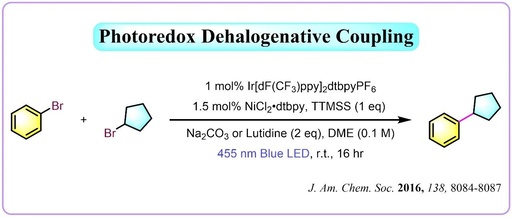
Timeless: Photocatalytic Dehalogenative Coupling

Timeless: Photocatalytic Dehalogenative Coupling

From J. Am. Chem. Soc. Hi, everyone! Since 2014, the field of radical chemistry has developed rapidly, establishing various methods for constructing Csp²-Csp³ bonds, achieving remarkable results in practical applications. Among these methods, photocatalytic dehalogenative coupling has remained timeless over the years, becoming a classic method for constructing Csp²-Csp³ bonds in photochemistry: “Timeless” — Photocatalytic … Read more