A Beginner’s Guide to Automotive Embedded Systems
A Beginner's Guide to Automotive Embedded Systems

IntroductionWhen we sit in a modern car and press the start button, the dashboard lights up with colorful animations, the central display mirrors the rich features of our smartphones, and the driving assistance systems silently protect our safety. Have you ever wondered what technology supports this seamless experience? The answer lies in the mysterious world … Read more
Bus – CAN 2.0B/CAN

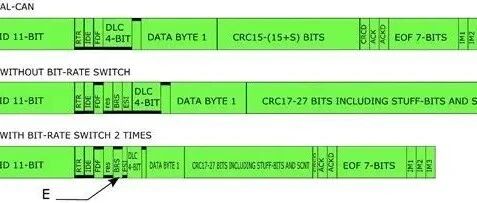
Comparison of Core Technologies: CAN 2.0B and CAN FD 1. Overview: Definitions and Relationships CAN 2.0B: This is the complete version of the Classic CAN protocol, released in 1991. It is fully compatible with earlier CAN 1.2 and CAN 2.0A specifications. Its most important feature is the simultaneous support for standard frames with 11-bit identifiers … Read more

Analysis of CAN FD Technology: A Vehicle Communication Solution to Overcome the Bottleneck of Traditional CAN Bus

Analysis of CAN FD Technology: A Vehicle Communication Solution to Overcome the Bottleneck of Traditional CAN Bus

With the rapid development of automotive electronics technology, the iteration of technologies such as new energy vehicles and autonomous driving is driving profound changes in the overall vehicle electronic architecture. The number of ECU controllers installed in vehicles has surged from dozens in traditional models to hundreds, and the number of various sensors (such as … Read more

Differences Between CAN FD and Traditional CAN

Differences Between CAN FD and Traditional CAN

Click the blue text Follow us Abstract: What exactly are the differences between CAN FD and traditional CAN? How do they differ in terms of data transmission and real-time performance? With the rapid development of automotive electronics and industrial automation, the number of devices and data volume on the CAN bus has greatly increased, posing … Read more

Basic Concepts of CAN

Basic Concepts of CAN

The CAN bus (Controller Area Network), is a serial communication protocol designed specifically for industrial, automotive, and embedded systems. Its core features include multi-node shared bus, high reliability, and strong real-time performance, enabling efficient data exchange between multiple electronic devices (nodes) without the need for a central controller. The CAN bus was developed by Bosch … Read more

Differences Between CAN and CAN FD: An Analysis of CAN FD Frame Structure

Differences Between CAN and CAN FD: An Analysis of CAN FD Frame Structure

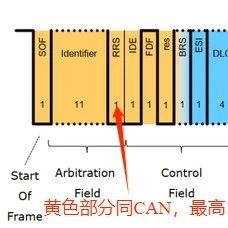
1. Overview CAN FD: It can be understood as an upgraded version of the CAN protocol, with only the protocol upgraded while the physical layer remains unchanged. The main differences between CAN and CAN FD are: transmission rate, data length, frame format, and ID length. 2. CAN FD The introduction of CAN FD (CAN with … Read more

Comprehensive Guide to Automotive Buses

Comprehensive Guide to Automotive Buses

The types of buses used in automobiles mainly include LIN, CAN, CAN FD, FlexRay, MOST, and Ethernet buses. However, MOST and Ethernet are currently only partially used, for example in ADAS controllers and central control systems. LIN, CAN, CAN FD, and FlexRay are very common in most ECUs. Therefore, in previous series of articles, the … Read more

SIT1044 CAN FD Transceiver Chip Anti-Interference Remote Wake-Up Timing

SIT1044 is a high-performance CAN FD transceiver chip independently developed by SIT, which is used between the CAN protocol controller and the physical bus. It can be applied in fields such as trucks, buses, cars, and industrial control, with a bus withstand voltage of ±40V, supporting a flexible data rate of 5Mbps for CAN FD, … Read more

Driver Design for CAN-FD Bus Controller Based on Cortex-M0

Driver Design for CAN-FD Bus Controller Based on Cortex-M0

Abstract The CAN-FD bus protocol has a high effective data rate and is widely used in automotive internal buses. This paper introduces the design of a CAN-FD protocol controller driver based on the Cortex-M0 processor, detailing the development process of the CAN-FD driver. It achieves multi-node communication by communicating with other CAN-FD nodes and captures … Read more

Comprehensive Analysis of the CAN Interface in Embedded Education

Comprehensive Analysis of the CAN Interface in Embedded Education

The full name of CAN is Controller Area Network, which translates to Controller Area Network. It is a half-duplex asynchronous serial communication protocol and physical interface used in embedded systems such as vehicles, power systems, and industrial equipment. CAN is an event-driven communication protocol that employs a non-master-slave structure, allowing all nodes to send and … Read more