Reporter: Shi Jiaqing, Editor: Chen Rongxue
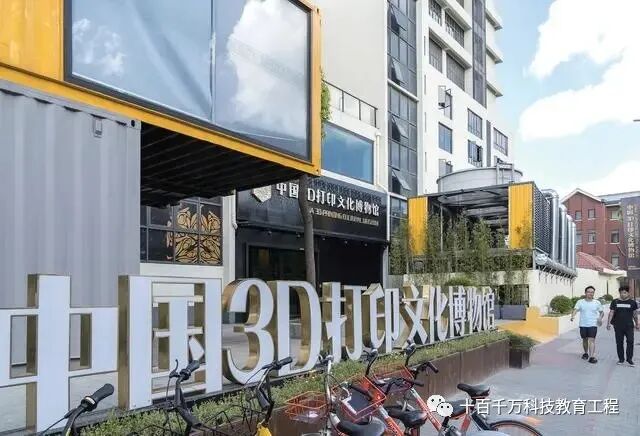
△ Shanghai, China’s first 3D printing cultural museum
On July 12, 2023, the style of the undergraduate admission notice from Northwestern Polytechnical University was released. In addition to reflecting the school’s characteristics in aviation, aerospace, and navigation, the admission notice also contains a “surprise.”“With the admission notice, new undergraduate students in 2023 can draw exclusive blind boxes at the registration site,” said a relevant person from the school’s admissions office. The contents of the blind boxes include: a signed model of the J-20Q 3D printed by Chief Designer Yang Wei, a signed model of the Y-20Q 3D printed by Chief Designer Tang Changhong, and a signed model of the Z-20Q 3D printed by Chief Designer Deng Jinghui, among others.The highly sought-after 3D printing, also known as additive manufacturing, is a technology that constructs objects based on digital model files, using powdery metals or plastics and other adhesive materials, by printing layer by layer.Printing food, rockets, cars… everything can be 3D printed. Against the backdrop of a burgeoning digital economy and the rise of smart manufacturing, the development of the 3D printing industry is quietly accelerating.3D Printed FoodIn recent years, guided by new dietary concepts of environmental protection, health, safety, and efficiency, innovative food 3D printing has rapidly emerged.Visitors to the Zhejiang Science and Technology Museum discovered that six chocolate 3D printers in the museum provided them with a trendy science experience.“Visitors have various options to print chocolates in the shapes of astronauts, flying saucers, rockets, or tanks,” said Li Jingyuan, CEO of Hangzhou Shiyin Technology Co., Ltd., the provider of the equipment, to the Outlook Oriental Weekly. 3D printing not only brings richer shapes and more appealing tastes to food but also makes visitors more interested in learning about technology.According to reports, this self-service chocolate 3D printer, named “Panda,” completes the entire process from design, payment to printing, allowing operators to be unattended, and can be widely applied in fields such as science education, cultural tourism, and commercial complexes.In cultural tourism scenarios, chocolate 3D printing has become quite common.The cultural and creative space of the Hangzhou branch of the National Version Museum of China offers visitors a new choice of 3D printed “cultural relic chocolates.” Visitors can scan a QR code via WeChat to select their favorite model for on-site printing, and within three to five minutes, they can print exquisite chocolates modeled after museum relics, such as the museum building model or the bronze sword of the King of Yue from the Warring States period.At the Suzhou Museum, Nanjing Museum, and Yunnan Provincial Museum, visitors can print chocolates shaped like museum collections; at the Shanghai Ocean Aquarium, chocolates in the shapes of seahorses, devil rays, whales, turtles, and dolphins can be printed.“In commercial complexes like Yintai and Wanda, we will combine fashionable IP content to create 3D food in IP shapes; during the release of popular movies, we will also make chocolates shaped like characters from the films,” Li Jingyuan said.Rockets and Cars Can Also Be Printed“Currently, 3D printing technology has been widely applied in many fields, involving our daily life in clothing, food, housing, transportation, aerospace, automotive manufacturing, medical care, construction, and more,” said Professor Zhang Yamei from the School of Materials Science and Engineering at Southeast University to the Outlook Oriental Weekly.On March 22, 2023, local time, the world’s first 3D printed rocket, “Humanity One,” attempted its third launch but failed to reach orbit. According to the Associated Press, the “Humanity One” rocket is 33.5 meters tall, with 85% of its components made from 3D printing technology, including the rocket’s engine.In the fields of new energy batteries, cultural relic restoration, and human organs, 3D printing is also continuously being tried and practiced.“Our ‘Linglong’ series ultra-micro 3D printed batteries are customized batteries developed for implantable medical robots. Due to the small size of medical robots, the required batteries are even smaller, and currently, only 3D printing technology can solve the integrated manufacturing and packaging challenges of batteries with three-dimensional dimensions smaller than 4 millimeters,” said Lingqi, COO of Gaoneng Shuzhao (Xi’an) Technology Co., Ltd., to the Outlook Oriental Weekly.It is reported that the company has also produced a small, long-lasting, high-discharge-rate micro battery. With the help of this 3D printed battery, capsule robots can observe the internal details of the human digestive tract through video, providing more reliable and detailed information for doctors’ diagnoses.In Anhui, Hefei Youyao Technology Company’s lightweight electric vehicle—XEV-YOYO—is the world’s first electric vehicle with both interior and exterior parts produced using 3D printing technology; in the Longmen Grottoes in Luoyang, a statue of the Amitabha Buddha, which had been lost for a hundred years, was realized through digital 3D printing technology; to help more people understand the Shandong provincial-level intangible cultural heritage protection project of Laixi puppet show, the fifth-generation inheritor of Laixi puppet show, Jiang Yutao, used 3D printing to create internal mechanisms and bearings for puppets, enhancing the difficulty and visual effects of puppet performances…
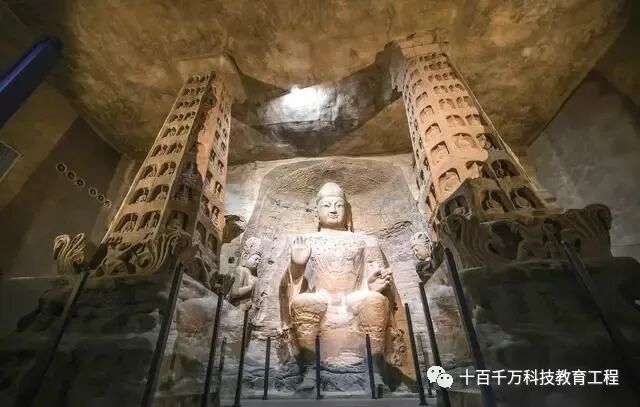
On February 13, at the Yungang Grottoes Art Museum in Qingdao, Shandong, a 3D printed statue of the main Buddha Amitabha in Cave 3 of the Yungang Grottoes, 9.93 meters tall, has a round and plump face and an extraordinary demeanor.3D printing has become a high-tech tool in people’s lives, entering ordinary households and changing people’s lifestyles.Disrupting Traditional ManufacturingAt the Chongqing exhibition area of the 2023 Zhongguancun Forum, a 3D printing device attracted crowds.This device, capable of achieving ultra-high precision 3D printing at 2 microns, comes from Chongqing Mofang Precision Technology Co., Ltd.It is understood that this 3D printing device uses a micro-stereolithography technology with projected light, employing a high-precision UV lithography projection system—layering the model to be printed onto the resin surface, allowing for rapid micro-stereolithography, transforming digital models into three-dimensional complex industrial samples.Compared to traditional printing technology, 3D printing requires a three-dimensional model created using computer-aided design software, then the raw materials are loaded into the machine, and through computer control, a laser injector accumulates the materials layer by layer, turning the blueprint on the computer into a physical object. Throughout the process, the computer automatically calculates the dimensions and positions of each step, ensuring the precision of the manufactured object.“The outstanding advantage of 3D printing technology over traditional manufacturing technology is that it does not require templates and can directly print layer by layer, thus achieving manufacturing,” Zhang Yamei told the Outlook Oriental Weekly. This advanced process is particularly advantageous for the production of various irregular components or devices.“First, it does not require templates, allowing for design freedom; second, it can be printed directly, saving template materials and labor, thus improving manufacturing efficiency.” Zhang Yamei stated that currently, there is a global shortage of manufacturing workers, and 3D printing technology effectively addresses this social issue.“After purchasing a 3D printer, parts that previously cost 60,000 yuan can now be printed for just a few hundred yuan.” Li Yunlong, the factory manager of Mondelēz (Suzhou) Food Co., Ltd., told the Outlook Oriental Weekly that they used to buy parts by the piece, but now they buy plastic filament by weight, saving the factory hundreds of thousands of yuan.“Traditional baked products were all handmade. Now, we can present them digitally.” Li Jingyuan stated that a food 3D printer can produce over 20 different types of food—turning ingredient recipes into printing “ink,” inputting the recipe, and pressing a button, leaving the rest of the cooking to the program.According to Li Jingyuan, the working principle of the food 3D printer is to melt the raw materials at a certain temperature, using a high-throughput 3D printing nozzle to layer and shape from the bottom up, achieving a high three-dimensional effect. Food 3D printers can print different shapes of products that consumers like, which is not only convenient and fast but also allows for customized personalized operations.3D printing technology has opened new avenues for low-cost, high-efficiency manufacturing of batteries with unique structures and high performance. “Electrode production requires five or six manufacturing steps, including coating, baking, pressing, cutting, rolling, or stacking, which are energy-intensive, occupy large areas, and lack flexible production capacity,” Lingqi told the Outlook Oriental Weekly. Compared to traditional technology, their newly developed generation of battery 3D printing equipment can achieve 10μm-level high precision and high design freedom for all-solid-state battery integrated manufacturing.It is reported that this equipment has broad material adaptability, requiring no special modification adjustments, and can directly use different materials for integrated battery manufacturing, providing higher quality battery products for electric vehicles, electric aviation, and smart wearable devices.“Compared to traditional production methods, the advantages of 3D printing in battery manufacturing include faster and simpler processes, lower costs, customizability, smarter, and safer. Notably, the integrated preparation of complex electrode structures through 3D printing can also achieve low pollution and low energy consumption,” Lingqi said.Challenges Awaiting BreakthroughChina places great importance on the development of 3D printing technology.In March 2021, the “14th Five-Year Plan for National Economic and Social Development of the People’s Republic of China and the Long-Range Objectives Through the Year 2035” was released, clearly stating the importance of developing additive manufacturing in enhancing the core competitiveness of the manufacturing industry and the development of intelligent manufacturing technology, positioning additive manufacturing as a key area for future planning and development.At the local policy level, governments in Guangdong, Jiangsu, Chongqing, Zhejiang, Shandong, Shanghai, Shaanxi, and other regions have explicitly stated the important position of additive manufacturing in the overall development of high-end manufacturing in their policy documents.With the support of policies, domestic 3D printers are emerging continuously, rapidly expanding the application of related industries.Guo Dan, secretary of the China Additive Manufacturing Industry Alliance, stated that although global venture capital investment actions have slowed down, domestic institutions continue to maintain stable growth in investment in the 3D printing industry.Guo Dan said that in 2022, the total financing of 3D printing companies in China reached 6.4 billion yuan, a 33% increase compared to 4.8 billion yuan in 2021.Academician of the Chinese Academy of Engineering and former dean of the School of Mechanical Engineering at Xi’an Jiaotong University, Professor Lu Bingheng, known as the “Father of 3D Printing in China,” believes that the research level of 3D printing technology in China is already among the top in the world, but there is still significant room for development in process equipment and engineering applications. Therefore, a technical development roadmap for 3D printing technology needs to be formulated in China, planning the development routes for basic research, industrialization, and engineering applications to achieve true industrialization.Lu Bingheng stated that 3D printing technology provides a new path for high-end manufacturing. Everything can be 3D printed, and it is essential to reasonably utilize different manufacturing methods to leverage their respective advantages for product production.However, there are still some bottlenecks in the development of 3D printing.“In some areas, it is necessary to strengthen the synergy between enhanced processes and 3D printing processes. However, in reality, achieving synergy is not easy, as some enhancement measures may interfere with the printing process.” Zhang Yamei cited an example to the Outlook Oriental Weekly, stating that in the field of 3D printed construction, there are significant issues with steel reinforcement in 3D printed concrete, as the performance of the printed products is far inferior to that produced by traditional methods.Moreover, due to the layer-by-layer construction method of 3D printing, interface issues have become a common challenge.“Although there are strategies to solve interface issues technically, when printing large sizes, the problems are often more complex and require systematic solutions from material and process perspectives,” Zhang Yamei said.In the application process, how to protect intellectual property rights in 3D printing technology has also attracted much attention. In this regard, Zong Guisheng, founder and chairman of Beijing Sandi Technology Co., Ltd., proposed two suggestions at the 2023 China Economic Media Conference: first, to protect through the integration of blockchain technology; second, to legally apply for patent protection for original intellectual property rights.“As the cost of 3D printing technology gradually decreases, many 3D printed products are now priced close to or even lower than traditional manufacturing prices. I believe that within five years, 3D printing technology will cover most manufacturing fields,” Li Jingyuan stated, adding that in the future, 3D printing technology will better benefit people’s lives.