
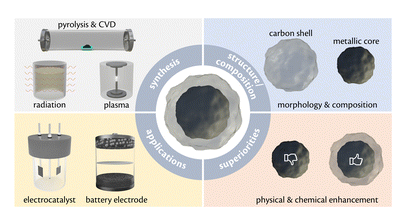
To technically achieve electrochemical energy conversion and storage, it is essential to obtain high-performance electrocatalysts and electrodes. Carbon-coated nanoparticles have become an exciting option due to their unique advantages, as they can achieve a high level of activity-stability balance. The growing interest in this unique material is partly due to its direct principle of carbonizing ubiquitous organic matter under high-energy conditions. Moreover, the precursors used on demand not only pave the way for introducing dopants and surface functional groups into the carbon shell but also facilitate the generation of various metal-based nanoparticle cores. By controlling the synthesis parameters, the structure, composition, and size of the carbon shell and metal core can be easily designed. In addition to various easily understood advantages (such as better agglomeration, corrosion resistance, oxidation resistance, and crush resistance brought by carbon coating, as well as charge conductivity), the potential core-shell synergistic effect can also fine-tune the electronic structure of the two components. These features collectively promote these nanostructures as emerging energy applications for novel electrocatalysts and electrodes. Therefore, we need a systematic and comprehensive review to summarize the latest progress and inspire further efforts in this rapidly developing research field.
This article, authored by Lecturer Guo Kun and Professor Lu Xing from Huazhong University of Science and Technology, among other researchers, is published in the journal Chem. Soc. Rev under the title “Carbon Encapsulated Nanoparticles: Materials Science and Energy Applications.”
This review will focus on feasible solutions to achieve this goal from the fundamental and comprehensive perspectives of materials science (synthesis methods, structure/composition, and inherent properties) and energy applications, specifically developing catalysts/electrodes based on CENPs.The most widely used direct method for preparing CENPs is furnace pyrolysis of suitable precursors. However, we also discuss the fundamental principles of other synthesis strategies, such as CVD, radiation, and plasma-assisted methods. We elaborate on the key synthesis conditions that influence the structural and compositional parameters of the metal core and carbon shell. Specifically, we discuss the ideal application-oriented structural advantages of CENP catalysts and electrodes. Next, we discuss the energy applications of CENPs in key electrocatalytic reactions involving small molecules and in emerging metal-ion batteries from different perspectives, clearly emphasizing the enormous potential and prospects of CENPs. This review aims to guide and inspire future work, promoting the development of CENPs in energy applications.Nevertheless, further efforts are necessary to fundamentally deepen our understanding of these special and fascinating types of nanostructures. Here, we summarize several research directions worth close attention.(i) In-depth understanding of the formation mechanisms of the metal core and carbon shell: The pyrolysis in the furnace is akin to an unknown operation in a black box. To unravel this mystery, it is necessary to combine various in-situ characterization techniques, such as in-situ TEM/STEM, Raman, XPS, and TGA-MS, to trace the formation trajectory of the inorganic core and the carbonization pathway of the organic matter. In particular, in-situ structural and compositional information of primary products and by-products should be provided to address core issues, such as the role of the metal core in the formation of the carbon shell, how the properties of the metal influence the growth of the carbon shell, and how the NP core encapsulated by the carbon shell gradually evolves. This firsthand information will, in turn, provide valuable guidance for controlling synthesis parameters, thereby designing CENPs with desired functionalities.(ii) Precise synthesis of CENPs with defined structural parameters: The structure and morphology of the carbon shell can be qualitatively detected through various spectroscopies and visually observed through electron microscopy. In stark contrast to ideal CENPs, in almost all cases, the actual shell thickness around the NP core is neither concentric nor uniform. There are also cases where the NP core is not or is partially embedded in the carbon shell. On the other hand, the core NP is often irregularly shaped rather than spherical. Furthermore, their spatial distribution in the carbon network is also uneven, and the NP size distribution is quite broad. This structural complexity undoubtedly poses a significant challenge in clearly linking the functionality of CENPs to their specific structural features. Therefore, precise synthesis of CENPs with defined structural parameters should be prioritized. In terms of chemical composition, both the core and shell need to be examined at the atomic level. Additionally, the formation of atomic species doped in the carbon shell and mixed core should be clearly studied to distinguish their contributions to the final performance.(iii) Clarifying the structure-performance relationship of CENPs: For a long time, performance sensitive to structure has been a focus in the study of functional nanomaterials. For CENPs, key structural/compositional factors (such as size, composition, shape, distribution, thickness, porosity, dopants, and crystallinity) are closely related to their performance. However, research on how these key parameters affect the electrochemical properties of CENPs is still limited. Furthermore, the structural stability of CENPs during energy applications should also be investigated to track potential structural adjustments during the reaction process. Therefore, it is necessary to fill this knowledge gap through controlled synthesis, advanced characterization methods, and refined experiments, laying the foundation for rationally designing CENPs with customized functionalities for specific energy applications.(iv) Combining theoretical simulations and experimental evidence to elucidate fundamental mechanisms: To determine catalytic active sites or assess the diffusivity of metal ions in electrodes, many researchers have employed atomic models based on large fullerene cages encapsulating well-defined metal clusters (finite atomic structures) or single-layer/multilayer graphene sheets encapsulating irregular metal crystals (periodic structures) for DFT calculations. However, we must acknowledge that actual CENPs are far more complex than these simplified models. Therefore, we will simultaneously employ theoretical and experimental tools, such as DFT, machine learning, molecular dynamics, and in-situ/operando techniques, to draw consistent and convincing conclusions regarding the fundamental functional mechanisms of CENPs. Additionally, it is strongly recommended to use probes that have been proven to poison transition metals and certain N dopants (i.e., SCN-, EDTA, and PO43-) as a routine practice to distinguish whether the true source of CENPs’ active sites is the metal core or the carbon shell.As the number of papers on the synthesis and application of CENPs continues to increase, we can confidently anticipate encouraging discoveries and potential challenges. We believe that these research efforts and attempts will attract widespread attention, driving further development and paving the way for the large-scale application of these novel materials.References:https://doi.org/10.1039/D3CS01122D

▼Previous Highlights▼Dalian University of Technology: Graphene/MD@Carbon Nanotube Aerogel for Multifunctional Efficient Electromagnetic Wave Absorbers Jiangsu University: 2.5 Seconds Flash Joule Heating Synthesis of Vanadium Oxide/Graphene Hybrids for High-Performance Aqueous Zinc-Ion Batteries Jilin University: Alarm Prototype of Integrated Pulse-Driven Nitrogen Dioxide Sensor Based on Graphene/In2O3
Source: The article is from Chem Soc Rev, organized and edited by Materials Analysis and Applications.

 Long press to identify the QR code in the image and click to follow
Copyright and Disclaimer:
① All works marked “Materials Analysis and Applications” on this website are copyrighted by Materials Analysis and Applications. Unauthorized reproduction, excerpting, or use in other ways is prohibited. Works authorized by this website should be used within the scope of authorization and must indicate “Source: Materials Analysis and Applications.” Violators will be held legally responsible.
② All works marked “Source: xxx (not from this website)” are reprinted from other media. The purpose of reprinting is to convey more information and does not represent the website’s endorsement of their views or responsibility for their authenticity, nor does it bear direct or joint liability for infringement of such works. If other media, websites, or individuals download and use from this website, they must retain the “manuscript source” indicated by this website and bear the copyright and other legal responsibilities.
③ If there are issues regarding the content or copyright of the works, please contact this website within three days from the date of publication; otherwise, it will be deemed as a waiver of related rights.