3D printing, also known as additive manufacturing, is a technology that constructs objects based on digital models by using powdery metals or plastics and other adhesive materials, layer by layer. In recent years, major countries around the world have increased their support for 3D printing technology, leading to rapid development in the global 3D printing industry. From children’s toys and crafts to highly complex components used in airplanes and rockets, 3D printers have been widely applied in various fields.
The importance of 3D printing and its vast potential are self-evident, as it profoundly impacts traditional processes, production lines, factory models, and industrial chain combinations, representing a disruptive technology in manufacturing. All of this is thanks to the “father of 3D printing”—the renowned American inventor Chuck Hull. He is a figure akin to Geppetto (the old carpenter who created Pinocchio), initially unaware of how magical his creation would become.

A Flash of Inspiration

In 1983, Hull served as the vice president at UVP, a manufacturer of ultraviolet equipment, primarily applying thin plastic veneers to desktops and furniture. Like others in the industry, he was frustrated that producing small plastic parts for new product prototypes could take up to two months. Every day, he fiddled with various ultraviolet lamps at the company, observing the process where liquid resin solidified upon exposure to UV light. One day, he suddenly realized that if he could sweep UV light layer by layer across the surface of a photosensitive polymer, solidifying it layer by layer, he could create any imaginable three-dimensional object by stacking hundreds or thousands of these thin layers together.
Thus, he developed a system using a computer to direct light into a large vat of photopolymer, tracking the horizontal shape of the object and printing subsequent layers until completion. After several months of effort, he successfully created a cup for rinsing eyes, which he termed stereolithography, marking the official birth of 3D printing technology.
The Twisted Path to Success
However, this technology did not receive attention at the time. When he presented the technology to the president of his company, he was rejected on the grounds of insufficient funding and time. Even though the technology did not achieve its expected commercial value, Hull was clear about where it would eventually be applied.
In 1984, Hull submitted a patent application for the stereolithography apparatus (SLA) to the United States Patent and Trademark Office and received patent authorization. In the patent, he coined the term “stereolithography,” abbreviated as SLA, which refers to the later stereolithography technology—using ultraviolet light to catalyze photosensitive resin, layer by layer, to form objects.
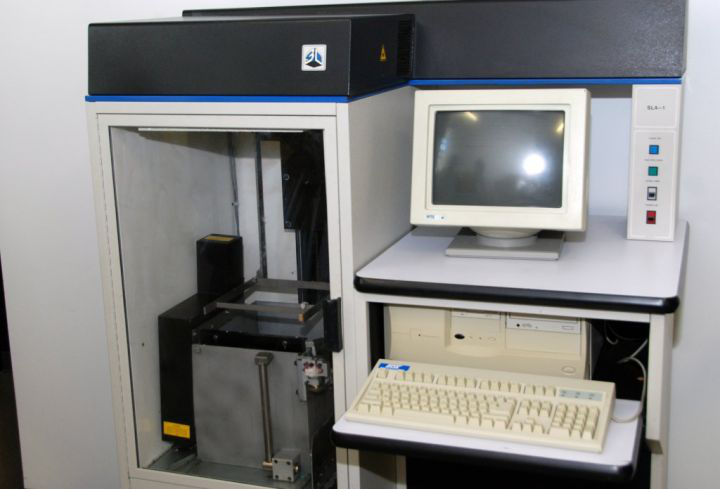
That same year, Hull founded 3D Systems in California to commercialize this new manufacturing method and manage technologies and products related to 3D printing. The first commercial 3D printer developed by the company, “SLA-1,” reduced the time required to create a disposable mold from 6 to 8 weeks to just a few hours, marking a breakthrough in manufacturing technology, although the product did not generate returns commensurate with its value from the patent.
But Hull did not lose heart; instead, he continued to lay a strong foundation in intellectual property. Due to his strong awareness of intellectual property protection, he has obtained over 90 patents related to 3D printing in the United States and Europe.
When Hull first proposed his invention, he predicted that it would take 25 to 30 years for this technology to enter households. This prediction proved correct, as the widespread commercialization of 3D printers only became a reality in recent years, but its possibilities are endless.
In 1993, the Massachusetts Institute of Technology obtained a patent for 3D printing technology, and subsequently, companies licensed it from MIT for commercial operations, developing new types of 3D printers. Over the following decades, various structures were printed using these machines, including cars, clothing, food, aircraft, human tissues, and buildings.
After decades of development, 3D Systems holds nearly a thousand patents. Among all the patents registered by Hull, many cover fundamental technical methods of today’s 3D printing technology, such as using triangular models (STL file format) for slicing data preparation and alternating exposure strategies. Today, the 3D printers invented by 3D Systems have entered countless industrial and commercial applications, with various industries enjoying the changes brought by 3D printing technology. In May 2014, Hull was inducted into the National Inventors Hall of Fame and received a nomination for the European Inventor Award.
A New Journey

After his retirement, Hull found that he was not suited to retired life, so he returned to the company he founded and dedicated himself to the research and development of 3D technology. In recent years, 3D printing has developed differently across various fields and systems, and Hull has not specified the key development direction for 3D printing. For him, every project is challenging. At present, it may be best not to exaggerate or look too far ahead. “I am also familiar with how much work is needed to turn these concepts into reality,” Hull said. “Therefore, there is still a lot of research and work to be done before these miracles happen.”
References:
Liuyihuan. The Father of 3D Printing Charles W. Hull
NetEase Capital Theory. “The Father of 3D Printing” Chuck Hull Did This After Inventing the Technology
Creative Fun World. The Story of Chuck Hull, the Father of 3D Printing Technology!
3D Printing Business. The Father of 3D Printing Finally Spoke the Truth: Miracles Will Not Come Too Quickly or Easily
Note: Images are sourced from the internet; please notify for removal in case of infringement!