Xinchip Technology and analog IC design company Richtek have jointly launched the “SD210” reference design aimed at smart cockpits. This reference design is based on Xinchip’s X9 series smart cockpit SoC chips and incorporates Richtek’s SoC PMIC RTQ2209 and other products, fully meeting diverse power supply requirements and aiding in the realization of high-performance, miniaturized smart cockpit systems.
Xinchip Technology and Richtek established an advanced technology development partnership in 2023, focusing on applications related to smart cockpits. Previously, the two companies developed a reference board based on Xinchip’s “X9M/E” products, equipped with Richtek’s RTQ2209, DCDC RTQ2102A, and other products, which have been adopted by several automotive manufacturers. The newly launched reference design “SD210” will continue to enhance the convenience and safety of automotive infotainment systems.
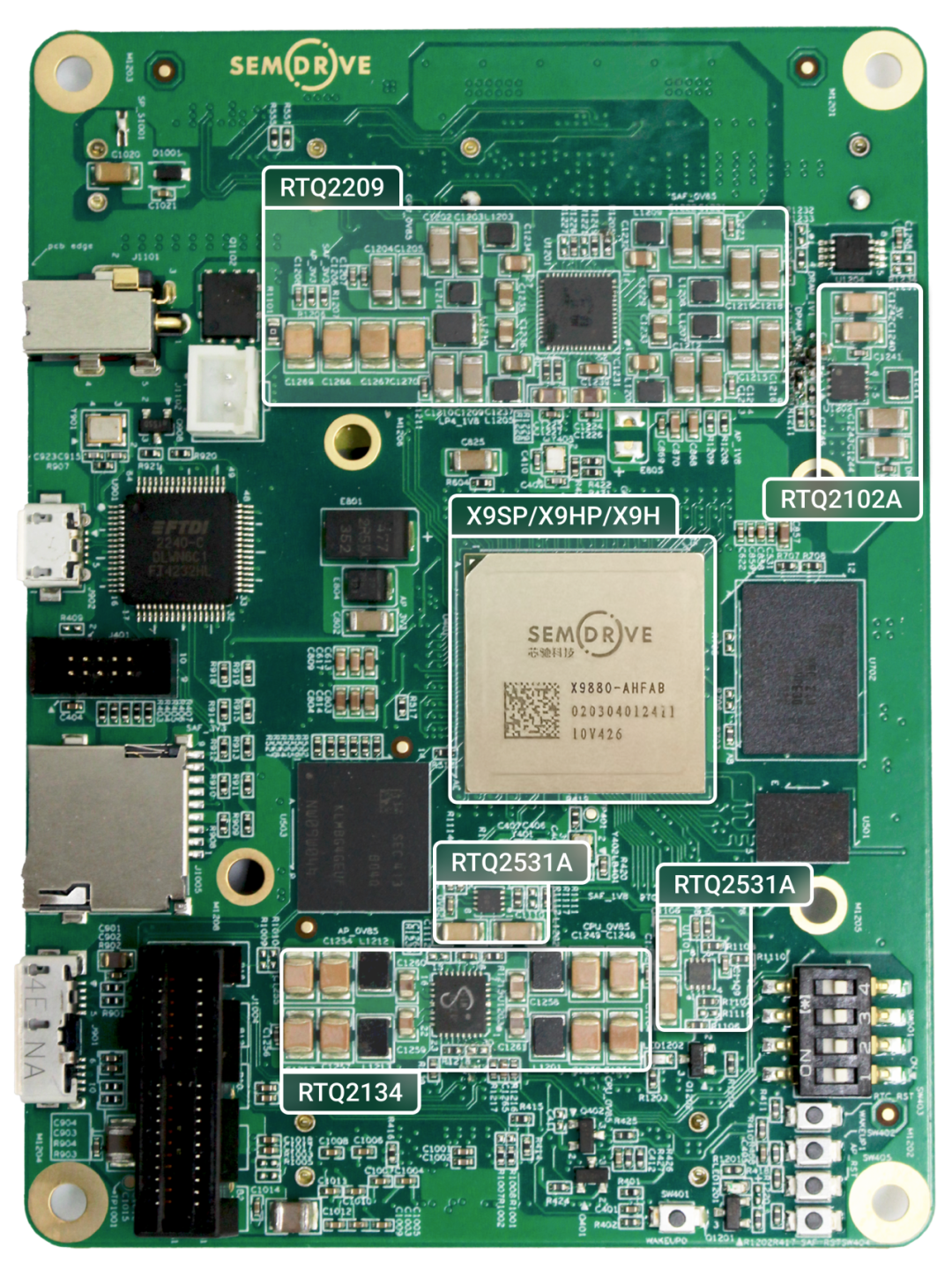
About the “SD210” Reference Design
The “SD210” is based on Xinchip’s “X9H”, “X9HP”, and “X9SP” smart cockpit SoCs, featuring Richtek’s SoC PMIC RTQ2209, Multi-Phase Step-Down Converter RTQ2134, DCDC RTQ2102A, and LDO RTQ2531A. This reference design can utilize the IC’s internal memory (MTP/OTP) for output voltage setting and timing control, providing efficient and flexible power supply according to specific circuit requirements. Pin-compatible SoCs can quickly change specifications without altering the circuit.
Richtek’s newly launched RTQ2209-QA analog IC is designed for automotive applications, featuring an advanced wettable flank QFN6x6 package, integrating 10-channel multi-configuration power management, supporting flexible I2C configuration, and boasting ultra-low static current (50uA), achieving extreme low power consumption in STR mode, significantly optimizing system performance and extending battery life. Additionally, for high-power platforms, Richtek offers high-end automotive products such as the 20A output, multi-phase 4-channel buck converter RTQ2134-QA to meet higher performance demands.
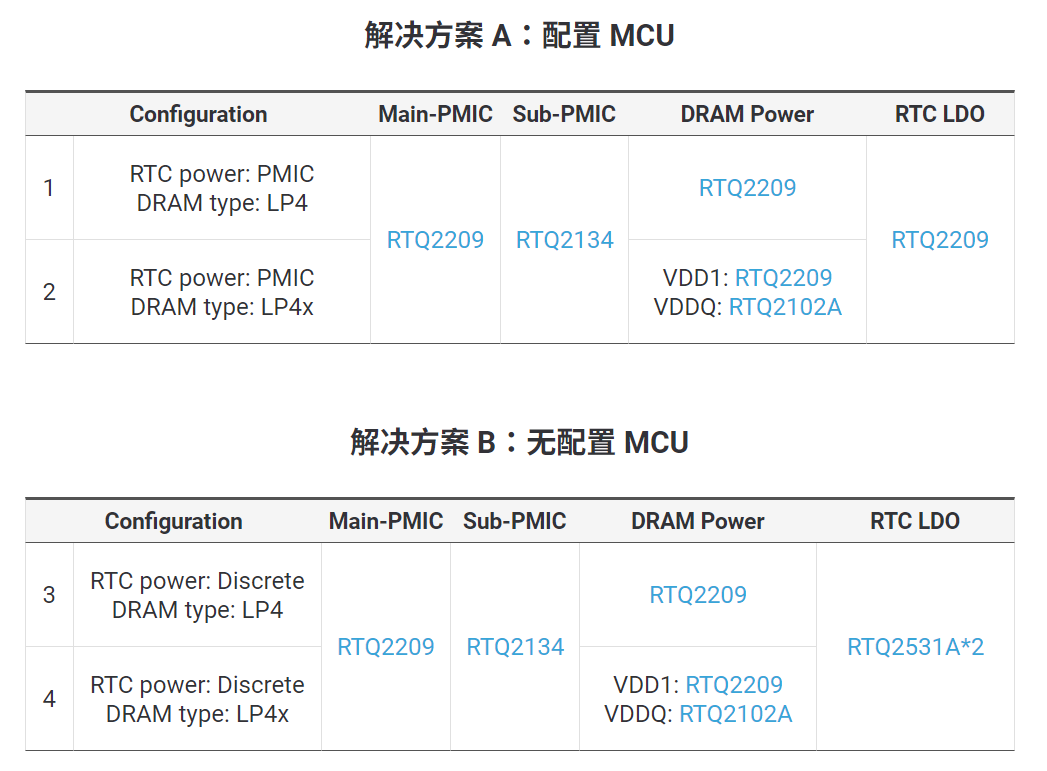
To address the diverse configuration needs of cockpit systems, Richtek provides four power configuration solutions to adapt to SoCs like X9SP/X9HP/X9H. These solutions fully leverage the highly integrated advantages of RTQ2209: simplified circuitry, space-saving, ease of operation, perfectly meeting the minimalist and efficient demands of cockpit systems.
-
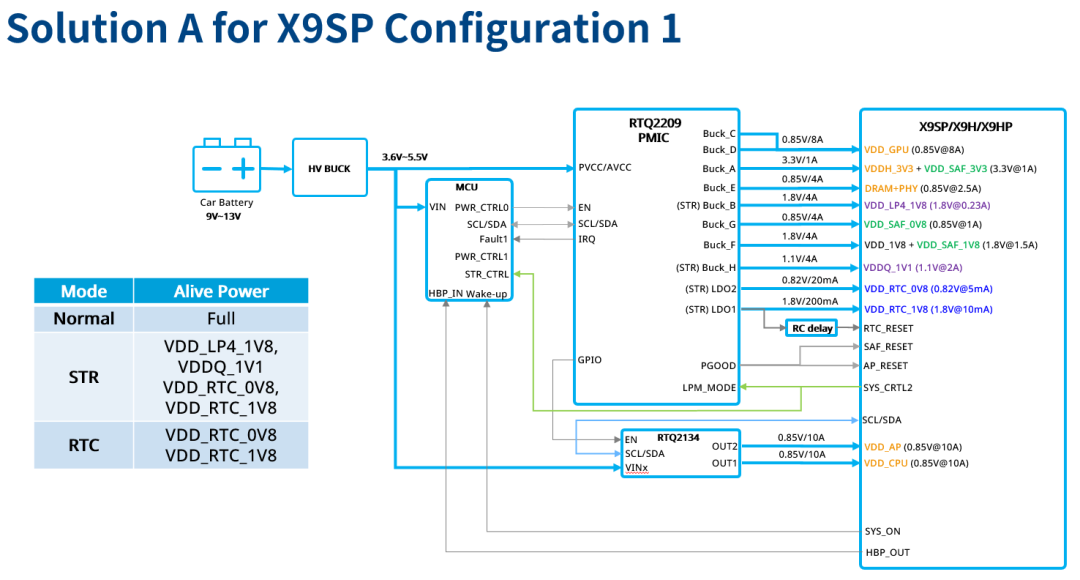
Solution A for X9SP/X9H/X9HP Configuration 1 (see below):
This solution is suitable for systems equipped with an MCU and using DRAM LP4, consisting of RTQ2209+RTQ2134. The MCU controls the operation of RTQ2209+RTQ2134 via GPIO and I2C interfaces. RTQ2209 powers the RTC, SAF, DRAM, GPU, etc., while RTQ2134 powers the AP and CPU.
-
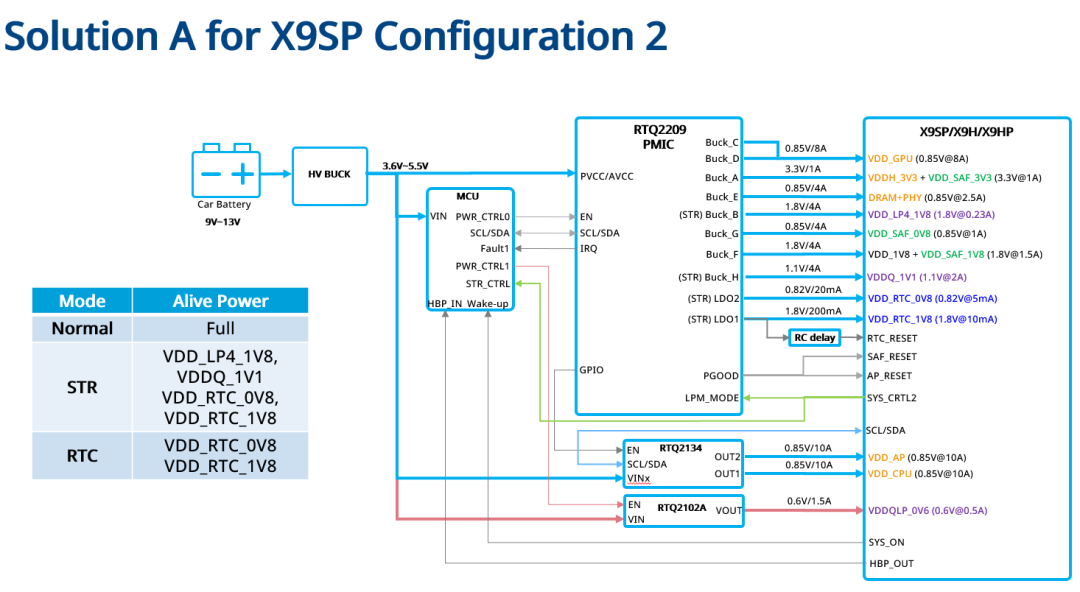
Solution A for X9SP/X9H/X9HP Configuration 2 (see below):
This solution is suitable for systems equipped with an MCU and using DRAM LP4x, consisting of RTQ2209+RTQ2134+RTQ2102A. The MCU controls the operation of RTQ2209, RTQ2134, and RTQ2102A via GPIO and I2C interfaces. RTQ2209 powers the RTC, SAF, GPU, and LP4x, while RTQ2134 powers the AP and CPU, and RTQ2102A powers the LP4x.
-
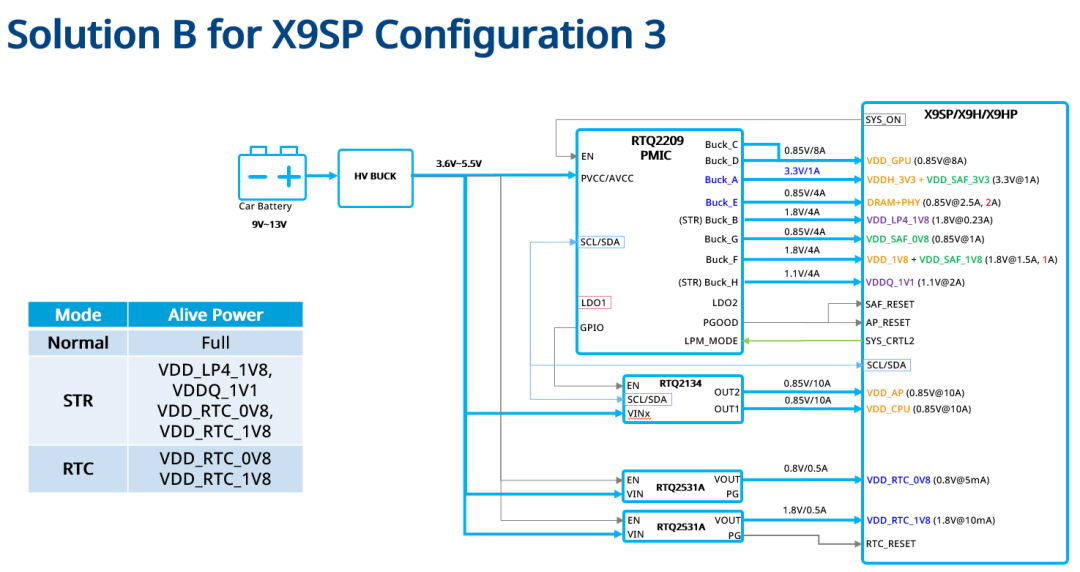
Solution B for X9SP/X9H/X9HP Configuration 3 (see below):
This solution is suitable for systems without an MCU and using DRAM LP4, consisting of RTQ2209+RTQ2134+RTQ2531A. The X9SP/X9H/X9HP controls the operation of RTQ2209+RTQ2134 via GPIO and I2C interfaces. RTQ2209 powers the SAF, DRAM, GPU, etc., while RTQ2134 powers the AP and CPU, and RTQ2531A powers the RTC domain.
-
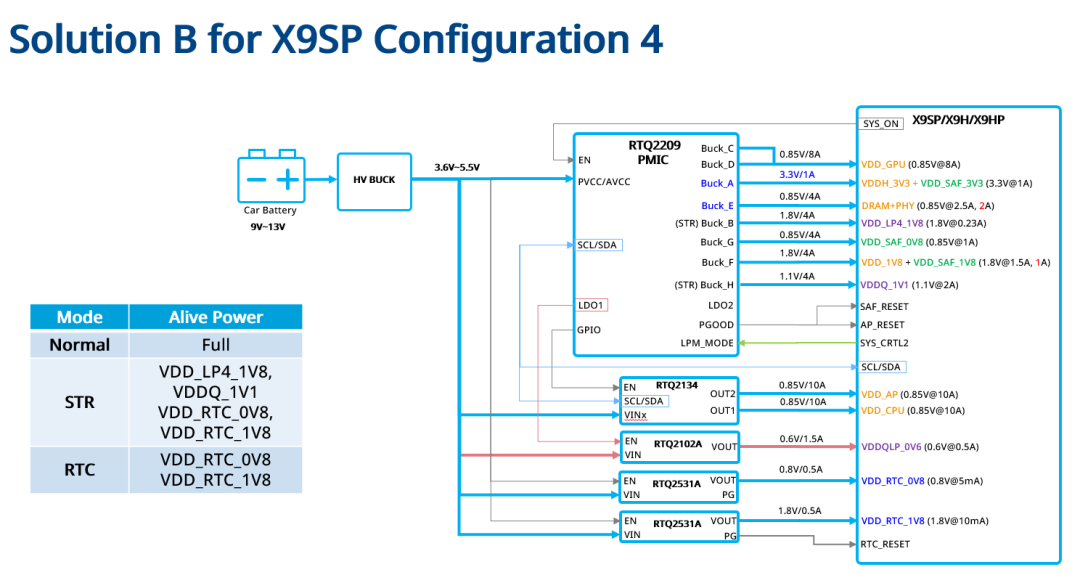
Solution B for X9SP/X9H/X9HP Configuration 4 (see below):
This solution is suitable for systems without an MCU and using DRAM LP4x, consisting of RTQ2209+RTQ2134+RTQ2102A+RTQ2531A. The X9SP/X9H/X9HP controls the operation of RTQ2209+RTQ2134+RTQ2102A via GPIO and I2C interfaces. RTQ2209 powers the SAF, GPU, and LP4x, while RTQ2134 powers the AP and CPU, RTQ2102A powers the LP4x, and RTQ2531A powers the RTC domain.
Xinchip’s X9 series products comprehensively cover cockpit application scenarios from entry-level to flagship, including instrument panels, IVI, cockpit domain control, and cabin docking, with over a million units shipped and rich mass production experience, forming a mature ecosystem. According to the latest data from the Automotive Research Institute, in the first quarter of 2025, among models priced above 100,000 yuan, Xinchip’s X9 series cockpit chips (including instrument panels, central control, and domain control) ranked first in domestic installations, covering over 50 mainstream models from automakers such as SAIC, Chery, Changan, FAW, GAC, BAIC, Dongfeng Nissan, and Dongfeng Honda, as well as many models exported overseas.
Brian Chu, Assistant Manager of Market Integration and Marketing at Richtek, stated: “We are honored to once again collaborate with Xinchip Technology to provide comprehensive power management support for its X9 series platform. The deep cooperation between both parties not only promotes innovative breakthroughs in smart cockpit technology but also injects strong momentum into the new energy vehicle industry. We look forward to continuing to deepen our cooperation with Xinchip Technology in the future, jointly leading the new era of smart automobiles and exploring infinite possibilities.”
About Richtek Technology
Richtek Technology is an international analog IC design company established in 1998, headquartered in Taiwan, with service points in Asia, the United States, and Europe. The company focuses on integrating technical capabilities, maintaining quality, and providing proactive customer service, aiming to deliver product value to customers. Its products are widely used in computers, consumer electronics, network communication devices, industrial applications, and automotive fields. For more details, please visit Richtek Technology’s official website: https://www.richtek.com
For more information on automotive power management products, please contact us at [email protected]
About Xinchip
Xinchip Technology is a leader in full-scenario intelligent vehicle chips, focusing on providing high-performance, high-reliability automotive-grade chips that cover the fields of smart cockpits and intelligent vehicle control, encompassing the core chip categories of future automotive electronic and electrical architectures.
All series of Xinchip chips have been mass-produced, with shipments exceeding 8 million units. Xinchip currently has over 200 designated projects, serving more than 260 customers, covering over 90% of domestic OEMs and some international mainstream automakers, including SAIC, Chery, Changan, Dongfeng, FAW, Nissan, Honda, Volkswagen, and Li Auto.
Five Certifications for Xinchip’s Excellence
· TÜV Rheinland ISO 26262 ASIL D Functional Safety Management System Certification
· AEC-Q100 Grade 1/Grade 2 Reliability Certification
· TÜV Rheinland ISO 26262 ASIL B/D Functional Safety Product Certification
· TÜV Rheinland ISO/SAE 21434 Automotive Cybersecurity Management System Certification
· Certification from the State Administration for Market Regulation and the National Cryptography Administration for National Secret Information Security