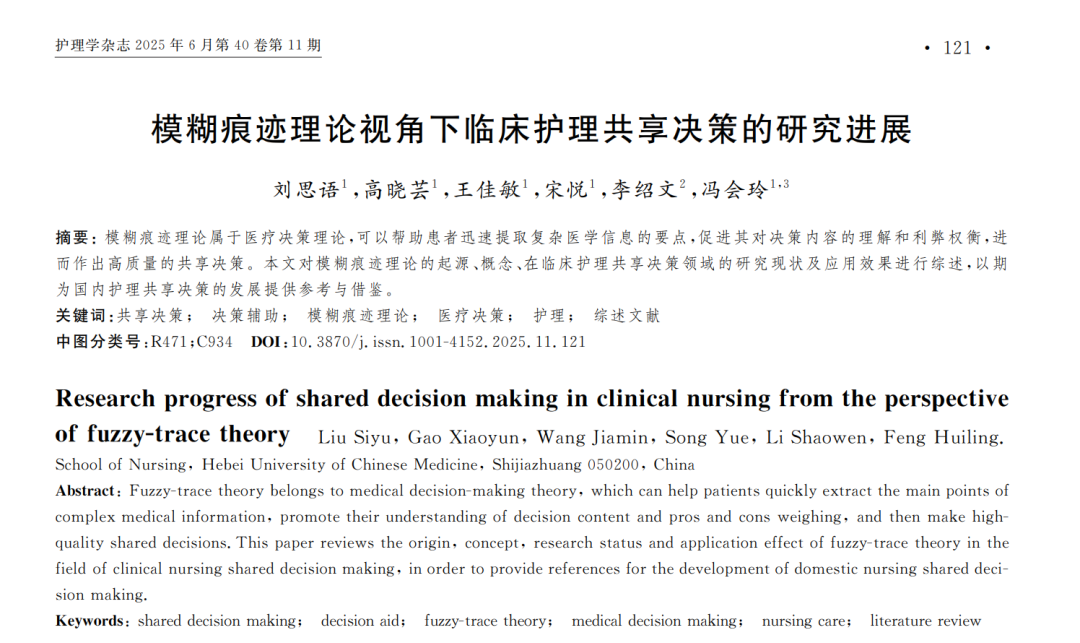
 Recently, Liu Siyu and other scholars published a review article titled “Research Progress on Shared Decision-Making in Clinical Nursing from the Perspective of Fuzzy Trace Theory” in the Journal of Nursing in 2025. The authors pointed out that the Fuzzy Trace Theory (fuzzy-trace theory) as a medical decision-making theory can help patients distill core points when faced with complex medical information, promoting understanding of treatment content and its pros and cons, thereby facilitating high-quality shared decision-making. This study provides a new perspective on the application of fuzzy trace theory in the nursing field. Based on this, this article will further introduce the origin, core content, and its applications and implications in nursing practice.01| Overview of Fuzzy Trace TheoryFuzzy Trace Theory (FTT) was first proposed by American psychologists Brainerd and Reyna in the 1980s and gradually developed into a systematic cognitive theoretical framework in the 1990s. The theory originated from research on the relationship between memory and reasoning, aiming to explain phenomena that traditional information processing theories cannot adequately account for, such as the fact that individuals’ performance in reasoning tasks is often unrelated to the accuracy of their memory of factual details. Through numerous experiments, researchers found that humans do not solely rely on precise information verbatim in cognitive processes but are more inclined to extract and use “gist traces,” which represent the core meaning of events. Since then, the theory has been continuously expanded and applied in cognitive psychology, developmental psychology, social psychology, and medical decision-making.02| Principles of Fuzzy Trace Theory
FTT belongs to the dual-process cognitive model, with the core idea that humans store and process information through two types of representations:
| Verbatim traces | Precise encoding of event details, such as specific numbers, vocabulary, or scene characteristics. |
|
Gist traces |
Abstract representation of the meaning of events, emphasizing “core meaning” or “bottom-line significance.” |
Research shows that individuals generate both types of traces when faced with complex information, but in actual reasoning and decision-making, they often rely more on gist traces. This “gist processing preference” enables people to make quick judgments in information-overloaded environments and explains various cognitive phenomena such as risk perception, probability judgment biases, and false memories.03| Five Principles of Fuzzy Trace Theory
| Principle | Core Content | Typical Example |
|---|---|---|
| Principle 1: Parallel Storage of Verbatim and Gist Traces | Verbatim information and gist information are stored in parallel, rather than gist information deriving from verbatim information. | When seeing the word “basketball,” the verbatim features (orange letters, lowercase form, etc.) and gist features (representing “ball games”) are encoded simultaneously. |
| Principle 2: Independent Extraction of Verbatim and Gist Traces | The extraction of verbatim traces and gist traces is independent and does not rely on each other. | In recognition tests, “Mustang” serves as a cue for verbatim traces, while “truck” serves as a cue for gist traces. |
| Principle 3: Opposing Processes in False Memory | Verbatim extraction and gist extraction have opposing effects on false memory: gist extraction may induce false memories, while verbatim extraction helps suppress them. | Gist traces make certain meanings seem familiar but do not exist, while verbatim traces correct this bias through detail verification. |
| Principle 4: Developmental Differences | The ability to store and extract verbatim and gist traces gradually improves with age. | 14-year-old children perform better in both verbatim and gist memory than 4-year-old children. |
| Principle 5: Both Verbatim and Gist Processing Can Trigger Vivid Memories | Verbatim trace extraction usually leads to “recall,” while gist trace extraction leads to “familiarity.” | Some people often say, “I remember this!” (recall) or “This feels familiar” (familiarity). |
04| Case Demonstration of Fuzzy Trace Theory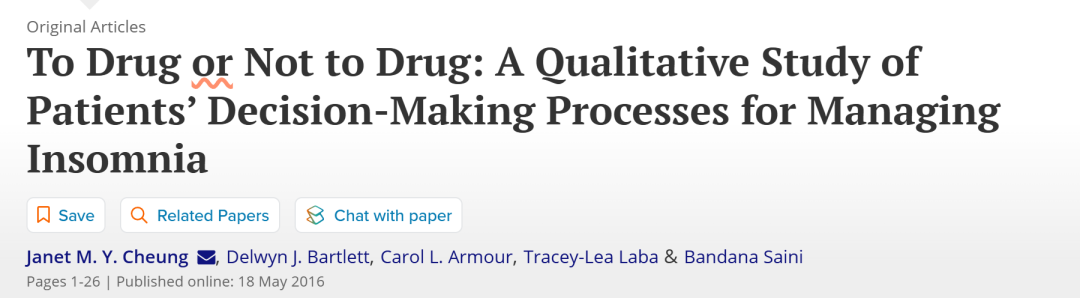
In 2016, Janet and other scholars published a study titled “To Drug or Not to Drug: A Qualitative Study of Patients’ Decision-Making Processes for Managing Insomnia”↳to explore the choice mechanisms between drug and non-drug treatments for insomnia patients. In the study, the authors used Fuzzy Trace Theory (FTT) to construct a patient treatment decision framework (see figure) to reveal the cognitive and social-psychological processes involved in forming patient preferences.
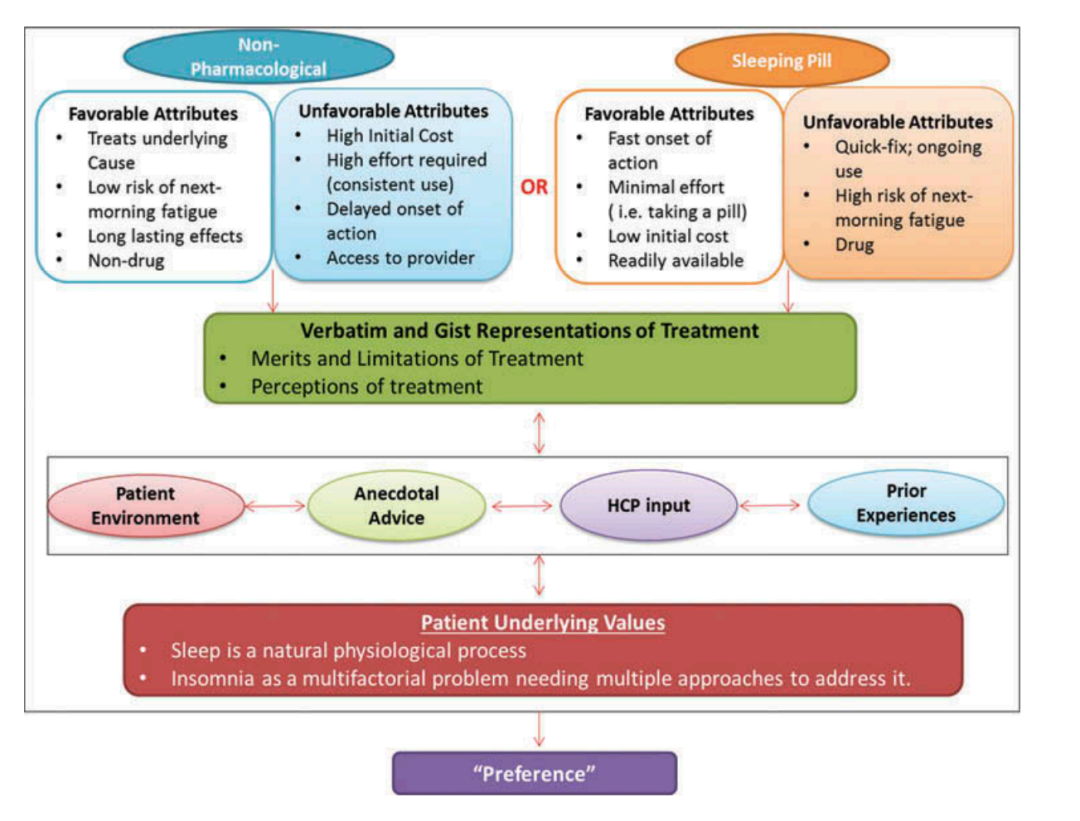
In this framework, two types of treatment options are clearly presented:Drug Treatment (Sleeping Pill) and Non-Drug Treatment (Non-pharmacological). The beneficial attributes of drug treatment include quick onset, ease of use (only requires taking medication), low cost, and easy access; however, its disadvantageous attributes are also prominent, such as being seen as a “stopgap measure,” high risk of prolonged use, potential for next-day fatigue, and issues of drug dependence. In contrast, the beneficial attributes of non-drug treatment lie in its ability to address the root cause, low risk, lasting efficacy, and avoidance of drug dependence, but its disadvantageous attributes include high initial costs, the need for long-term adherence, slower onset, and limited access.
When faced with these options, patients will engage in cognitive processing based on fuzzy trace theory, simultaneously forming verbatim representations (specific pros and cons details) and gist representations (overall impressions and key points). This dual representation helps patients form a core understanding between “drugs are fast but have side effects” and “non-drugs are slow but more curative.” Additionally, patients’ cognitive representations are also influenced by multiple social and experiential factors, including the environment in which the patient is situated, anecdotal advice from friends and family, professional opinions from healthcare providers, and the patient’s previous treatment experiences.
Furthermore, patients’ underlying values play a crucial role in the decision-making process, such as viewing sleep as a natural physiological process and understanding insomnia as a multifactorial issue that requires a multifaceted approach. These values, along with cognitive representations and external environments, dynamically interact to shape the patient’s final treatment preference.
This case fully illustrates the application value of fuzzy trace theory in clinical decision-making research. By revealing how patients process information between verbatim and gist representations and how preferences are formed under the influence of social environments and personal values, this theory provides a new theoretical perspective for understanding and optimizing patient shared decision-making.
05| Current Applications, Limitations, and Future Research Directions of Fuzzy Trace Theory
1. Current Applications
Memory Research: Explaining the mechanisms of true and false memory formation, applied in judicial testimony, child interviews, etc.
Risk Perception: Revealing biases in probability judgment and risk assessment, such as framing effects.
Medical and Nursing Decision-Making: Helping patients filter key points in complex information, improving health education and shared decision-making effectiveness.
Health Communication: Guiding how to convert complex numbers and risks into easily understandable “gist” information.
2. Major Limitations
Lack of Measurement Tools: Methods to distinguish between verbatim and gist memory are not yet standardized.
Ambiguous Theoretical Boundaries: Overlap with other dual-system theories.
Limited Evidence: Few studies across cultures and groups, insufficient neurobiological mechanisms and causal evidence.
3. Research Directions Worth Exploring
Standardized Measurement: Developing more scientific tools to distinguish between verbatim and gist representations.
Mechanism Research: Exploring its neurobiological basis and causal relationships through brain imaging and experimental interventions.
Group Differences: Comparing cognitive processing differences across different ages, education levels, or cultural backgrounds.
Clinical Applications: Applying FTT in real scenarios such as chronic disease management, medication use, and screening compliance.
Information Dissemination: Exploring how to balance “simplification” and “accuracy” in health education, digital healthcare, and public policy.
06| Recommended Reading
- Reyna, V.F.; Brainerd, C.J. (1995). “Fuzzy-trace theory: An interim synthesis”. Learning and Individual Differences. 7: 1–75.
- Brainerd, C.J.; Reyna, V.F. (2002). “Fuzzy-trace theory and false memory”. Current Directions in Psychological Science. 11 (5): 164–169.
- Gomes, C.F.A.; Brainerd, C.J. (2012). “Dual processes in the development of reasoning: The memory side of the story”. In Gauffroy, J.; Barrouillet, P. (eds.). The Development of Thinking and Reasoning. Psychology Press.
- Brainerd, C.J.; Reyna, V.F. (October 1, 2002). “Fuzzy Trace Theory and False Memory”. Current Directions in Psychological Science. 11 (5): 164–169.
- Cheung, J. M. Y., Bartlett, D. J., Armour, C. L., Laba, T. L., & Saini, B. (2016). To Drug or Not to Drug: A Qualitative Study of Patients’ Decision-Making Processes for Managing Insomnia. Behavioral Sleep Medicine, 16(1), 1–26.
- Chang M, Johns B T, Brainerd C J. True and false recognition in MINERVA2: Integrating fuzzy-trace theory and computational memory modeling[J]. Psychological Review, 2025.
- Roue J E, Edelson S M, Singh A, et al. Fuzzy-Trace Theory, Decision Making, and the Law[M]//Decision-Making in Life and Work: Foundations, Strategies, and Current Neuroscience. Cham: Springer Nature Switzerland, 2025: 47-67.
-
Liu Siyu, Gao Xiaoyun, Wang Jiamin, Song Yue, Li Shaowen, Feng Huiling. Research Progress on Shared Decision-Making in Clinical Nursing from the Perspective of Fuzzy Trace Theory[J]. Journal of Nursing, 2025, 40(11):121-125.
🌟 If you like this content, feel free to bookmark, like, and share!
📌 Follow us to not miss any updates!🔹 Click on the top 【Nursing Perspective】 public account name → Click the upper right corner “…” → Set as a star⭐🔹 Unlock nursing theory, literature sharing, research news, and more exciting content!! (You can view past collections in the bottom menu of the public account)