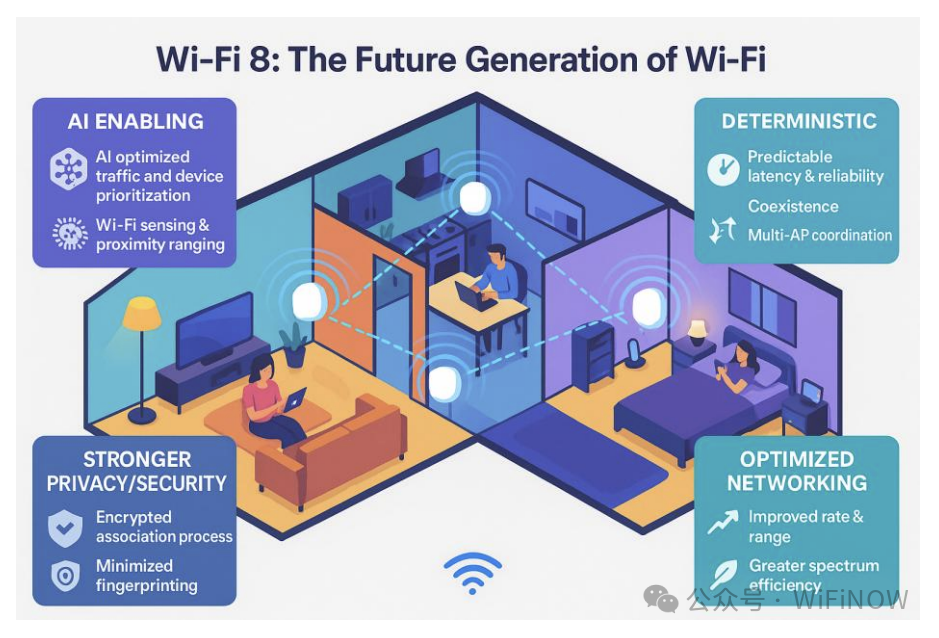
Wi-Fi 8 has become a hot topic today. Regardless of your opinion on the rush by some to adopt Wi-Fi 8, now may be the perfect time to gain a deeper understanding of Wi-Fi 8. Intel recently released a comprehensive and easy-to-understand white paper outlining its vision for the future of Wi-Fi 8 technology.
Before delving into Wi-Fi 8, it is important to clarify one point: although some manufacturers are racing to bring Wi-Fi 8 technology to market, actual certification of Wi-Fi 8 products is not expected to be completed until late 2027 or early 2028 at the earliest, which means that Wi-Fi 8 will take a few more years to become truly widespread. This aligns with the 4-5 year cycle of Wi-Fi technology upgrades. Of course, this does not mean that Wi-Fi technology vendors like Intel are not fully committed to advancing the development of the new standard.
Indeed! — The Wi-Fi white paper recently released by Intel proves this point. The white paper reflects the consensus reached on the IEEE 802.11bn draft version 1.0 (strictly speaking, according to IEEE rules, it is still referred to as P802.11bn since it has not yet been officially approved). The author of the white paper is Carlos Cordeiro, an Intel researcher and Chief Wireless Technology Officer of the Client Computing Group, who stated that progress has been excellent, but there is still much work to be done.
“Within the IEEE 802.11 working group, we have received nearly 9,000 comments on the first draft. This sounds like a lot, and it is indeed a lot, but it is normal at this stage of the process. It is an exciting process because we firmly believe that Wi-Fi 8 will be — as we envision it — extremely reliable,” said Carlos Cordeiro.

Above: The author of Intel’s new Wi-Fi 8 white paper, Carlos Cordeiro, Intel researcher and Chief Wireless Technology Officer of the Client Computing Group.
All content has been elaborated in the white paper, but essentially, the value propositions of Wi-Fi 8 include optimized network performance, determinism, enhanced security/privacy protection, and of course, AI empowerment. As work progresses and the standards mature, we look forward to bringing more updates on Wi-Fi 8.
Follow the Wi-Fi NOW public account for updates on global
Wi-Fi industry news and analysis