The antenna serves a dual function of transmitting and receiving signals in wireless access points (AP) and terminal devices. When a device transmits data, the antenna receives the oscillating carrier signal from the transmitter and radiates or directs the radio frequency waves outward. When a device receives data, the antenna captures the radio frequency signals and directs the oscillating carrier to the receiver.
Antenna Types
Antenna types are mainly divided into two categories: Omni-directional Antennas and Directional Antennas.
-
Omni-directional Antennas: “Omni” means “all” or “in all directions or places.” Omni-directional antennas radiate energy in all directions, and their energy radiation pattern is typically elliptical or “flattened spherical”.
-
Directional Antennas: Directional antennas concentrate more energy in a single direction, resulting in reduced energy in all other directions. Such antennas may also be referred to as “sectional” or “sector” antennas.
Radiation Pattern Interpretation
To better understand the coverage area of antennas, vendors typically provide antenna radiation pattern diagrams:
-
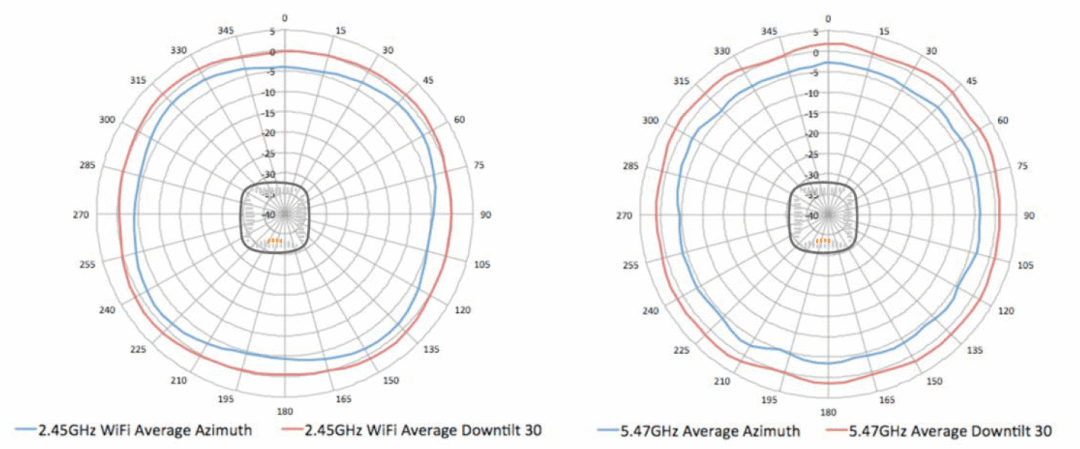
Horizontal Plane (H-plane / Azimuth): This is a top-down view of the antenna radiation pattern, describing the antenna’s coverage in the horizontal direction.
-
Vertical Plane (E-plane / Elevation): This is a side view of the antenna radiation pattern.
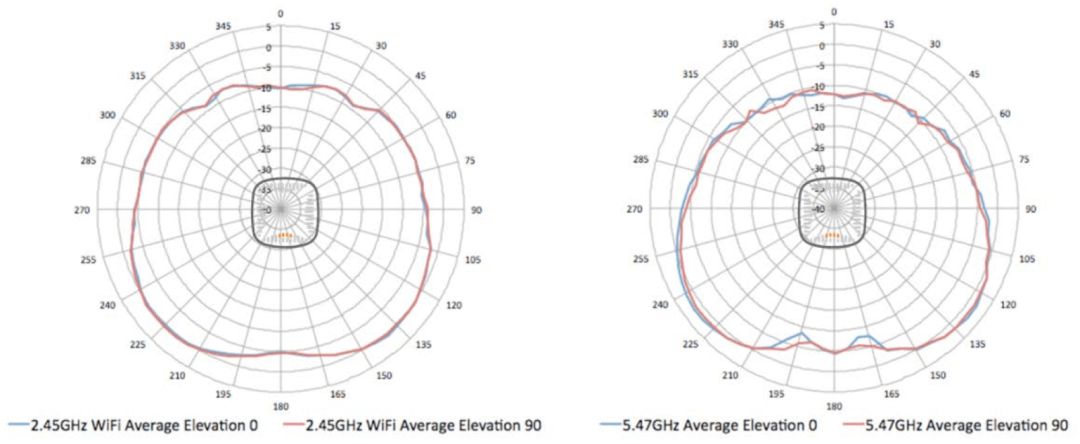
Combining the horizontal and vertical plane diagrams can provide a three-dimensional concept of the expected coverage area. It is important to note that physical obstacles and radio frequency interference may alter the actual radiation pattern in specific spaces.
Passive Antenna Gain
An antenna is a passive device that does not draw power from the AP or other sources, so it does not “amplify signal power.” However, antennas can concentrate energy by shaping the radiation pattern of the signal.
-
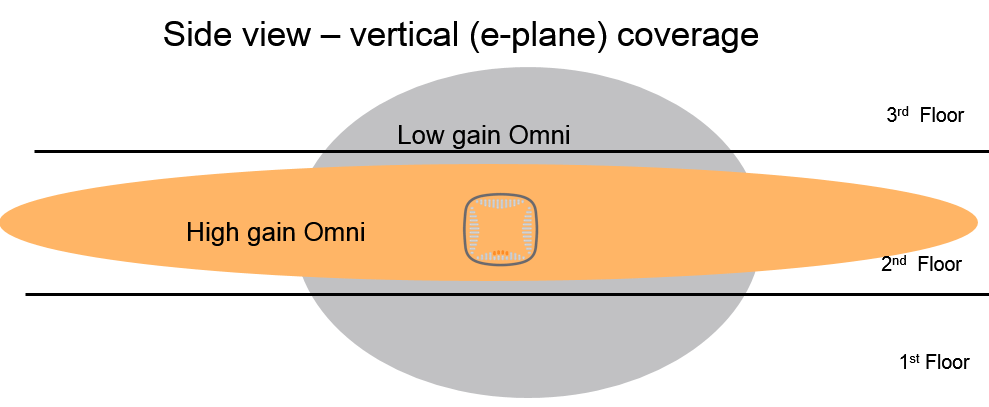
Low Gain Omni-directional Antennas: In the E-plane (vertical plane), low gain antennas radiate energy uniformly in all directions, with emitted energy being roughly the same in all directions.
-
High Gain Omni-directional Antennas: These antennas are designed to direct more power horizontally to cover a larger floor space. This comes at the expense of vertical coverage, resulting in reduced energy radiation in the E-plane (vertical plane) and smaller vertical space coverage.
-
H-plane Coverage: Omni-directional antennas have a 360-degree circular coverage pattern in open spaces or on floors. High gain omni-directional antennas cover a larger area from above.
-
Equivalent Isotropic Gain: Antenna gain is measured in dBi (decibels relative to an isotropic antenna).
AP/Antenna Installation Options
There are three common installation methods for APs with integrated antennas:
1. Ceiling Mount: This is a common installation method in medium-density deployments (e.g., typical offices). APs are usually flush-mounted or parallel to the ceiling.
2. Side Mount: APs are mounted on walls, beams, or columns. This is a less common method because human bodies absorb radio frequency energy, and variations in user density can significantly affect coverage.
3. Floor Mount: APs are installed on or below the floor of the coverage area. This is occasionally used in ultra-high-density deployments such as stadiums.
Evolution of RF Technology: SISO to MIMO
Single Input Single Output (SISO)
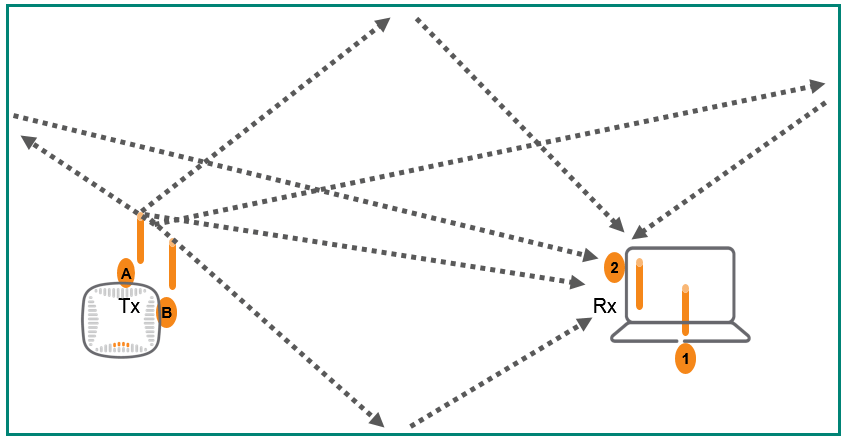
Traditional WLAN (based on 802.11a/b/g) uses Single Input Single Output (SISO) radio technology. Only one antenna transmits or receives at a time. Terminal devices receive signals on multiple antennas, but the radio only selects the best signal for processing, discarding the others. This concept of selecting the best signal is known as antenna diversity, primarily aimed at mitigating multipath distortion issues.
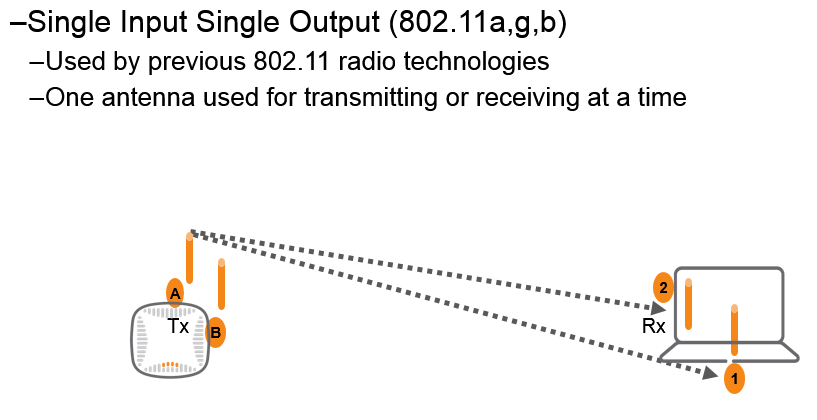
Multipath Propagation Scenario: Multipath distortion occurs when signals propagate along multiple paths. For example, some signals may bounce off metallic objects (like iron pipes or metal tables), causing that signal to arrive at the antenna a few microseconds later than the direct signal, resulting in signal distortion. When the AP detects multipath distortion, it uses another antenna to receive the signal to mitigate the distortion.
Multiple Input Multiple Output (MIMO)
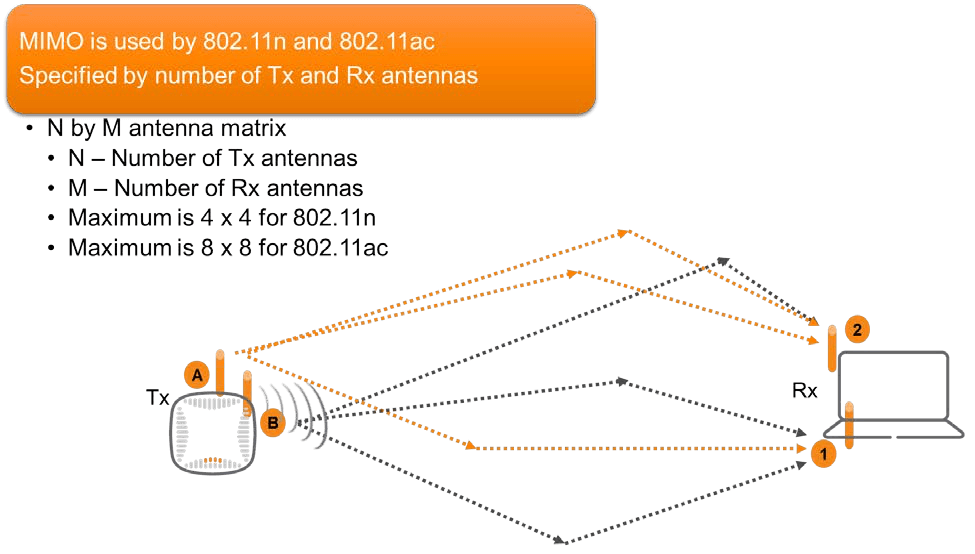
802.11n and 802.11ac utilize Multiple Input Multiple Output (MIMO) technology to turn the multipath propagation challenges faced by SISO into advantages.
-
MIMO uses multiple antennas to simultaneously transmit and receive multiple data streams. These “spatial streams” significantly increase throughput compared to traditional SISO technology.
-
The specifications of MIMO devices are typically represented using an “N x M” matrix, for example, “2 x 2” MIMO indicates the use of two transmitting antennas and two receiving antennas.
Multi-User MIMO (MU-MIMO)
Multi-User MIMO (MU-MIMO), introduced in 802.11ac Wave 2, is a significant improvement that breaks the previous limitation of WLAN technology where only one device could transmit at a time. MU-MIMO allows different user data to simultaneously traverse up to eight paths through different spatial streams. Multiple Wi-Fi clients can now share larger data streams and antenna pools.