The era is advancing, and voice modules are also being updated. Whether it is the pursuit of product quality or the increasing demands of consumers for product experience, the research and development technology of voice modules has been continuously progressing. Depending on different fields, the functions and research directions of voice modules vary, and their quality is also uneven.
To stand out among numerous products, technology is key.
LoRa wireless technology is a long-range wireless transmission technology based on spread spectrum technology, and is one of many LPWAN communication technologies, providing users with a simple means of achieving long-distance, low-power wireless communication. LoRa technology is based on linear frequency modulation spread spectrum, maintaining low power characteristics while significantly increasing communication distance, and integrates digital spread spectrum, digital signal processing, and forward error correction coding technologies, achieving unprecedented performance.
The voice module adopts LoRa wireless technology, featuring higher sensitivity, stronger anti-interference, longer standby time, and longer transmission distance.
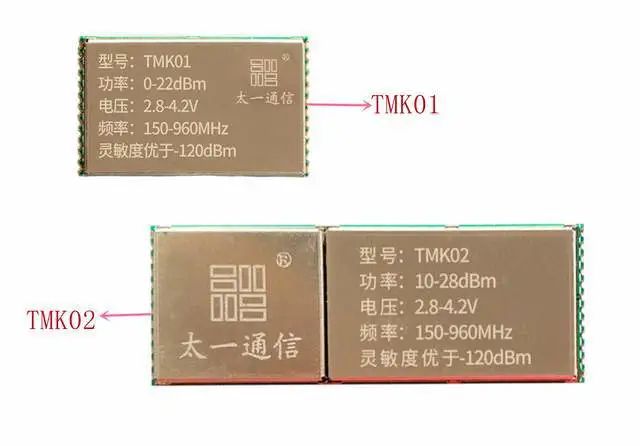
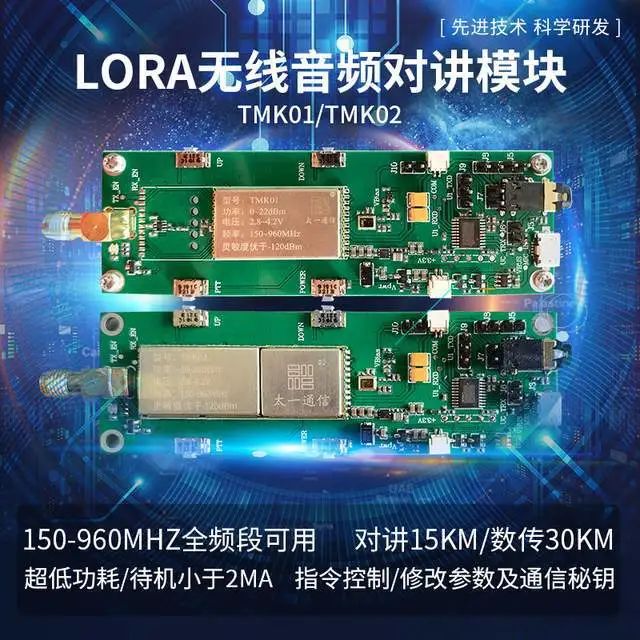
Currently, among the voice modules using LoRa wireless technology, Taiyi Communication’s digital LoRa wireless voice modules perform well, including TMK01 and TMK02, which utilize a new spread spectrum technology, with small size, longer transmission distance, and lower power consumption.
The module uses a digital format to digitally encrypt voice transmission, resulting in clearer calls compared to traditional analog formats, making it suitable for high-end walkie-talkie development.
In walkie-talkies, according to technical classification, they can be divided into digital walkie-talkies and analog walkie-talkies. In terms of performance, digital walkie-talkies outperform analog ones, not only providing clearer sound quality but also having strong anti-interference capabilities, preventing frequency interference and eavesdropping, ensuring information security.
Therefore, the walkie-talkie developed using TMK01 has stronger functions.
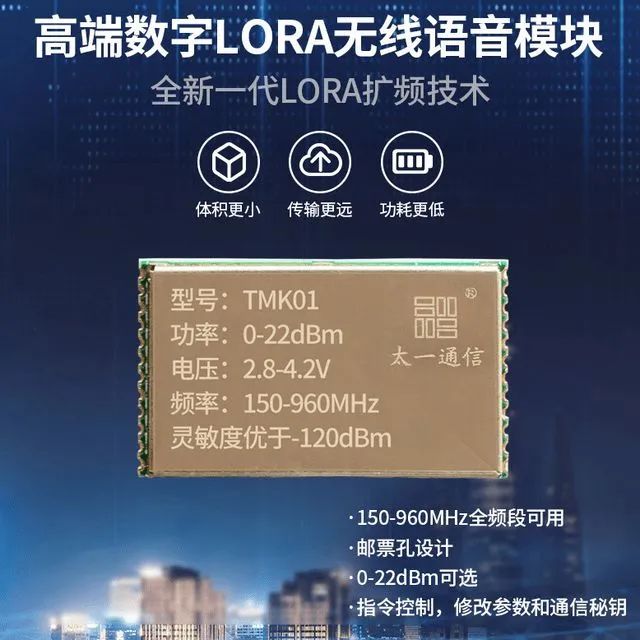
The module supports low-power standby mode and sleep mode, with a working voltage of 2.8V—4.2V. The transmission power of TMK01 is 0—22dBm, and TMK02 is 10-28dBm, with ultra-low standby mode power consumption of less than 2mA and sleep mode working current of less than 1mA, ensuring that the walkie-talkie developed is of low power design, safe, and environmentally friendly.
TMK01 is a basic model, with separate transmit and receive, transmit and receive control output, allowing users to add low-noise amplification and power amplifiers themselves, and use the output transmit and receive control signals to achieve synchronous low-power operation of the whole machine. TMK02 is a complete model that connects directly to the antenna and external control buttons to realize all functions.
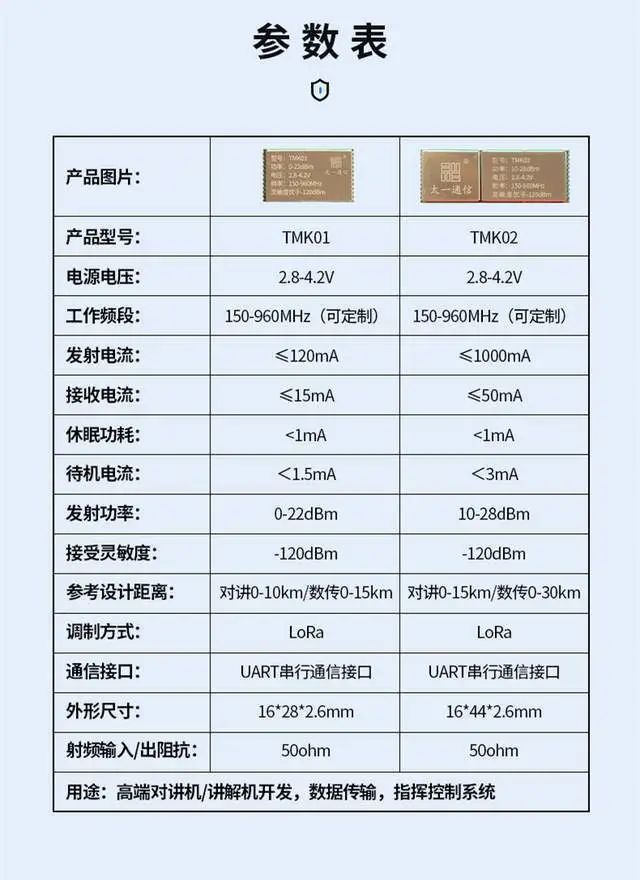
The walkie-talkies developed using TMK01 and TMK02 modules are not only high-end but also feature-rich. The Tooone micro digital walkie-talkie independently developed by Taiyi Communication has achieved miniaturization of digital walkie-talkies.
In addition to high-end walkie-talkie development, TMK01 and TMK02 can also be used for high-end walkie-talkie development, data transmission, and secondary development of command and control systems, with clear sound quality and high information security, making them worth using.

 ● Drone + Satellite! High-tech ensures communication recovery in disaster areas and secures lifelines● AR500 Drone Floating Communication Relay Platform: Overcoming the “Last Mile” Communication Challenge in Fire Scenes● Another “Aerial Base Station” passes preliminary acceptance; what is the future of aerial base stations?● Understand the difference between police walkie-talkies and civilian walkie-talkies in 1 minute