

Since 2018, Professor Chu Baojin’s team at the University of Science and Technology of China has been conducting research on artificial vision systems with the support of a special project from the Ministry of Science and Technology. The aim is to develop a new generation of materials that can replace retinal functions to restore vision for the blind and improve the quality of life for patients suffering from retinal diseases. The research team introduced light-responsive materials, enabling ferroelectric polymer materials to respond to visible light and achieve excellent optoelectronic response performance. Further animal experiments showed that when these materials, which possess good flexibility and excellent optoelectronic response, were implanted into blind mice, the light sensitivity of the blind mice could be restored, indicating a promising application of these materials in biomedical fields.

Figure | Chu Baojin (Source: Chu Baojin)
In the aforementioned research, it was found that the materials exhibited significant photodielectric phenomena (i.e., changes in the dielectric constant of the material caused by light exposure). In subsequent studies, they discovered that the photodielectric phenomenon also existed in samples without added light-responsive materials. Further research revealed that before measuring the electrical properties of the materials, gold electrodes sputtered on the surface of the ferroelectric polymer exhibited a strong photothermal effect. This is an interesting phenomenon because previous studies have mainly reported the photothermal effects of gold nanoparticles, while the gold electrodes used in the research team’s tests were approximately 30 nanometers thick films.
In recent years, research on pyroelectric energy harvesting devices has gained attention, with potential applications in wearable devices, wireless sensors, and smart electronic skin. Based on the aforementioned research, the team considered whether ferroelectric polymers with gold electrodes could be studied as pyroelectric energy harvesting devices.
They speculated that this device has the following advantages compared to traditional pyroelectric devices:
Firstly, the structure of the device is very simple, consisting only of polymer materials and electrodes, with the gold electrode serving both conductive and photothermal conversion functions.
Secondly, traditional pyroelectric devices require periodic contact with a heat source and a cold end to achieve pyroelectric energy conversion, a relatively slow process that leads to slow energy release. To increase the released energy, a relatively high electric field is usually applied to the pyroelectric device, but the slow thermal cycling process reduces the reliability of the pyroelectric materials under breakdown electric fields and breakdown devices, resulting in lower energy density. The research team’s photothermal-pyroelectric device can solve these problems, as the rapid photothermal conversion speed and effective thermal conduction between the gold electrode and the polymer can accelerate the thermal cycling process while increasing energy density and power density.
Thirdly, traditional pyroelectric devices respond to infrared light, while the photothermal-pyroelectric device developed by the research team can extend the response spectrum range to visible light, making it very beneficial for remote power applications.
In addition to the above advantages, using dielectric materials is currently a “popular practice” in the field when developing high energy density capacitors. Therefore, the research team considered whether they could utilize the strong photodielectric effect of the materials to regulate the energy density and enhance the energy release of dielectric materials through the pyroelectric effect. Based on the above research background and considerations, they initiated a project.
In this study, they used gold electrodes as photothermal media, leveraging the strong pyroelectric effect of poly(vinylidene fluoride) (PVDF) based ferroelectric polymers, combined with specially designed charge-discharge circuits and thermodynamic cycles, to achieve efficient photothermal-pyroelectric energy harvesting in samples with a simple structure of Au/P(VDF-TrFE)/Au.
The main innovations of this research include:
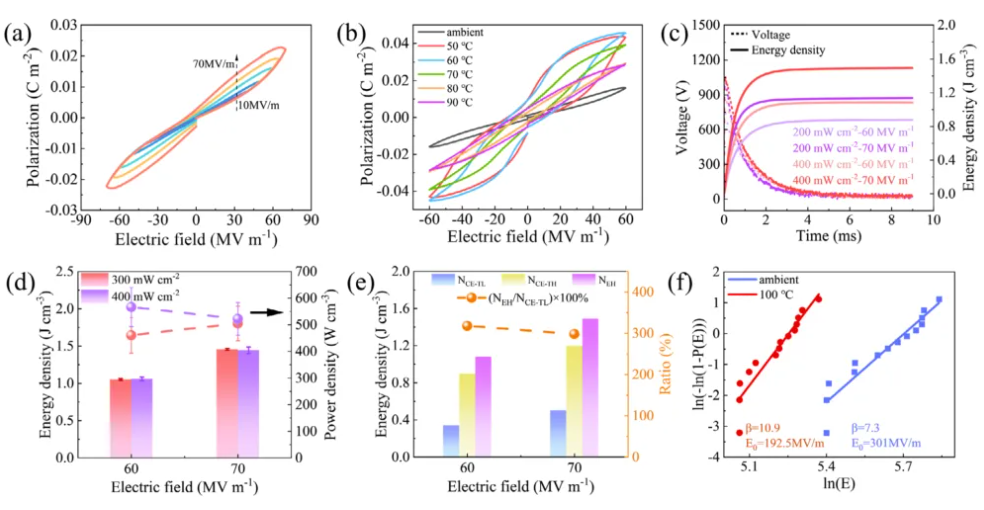
Firstly, the simultaneous achievement of high energy density and high power density. Thanks to the strong photothermal effect of the gold electrode and the ultra-fast discharge rate brought by the circuit design, the energy density of this harvester reached up to 4.75 J/cm³, and the power density reached 1711.9 W/cm³, both surpassing the current reported maximum values for pyroelectric devices (it should be noted that the values of 4.43 J/cm³ and 526 W/cm³ come from two separate works, not obtained in the same device), while also achieving the highest energy conversion efficiency reported to date.
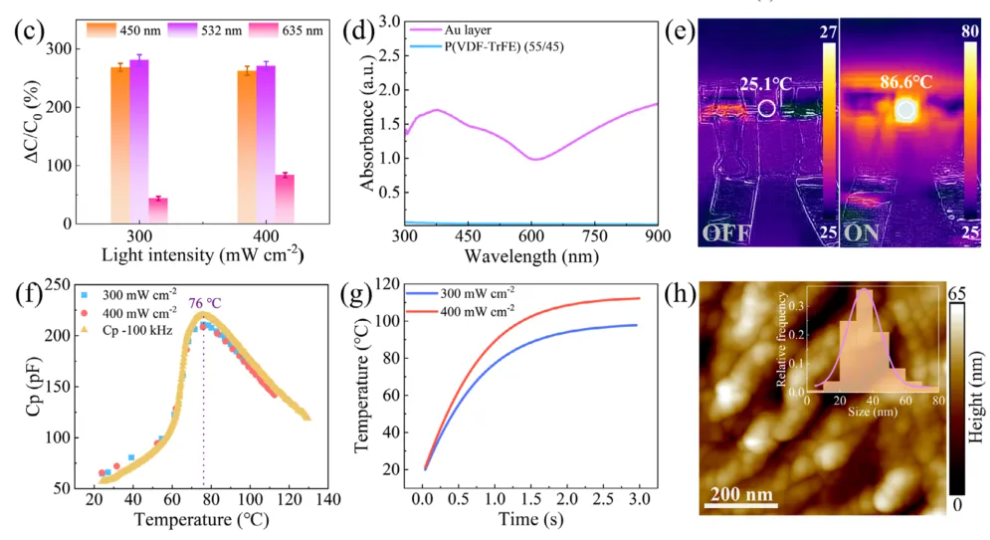
Secondly, a significant photodielectric effect was observed. A strong photodielectric effect was found in polymer films with gold electrodes, with a capacitance change rate of up to 281% under light exposure.
Thirdly, the combination of pyroelectric energy harvesting and dielectric energy storage can be achieved in a single material. Traditional pyroelectric devices have low discharge power density due to slow thermal cycling processes, which cannot match the high power required in capacitor applications. The proposed pyroelectric device has a high energy release rate, and its power density can rival that of capacitors while also having high energy density. Therefore, the photothermal-pyroelectric harvester proposed in this study resolves the incompatibility between dielectric energy storage and pyroelectric energy harvesting. The research team’s results indicate that the combination allows ferroelectric polymers to achieve a discharge energy density 1.5 times that of polypropylene polymer films (a dielectric material widely used in commercial film capacitors) at 1/4 of the electric field. This indicates that the device can not only function as a pyroelectric device but also operate as a capacitor, increasing energy density by over 250% solely through light exposure. Additionally, for capacitor applications, heat is generally considered a negative factor. The research team pointed out that if ferroelectric materials are used as dielectric materials for capacitors, with appropriate design, heat can serve as a beneficial factor to enhance energy density.
Finally, the research team discovered the strong photothermal effect of gold electrodes and further found that similar photothermal effects exist in other metal electrodes. Electrodes, as conductive materials, are an essential part of some devices, and this discovery can provide new ideas for designing new functional devices and understanding certain physical phenomena.
In terms of basic research, the research team distinguished the contributions of different physical processes in the pyroelectric energy harvesting process, leading to a deeper understanding of pyroelectric energy recovery.
The potential application areas of this achievement include:as energy harvesting devices and optoelectronic sensors for microelectronics and wearable devices, IoT and industrial sensor networks, implantable medical devices, micro robots, etc.; in addition, it is expected to be applied in high energy density capacitors, playing a role in power grids and electric vehicles.
(Source: https://advanced.onlinelibrary.wiley.com/doi/10.1002/adma.202502803)
Regarding the specific research process:
First, the research team discovered that the P(VDF-TrFE) ferroelectric polymer with gold electrodes exhibited a strong photodielectric effect during their research on artificial retinas, which sparked their strong curiosity. They then explored the specific manifestations and corresponding mechanisms of the photodielectric effect, discovering significant photothermal conversion generated by the gold electrodes, and that the speed of photothermal conversion was very fast.
Next, the research team considered whether they could utilize the thermal effect of the gold electrodes under light exposure and the pyroelectric effect of ferroelectric polymers to achieve pyroelectric energy harvesting; on the other hand, they also considered whether they could use the photodielectric effect to regulate the discharge energy density of ferroelectric polymers when used as capacitors. To verify this idea, the research team measured the hysteresis loops of the copolymer under light conditions (a method for measuring the polarization response of ferroelectric materials) and found that it was indeed possible to transform the hysteresis loop representing the ferroelectric phase into a thinner one representing the paraelectric phase, preliminarily validating the feasibility of the research team’s idea.
With preliminary results in hand, accurately measuring the energy released under light exposure became a new challenge. After various attempts, they ultimately used the circuit used in dielectric material research to measure the discharge energy density and power density of the samples, and verified the feasibility of the measurement method through extensive experiments. Based on this, the research team conducted a systematic study of the energy density of ferroelectric polymers under different conditions.
Subsequently, they began to consider how to further increase the discharge energy density. By optimizing material preparation conditions, light power density, and light exposure time, the research team achieved an energy density of 4.75 J/cm³ and a power density of 1711.9 W/cm³.
During the research process, they encountered numerous problems and challenges, such as what mechanisms produce the significant photodielectric phenomenon, how to measure energy release under light exposure, and how to accurately measure the temperature of materials under light exposure. Many times, there were no precedents to follow, and solving these problems often involved repeated attempts and experimental validation. For example, accurate temperature measurement is crucial for a deeper understanding of the photothermal-pyroelectric effect, but due to the presence of gold electrodes on the sample surface, the emissivity of gold is very low and varies with temperature, making it impossible to accurately measure the temperature changes of the sample over time using infrared thermography (a device commonly used for temperature measurement in previous studies).
Direct contact temperature measurement methods used in previous studies (such as thermocouples) also had certain issues: firstly, the polymer film is very soft and does not make good contact with the probe; secondly, light exposure on the temperature measurement probe can cause temperature changes in the probe itself, leading to inaccurate measurements. Therefore, accurately measuring the sample temperature troubled them for a long time. Later, after determining the photodielectric mechanism, considering the dielectric performance of ferroelectric polymers with temperature changes, the research team thought of using the capacitance change of the sample under light exposure to calibrate the temperature, and further research indicated that this method was reliable. “We would like to thank the funding from the Ministry of Science and Technology’s key research and development program and the hard work of the graduate students involved in this project. In particular, the first author of the paper, Zhu Yuhong, overcame various difficulties to successfully complete this work,” said Chu Baojin to DeepTech.
(Source: https://advanced.onlinelibrary.wiley.com/doi/10.1002/adma.202502803)
In the future, the research team will work on the following two aspects: in terms of materials, they will conduct further optimization research on electrode materials and ferroelectric polymer materials to enhance the materials’ response to the full spectrum and their photonic-electrical energy conversion capabilities; in terms of applications, they will utilize the optoelectronic response properties of these materials to conduct research on energy harvesting devices, dielectric energy storage, and optoelectronic sensors.
References:
https://advanced.onlinelibrary.wiley.com/doi/10.1002/adma.202502803
Operation/Layout: He Chenlong


 01/Scientists Solve X-ray Endoscopic Imaging Problem, Develop 1600-Pixel Fiber Optic Array Detector to Penetrate Human Body for Real-Time Tumor Observation02/New Selection of “35 Innovators Under 35” in the Asia-Pacific Region Announced03/Breaking Through the Static Limitations of Implantable Electrodes: Scientists Develop “Neuro Worm” to Achieve Intracranial Electrode Wandering Mode04/Jensen Huang Visits the UK with Trump: $2.6 Billion Bet on UK AI, Self-Driving Company Wayve May Receive $500 Million Boost05/AI Remotely Operates Artificial Insemination, US Startup Has Facilitated the Birth of the First AI Test Tube Baby