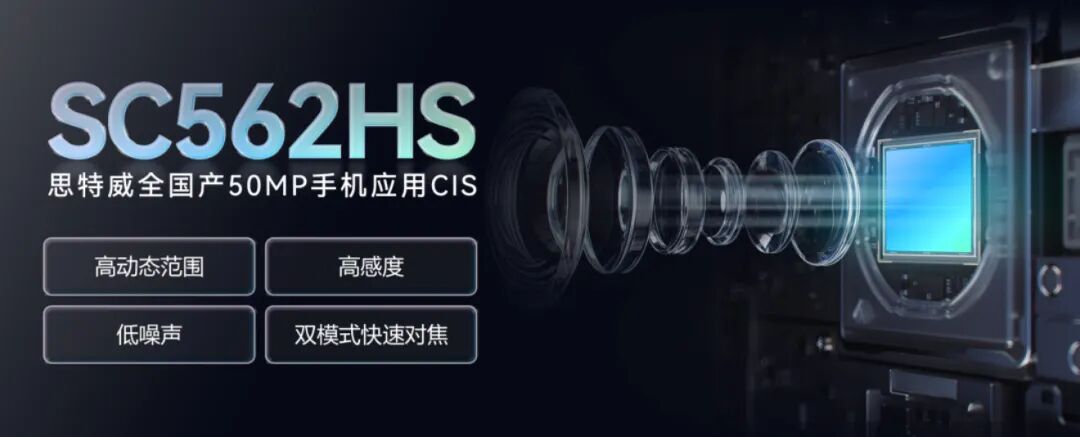
A new “domestic heart” has emerged in the field of mobile photography, as SmartSens officially launches the SC562HS sensor, boasting an 88dB high dynamic range and multiple innovative technologies, targeting the mainstream smartphone market.
Recently, domestic CMOS image sensor manufacturer SmartSens has officially released its next-generation 50-megapixel mobile CMOS image sensor—SC562HS. This new product, based on the SmartClarity-XL technology platform, is expected to enter mass production in the fourth quarter of 2025.
The sensor utilizes advanced 55-nanometer Stacked BSI process technology and incorporates SmartSens’ patented core technologies such as PixGain HDR, SFCPixel, and AllPix ADAF.
01 Outstanding Performance
The SC562HS features a large 1/1.55-inch sensor size with a 1μm pixel size. Its 50-megapixel design balances imaging quality with sensor size, making it suitable for the main camera configuration of mainstream smartphones.
Its sensitivity reaches 4033mV/lux*s, significantly higher than industry counterparts of the same specifications. The read noise is less than 1e-, approximately 56.7% lower than competing products of similar specifications.
This means that in low-light environments such as dusk and nighttime, the SC562HS can significantly enhance the camera’s imaging quality, ensuring clear, detailed, and clean night scene photography.
02 High Dynamic Range
The PixGain HDR technology equipped in the SC562HS allows for a maximum dynamic range of 88dB. This specification is close to that of some flagship sensors, enabling mainstream smartphones to achieve high dynamic range video recording capabilities comparable to high-end flagship phones.
In PixGain HDR mode, the SC562HS utilizes single-exposure dual-frame fusion technology to help the camera capture clearer details in dark areas, achieving high dynamic video recording effects with rich light and shadow layers and no motion artifacts.
03 Energy Efficiency and Heat Dissipation
The on-chip dual-frame fusion technology of the SC562HS not only enhances image quality but also reduces the computational power requirements for high dynamic range video recording on smartphone SoCs.
This design helps to reduce the power consumption of the smartphone SoC, alleviating device heating during recording, thus ensuring stable high-definition video recording over extended periods. This is a significant improvement for users who enjoy shooting vlogs and long videos.
04 Dual-Mode Focusing
The SC562HS supports two focusing modes: AllPix ADAF and Sparse PDAF, catering to high-speed focusing needs under different lighting conditions.
In low-light conditions, the SC562HS can utilize the AllPix ADAF mode, achieving accurate and fast focusing in dark scenes through 100% full-pixel focusing, meeting the demands for high-speed night shooting.
Under normal lighting conditions, the SC562HS can use Sparse PDAF, achieving fast focusing while reducing operational power consumption through 6% pixel phase detection.
05 Market Prospects
The SC562HS is an expansion of SmartSens’ domestic high-performance Stacked BSI series, ensuring excellent imaging performance while considering cost advantages.
This sensor is positioned for the mid-to-high-end smartphone main camera market, with its core advantage being the ability to achieve flagship-level imaging performance at a lower cost, particularly suitable for domestic smartphone manufacturers looking to enhance imaging competitiveness in the 2000-3000 yuan price range.
The SC562HS is currently accepting samples and is expected to enter mass production in the fourth quarter of 2025. Industry analysts point out that the mass production of the SC562HS will accelerate the popularization of domestic high-end CMOS.
The SC562HS can be combined with SmartSens’ other mobile CIS products, SC532HS and SC130HS, to form a complete mobile camera CIS solution, covering multi-camera configurations from ultra-wide angle to telephoto.
The launch of this sensor not only showcases China’s R&D strength in the high-end imaging sensor field but is also expected to drive the transformation of smartphone imaging technology from “hardware stacking” to “algorithm + sensor collaborative optimization.”