Industrial robots are widely used in the industrial field as multi-joint mechanical arms or multi-degree-of-freedom machines, possessing a certain level of automation. They can rely on their own power sources and control capabilities to perform various industrial processing and manufacturing functions. Industrial robots are extensively applied in various industrial sectors such as electronics, logistics, and chemicals.
01
Composition of Industrial Robots
Industrial robots mainly consist of three basic parts: the main body, the drive system, and the control system.
The main body — which includes the base and the actuators — comprises the arm, wrist, and hand, with some robots also featuring a walking mechanism. Most industrial robots have 3 to 6 degrees of freedom, with the wrist typically having 1 to 3 degrees of freedom;
The drive system — which includes the power unit and the transmission mechanism, centered around the reducer and servo motor, is responsible for enabling the actuators to perform corresponding movements;
The control system — issues command signals to the drive system and actuators based on the input program and performs control.
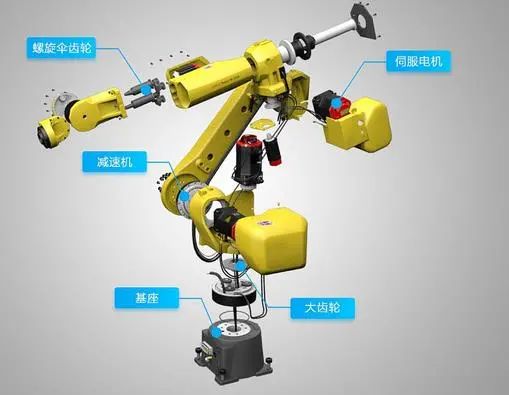 Disassembly diagram of an industrial robot
02
Classification of Industrial Robots
Regarding the classification of industrial robots, there is no unified international standard; they can be categorized based on load capacity, control methods, degrees of freedom, structure, and application fields.
Classification by structural form is as follows: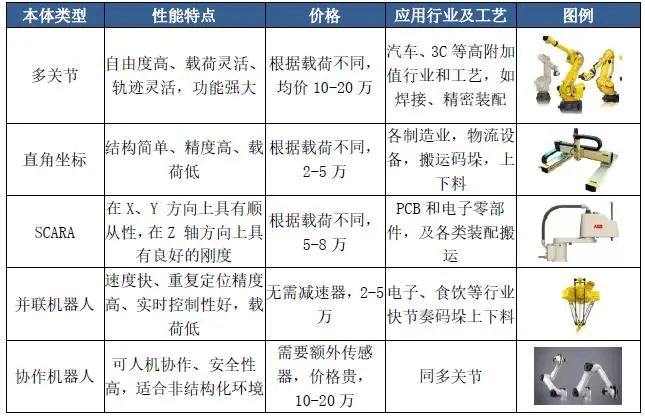 Classification by application is as follows: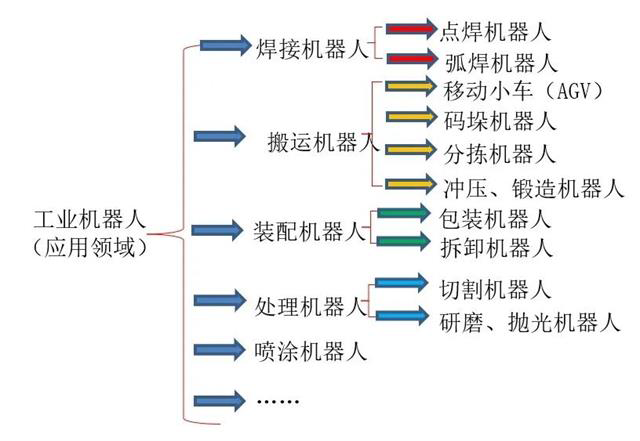
03
Industrial Robot Industry Chain
The industrial robot industry chain mainly consists of robot component manufacturing companies, robot body manufacturers, agents, system integrators, and end users. The body is the core of the robot industry chain. Typically, the body enterprises design the body, write software, and procure through agents to sell to system integrators, who directly face the end customers. Some body companies and agents may also act as system integrators.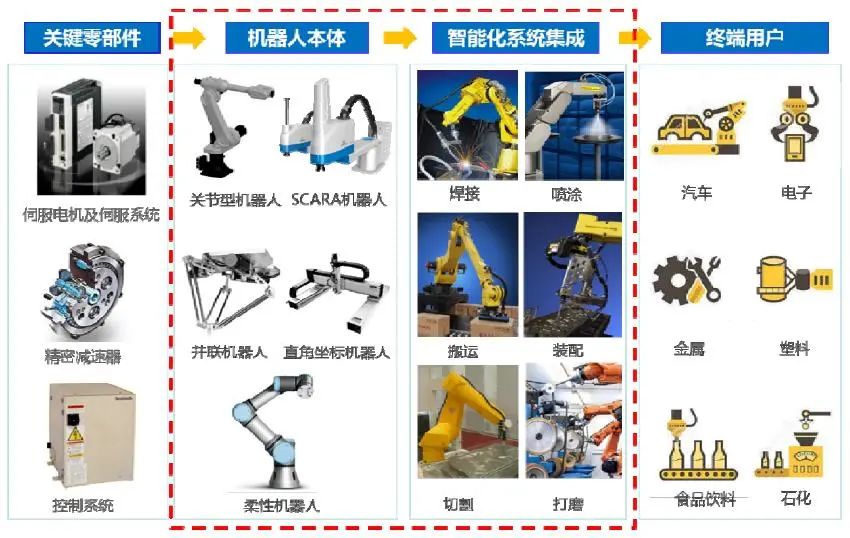 From the perspective of companies, ABB, FANUC, KUKA, and YASKAWA are the four major families of industrial robots, becoming the world’s main suppliers of industrial robots, accounting for approximately 50% of the global market share.
04
Working Principles of Industrial Robots
The working principle of robots is a relatively complex issue. Simply put, the principle of robots is to imitate various human limb movements, thinking patterns, and decision-making abilities. From a control perspective, robots can achieve this goal through the following four methods.
“Teaching-Replay” method: It teaches the mechanical arm how to move through either a “teaching box” or a “hand-in-hand” method. The controller memorizes the teaching process, and then the robot repeatedly performs the taught movements according to memory, such as in spray painting robots.
“Programmable Control” method: Operators prepare control programs in advance based on the robot’s work tasks and motion trajectories, then input the control program into the robot’s controller. Once the control program is activated, the robot completes the actions step by step as specified in the program. If the task changes, it is very flexible and convenient to modify or rewrite the control program. Most industrial robots operate according to the first two methods.
“Remote Control” method: The robot is controlled by a person using a wired or wireless remote control to complete tasks in places that are difficult or dangerous for humans to reach, such as bomb disposal robots, military robots, and those working in environments with nuclear radiation and chemical contamination.
“Autonomous Control” method: This is the highest and most complex control method in robotics, requiring the robot to have the ability to recognize the environment and make autonomous decisions in complex unstructured environments, similar to certain intelligent behaviors of humans.
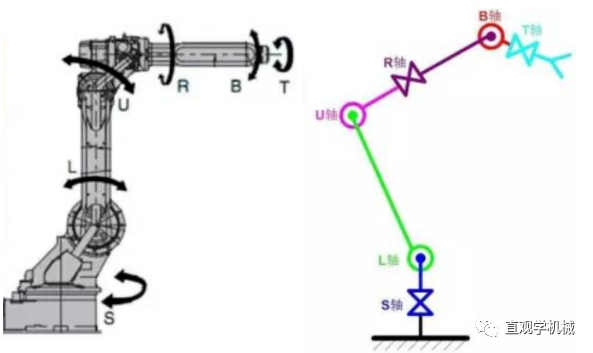
Taking a six-axis vertical multi-joint robot as an example (as shown below), through the robot controller and its control system, the S-axis rotation, L-axis lower arm tilt, U-axis upper arm tilt, R-axis arm swing, B-axis wrist pitch, and T-axis wrist rotation can be achieved, enabling the operation and coordination of the six axes.
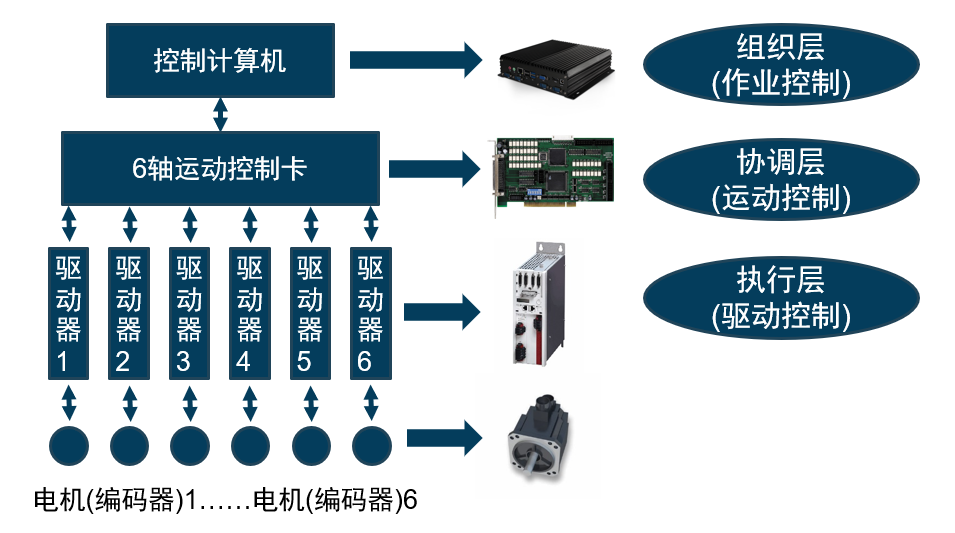
 If a centralized control system is used, the control principle will be as shown below:
 However, if a distributed control system is adopted, the control principle will be as shown below: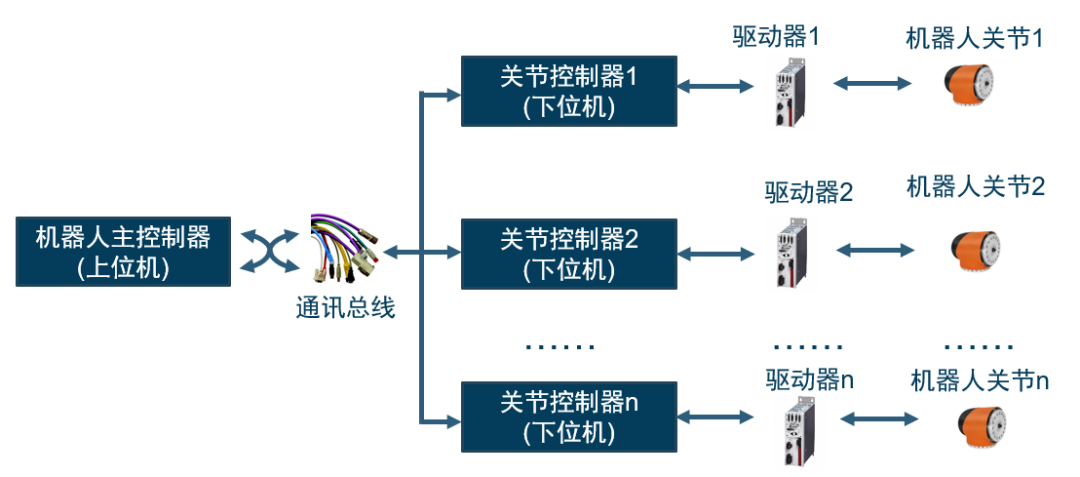
05
Challenges Faced by Industrial Robot Manufacturers
With the continuous upgrading of the industrial manufacturing industry and the emergence of various new technologies, robot manufacturers must also consider the usage needs of their end users during the production process. For example, upgrading and transforming some factories and production lines, robot manufacturers also need to adapt to market changes and make corresponding adjustments.

Source: Industrial Robots

Editor ▎Wang Yan
Reviewer ▎Yu Yongchu
Advertising Cooperation ▎ (WeChat same number)18240442679 Mr. Fu
Gold Powder Mall Popular Book Rankings
☞ Gold Powder Favorite Book Rankings
☞ Mechanical Book Rankings
☞ Production Management Rankings
☞ Design Software Rankings

- “Automotive Process Engineer” First Youth Editorial Board List
-
Summary of BYD New Energy Vehicle “Self-Supply + External Supply” Core Suppliers
- Comprehensive Analysis of CATL Production Line, Not Missing Any Process!
- Domestic Solid-State Battery and Process Patents
- Large Automotive Supply Chain Behind Many Domestic Car Companies, Recommended to Collect!
- 2023 Global Top 100 Automotive Parts Suppliers List
- Automotive Knowledge Encyclopedia, One Article Covers It All, Must Collect!
- Germany Continental 8D Problem Solving Training Materials
- BMW Supplier Training Materials
- Detailed Explanation of New Energy Vehicle Three Electric Systems
- Necessity and Goals of Digital Factory Construction for New Energy Batteries
- 5G Empowerment Recommended by Ren Zhengfei, Already Published! This PPT Lets You Know Everything.
- Great Wall Xushui Intelligent Factory: 286 Robots Create Luxury and Safety for VV5s

For submissions, please click the image above