[Introduction to Large Model Industry Applications Series] NO.9
[Abstract] Single-task training often overlooks valuable information hidden in related tasks. The emergence of Multi-Task Learning (MTL) provides a new approach to this problem.Author Li Jie, focused on exploring and researching Java Virtual Machine technology and cloud-native technologies.
*This article is the 9th in the [Introduction to Large Model Industry Applications Series]. To learn about this series and read the articles, please see the end of this article, and feel free to follow.
In the field of Machine Learning (ML), we typically focus on optimizing for specific metrics, whether it is a specific benchmark score or a business Key Performance Indicator (KPI). To achieve this goal, we usually train one or a set of models to perform specific tasks. Then, we fine-tune and adjust these models until their performance reaches a satisfactory level. However, this single-task training approach often overlooks valuable information hidden in related tasks, which could help us achieve better results on the metrics we care about.
The emergence of Multi-Task Learning (MTL) provides a new approach to this problem. MTL aims to mine common information between tasks by allowing the model to learn multiple related tasks and apply it to the learning process of the original task. By sharing representations among related tasks, MTL can enable the model to better generalize to the original task, thereby improving the model’s performance on specific metrics.
1. What is Multi-Task Learning?
Multi-Task Learning (MTL) is a widely used method in the field of machine learning that simultaneously trains models to handle multiple related tasks through Shared Representation. The core idea is that by sharing information and patterns, multiple tasks can be learned in parallel, thereby improving model performance on each task.
In Multi-Task Learning, the model is designed to handle inputs and outputs for multiple tasks. By sharing underlying representation learning, the model can effectively transfer information and patterns learned from one task to other related tasks. This characteristic of shared representation allows the model to better capture commonalities and relationships between tasks, thus enhancing overall performance.
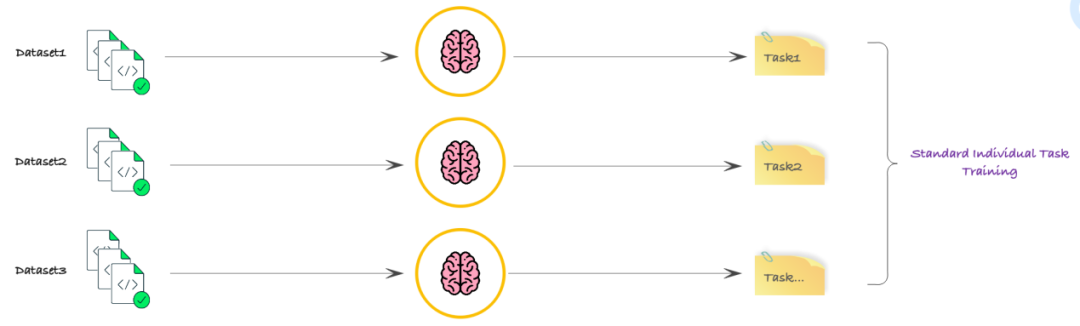
Standard Individual Task Training Reference Diagram
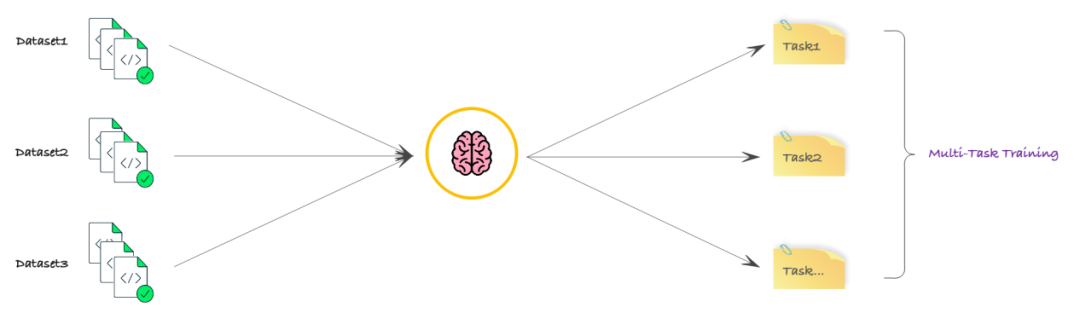
Multi-Task Training Reference Diagram
Multi-Task Learning can be seen as a broadly applied machine learning method, as described in a common definition proposed by Rich Caruana in his paper, which characterizes it as a method of “inductive transfer.” This method improves the model’s generalization ability by leveraging domain information contained in the training signals of related tasks as inductive bias.
Specifically, inductive transfer refers to applying inductive biases learned from one task to other related tasks. These inductive biases can be shared representations of input features, shared model parameters, or constraints. In this way, the model can gain additional information and structure from related tasks to improve its performance on new tasks.
A key advantage of Multi-Task Learning is leveraging domain information between related tasks. This domain information can be shared attributes between tasks, similar input distributions, or similar output structures. By utilizing this shared domain information, the model can generalize more effectively, thereby improving prediction accuracy on new tasks.
This approach is crucial for the efficient use of data and parameters. By sharing representations and parameters, the model can better capture commonalities between tasks and reduce the need for large amounts of training data. This efficiency in data and parameters enhances the model’s training speed and reduces the risk of overfitting.
2. Why Do We Need Multi-Task Learning?
In the field of machine learning, Single-Task Learning (STL) is the most common learning paradigm. As the name suggests, STL refers to training and optimizing a model for a single task. However, in practical applications, we often encounter multiple related tasks, and there may be some common information between these tasks. In this case, Multi-Task Learning (MTL) provides a more effective solution.
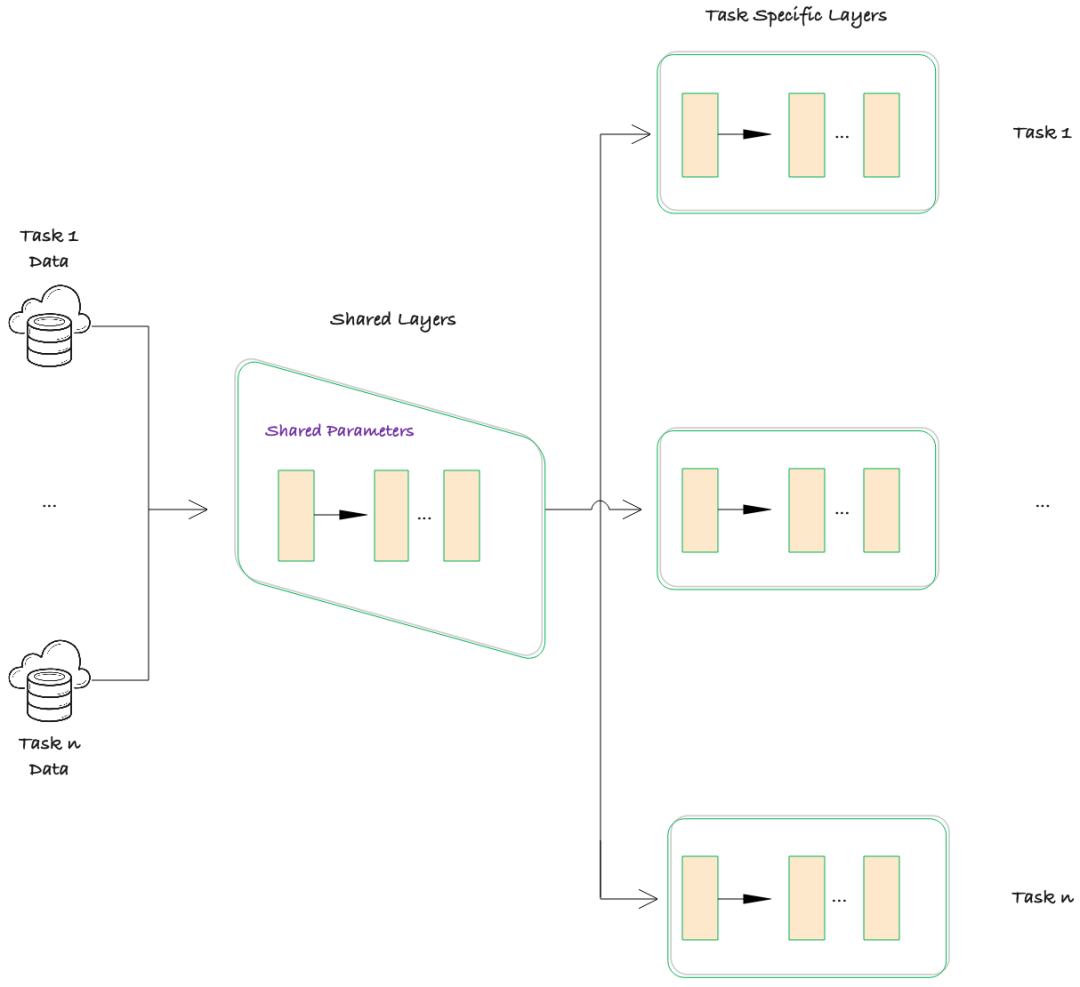
Multi-Task Learning (MTL) Reference Framework
MTL aims to allow models to learn multiple related tasks simultaneously and improve overall model performance through information sharing between tasks. Compared to STL, MTL has several significant advantages:
1. Reducing Overfitting
In a Multi-Task Learning framework, the model learns to encode more general features through shared representation layers instead of features specific to a single task. Generally, neural networks can extract useful features from input data, which will then be used to perform specific tasks (such as classification or regression). If we have multiple related tasks, there is no need to repeatedly extract features; we only need to extract these features once and then input them into task-specific models for processing. This is the core idea of the multi-task architecture.
By sharing representations, the model learns to encode features in a more general way, rather than specifically serving a single task. This general feature representation can significantly reduce the risk of overfitting. Overfitting typically occurs when a model focuses too much on capturing specific patterns of a task while ignoring broader, more fundamental features. However, in Multi-Task Learning, since the model needs to share underlying representations to serve multiple tasks simultaneously, it is forced to learn to capture more general, generalized feature patterns.
Another important benefit of this shared representation mechanism is that it facilitates knowledge transfer between different tasks. When there are commonalities among different tasks, the model can effectively capture these commonalities through shared feature encoding layers and internalize them as general knowledge representations, thereby obtaining positive transfer effects on other related tasks and further enhancing the model’s generalization ability.
It is evident that the shared representation strategy in a Multi-Task Learning architecture not only reduces the risk of overfitting for individual tasks but also promotes cross-task knowledge transfer, thus enhancing the overall generalization performance of the model. This knowledge transfer and generalization advantage achieved through sharing mechanisms is a significant advantage of Multi-Task Learning over Single-Task Learning.
2. Improved Training and Inference Efficiency
By executing multiple tasks simultaneously with a single model, the multi-task architecture can significantly accelerate the inference process, which is particularly important for edge application scenarios with stringent “efficiency requirements.” One often-overlooked benefit of improved speed and efficiency is that it can alleviate the pressure on server costs by reducing the overall computational load during training and inference phases. Reducing computational load also means lowering necessary energy consumption, thereby reducing carbon emissions. This impact becomes particularly significant for large data centers that need to operate 24/7.
An efficient multi-task processing pipeline not only reduces costs but also decreases carbon emissions, thereby positively impacting the integration of AI applications.
Moreover, Multi-Task Learning often learns more compact and highly generalized feature representations, making the model more efficient in storage and computation. Compared to traditional approaches that require separately extracting and storing features for each task, multi-task models only need to save shared feature representations, thus saving a significant amount of memory and storage resources.
3. Performance Improvement Based on Positive Transfer
In Multi-Task Learning, there is a situation where learning certain tasks together leads to performance improvements across all tasks; this phenomenon is called “Positive Transfer.” In contrast, if learning certain tasks together reduces their performance, it is referred to as “Negative Transfer.”
The occurrence of positive transfer arises from certain commonalities and correlations between different tasks. When the model learns these related tasks simultaneously through shared representation layers, common knowledge between tasks is well refined and internalized at the bottom level, forming general feature representations. This general representation not only improves the generalization performance of each task but also facilitates knowledge transfer across different domains, enhancing the model’s performance on related tasks.
The key to producing positive transfer is that there must be certain correlations and complementarities between these tasks, allowing for the sharing of valuable underlying feature patterns. For example, in the field of natural language processing, there are obvious correlations among tasks such as semantic understanding, syntax analysis, and named entity recognition. Learning them together can allow the model to learn richer and more general semantic feature representations, thereby improving performance across all tasks.
3. Common Multi-Task Learning Methods
In the field of deep learning, Multi-Task Learning (MTL) is a powerful learning paradigm that has garnered attention for its ability to effectively improve model generalization and learning efficiency. The core idea of MTL is to allow the model to learn multiple related tasks simultaneously and enhance overall model performance through information sharing between tasks.
In the implementation framework of deep learning, the key to MTL lies in the application of parameter sharing strategies. By sharing some or all parameters at the hidden layer level of the neural network, the model can learn common features between tasks, thereby improving learning effectiveness across all tasks. Depending on the method and degree of sharing, the parameter sharing strategies of MTL can be mainly divided into two categories: Hard Parameter Sharing and Soft Parameter Sharing.
3.1. Hard Parameter Sharing
Hard Parameter Sharing is considered the most common and direct method for implementing Multi-Task Learning (MTL) within neural network architectures, and its concept can be traced back to early pioneering research.
In a hard parameter sharing multi-task neural network, different tasks share most of the underlying hidden layers and parameters, including input layers, convolutional layers, fully connected layers, and other modules used for feature extraction and representation learning. These shared layers are responsible for extracting common underlying feature patterns from the input data, capturing the shared essence between tasks. However, at the top level of the network, each task has its own dedicated output layer for making predictions and decisions specific to that task.
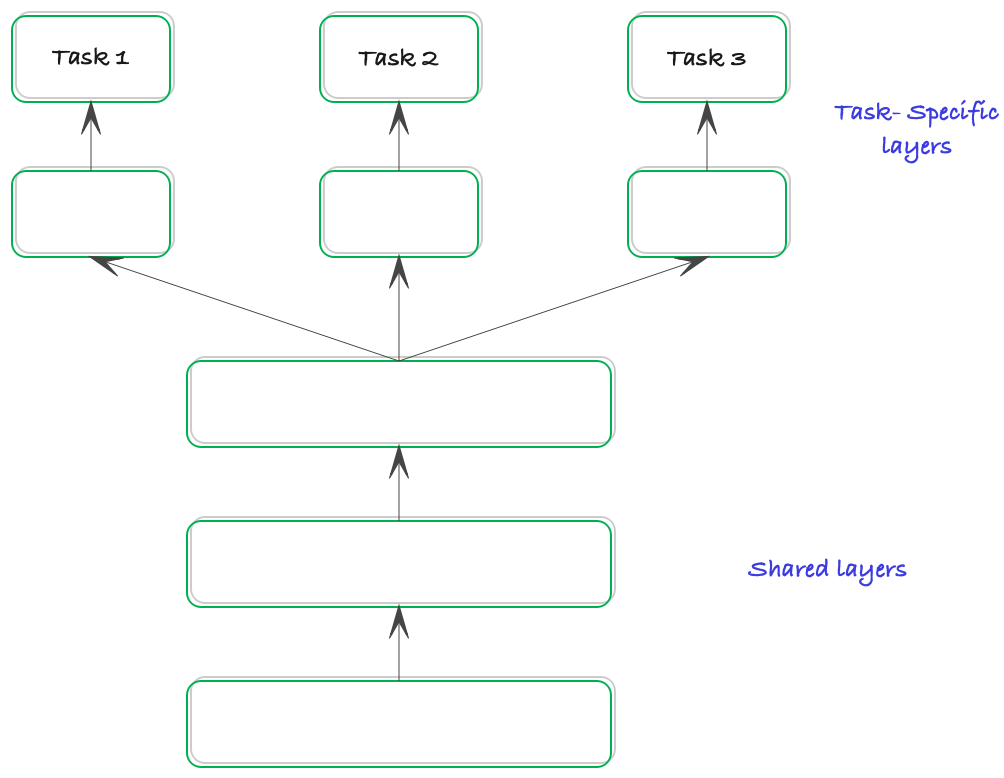
Reference Diagram for Hard Parameter Sharing in Deep Neural Networks
The core idea of this architecture is that there exist certain common feature patterns and statistical rules among multiple related tasks. By explicitly sharing underlying representations, the model can efficiently learn these general knowledge representations from the data of all tasks, thereby improving generalization ability and enhancing the performance of each task.
The greatest advantage of hard parameter sharing is its efficiency and simplicity. Since most network layers and parameters are shared, the computational overhead of training and deploying multi-task models is only slightly higher than that of training a single task model, thus significantly saving computational resources. Moreover, this fully shared approach also helps avoid overfitting and improves model robustness.
However, the drawback of hard parameter sharing is that excessive sharing may limit each task’s ability to fully leverage its uniqueness. Different tasks may need to capture different feature patterns, and if parameters are shared too strictly, it may affect the model’s ability to fit each task. To overcome this limitation, researchers have proposed more flexible multi-task architectures, such as soft parameter sharing.
In addition to the basic hard sharing method, current research has also developed some more advanced variants of hard parameter sharing, such as Cross-Stitch and hierarchical multi-task structures. These variants aim to introduce some interaction mechanisms between tasks while fully sharing parameters, yet still retaining a certain degree of task specificity, achieving a balance between parameter sharing and task exclusivity.
Overall, hard parameter sharing is a highly efficient and straightforward multi-task architecture that can greatly save computational resources and facilitate knowledge transfer between related tasks. It lays an important foundation for the application of multi-task learning in deep neural networks. Although there are certain drawbacks, hard parameter sharing will remain an essential part of building efficient multi-task models when combined with other strategies.
3.2. Soft Parameter Sharing
Unlike hard parameter sharing, soft parameter sharing provides a more flexible and loose multi-task learning architecture.
In the soft parameter sharing framework, each task has its own independent model structure and a set of exclusive parameters, rather than directly sharing most network layers. This design considers that different tasks may need to learn different feature representations, and thus providing each task with a certain degree of exclusive representation capability helps enhance overall performance.
However, to achieve knowledge transfer and promote the learning of general representations, soft parameter sharing does not completely isolate each task’s model parameters from each other. Instead, it imposes certain constraints to encourage the model parameters of different tasks to converge, thereby sharing parameters to a certain extent.
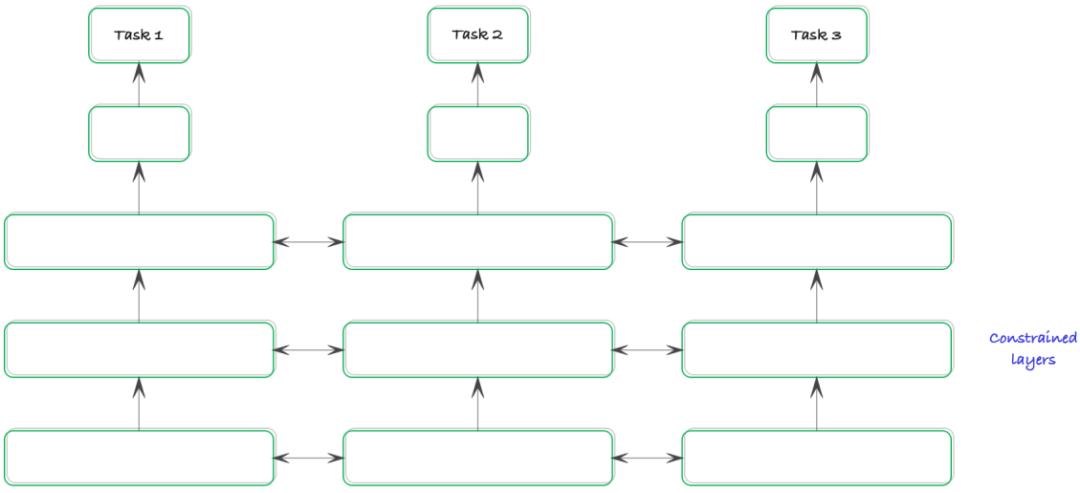
Reference Diagram for Soft Parameter Sharing in Deep Neural Networks
Specifically, soft parameter sharing typically adds a special regularization term to the loss function to measure and minimize the distance or difference between model parameters of different tasks. This regularization strategy forces each task to consider the similarity of its parameters with other tasks while learning task-specific representations, thereby achieving a certain level of sharing in the parameter space. Common soft parameter sharing methods include:
1. Weight Sharing: Only share the weight parameters of hidden layers while keeping bias parameters independent.
2. Activation Function Sharing: Share the activation functions of hidden layers while keeping weight parameters independent.
3. Regularization Sharing: Use regularization terms to constrain the similarity of shared parameters, allowing each task to fine-tune its parameters.
Soft parameter sharing can provide each task with a certain degree of flexibility while retaining common features, thus better balancing the model’s generalization ability and the adaptability of individual tasks.
The main advantage of the soft parameter sharing architecture is its flexibility. Each task has its own exclusive parameters, allowing it to autonomously capture highly relevant feature patterns; at the same time, it achieves knowledge transfer and enhanced generalization ability through parameter regularization mechanisms. This strategy is particularly suitable for handling tasks that are related yet exhibit significant differences.
Of course, soft parameter sharing also has some limitations that need further optimization. For example, how to best design the parameter distance measurement method and how to balance parameter sharing and task independence are issues worth discussing. Some emerging multi-task architectures, such as Hierarchical Multi-Task Learning, are attempting to address these challenges from new perspectives.
In addition to the two basic strategies mentioned above, researchers have proposed various hybrid parameter sharing strategies aimed at further enhancing MTL performance. For example, different types of parameter sharing strategies can be applied to different layers of the network, or the range of shared parameters can be dynamically adjusted based on the degree of correlation between tasks.
Multi-Task Learning in deep learning effectively utilizes common information between tasks through parameter sharing strategies, significantly improving the learning efficiency and generalization ability of the model. Hard parameter sharing and soft parameter sharing are the two main parameter sharing strategies, each with its own advantages and disadvantages. Hybrid parameter sharing strategies further enhance MTL performance. When selecting MTL parameter sharing strategies, it is necessary to consider the correlation between tasks, model complexity, and the amount of training data. As research deepens, MTL parameter sharing strategies will continue to improve, providing us with more efficient and flexible multi-task learning solutions.
References:1.https://www.geeksforgeeks.org/introduction-to-multi-task-learningmtl-for-deep-learning/2.https://shreyusp.medium.com/multi-task-learning-f3ba67eaa8363.https://medium.com/@hg2590/introduction-to-multi-task-learning-bc8689e2ce78
Click at the end of the article to read the original text, you can leave comments and communicate in the original text
If you find this article useful, pleaseshare, like or click “See”, so more peers can see it
About [Introduction to Large Model Industry Applications Series] The era of intelligent native has officially begun in 2024, and the trend of enterprise applications is transitioning from AI-Enable to AI-Native technology route changes. For community users, regardless of their previous roles or the technologies they mastered, they will need to actively embrace the trend of AI applications under the new technological paradigm, upgrade their skills, and quickly integrate into the army that helps enterprises innovate based on AI model applications. Keeping up with the times, mastering new technical skills and integrating existing job technologies and experiences are the core talents that enterprises rely on for innovation today. To improve the efficiency of community users’ skills upgrading under the new technological wave, the IT Trend Project Application Innovation Alliance’s large model research group has organized and compiled the [Introduction to Large Model Industry Applications Series] articles, which will be followed by examinations and certifications. While you read these articles, the community also looks forward to your active feedback, which can further correct the framework and specific knowledge points of the introductory series, and even join the research group and become a professional author of the introductory series.
Articles published in this series:
Understanding LLM (Large Language Model) Ecosystem Understanding NLM (Neural Language Model) Understanding Deep Learning Framework PyTorch vs TensorFlow Differences Understanding LLM Datasets (Large Language Model Datasets) Understanding LLM Training: From Pre-training to Fine-tuning
What you should know about LLM Pre-training
Understanding LLM Fine Tuning
Common LLM Fine Tuning Methods Analysis The latest article in this series will guide readers further into the field of large model fine-tuning technology—Target audience: It is suitable for technical personnel in various fields such as natural language processing, artificial intelligence, and computer science. For those who wish to understand and master cutting-edge techniques in large language model fine-tuning, it is an excellent introductory reference material. Reader’s concerns about entry: Aimed at eliminating the various concerns readers may encounter when learning large language model fine-tuning technology, through comprehensive content design and reasonable knowledge structure, guiding readers to efficiently master this cutting-edge technology and laying the foundation for future in-depth learning and practical applications.
How this series will help readers get started: Through theoretical learning, practical training, tool applications, and understanding of cutting-edge topics from multiple dimensions, it guides readers to comprehensively master all aspects of large language model fine-tuning technology, enabling them to quickly get started in this field and prepare for subsequent deep learning.
Welcome to follow the community “Large Model Applications” technology theme , which will continuously update quality materials and articles. Address:https://www.talkwithtrend.com/Topic/155171
Download the twt community client APP


Long press to identify the QR code to download
Or search for “twt” in the app store
Long press the QR code to follow the public account

*The content published by this public account only represents the author’s views and does not represent the community’s position; cover images are used with authorization from copyright image libraries