In modern industrial automation systems, interconnectivity between devices is core. Whether for data acquisition, remote control, or production management, an efficient and stable communication system is essential.
From the underlying physical interfaces to protocol standards, and up to the upper-level HMI and SCADA application software, industrial communication has gradually developed a complete architecture. Today, we will analyze the relationships between common communication methods and devices such as RS-485, Modbus, PLC, TCP, and MQTT, and see the roles played by industrial computers, HMI, and SCADA.
Beijing Chuangyoushe – Providing industrial automation solutions
1. Low-Level Communication: The “Physical Channel” of Devices
RS-485 is the most common physical communication method in industrial sites. It uses differential signals, has strong anti-interference capabilities, and supports multi-point communication, widely used among sensors, PLCs, and inverters. It can be understood as: devices “talking” via cables.
2. Industrial Protocols and Control Core
Above the physical lines, a unified “language” is needed for communication, which is the Modbus protocol.
-
Modbus RTU: Based on RS-485;
-
Modbus TCP: Based on Ethernet.
In summary: 👉 RS-485 is the transmission channel, Modbus is the communication language.
At the control level, PLC (Programmable Logic Controller) acts as the brain of the industrial system. It collects sensor signals, performs logical operations, controls actuators such as motors and valves, and communicates with other systems via RS-485 + Modbus or TCP/IP.
Beijing Chuangyoushe – Providing industrial automation solutions
3. Network Communication and IoT Protocols
With the introduction of Ethernet into factories, industrial communication has further advanced towards networking and cloud integration.
-
TCP/IP: The cornerstone for industrial devices to access the internet, providing reliable point-to-point data transmission.
-
MQTT: A lightweight IoT protocol that uses a publish/subscribe model, making it very suitable for remote monitoring and cloud platform access. It is often used to upload data from PLCs and sensors to the cloud, supporting big data analysis and intelligent decision-making.
4. Upper-Level Machines and Industrial Software
Upper-Level Machines: The Bridge Between Field and Management
“Upper-level machines” is a relative concept, usually referring to computer systems that interact with lower-level devices such as PLCs and sensors. It can be a PC or an industrial computer, primarily responsible for data acquisition, visualization, and monitoring. Upper-level machines often host HMI or SCADA systems.
HMI (Human-Machine Interface): The Direct Operation Window
Beijing Chuangyoushe – Providing industrial automation solutions
HMI provides the interface for interaction between humans and devices, such as touch screens and control panels. It displays data and alarm information in a graphical interface, allowing operators to control directly. HMI focuses more on intuitive interaction with single-point devices.
SCADA (Supervisory Control and Data Acquisition): The Central Hub for Global Monitoring
SCADA is a broader monitoring system that can centrally collect data from factories and workshops, enabling remote operations, alarm management, and report analysis. SCADA typically runs on industrial computers or servers, connecting multiple PLCs, HMIs, and sensors, and is the core of enterprise-level monitoring.
It can be understood as:
- HMI → Single Point Interaction
- SCADA → Global Monitoring
5. Hierarchical Relationship of the System
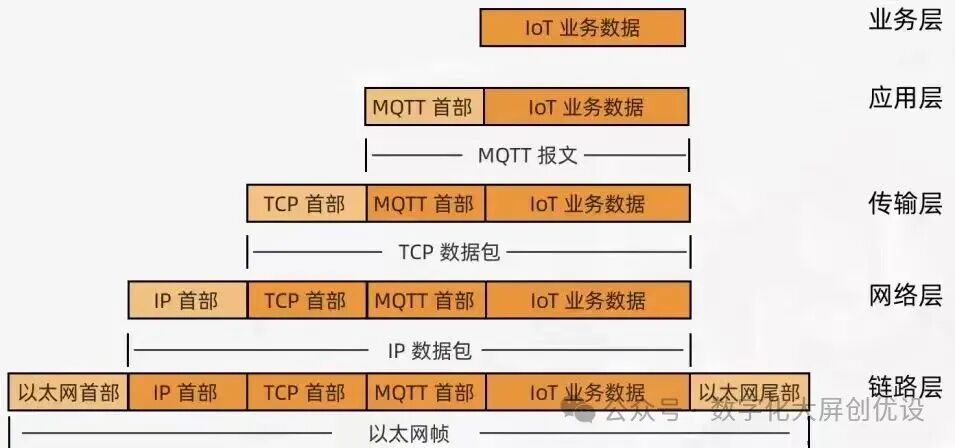
The industrial automation communication and control system can be divided into the following levels:
-
Low Level: Data acquisition and execution (sensors, PLCs);
-
Middle Level: Communication and protocols (RS-485, Modbus, TCP, MQTT);
-
Upper Level: Monitoring and interaction (HMI, SCADA, upper-level machines);
-
Extension Level: Cloud platforms, big data, AI intelligent analysis.
This layered architecture ensures that industrial sites can operate stably while deeply integrating with smart manufacturing and the industrial internet.
From the physical communication of RS-485, to the protocol standards of Modbus, TCP, and MQTT, and then to the control and management of PLC, HMI, and SCADA, industrial automation has formed a clear technical chain: machines can communicate, devices can interconnect, factories can be managed, and operations are more efficient.
Beijing Chuangyoushe – Committed to providing machines that can communicate, devices that can interconnect, factories that can be managed, and operations that are more efficient intelligent solutions.