
DeepSeek’s MLA (Multi-head Latent Attention) is an improved attention mechanism technique based on the Transformer architecture (combining multi-head attention and latent variables), aimed at enhancing the model’s understanding and processing capabilities of input data. By introducing latent variables and sparse attention, MLA can better capture the hidden structure of input data while reducing computational overhead, making it suitable for long sequence processing, multi-task learning, and complex reasoning scenarios.
Here are the basic concepts and core features of MLA:
1. Core Idea
The core idea of MLA is to enhance the model’s multi-layered, multi-dimensional understanding of input data through the combination of multi-head attention mechanism and latent variables. Specifically:
-
Multi-head attention: Maps the input data into multiple subspaces, where each “head” independently learns different feature representations (such as syntax, semantics, contextual relationships, etc.).
-
Latent variables: Introduces latent variables to capture the hidden, unobserved structural information in the input data (such as long-range dependencies, topic distributions, etc.), thereby enhancing the expressiveness and computational efficiency of the attention.
2. Key Components
The core components of MLA include the following parts:
-
Multi-head attention:
-
Maps the input sequence into multiple subspaces (through different linear transformations), with each subspace processed by an independent attention head.
-
Each head learns different features of the input data (such as local dependencies, global relationships, etc.), and finally concatenates or weighted fuses the outputs of multiple heads.
Latent variables:
-
Latent variables are implicit, unobserved variables used to capture the latent structure in the input data (such as topics, semantic patterns, etc.).
-
In MLA, latent variables are dynamically generated through the attention mechanism and are used to guide the weight allocation of attention.
Sparse attention:
-
Limits the attention scope via latent variables, reducing unnecessary computational overhead (e.g., focusing only on local windows or key segments).
-
This sparsity is particularly important in long sequence tasks, significantly reducing computational complexity.
Dynamic routing:
-
Dynamically selects the most relevant latent variables and attention heads based on the characteristics of the input data, achieving task-adaptive feature extraction.
3. Workflow
The workflow of MLA can be summarized in the following steps:
-
Input encoding:
-
Maps the input sequence (such as text, images) into a high-dimensional vector space.
Latent variable generation:
-
Generates a set of latent variables through latent variable models (such as variational autoencoders or generative models) to capture the hidden structure of the input data.
Multi-head attention calculation:
-
In each attention head, combines latent variables to calculate attention weights, focusing on the key parts of the input sequence.
Output fusion:
-
Concatenates or weighted fuses the outputs of multiple attention heads to generate the final representation.
4. Advantages
The main advantages of MLA include:
-
Stronger expressiveness: Captures multi-layered, multi-dimensional features of input data through latent variables and multi-head mechanisms.
-
Higher computational efficiency: The sparse attention mechanism reduces computational overhead, especially suitable for long sequence tasks.
-
Better task adaptability: The dynamic routing mechanism enables the model to adaptively select attention heads and latent variables based on task characteristics.
5. Application Scenarios
MLA is suitable for the following scenarios:
-
Long text processing: Efficiently handles long sequences (such as document summarization, long text question answering) through the sparse attention mechanism.
-
Multi-task learning: Utilizes the multi-head mechanism and latent variables to achieve knowledge sharing and transfer between tasks.
-
Complex reasoning tasks: Captures implicit logical relationships via latent variables, enhancing multi-hop reasoning capabilities.
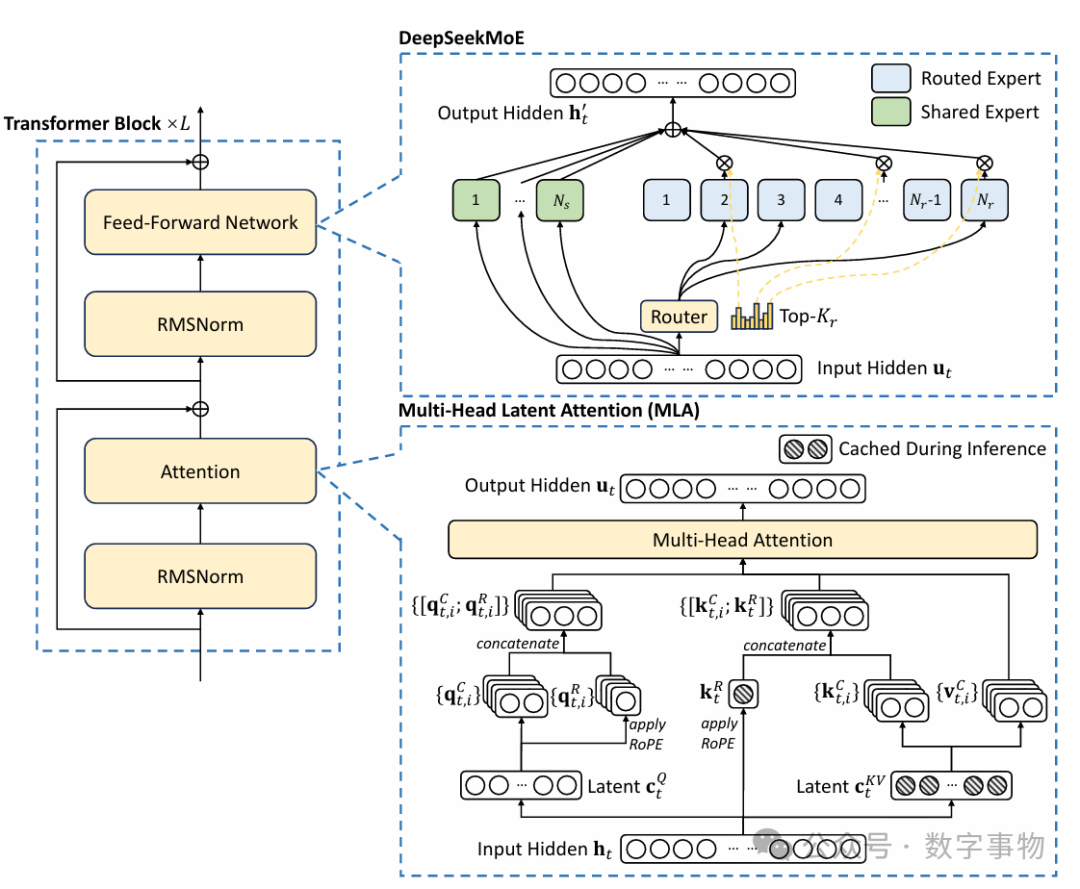
Understanding the principles of MLA (Multi-head Latent Attention) will help in using models based on the Transformer architecture like DeepSeek:
1. More Efficient Prompt Engineering
-
Attention allocation optimization: By understanding the roles of different “heads” in multi-head attention (for example, capturing syntax, semantics, long-range dependencies, etc.), clearer input prompts can be designed to guide the model to focus on key information in the latent space.
-
Example: In long text reasoning tasks, by segmenting inputs or adding explicit separators (like
##Key Points##), help different attention heads to more accurately locate relevant context.
2. Model Tuning and Fine-tuning Guidance
-
Targeted parameter adjustments: After understanding the weight distribution patterns of the latent attention layer, specific attention heads can be selectively frozen/enhanced during fine-tuning (for example, enhancing the head that captures domain-specific terminology).
-
Computational resource optimization: If MLA reduces computational complexity through latent variables (like sparse attention), users can adjust the attention scope based on task needs (e.g., limiting local windows or global interactions).
3. Controllability and Interpretability of Output Results
-
Attention visualization diagnostics: By analyzing the weight distribution of multi-head latent attention, the basis for model decisions can be located (for example, discovering that the model overly focuses on certain irrelevant words), and thus optimize input or add constraints.
-
Example: When generating technical documents, if the model overly focuses on non-expert vocabulary, the weighting of domain keywords can be increased to correct this.
4. Structured Processing of Complex Tasks
-
Task decomposition and attention guidance: Utilizing the division of labor characteristics of the multi-head mechanism, complex problems can be decomposed into sub-tasks, guiding different attention heads to collaborate through prompt design.
-
Example: In code generation, hierarchical prompts can be designed (like “first describe the logic, then write the syntax”) to activate attention heads that capture logical structures and syntax rules respectively.
5. Awareness of Model Performance Boundaries
-
Understanding the upper limits of comprehension: Through the sparsity or interaction range of latent attention, the limitations of the model in handling long texts, multi-hop reasoning tasks, etc., can be predicted, avoiding blind reliance on outputs.
-
Example: If MLA’s latent attention window is small, in ultra-long text question answering, it is necessary to actively segment inputs and provide explicit contextual association prompts.
6. Inspiration for Innovative Applications
-
Cross-modal expansion: If DeepSeek’s MLA supports cross-modal latent attention (like text-image), multi-modal inputs can be designed to unleash the model’s potential.
-
Dynamic interaction optimization: In dialogue systems, utilizing latent attention for compressed representations of historical dialogues can achieve more efficient long-term memory management.
Conclusion
Understanding the principles of Multi-head Latent Attention is essentially mastering the key to how the model “thinks”—it can help users:
-
Upgrade from black-box invocation to white-box collaboration: Actively guide the model through the characteristics of the attention mechanism;
-
Upgrade from empirical trial-and-error to scientific tuning: Diagnose issues based on attention distribution and design solutions;
-
Expand from single tasks to composite innovations: Develop higher-order applications by combining multi-head division characteristics.
It is recommended to practice and verify theoretical understanding in conjunction with specific tasks using tools (like DeepSeek’s attention heatmap visualization) for continuous iterative optimization of usage strategies.