▉ What Is V2X
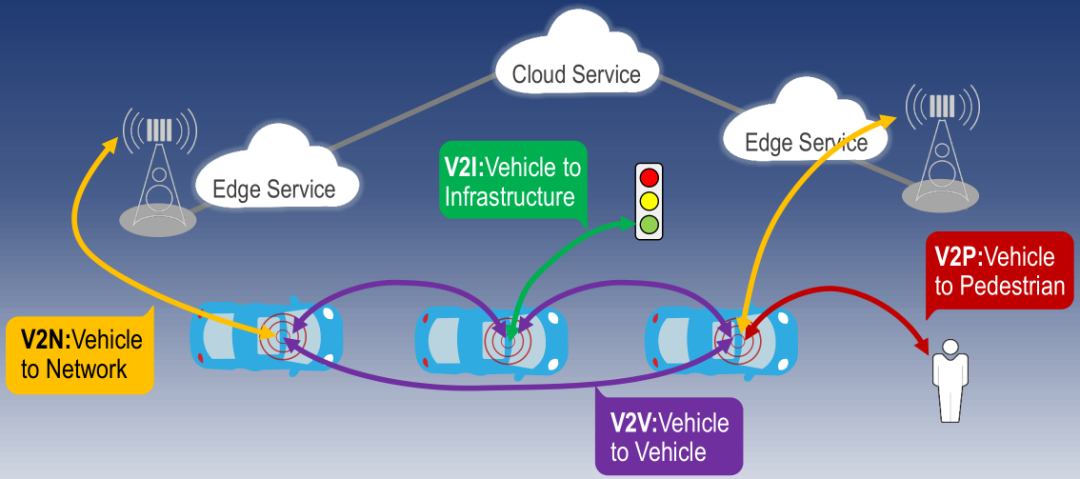
V2X, or vehicle to everything, refers to the communication capability of vehicles, enabling V2V (Vehicle-to-Vehicle), V2P (Vehicle-to-Pedestrian), V2I (Vehicle-to-Infrastructure), and V2N (Vehicle-to-Network) interactions, which enhance driving comfort and safety, enabling future automated driving.
Source: Rohde & Schwarz
Many drivers have experienced the frustration of hitting multiple red lights on a road, wasting time and fuel. Sometimes, even with no cars ahead, drivers are left waiting for the light to turn green. You might wonder, how great would it be if traffic lights had eyes and brains!
By utilizing V2I (Vehicle-to-Infrastructure) and V2N (Vehicle-to-Network) technologies, we can control traffic flow, significantly reducing waiting times and achieving “green light passage”.
For instance, have you ever encountered a pedestrian or an electric bike suddenly appearing while driving, giving you a fright?
In such cases, V2P (Vehicle-to-Pedestrian) technology comes into play, capturing information about the surrounding environment even in non-line-of-sight situations, giving us a “God’s eye view” to prepare for potential threats.
Source: KEYSIGHT
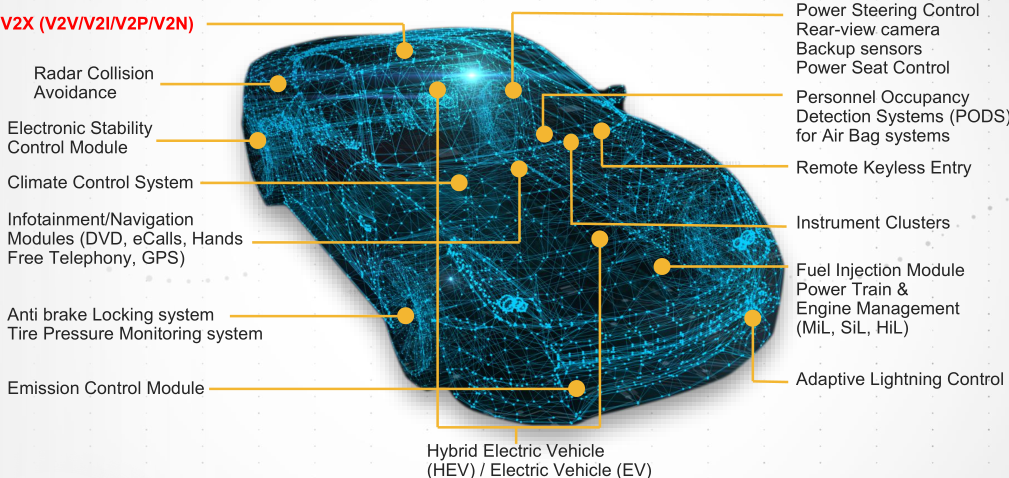
In fact, we should view V2X technology as part of the Advanced Driver Assistance Systems (ADAS). V2X complements various sensors (such as cameras and LiDAR) to assist in achieving higher levels of automated driving.
Theoretically, a single vehicle (like Google’s self-driving car) can achieve automation by stacking sensors without considering costs.
However, an automated vehicle without V2X is like an information island. It cannot effectively communicate with surrounding vehicles or infrastructure, leading to significant limitations in perception and decision-making.
▉ Comparison of Two Solutions (DSRC vs C-V2X)
Currently, there are two mainstream V2X communication technology standards internationally:
-
DSRC (Dedicated Short Range Communications): Based on IEEE 802.11p, Europe’s ITS-G5 is also based on this physical layer technology; we will only discuss DSRC here.
-
C-V2X (Cellular Vehicle-to-Everything): Based on 3GPP LTE.
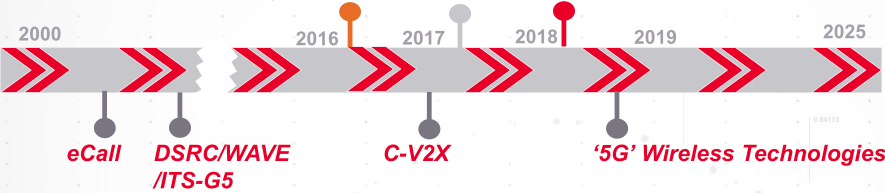 Source: KEYSIGHTDSRC has been around for many years, but its development has faced some inherent shortcomings. In contrast, 3GPP’s C-V2X has many advantages, leading to rapid development in recent years.Let’s compare these two technology solutions from various perspectives:First, from a technical perspective.5GAA (5G Automotive Association) conducted comparative tests in laboratories and outdoor environments for DSRC and C-V2X. The results confirmed that C-V2X outperforms DSRC in many aspects, such as supporting longer communication distances, better non-line-of-sight performance, stronger reliability, higher capacity, and better congestion control. (Please refer to the detailed test report in the attachment at the end)
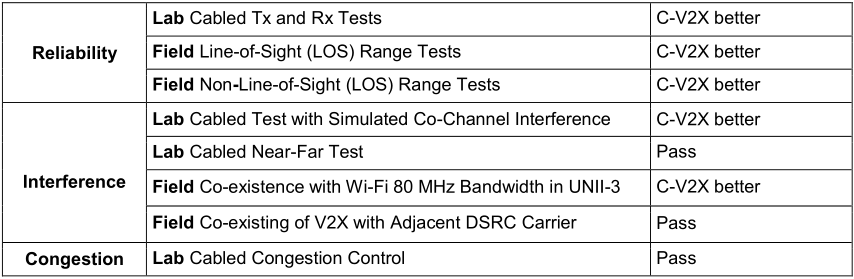 Source: 5GAA Test Report P-190033Next, from the perspectives of cost and standardization.In these areas, C-V2X also has significant advantages:
-
C-V2X is based on cellular networks, which can reuse existing 4G and 5G networks, providing wide coverage and lower deployment costs. In contrast, DSRC technology, based on 802.11p, requires a larger number of roadside units (RSUs) for networking, resulting in high deployment costs.
-
C-V2X is based on 3GPP standards, offering better global compatibility.
-
C-V2X has a clear evolutionary path and backward compatibility (LTE C-V2X to NR C-V2X).
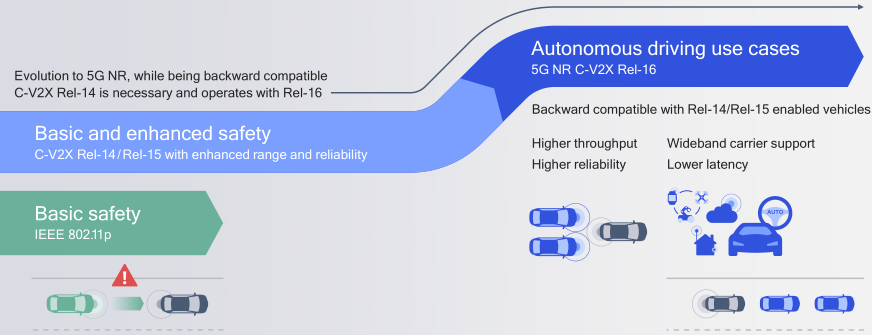 Source: QualcommFinally, from the perspective of policy support.In this regard, C-V2X is gaining momentum:
-
The US has traditionally supported DSRC, but recently the stance has begun to shift towards C-V2X. The US Federal Communications Commission (FCC) recently voted on the reallocation of 5.9GHz, designating 20MHz for C-V2X.
-
Europe’s stance is more complicated, supporting both DSRC and C-V2X technologies.
-
China has the world’s largest LTE network, and considering various factors such as application value, cost, performance, patents, policies, and industry maturity, C-V2X is undoubtedly the preferred V2X technology route in China. In terms of spectrum, 20MHz has been allocated for C-V2X.
▉ Progress of C-V2X’s 3GPP StandardizationThe success of C-V2X in the future requires not only support from the communication industry but also strong backing from representatives of the automotive industry.In September 2016, the 5GAA alliance was established, with over a hundred representatives from the automotive and communication industries participating to jointly promote the global development and deployment of C-V2X.For C-V2X, 3GPP has adopted a phased iterative development strategy:
-
The first phase involves LTE-V2X (R14) and LTE-eV2X (R15), focusing on enhancing security for V2X.
-
The second phase involves NR-V2X (R16 and its evolution versions), focusing on automated driving scenarios.
 Source: KEYSIGHTR16 already supports scenarios such as vehicle platooning, advanced driving, extended sensing, and remote driving.
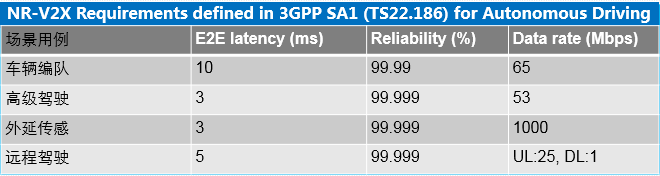 Source: 3GPP TS 22.186The author predicts that, similar to LTE-V2X, NR-V2X will undergo at least two versions (or even more) of evolution and iteration. Currently, 3GPP has initiated research on R17 technical standards, with preliminary planning for the main enhancement technologies of R17, continuing the evolution of existing versions.
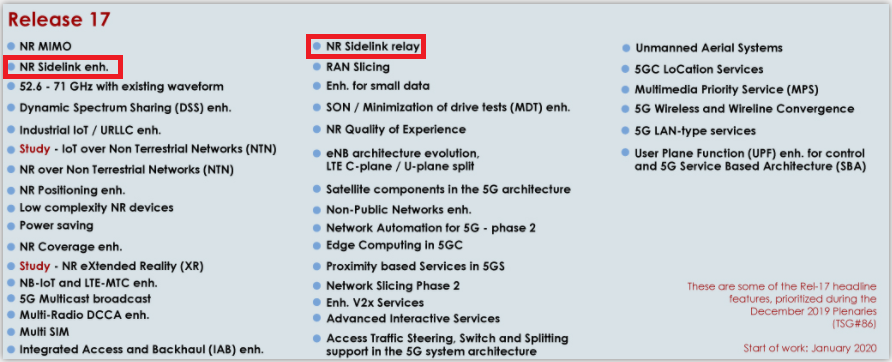 Source: 3GPP Official Website▉ Key Technologies of C-V2XFirst, from the architectural perspective. In non-roaming scenarios, the architecture supporting V2X in 5G is shown in the figure below:
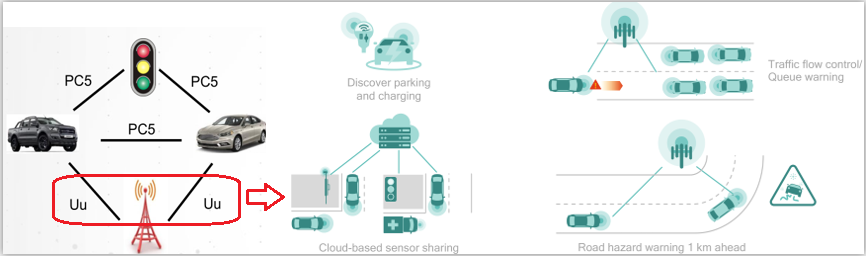
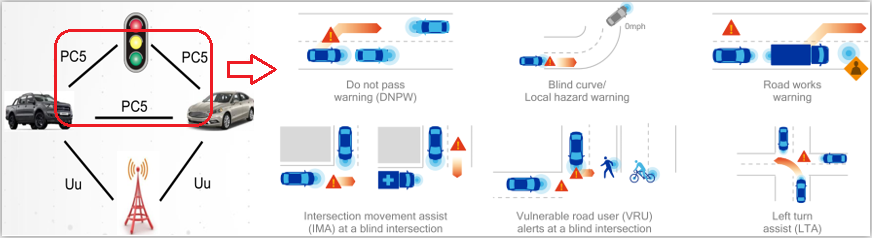
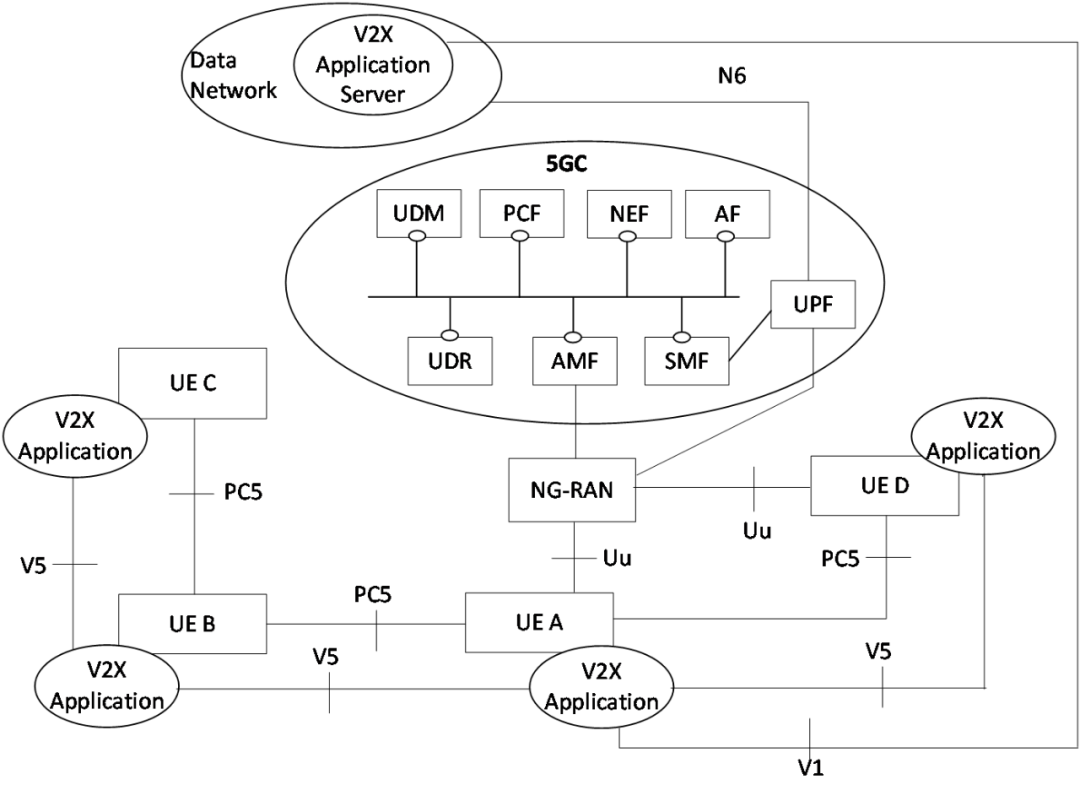 Source: 3GPP TS 23.287The author believes that MEC will be an important focus for V2X (not directly depicted in the architecture diagram).According to an Intel research report, in 2020, a self-driving car will use 4000GB of data daily. In contrast, an internet user consumes about 1.5GB of data daily. The vast and complex number of vehicles and roads, combined with the increasing number of sensors, leads to challenges in big data processing and storage.MEC is an effective means to address this challenge. With MEC technology, many services can be deployed closer to data sources such as vehicles and roads, saving network resources and reducing latency.Next, let’s look at it from the interface perspective.People often ask, “How does C-V2X work without network coverage?”The previous architecture diagram shows that even in environments without 4G/5G network coverage, C-V2X can still communicate with each other using the PC5 interface.The Uu interfaceis mainly used for delay-insensitive services, facilitating information sharing and early predictions.
 The PC5 interfaceis primarily used to implement low-latency services, enhancing reliability in non-line-of-sight conditions.
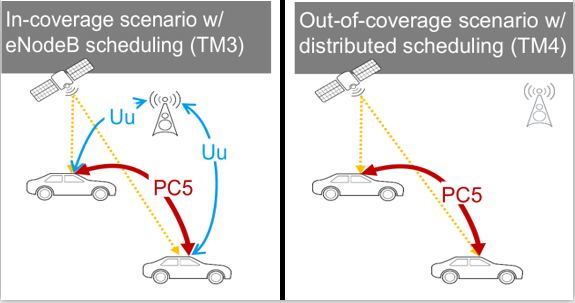
 Source: QualcommThe PC5 interface is further divided into two working modes:
-
Mode 3: Utilizing the base station, V2V data scheduling and interface management are achieved through the control signaling interface Uu. In this case, a dynamic approach is used for resource scheduling, and vehicles communicate using the PC5 interface.
-
Mode 4: V2V data scheduling and interface management are implemented based on distributed algorithms among vehicles.
 Source: Rohde & SchwarzFinally, from the protocol stack perspective.The protocol stack based on the PC5 interface is shown below (the protocol stack based on the Uu interface is the same as the traditional 5G protocol stack and will not be elaborated here):
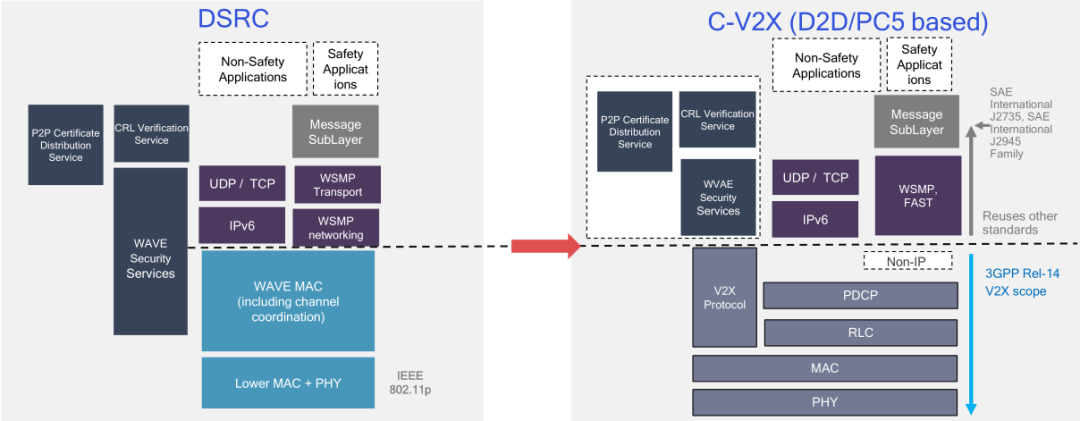 Source: Qualcomm3GPP defines the PHY and MAC layers, fully reusing the existing high-level protocol specifications of DSRC (established by SAT and IEEE). This means that the cost for users migrating from DSRC to C-V2X will be relatively low.Finally, let’s briefly understand the improvements made by the latest NR-V2X in the physical and protocol layers (Chapter 5 and 6 of 3GPP TR 38.885 provide more detailed descriptions. Note: The protocol specification typically uses the term Sidelink to describe the specific functions of PC5, abbreviated as SL), focusing on the enhancements of PC5:
-
Conceptually, the point-to-point and multicast concepts were introduced; previously, PC5 only supported broadcasting.
-
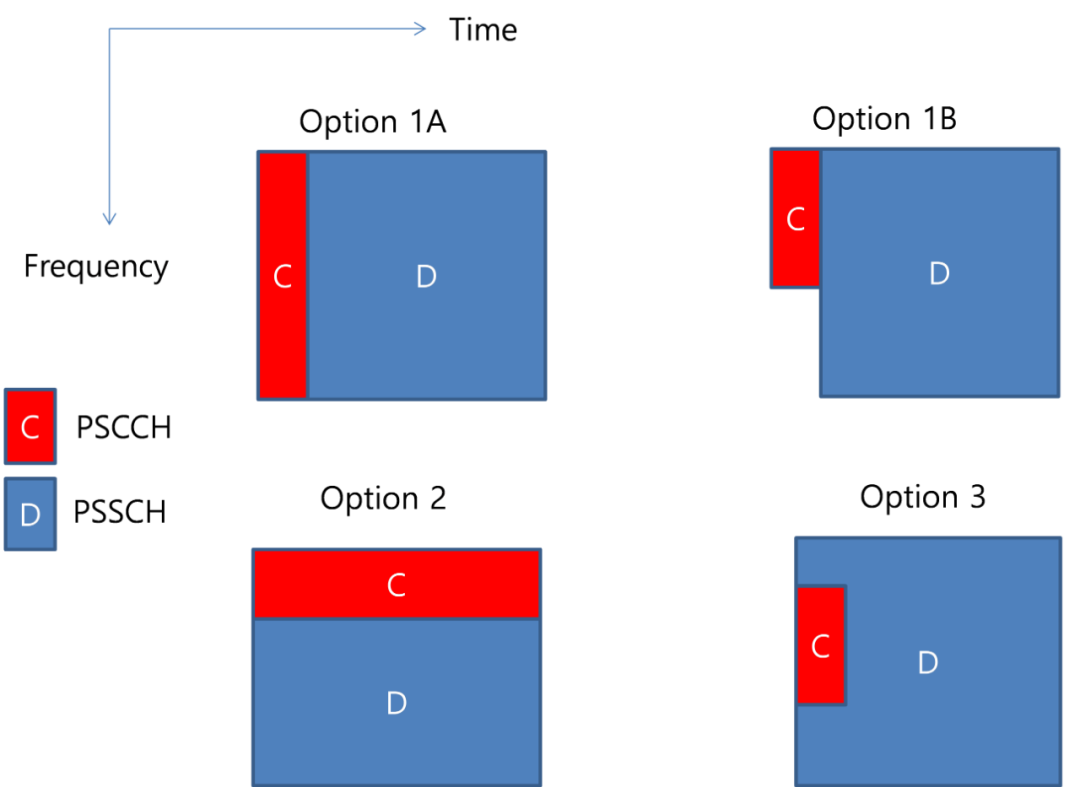
In terms of physical layer processing, the resource allocation for SL’s PSSCH and PSCCH is more organized, facilitating implementation (as shown in the figure below); additionally, SL supports open-loop power control (OLPC).
-
In terms of synchronization, SL can use S-PSS and S-SSS to achieve synchronization.
-
In terms of protocol layer, SL communication is clearly defined to have three modes: RRC connected mode (RRC_CONNECTED), idle mode (RRC_IDLE), and inactive mode (in NR context) (RRC_INACTIVE). In idle or inactive modes, UE’s SL communication is achieved through cell configuration information in SIB messages.
▉ ConclusionCurrently, global C-V2X test cases are continuously increasing.Manufacturers in the upstream and downstream sectors, including communication chips, modules, terminals, vehicle manufacturing, testing, verification, operation services, high-precision positioning, and mapping services, are actively positioning themselves to seize market opportunities.Industry consensus suggests that C-V2X-based vehicle networking could likely become the first successful vertical industry application scenario in the 5G era.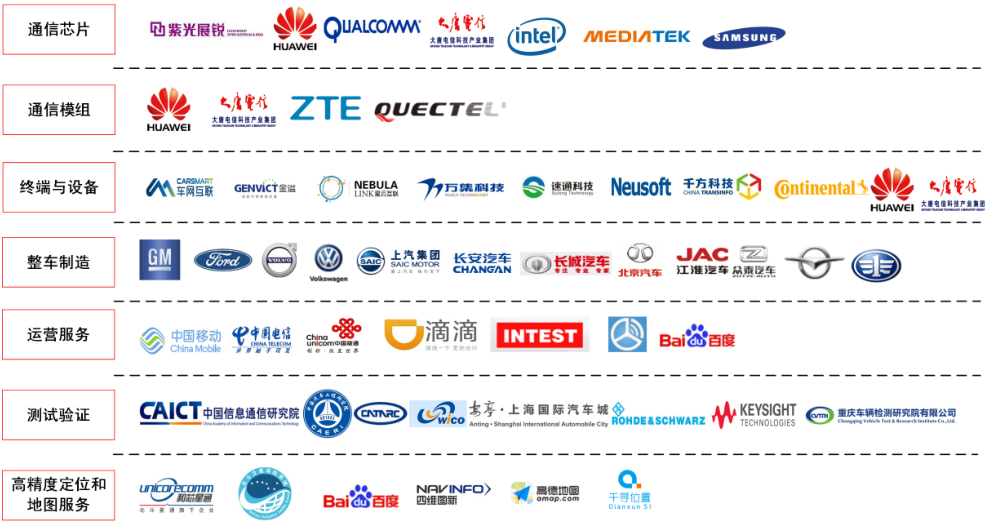 Source: IMT-2020 Promotion Group C-V2X White PaperIn our country, the government strongly encourages the development of vehicle networking technologies, including C-V2X. Ministries such as the Ministry of Industry and Information Technology, National Development and Reform Commission, Ministry of Transport, Ministry of Public Security, and Ministry of Science and Technology, among others, have provided clear policy support.According to incomplete statistics, there are currently over 30 testing demonstration zones nationwide, including national-level demonstration zones in Shanghai, Beijing-Hebei, Chongqing, Wuxi (pilot area), Hangzhou-Tongxiang, Zhejiang, Wuhan, Changchun, Guangzhou, Changsha, Xi’an, Chengdu, Taixing, Xiangyang, etc.These demonstration zones cover functions such as the construction of autonomous driving and V2X testing scenarios, LTE-V2X/5G vehicle networking applications, and smart transportation technology applications, providing testing content related to safety, efficiency, information services, new energy vehicle applications, and communication capabilities.While vehicle networking technology is rapidly developing, we must also recognize that the ultimate goal of vehicle networking (including the realization of automated driving) is a long process. In addition to technology and funding, it also involves legal and ethical issues.More importantly, it depends on whether it can gain the trust and acceptance of end-users.Industry experts have pointed out that the realization of automated driving will occur in several stages:First stage: Assisted driving for safety and improved traffic efficiency.Second stage: Automated driving in closed areas (commercial vehicles).Third stage: Automated driving on open roads (passenger vehicles).
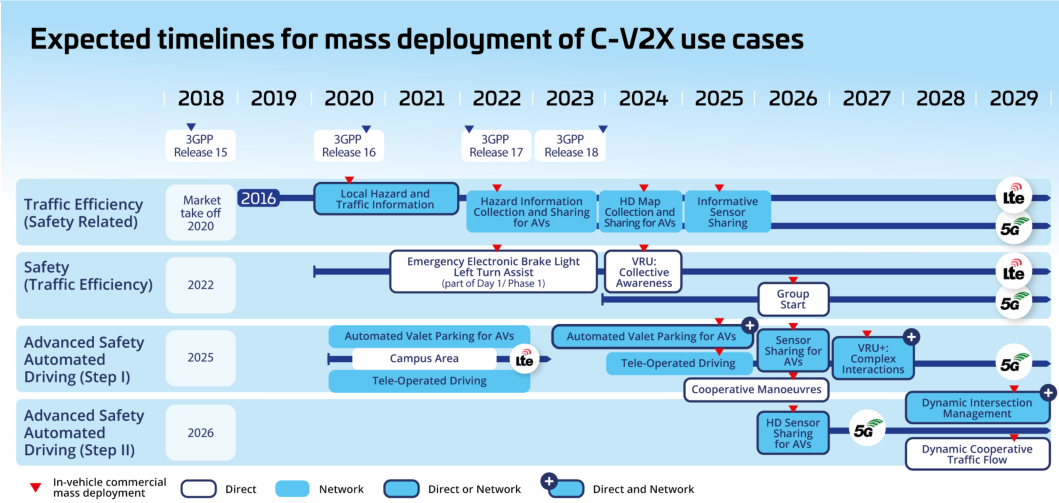 Source: 5GAA White PaperIn summary,the road ahead is long, and C-V2X will continue to seek progress.—— End of Article ——References:[1] 5GAA White Paper[2] 3GPP TS 22.186, “Enhancement of 3GPP support for V2X scenarios; Stage 1”[3] 3GPP TS 23.287, “Architecture Enhancements for 5G System to Support Vehicle to-Everything (V2X) Services”[4] 3GPP TR 22.185, “Service requirements for V2X services; Stage 1”[5] 3GPP TR 22.885, “Study on LTE Support for V2X Services”[6] 3GPP TR 22.886, “Study on enhancement of 3GPP Support for 5G V2X Services”[7] 3GPP TR 38.885, “Study on NR V2X”