Table of Contents | 2023 Issue 9 Topic: 6G Intelligent Sensing
Research on Integrated Network Architecture and Key Technologies for 6G
Research on Integrated Networking Concepts and Key Architectures for 6G
New Paradigm for High-Precision Positioning: Integrated Communication and Positioning Technology and Applications
Wireless Channel Sensing Network Model Based on Deep Denoising and Performance Analysis
Performance Analysis of Integrated Communication and Sensing Waveforms
2023 Issue 9
6G Intelligent Sensing Topic-6
Low-Cost Transmission Techniques for Sensing-Assisted Communications in 5G NR Internet of Vehicles
LI Yunxin1, LIU Fan1, DU Zhen1,2, YUAN Weijie1
(1. Southern University of Science and Technology, Shenzhen, Guangdong 518055; 2. Nanjing University of Information Science and Technology, Nanjing, Jiangsu 210044)
AbstractThe development of 5G NR has brought new possibilities and opportunities to the Internet of Vehicles. To accurately obtain channel state information in the highly mobile Internet of Vehicles, the frequent transmission of pilot and reference signals between vehicles and base stations increases a significant amount of signaling overhead while ensuring the stability of the communication link. To address this issue, we utilize the Extended Kalman Filtering algorithm based on 5G NR protocols and integrated sensing transmission technology to achieve prediction and tracking of vehicles. The active sensing capability based on the base station reduces beam management overhead, and a specific numerical analysis of the reduced overhead is provided. Experimental results from link-level simulations show that using integrated sensing technology in the Internet of Vehicles improves beam tracking accuracy and throughput of the communication system while reducing overhead.
KeywordsInternet of Vehicles; Integrated Sensing; 5G NR; Beam Tracking
doi:10.3969/j.issn.1006-1010.20230817-0001
Classification Number: TN929.5 Document Identifier Code: A
Article Number: 1006-1010(2023)09-0040-06
Citation Format: LI Yunxin, LIU Fan, DU Zhen, et al. Low-Cost Transmission Techniques for Sensing-Assisted Communications in 5G NR Internet of Vehicles[J]. Mobile Communications, 2023,47(9): 40-45.
LI Yunxin, LIU Fan, DU Zhen, et al. Low-Cost Transmission Techniques for Sensing-Assisted Communications in 5G NR Internet of Vehicles[J]. Mobile Communications, 2023,47(9): 40-45.

0 Introduction
The Internet of Vehicles is envisioned as a key driving force for future intelligent transportation applications, largely relying on seamless ultra-low latency wireless connections provided by next-generation cellular systems like 5G-A and 6G[1]. In addition to communication capabilities, future Internet of Vehicles also needs to possess highly reliable and precise active sensing functionalities to support various environmental sensing services, such as simultaneous localization and mapping, as well as vehicle platooning. Currently, positioning and localization services in the Internet of Vehicles mainly rely on Global Navigation Satellite Systems[2], but they suffer from low resolution and refresh rates, thus failing to meet the stringent requirements of future vehicle applications. More critically, the high mobility of the Internet of Vehicles poses significant challenges to channel training and beamforming, requiring frequent coordination and feedback between base stations/roadside units and vehicles. This inevitably generates considerable signaling overhead, leading to performance losses in communication throughput.
To address the above issues, integrated sensing technology leverages large-scale massive-MIMO antenna arrays and millimeter-wave (mmWave) technologies based on 5G NR infrastructure[3-4], achieving both active sensing and communication functionalities, making it a recognized promising solution[5]. In particular, by extending the antenna array and increasing bandwidth, finer angle and distance resolutions can be achieved. More importantly, compared to mmWave beam training and tracking that only have a single communication function, integrated sensing can significantly reduce channel estimation overhead. This is because it does not require dedicated downlink pilots and can reduce or even eliminate uplink feedback by directly processing the reflected echoes from vehicles. This technology is referred to as sensing-assisted communication and has recently attracted significant attention in the research community[6-9].
Most existing works on integrated sensing-supported Internet of Vehicles primarily focus on the algorithm design for sensing-assisted beam training and tracking. Literature [10], [11] first proposed algorithms for beamforming design based on integrated sensing using Bayesian filtering methods, such as the Extended Kalman Filtering algorithm and message-passing algorithms. To track extended vehicle targets, literature [12] envisioned an alternating beamforming technique based on integrated sensing that achieves accurate coverage of extended targets by dynamically changing the beam width of the base station according to the distance of the vehicle. Recently, literature [13] also designed an integrated sensing beamforming method based on a curved coordinate system to serve vehicles on complex roads, such as roundabouts and highway interchanges. Although these schemes have precise algorithms, they often assume simplified frame structures and transmission protocols, making them difficult to apply directly to the 5G NR framework. More importantly, the exact numerical values of overhead reduction achievable in practical systems are currently unclear.
To fill this research gap, this paper investigates a link-level Internet of Vehicles system based on 5G NR, reducing overhead through the use of integrated sensing signals. Specifically, we consider the base station/roadside unit serving vehicles with a large-scale uniform planar array, utilizing the integrated sensing waveform for downlink transmission standardized based on orthogonal frequency division multiplexing (OFDM) waveforms in the 5G NR mmWave frequency band. This paper comprehensively analyzes the NR frame structure and resource blocks that can be used to achieve dual functions of sensing and communication, and proposes an integrated sensing signal processing framework that uses NR signals for vehicle parameter estimation and tracking. The simulation environment is constructed using ray-tracing methods in real scenarios in Shenzhen, China, while considering both line-of-sight and non-line-of-sight paths. The simulation demonstrates the superiority of integrated sensing technology over traditional communication-only solutions in terms of angle tracking accuracy and achievable throughput, indicating that with the assistance of active sensing functionalities, communication overhead can be reduced by up to 43.24%.
1 System and Channel Model
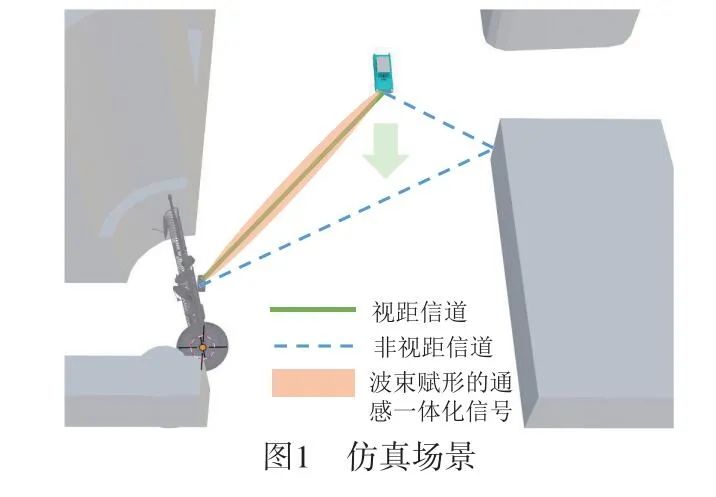
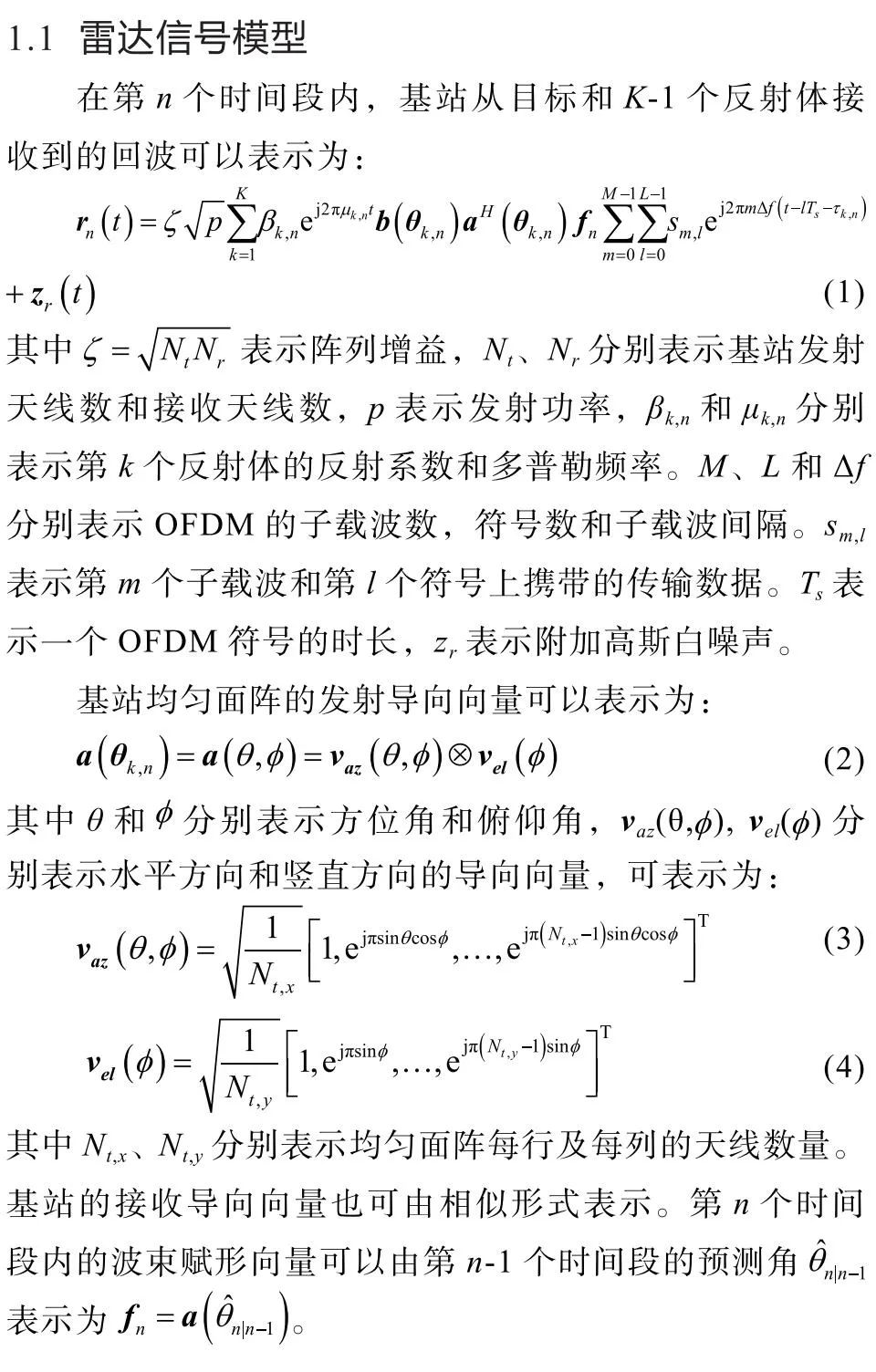
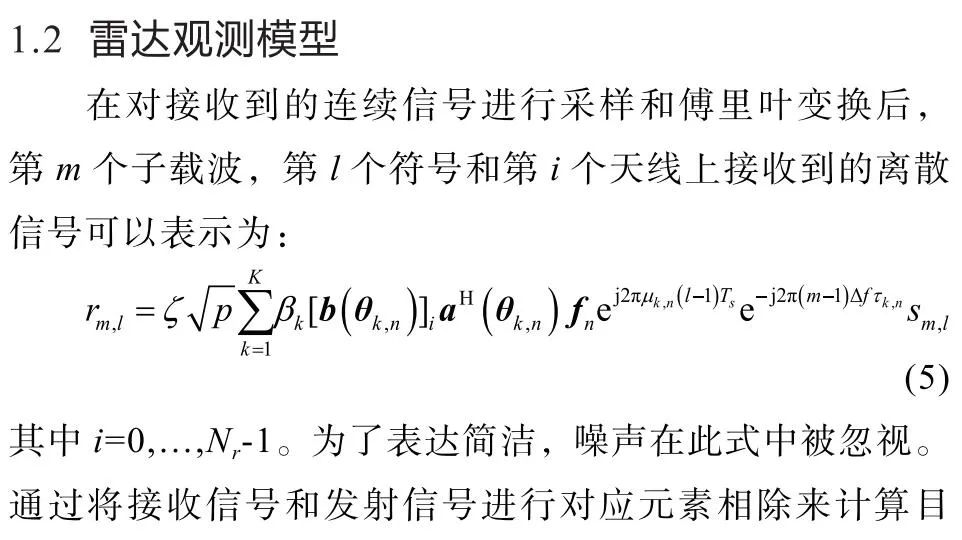
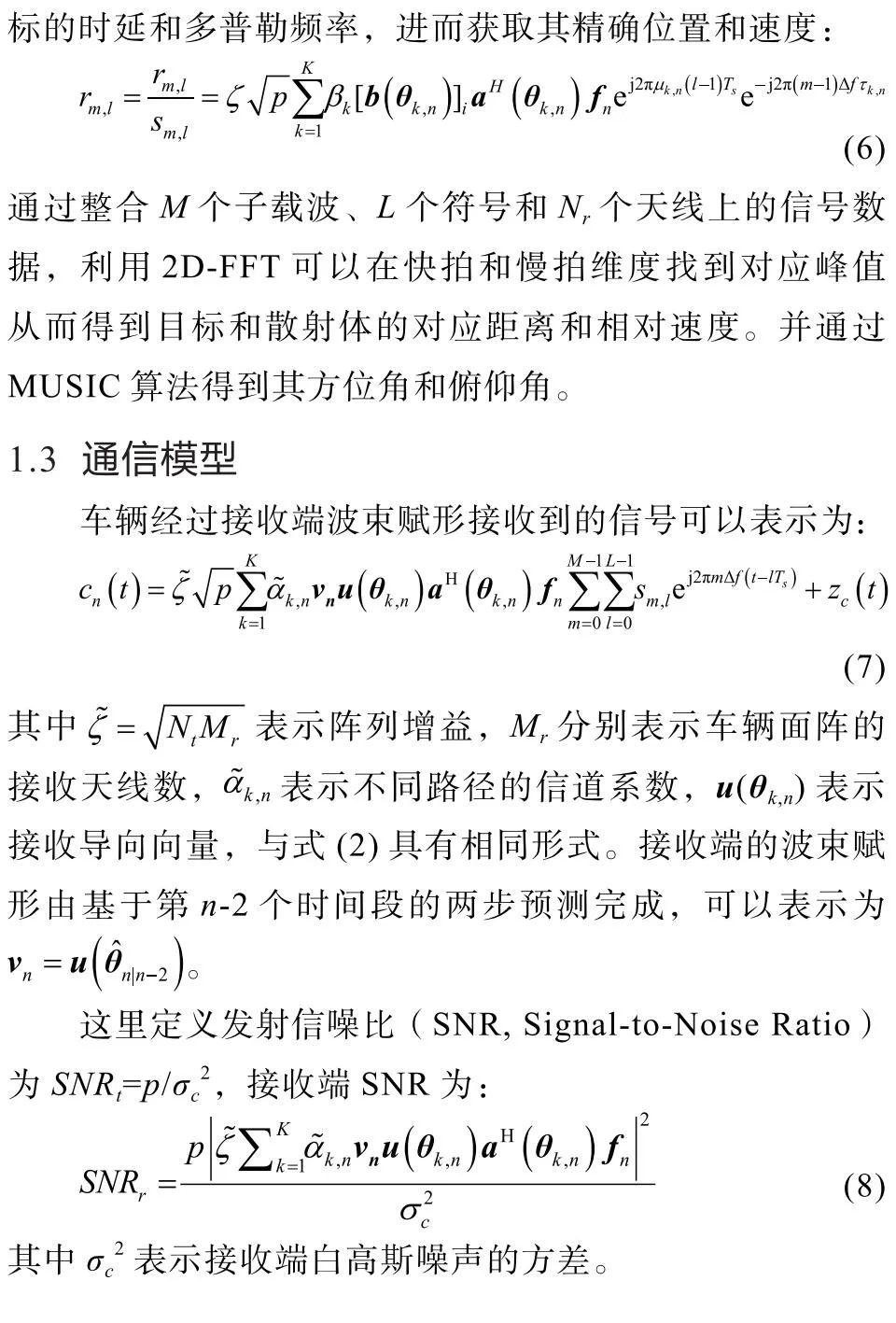
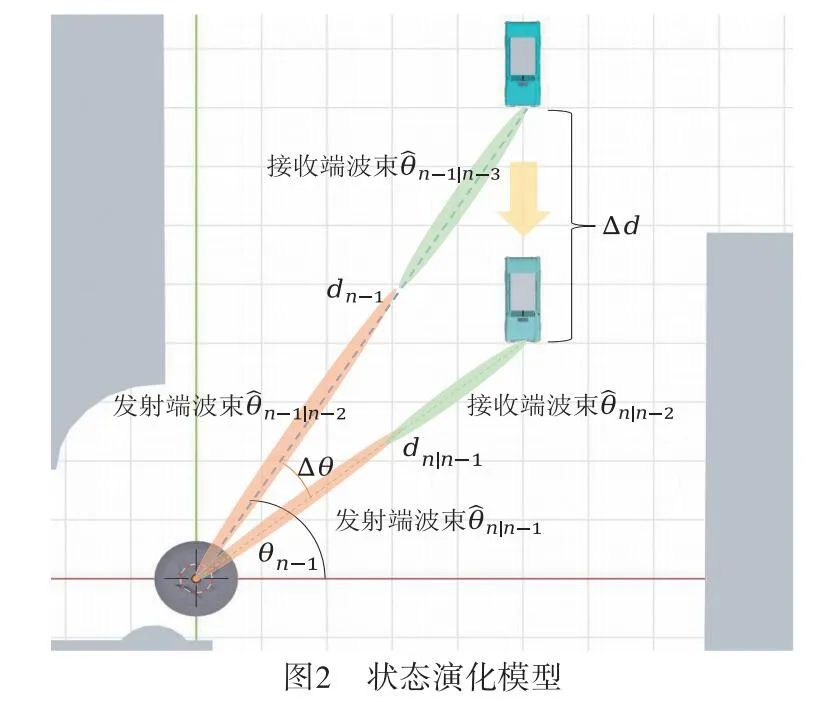
This paper considers communication between a base station equipped with a large-scale uniform planar array and a vehicle traveling along a straight line in the millimeter-wave band, with the channel including as shown in Figure 1 both line-of-sight and non-line-of-sight channels. All parameters are defined within the time period t∈[0, Tmax], where Tmax represents the longest simulation time and can be divided into several shorter time intervals ΔT. The angle, distance, and speed of the vehicle during the nth time period can be represented as θn, dn, and vn, respectively.
2 5G NR Sensing-Assisted Communication
2.1 NR Frame Structure
Like LTE, 5G NR still uses OFDM waveforms with cyclic prefixes. NR supports up to 7 parameter sets[14], with the relationship between subcarrier spacing and parameter set number μ being Δf=2μ·15 kHz, 0≤μ≤6. Although NR supports different parameter sets, the lengths of wireless frames and subframes remain unchanged at 10 ms and 1 ms, respectively. Each subframe can be further divided into 2μ time slots, with each time slot consisting of either 14 symbols with a normal cyclic prefix or 12 symbols with an extended cyclic prefix. Under dynamic time division multiplexing, symbols in the time slots can be used for downlink, uplink, and flexible configurations, providing more possibilities for different transmission scenarios.
2.2 NR Beam Management
Beam management is a crucial component in establishing and maintaining links between user equipment and millimeter-wave base stations, widely used for initial access by idle users and beam tracking for connected users to provide optimal beam pairs and improve beamforming gain and communication quality[15].
(1) Initial Access
Initial access consists of three stages, where the base station searches for the best downlink beam by scanning beamforming synchronization signal blocks and channel state information reference signals (CSI-RS) and utilizing feedback provided by users. The base station repeatedly sends the best downlink beam for beam scanning on the user side, selecting the best uplink beam to establish the optimal beam pair[16-17].
(2) Connection Mode
After initial access, the data transmission link between the user and the base station is established, transitioning the user from idle mode to connected mode[18]. To facilitate users in obtaining transmission resource scheduling information, the downlink control channel carrying downlink control information will be transmitted first. Data transmission will primarily be carried by the downlink shared channel[19], which embeds various reference signals, such as demodulation reference signals (DMRS), CSI-RS, and phase tracking reference signals (PTRS). DMRS is mainly used for coherent demodulation of data, and NR supports different embedding methods, densities, and additional DMRS. CSI-RS is used to obtain downlink channel state information, and its configuration in NR is highly flexible. Specifically, the base station can configure up to 32 CSI-RS antenna ports, and there are two codebooks available based on the number of panels and users in MIMO. Feedback reports for CSI-RS often include parameters such as rank indicator (RI), precoding matrix index (PMI), and channel quality information (CQI). PTRS is mainly used to compensate for phase errors caused by local oscillators.
(3) NR-Based Integrated Sensing Internet of Vehicles
All the reference signals mentioned above can be seen as overhead in the communication system, as they occupy time-frequency resources to transmit known signals to both parties rather than user data. Excessive overhead will limit communication performance, especially in highly dynamic application scenarios like the Internet of Vehicles. The embedded CSI-RS in the downlink shared channel is primarily used for channel detection, and its feedback parameters such as precoding matrices can be used to design beamforming for the next period. However, if integrated sensing signals are utilized reasonably in the Internet of Vehicles, it will effectively reduce the use of reference signals and improve the overall system throughput.
Specifically, consider a single-user single-layer MIMO Internet of Vehicles scenario. The uplink feedback report for CSI-RS includes information such as PMI and CQI. However, utilizing the echo of integrated sensing signals, the base station can extract numerous dynamic information about the vehicle from the echoes while assessing channel quality based on the feedback echo power. This information can be used to design beamforming for the next time slot. Therefore, in integrated sensing Internet of Vehicles, the transmission of CSI-RS can be eliminated, and the time-frequency resources occupied by CSI-RS can be utilized for transmitting communication data, which will reduce the overhead of the communication system and enhance data transmission throughput. On this basis, the Extended Kalman Filtering can be employed to predict and track the dynamic parameters of the vehicle.
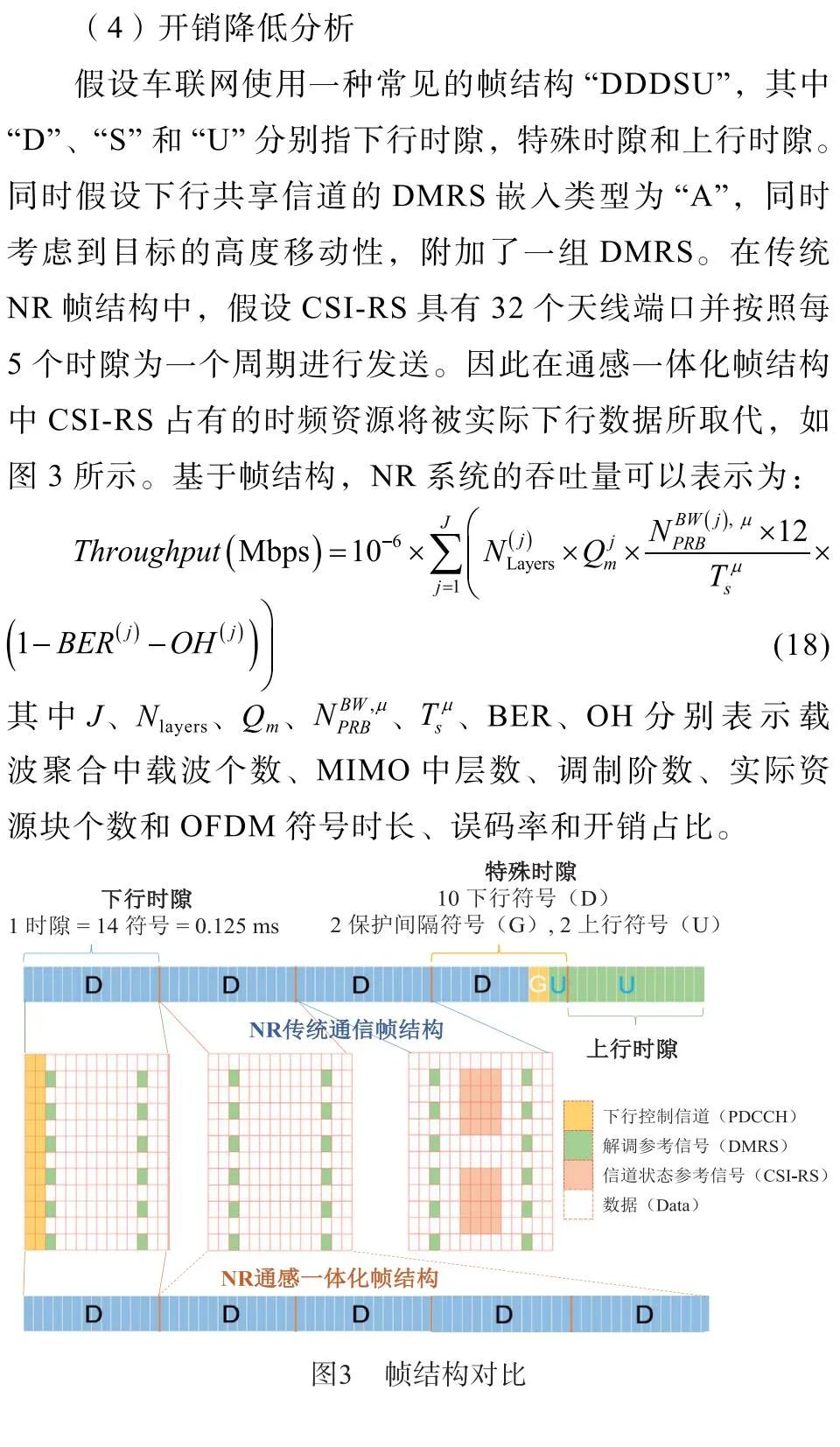
From Figure 3, it can be seen that in one cycle and one resource block, DMRS occupies 42 resource units, while CSI-RS occupies 32 resource units. By utilizing Extended Kalman Filtering for predicting and tracking users, CSI-RS will be eliminated in integrated sensing Internet of Vehicles, thus the overhead reduction can be as high as 32/(42+32)=43.24%. Moreover, since integrated sensing Internet of Vehicles uses echo signals for target detection and analysis, uplink feedback and protection intervals can also be replaced by downlink user data, which will enhance downlink throughput and utilize spectrum resources more efficiently.
3 Experimental Results
As shown in Figure 1, the simulation scenario involves a vehicle driving along a road among buildings while maintaining communication with the base station, which includes both line-of-sight and non-line-of-sight channels. The base station is located at the origin at a height of 4 m, and the initial position of the vehicle is (25 m, 40 m) at a height of 1 m, assuming the vehicle’s speed fluctuates around 20 m/s.
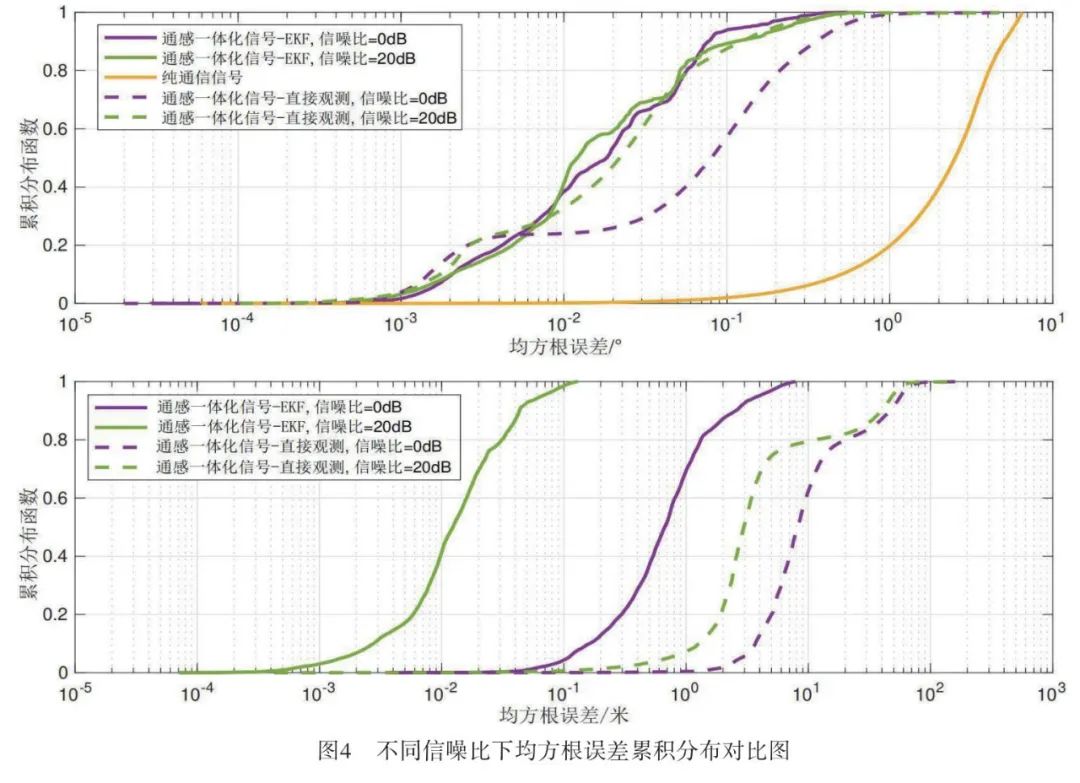
Figure 4 first displays the tracking conditions of angle and distance under different signal-to-noise ratios through the cumulative distribution function of the root mean square error. The beamforming of traditional NR pure communication signals must adhere to the CSI-RS codebook, thus the beamforming direction can only point to specific angles in the codebook. In contrast, integrated sensing combined with Extended Kalman Filtering can accurately predict and track changes in angle and distance, leading to significant improvements in the mean square error of angle and distance under this system.
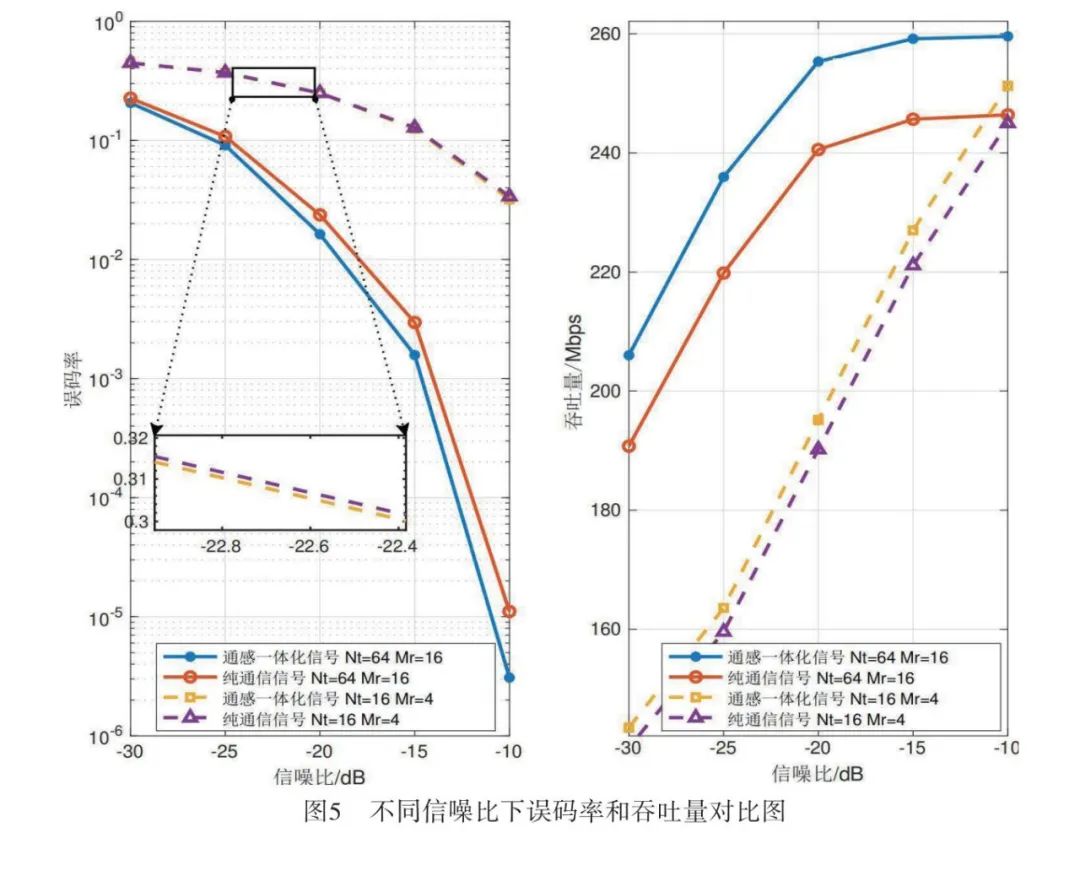
In Figure 5, the impact of bit error rate and throughput with respect to signal-to-noise ratio is explored under different numbers of transmitting and receiving antennas. As the signal-to-noise ratio increases, the bit error rates of both systems decrease, and throughput increases. Compared to the pure communication system, the integrated sensing system exhibits slightly better performance in bit error rate, and due to the significant reduction in overhead, there is a substantial improvement in throughput. Additionally, with an increase in the number of antennas, the array gain becomes larger, thus significant performance improvements can be observed in terms of bit error rate and throughput. Notably, the intersection of the two lines in the figure is due to the fact that at high SNR, throughput is primarily influenced by the proportion of overhead.
4 Conclusion
This paper proposes the use of integrated sensing signals in NR Internet of Vehicles, leveraging the information in their echoes and methods like Extended Kalman Filtering for vehicle prediction and tracking. This approach aims to efficiently utilize the sensing capabilities of integrated sensing signals to reduce the use of reference signals in traditional communication, thereby improving the utilization of spectrum resources. Link-level simulation results indicate that the proposed algorithm and frame structure can effectively enhance the accuracy of beam tracking and the throughput of the communication system.
References:(Scroll to browse)
[1] Wymeersch H, Seco-Granados G, Destino G, et al. 5G mmwave positioning for vehicular networks[J]. IEEE Wireless Communications, 2017,24(6): 80-86.
[2] Ghods A, Severi S, Abreu G. Localization in V2X communication networks[C]//IEEE Intelligent Vehicles Symposium (IV). IEEE, 2016: 5-9.
[3] Rappaport T S, Sun S, Mayzus R, et al. Millimeter wave mobile communications for 5G cellular: It will work![J]. IEEE Access, 2013,1: 335-349.
[4] Heath R W, Gonzlez-Prelcic N, Rangan S, et al. An overview of signal processing techniques for millimeter wave MIMO systems[J]. IEEE Journal on Selected Topics in Signal Processing, 2016,10(3): 436-453.
[5] Liu F, Masouros C, Petropulu A P, et al. Joint radar and communication design: Applications, state-of-the-art, and the road ahead[J]. IEEE Transactions on Communications, 2020,68(6): 3834-3862.
[6] González-Prelcic N, Méndez-Rial R, Heath R W. Radar aided beam alignment in mmWave V2I communications supporting antenna diversity[C]//2016 Information Theory and Applications Workshop (ITA). IEEE, 2016: 1-7.
[7] Liu F, Masouros C. A tutorial on joint radar and communication transmission for vehicular networks-Part I: Background and fundamentals[J]. IEEE Communications Letters, 2020,25(2): 322-326.
[8] Liu F, Masouros C. A tutorial on joint radar and communication transmission for vehicular networks-Part II: State of the art and challenges ahead[J]. IEEE Communications Letters, 2020,25(2): 327-331.
[9] Liu F, Masouros C. A tutorial on joint radar and communication transmission for vehicular networks-Part III: Predictive beamforming without state models[J]. IEEE Communications Letters, 2020,25(2): 332-336.
[10] Liu F, Yuan W, Masouros C, et al. Radar-assisted predictive beamforming for vehicular links: Communication served by sensing[J]. IEEE Transactions on Wireless Communications, 2020,19(11): 7704-7719.
[11] Yuan W, Liu F, Masouros C, et al. Bayesian predictive beamforming for vehicular networks: A low-overhead joint radar-communication approach[J]. IEEE Transactions on Wireless Communications, 2020,20(3): 1442-1456.
[12] Du Z, Liu F, Yuan W, et al. Integrated sensing and communications for V2I networks: Dynamic predictive beamforming for extended vehicle targets[J]. IEEE Transactions on Wireless Communications, 2022.
[13] Meng X, Liu F, Masouros C, et al. Vehicular connectivity on complex trajectories: Roadway-geometry aware ISAC beam-tracking[J]. IEEE Transactions on Wireless Communications, 2023.
[14] 3GPP. 3GPP TS 38.211: NR; Physical channels and modulation[S]. 2022.
[15] 3GPP. 3GPP TR 38.802: Study on New Radio (NR) Access Technology-Physical Layer[S]. 2017.
[16] 3GPP. 3GPP TS 38.300: NR; NR and NG-RAN Overall Description[S]. 2023.
[17] 3GPP. 3GPP TS 38.213: NR; Physical layer procedures for control[S]. 2023.
[18] 3GPP. 3GPP TR 38.804: Study on New Radio Access Technology Radio Interface Protocol Aspects[S]. 2017.
[19] 3GPP. 3GPP TS 38.331: NR; Radio Resource Control (RRC); Protocol specification[S]. 2023.
[20] Kay S M. Fundamentals of Statistical Signal Processing, Vol. I: Estimation Theory[M]. Englewood Cliffs, NJ, USA: Prentice Hall, 1998. ★
★ Scan the QR code to read and download this paper on CNKI

★ The original text was published in the “Mobile Communications” 2023 Issue 9★
doi:10.3969/j.issn.1006-1010.20230817-0001
Classification Number: TN929.5 Document Identifier Code: A
Article Number: 1006-1010(2023)09-0040-06
Citation Format: LI Yunxin, LIU Fan, DU Zhen, et al. Low-Cost Transmission Techniques for Sensing-Assisted Communications in 5G NR Internet of Vehicles[J]. Mobile Communications, 2023,47(9): 40-45.
LI Yunxin, LIU Fan, DU Zhen, et al. Low-Cost Transmission Techniques for Sensing-Assisted Communications in 5G NR Internet of Vehicles[J]. Mobile Communications, 2023,47(9): 40-45.
 Author InformationLI Yunxin:PhD student at Southern University of Science and Technology, focusing on the integration of communication sensing models and B5G/6G protocol design.LIU Fan:Currently an Assistant Professor, Associate Researcher, and PhD supervisor in the Department of Electrical and Electronic Engineering at Southern University of Science and Technology. Recognized as a young talent by the China Association for Science and Technology and introduced as a top talent under the Pearl River Plan in Guangdong Province. A Marie Curie Scholar, his main research areas include integrated communication sensing, Internet of Vehicles, and intelligent transportation. He won the IEEE Communications Society’s Rice Award and the IEEE ICC Best Paper Award in 2023, the First Prize for Scientific Progress from the China Communications Society in 2022, and the Best Paper Award for Young Authors from the IEEE Signal Processing Society in 2021.DU Zhen:Received his PhD from Shanghai Jiao Tong University and is currently a lecturer at Nanjing University of Information Science and Technology, focusing on integrated sensing systems, beam management in the Internet of Vehicles, and radar signal processing.YUAN Weijie:Assistant Professor, Associate Researcher, and PhD supervisor in the Department of Electrical and Electronic Engineering at Southern University of Science and Technology. Recognized as a young talent by the China Association for Science and Technology, his main research areas include OTFS delay-Doppler domain communication and integrated communication sensing. He won the IEEE ICC Best Paper Award in 2023 and the First Prize for Scientific Progress from the China Communications Society in 2022.
The submission method for “Mobile Communications” is online submission
Please log in to the web submission system
Link address:http://ydtx.cbpt.cnki.net
 HighlightsTable of Contents | 2023 Issue 10 Topic: Mobile Self-Organizing NetworksTable of Contents | 2023 Issue 9 Topic: 6G Intelligent SensingIoT Technologies for 6G | 2023 Issue 8 TopicResearch Papers (11 articles)Integrated Networks for Air, Land, and Sea | 2023 Issue 7 Topic Papers (13 articles)
 #Scan to follow us# “Mobile Communications” interprets communication through papers
“Mobile Communications” magazine is supervised by China Electronics Technology Group Corporation and hosted by the 7th Research Institute of China Electronics Technology Group Corporation. It is a “Double Effect Journal” in the array of Chinese journals, a fine electronic journal of the Ministry of Industry and Information Technology of China, a source journal for statistics on Chinese scientific papers, and a journal included in the “High-Quality Science and Technology Journals Classification Directory” by the China Association for Science and Technology, and a journal included in Japan JST. Domestic continuous publication number: CN44-1301/TN, International Standard Serial Number: ISSN1006-1010, Postal distribution code: 46-181.