Highlights:2019 automotive IoT intellectual property status, patent operation agencies, and intellectual property operation mechanisms. The automotive IoT involves multiple industries including automotive, electronics, information communication, the internet, and transportation, and is in a critical stage of accelerated development. Industry predictions suggest that by 2020, the global automotive IoT market is expected to exceed 100 billion euros, with China accounting for one-third. Through comprehensive connectivity and efficient information exchange between people, vehicles, roads, and cloud platforms, the automotive IoT industry has spawned a large number of new product applications and has entered a strategic opportunity period before industrial explosion. Intellectual property protection and utilization capabilities have become important drivers for the development of the automotive IoT industry. This issue of Smart Insights recommends the research report “Automotive IoT Intellectual Property White Paper” from the China Communications Society, which deeply analyzes the current status and trends of domestic and international intellectual property in the automotive IoT from three aspects: the status of automotive IoT intellectual property, automotive IoT patent operation agencies, and automotive IoT intellectual property litigation.If you want to collect the report (Automotive IoT Intellectual Property White Paper), you can reply with the keyword “nc420” on Smart Insights (public account: zhidxcom) to obtain it.This issue’s insights source:China Communications SocietyOriginal title:“Automotive IoT Intellectual Property White Paper”Author:Li Wenyu et al.

Overview of the Automotive IoT Technology System
The so-called automotive IoT refers to the comprehensive network connection achieved through a new generation of information communication technology, enabling vehicles to connect with each other, with roads, with people, and with service platforms, thereby enhancing the intelligence level of automobiles, assisting driving, and enabling autonomous driving capabilities, constructing new business forms for automotive and transportation services, thus improving traffic efficiency, enhancing the driving experience, and providing users with intelligent, comfortable, safe, energy-efficient, and efficient comprehensive services.
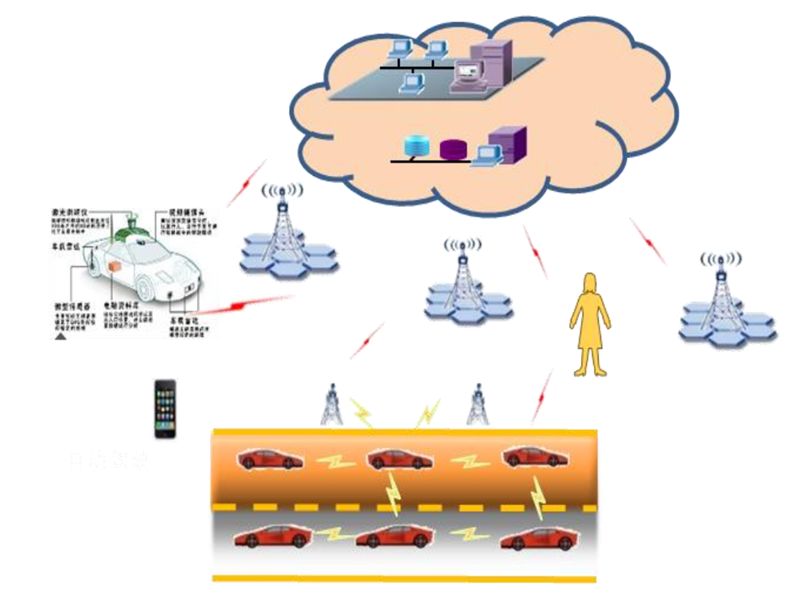 ▲ Automotive IoT
The automotive IoT is an important area of deep integration between informatization and industrialization, focusing on the implementation of 5G vertical applications, possessing enormous potential for industrial development, market application space, and considerable social benefits. It is of great significance for driving the transformation and upgrading of the automotive, transportation, and electronic information industries, as well as for systemic innovation and integrated development. Industry composition: The automotive IoT industry ecosystem is divided into three major links: “cloud”, “network”, and “terminal”.The key roles in the cloud include data and content providers, public and industry service providers, and communication service providers.The key roles in the “network” and “terminal” include vehicle manufacturers, system suppliers, key component suppliers, software providers, etc.From the perspective of industrial structure, the automotive IoT industry ecosystem consists of chip manufacturers, sensor manufacturers, terminal device manufacturers, integrators, platform operators, data service providers, and business providers.The roles within the automotive IoT industry chain are becoming increasingly diverse, reflecting the deep integration trend between the service industry and traditional manufacturing.Development status: The impact of the automotive IoT on the traditional automotive industry is manifested in the growth of intelligence and connectivity levels. Sensor manufacturers, operating systems, and autonomous driving systems have promoted the enhancement of automotive intelligence, while network operators and road testing unit equipment manufacturers have accelerated the process of automotive connectivity.Advantageous national and regional industrial policies: Countries and regions such as the United States, Europe, and Japan, which are at the forefront of automotive IoT industry development, continue to support technological innovation and research and development in the automotive IoT field at the policy level, and actively create adaptive conditions for the development of the automotive IoT and autonomous driving fields through legislation and revision of laws.In 2015, the U.S. government released the “U.S. Intelligent Transportation Systems (ITS) Strategic Plan”, focusing on achieving automotive IoT and promoting vehicle automation, planning five major themes: safety, efficiency, environment, intelligence, and information sharing.Europe emphasizes top-level design and new technology research and development for automotive IoT, viewing automotive IoT technology as a key technology related to the future core competitiveness of the country. Governments in various European countries invest heavily to guide the development of the automotive IoT industry, forming a three vertical and four horizontal development strategy.Japan started research in intelligent transportation information early, with the government directly participating in the promotion of the automotive IoT industry, supporting the application of new technologies in automotive intelligence, and implementing key promotion measures in intelligent transportation and autonomous driving fields. In 2014, the Japanese government implemented the “Autonomous Driving System Research and Development Plan”, proposing the goal of popularizing fully autonomous vehicles by 2030.Future trends: The integration of connectivity and intelligence is becoming the main trend in the development of the automotive IoT industry. The development plans for automotive IoT in the United States and Japan propose strategies for the integration of connectivity and intelligence, while the EU has proposed development goals that combine informatization and intelligence. China’s “Made in China 2025” development outline states that automotive IoT technology should be equipped with advanced onboard sensors and chips, integrating advanced information communication technology, enabling complex environmental perception, intelligent decision-making, and automated control functions, achieving zero casualties and zero congestion in transportation, and meeting the safety, efficiency, and energy-saving requirements for the next generation of automotive development.The automotive IoT is the area of the Internet of Things with the clearest market demand. Industry predictions suggest that the global automotive IoT market is expected to exceed 100 billion euros in 2020, with China accounting for about one-third. Currently, the development of automotive IoT technology and service capabilities is continuously improving, forming efficient information exchange between automotive IoT platforms, vehicles, road testing facilities, and pedestrians, which has spawned a large number of new products and services. The automotive IoT has entered a strategic opportunity period before industrial explosion, and intellectual property protection and utilization capabilities have become important drivers for the development of the automotive IoT industry.The automotive IoT technology system includes vehicle data collection, aggregation and transmission technology, automotive IoT data analysis and decision-making technology, and automotive IoT business operation and management technology, specifically involving automotive IoT V2X, onboard components, autonomous driving, automotive IoT-related edge computing, automotive IoT security technology, and automotive IoT services.

Status of Automotive IoT Intellectual Property
As of September 2019, the total number of patent applications in the global automotive IoT field has reached 114,587, with a total of 98,576 after merging family patents.
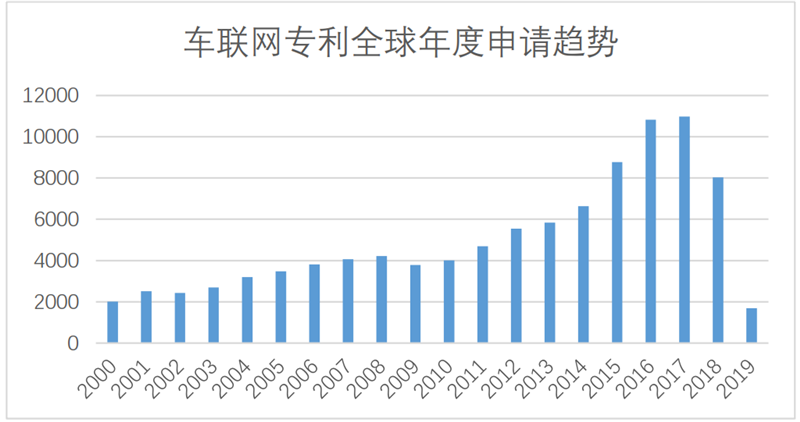 ▲ Global annual application trend of automotive IoT patents
Globally, the patent applications for automotive IoT technology show an overall growth trend, which can be roughly divided into two phases: the first phase from 2000 to 2009 was a starting-slow growth phase. During this period, due to the limitations of information communication technology development levels and the public’s vehicle penetration rate, the development of automotive IoT technology was in a stage of technical development and accumulation under limited conditions, represented by typical applications such as in-vehicle entertainment and navigation. Applicants during this phase were mainly traditional automotive industrial and electronic information powerhouses such as the United States and Europe, with annual application volumes generally maintained below 4,000 items. The second phase from 2010 to 2019 was a period of rapid development, with annual application volumes showing a significant year-on-year growth trend. With the rapid development of mobile communication technology, the network’s support capacity for information transmission and application has provided the basic guarantee for the widespread emergence of IoT technology. As a typical application branch of the Internet of Things, the automotive IoT field has attracted an increasing number of innovative entities from non-traditional automotive industries, stimulating the growth of patent applications in automotive IoT technology.As of September 2019, the total number of patent applications in the automotive IoT field in China has reached 33,895, with a total of 24,571 after merging family patents.
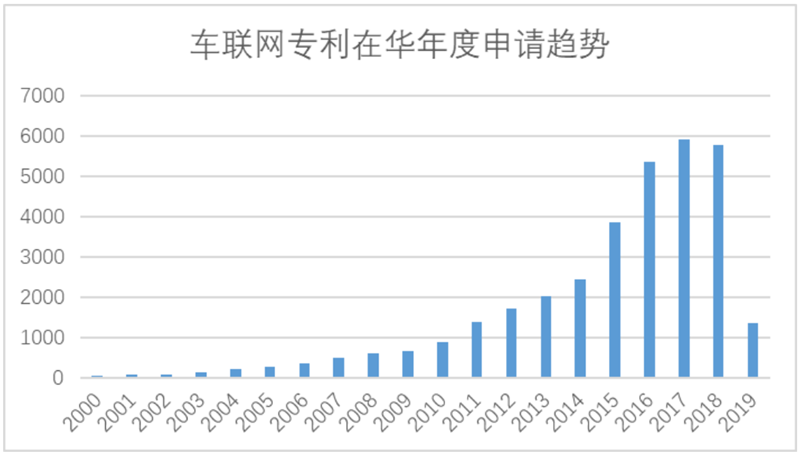 ▲ Annual application trend of automotive IoT patents in China
From the trend of annual distribution of patent applications in China’s automotive IoT technology, there were a total of 29,870 patent applications from 2011 to 2019; especially after 2015, there was a rapid growth. Combined with the global patent application trends, the growth rate of patent applications in the Chinese region is far greater than that of the global scope. Particularly around 2015, the innovation of 5G communication system technology has provided objective application conditions for achieving autonomous driving, leading to a surge in patent applications in this field driven by a peak of innovations in V2X technology and autonomous driving-related technologies.
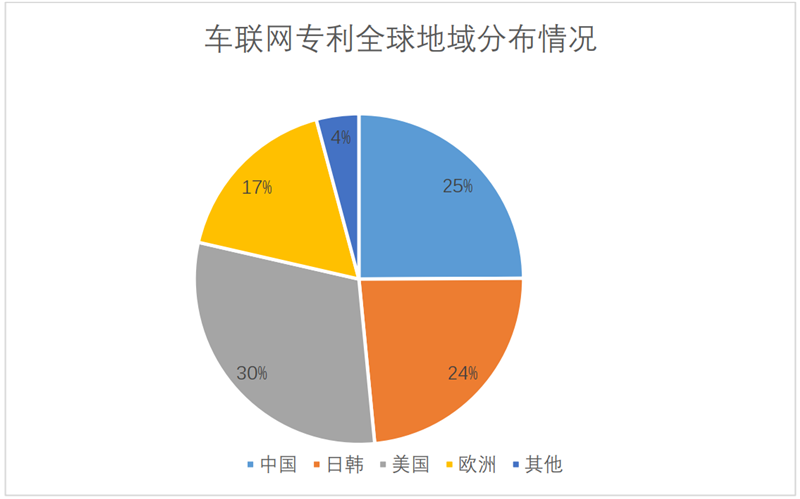 ▲ Global regional distribution of automotive IoT patents
From the perspective of regional distribution, the country with the highest number of accepted patent applications in the automotive IoT field is the United States, followed by China, Japan, South Korea, and Europe. China is the second-largest target market for automotive IoT patents. Although China’s automotive industry technology strength lags behind that of Europe and the United States and Japan, it holds an important market position in the automotive IoT field.
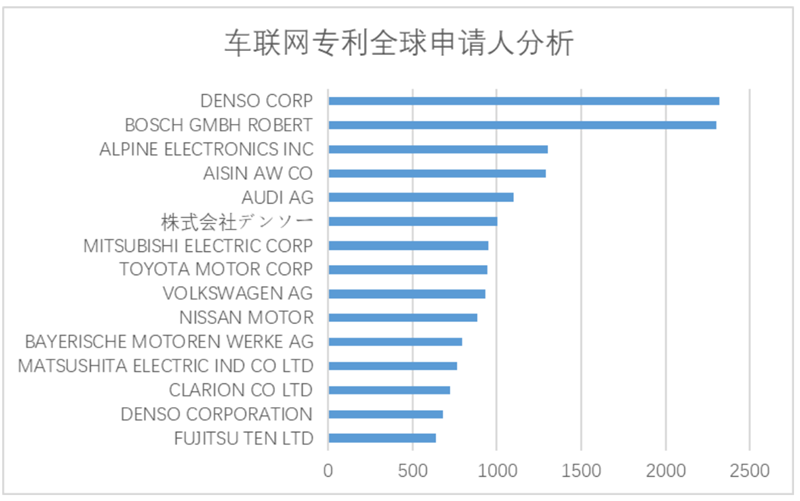 ▲ Analysis of global automotive IoT patent applicants
From the statistics of global patent applicants, the current top 15 applicants are mainly automotive parts companies and vehicle manufacturers. Due to historical reasons, parts manufacturers and vehicle manufacturers were early investors in automotive IoT technology, accumulating a large number of early automotive IoT technology patents. Information communication applicants entered the field of automotive IoT technology innovation relatively late, resulting in a relatively small cumulative application volume compared to automotive manufacturers.
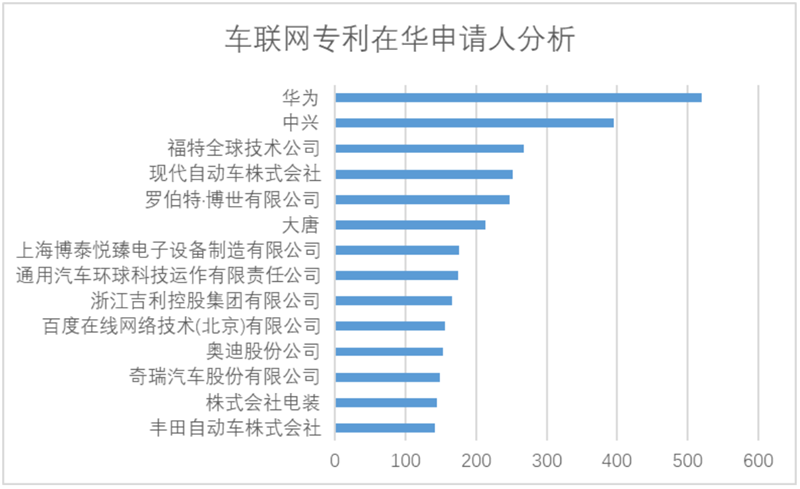 ▲ Analysis of automotive IoT patent applicants in China
Applicants in China consist of domestic communication companies, foreign communication companies, foreign automotive manufacturers, foreign automotive parts manufacturers, domestic automotive manufacturers, domestic internet companies, and domestic automotive IoT specialized companies. Domestic applicants have certain advantages in onboard communication technology and onboard communication terminal devices, while foreign applicants mainly consist of automotive manufacturers and parts manufacturers.
1. Patent Landscape of Key Automotive IoT Technologies
Automotive IoT V2X technology.Automotive IoT (V2X) wireless communication technology connects vehicles with everything, where V represents vehicles and X represents any objects interacting with the vehicle, including vehicle-to-vehicle (V2V), vehicle-to-infrastructure (V2I), vehicle-to-pedestrian (V2P), and vehicle-to-network (V2N). The automotive IoT is a new industrial form that deeply integrates the automotive, electronics, information communication, and road transportation industries, with V2X playing an important role.Based on the underlying communication technology of V2X, an ecosystem is formed consisting of chip companies, communication manufacturers, OEMs, Tier 1 suppliers, infrastructure suppliers, ITS software developers, automotive IoT solution providers, road operators, and mobile network operators.Currently, the mainstream V2X wireless communication technologies internationally are 802.11p and C-V2X (Cellular-V2X). The wireless communication technology standard based on IEEE 802.11P was released early, and experimental testing is relatively comprehensive, with chip manufacturers such as NXP and Qualcomm having launched relatively mature products. Automotive manufacturers have also formed relatively complete solutions. However, due to the differences in technical conditions and business needs at that time, there are certain gaps in capacity and anti-interference compared to current demands. C-V2X has matured over 10 years of wireless technology development, with scheduling, interference algorithms, and other technologies becoming more mature, and public network auxiliary modes becoming possible. Adapting to new application scenarios and meeting higher business demands, LTE-V2X technology has a clear technological evolution route with demand development, gradually evolving towards 5G V2X, which is significant for the existing automotive environment.
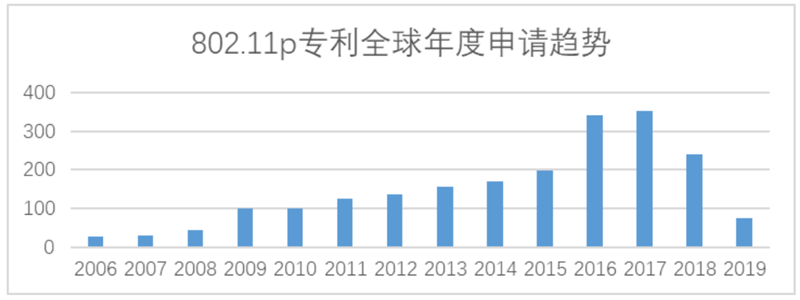 ▲ 802.11p technology patent trend
As of September 2019, the number of global patent applications for 802.11p-type V2X technology was 2,791, with a total of 2,532 after merging family patents.The patent applications in this technological direction show a relatively slow year-on-year growth trend, which can be roughly divided into two phases: before 2012, the average annual application volume was around 100 items, while in the last five years, the average annual application volume has been around 200 items. The first phase of patent applicants mainly consisted of traditional automotive enterprises, electronic component manufacturers, and communication manufacturers. The second phase from 2013 to 2019 saw rapid development in automotive IoT technology, with an increasing number of non-traditional automotive industry innovators, such as dedicated automotive IoT technology companies, software companies, and internet companies, participating in the competition in the automotive IoT V2X field.Demand from market consumers has gradually shifted from traditional automotive single driving needs to more diversified demands involving vehicle connectivity technologies, and this diversification of demands has driven the automotive IoT communication technology’s support capabilities for scenarios and use cases to continuously enrich.These two factors have simultaneously stimulated innovation and patent application growth in automotive IoT communication technology.
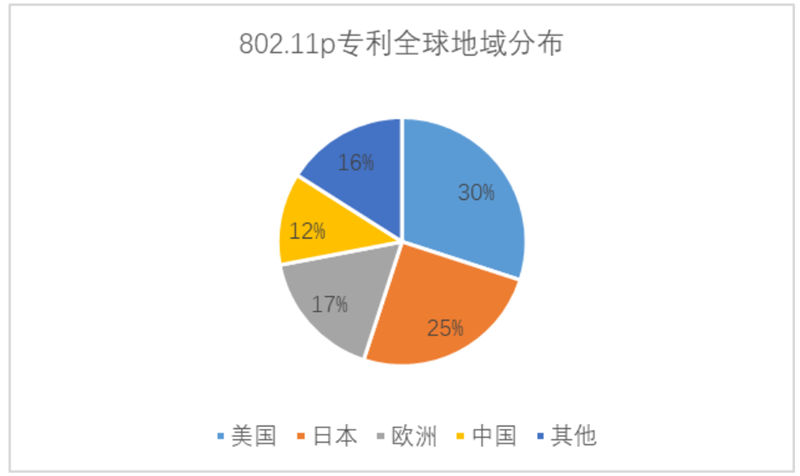 ▲ Global regional distribution of 802.11p patents
From the perspective of regional patent quantity share, the region with the most patents based on 802.11p DSRC automotive IoT communication technology is the United States, followed by Japan, Europe, and China. The patent application volume in the U.S. accounts for 30% of the total analyzed in major countries and regions, making the U.S. the largest patent layout target country for 802.11p-related technologies in the V2X field.It is worth noting that the number of patent applications entering Japan and the United States is lower than the number of their original patent applications, which to some extent reflects the overall strength of technology and patent layout in the 802.11p technology direction in the U.S. and Japan, primarily focusing on technology export and holding an important position in other countries’ markets. Domestic small and medium-sized automotive IoT companies do not care about taking sides, and have formed certain patent deployments along the 802.11p route.
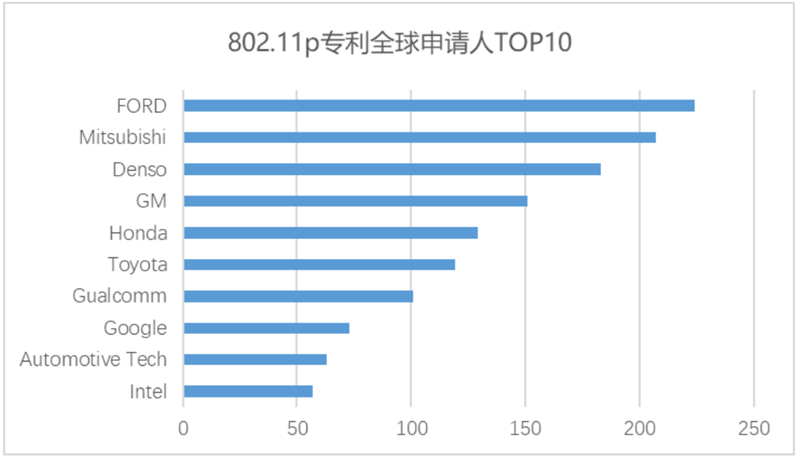 ▲ Distribution of global 802.11p patent applicants
Globally, the top ten applicants in terms of application volume are Denso, Ford, Mitsubishi, GM, Honda, Toyota, Qualcomm, Automotive Technology International, Google, and Intel. The total application volume of the top ten applicants exceeds 1,159 items, accounting for over 50% of the total application volume, indicating a concentration of patent holdings among leading companies in this field.The top ten applicants can generally be divided into vehicle manufacturers, automotive parts manufacturers, semiconductor chip manufacturers, and communication companies, with the top three in terms of patent application volume being traditional automotive manufacturers or parts manufacturers, with an average patent holding of around 200 items.Additionally, companies such as Bosch, which play an important role in the 802.11p industry and market competition, have not given sufficient attention to patents, resulting in fewer patent applications.From the perspective of domestic patent acceptance, as of September 2019, the number of patent applications for 802.11p-type V2X technology in China was 362, with a total of 341 after merging family patents.
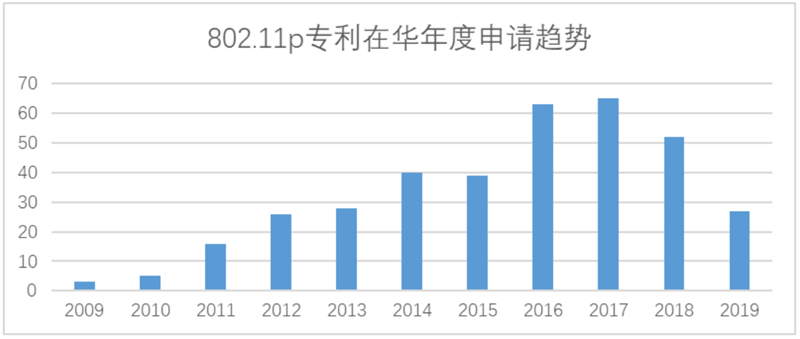 ▲ Annual application trend of 802.11p patents in China
This technology direction shows a relatively slow year-on-year growth trend in China, which is roughly consistent with the global trend and can be divided into two phases: before 2013, the average annual application volume was below 30 items. The second phase from 2014 to 2019, with the development of the automotive IoT industry, has seen more innovative entities participate in technological innovation and market competition, while market consumer demand has gradually shifted towards a more diversified direction, effectively promoting the automotive IoT communication technology’s support capabilities for scenarios and use cases.The cumulative growth trend of technological innovation results in this field has been slow.Domestic applicants in this field mainly consist of foreign companies, small and medium-sized electronic device companies, and technology service companies in the transportation industry.
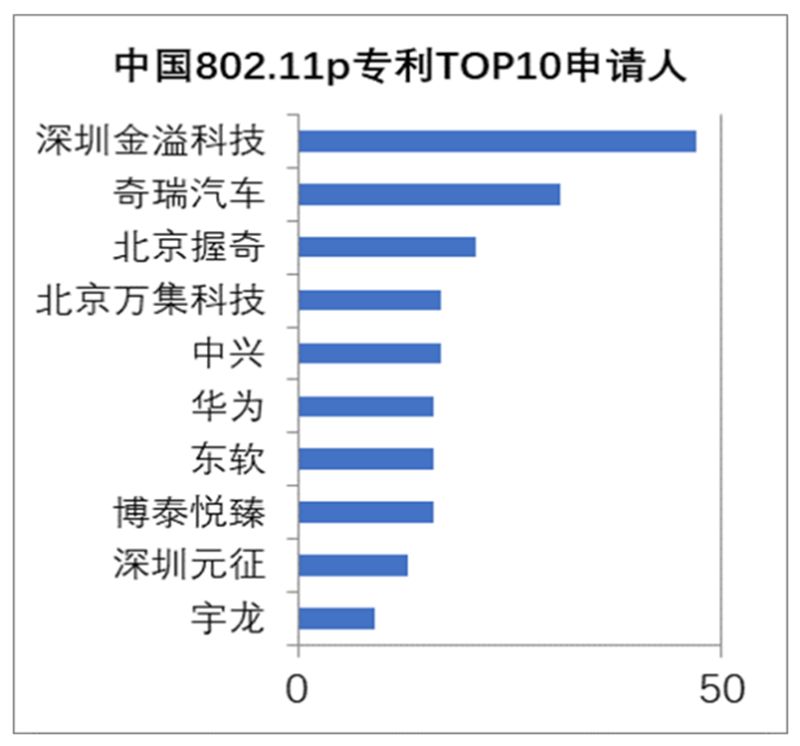 ▲ Distribution of 802.11p patent applicants in China
The top ten applicants for 802.11p patents in China are Shenzhen Jinyi Technology, Chery Automobile, Beijing Woqi, Beijing Wanjic Technology, ZTE, Huawei, Neusoft, Botai Yuzhen, Shenzhen Expedition, and Yulong; the applicant types are mainly automotive IoT technology companies, followed by automotive manufacturers and communication companies. Foreign companies do not hold an advantage in patent numbers in China and have not made it into the top ten.
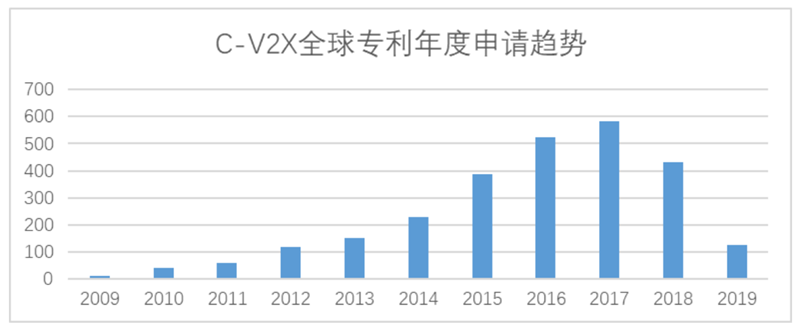 ▲ C-V2X global annual application trend
As of September 2019, the global number of patent applications for C-V2X technology was 4,201, with a total of 2,774 after merging family patents.This technology direction has shown a relatively rapid growth trend in patent applications over the past five years, with annual application volumes exceeding 500 items after 2016. With the development and commercial maturity of 4G wireless communication technology, cellular wireless communication technology has become an increasingly important technical means in communication scenarios between vehicles and vehicles, vehicles and road infrastructure, vehicles and networks, and vehicles and people, prompting manufacturers across the communication industry chain to increase their technological research and development and patent application efforts in the automotive IoT field.China’s leading communication companies have independent intellectual property rights in the C-V2X technology field and have made significant contributions to standardization and patent applications in this field, holding a pivotal influence in the industry.
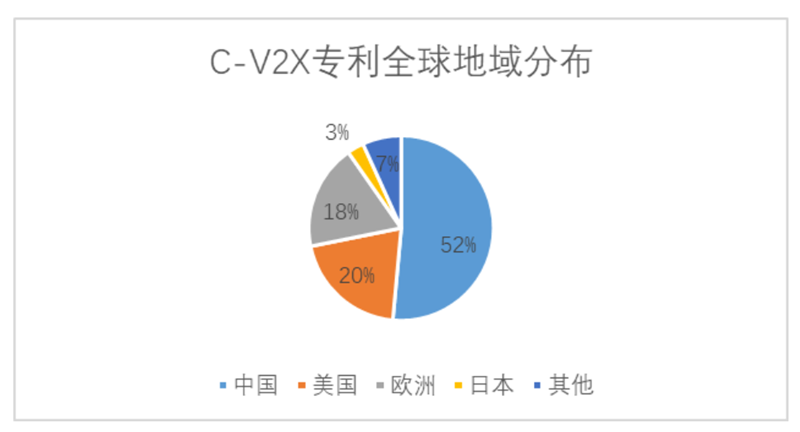 ▲ C-V2X global regional distribution of patents
From the perspective of regional patent quantity share, the region with the most patents for C-V2X automotive IoT communication technology is China, followed by the United States, Europe, and Japan. China’s patent application volume has exceeded 50% of the total analyzed in major countries and regions, making it the largest patent original country and layout target for C-V2X technology. Qualcomm, Intel, and other communication companies, as well as patent operation agencies such as Interdigital, and some mainstream automotive manufacturers are paying attention to patent applications and layouts in the C-V2X field. Chinese companies conducting overseas patent applications for C-V2X technology mainly include Huawei, ZTE, and Datang.
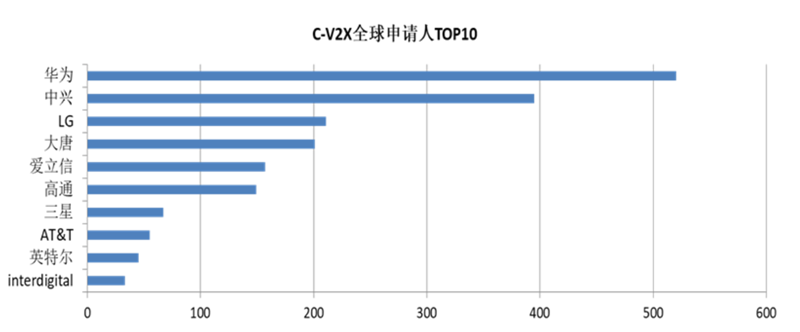 ▲ Distribution of C-V2X global patent applicants
Globally, the top ten applicants in terms of application volume are Huawei, ZTE, LG, Datang, Ericsson, Qualcomm, Samsung, AT&T, Intel, and Interdigital. The total application volume of the top ten applicants exceeds 1,800 items, accounting for nearly 50% of the total application volume, indicating a concentration of patent holdings among leading companies in this field.Unlike the applicant composition situation for 802.11p technology, the top ten applicants for C-V2X technology are mainly communication companies, including communication equipment providers, semiconductor chip manufacturers, and telecommunications operators, with their patent application numbers far exceeding those of traditional automotive manufacturers or parts manufacturers.As the industry continues to advance, the patent application activity of innovative entities in other segments of the industrial chain will gradually increase.From the perspective of domestic acceptance, as of September 2019, the number of patent applications for C-V2X technology in China was 1,326, with a total of 1,269 after merging family patents. The annual application trend for this technology in China is roughly consistent with the global trend, showing a relatively rapid growth trend over the past five years, with annual application volumes exceeding 200 items after 2015.
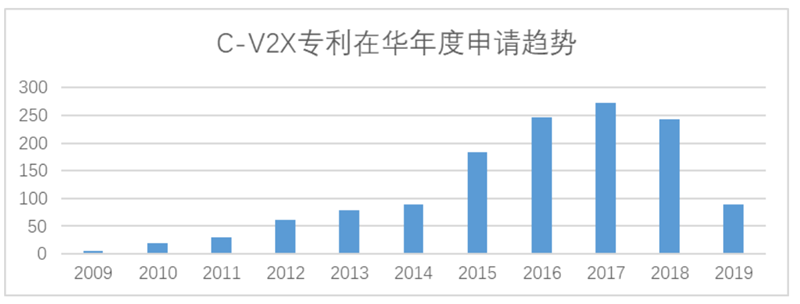 ▲ Annual application trend of C-V2X patents in China
Due to the relatively late standardization of LTE-V2X, the maturity of products has lagged, but with the continuous promotion from various sectors of the industry in recent years, the gap is gradually narrowing. From the statistics of patent application content, apart from the basic technologies of communication methods themselves, engineering and application-related patents associated with the industrial implementation have also seen good growth trends.A large number of innovative entities outside of leading communication companies are increasingly participating in the competitive landscape of C-V2X, including automotive IoT technology companies, automotive parts manufacturers, new automotive manufacturers, internet companies, and automotive IoT platform companies.
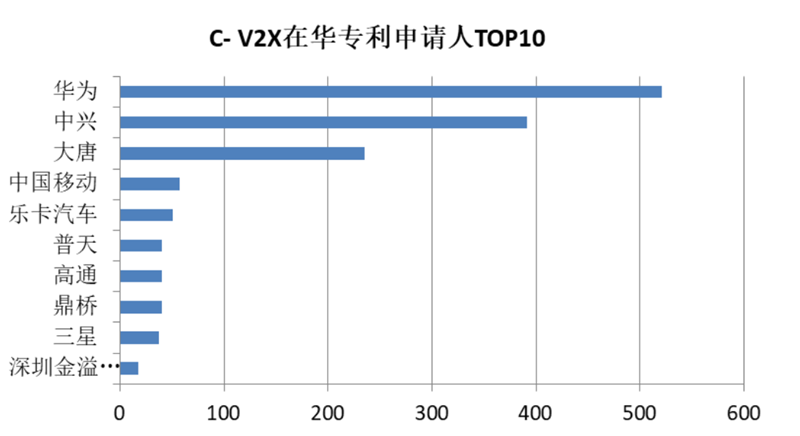 ▲ Distribution of C-V2X patent applicants in China
Unlike the 802.11p technology direction, the applicant types for C-V2X technology are mainly communication companies. Huawei, ZTE, and Datang hold significant advantages. China Mobile, Putian, Dingqiao, and other communication companies occupy the second tier. Internet automotive companies such as LeCar and technology companies in intelligent transportation and IoT, such as Shenzhen Jinyi Technology, pay considerable attention to patent applications. Foreign companies have a dispersed number of patents in China, with only Samsung entering the top ten in terms of application volume.
2. Components of Intelligent Connected Vehicles
With the acceleration of automotive intelligence, automotive semiconductors are rapidly growing, and onboard sensors, chips, and surrounding components are important technical links for intelligent connected vehicles.Onboard sensors include radar, V2X devices, high-definition cameras, and inertial navigation systems. The continuous innovation and development of advanced driver-assistance systems (ADAS) and autonomous driving technology have gradually increased the importance of onboard sensors in the industry. ADAS and autonomous driving technologies use various sensors installed in vehicles to collect data, perceiving the surrounding environment during driving, identifying, detecting, and tracking static and dynamic objects based on the collected data, and combining navigation map data for systematic computation and analysis, thus allowing drivers to be alerted to potential dangers in advance, effectively increasing the comfort and safety of driving.Onboard computing devices include MPUs, MCUs, and onboard AI chips. Placing MPUs, MCUs, and other computing devices in onboard systems gives vehicles strong computational and analytical capabilities. MCUs are typically microcontrollers that integrate CPUs, memory, counters, and other components on a single chip. MPUs can be understood as both processors and protection units, usually composed of grouped chips, with the main functions of computation, control, and judgment. In recent years, with the increase in intelligent driving penetration, global chip giants have entered the automotive industry, launching main control chips with AI computing capabilities. According to IHS forecasts, the market size for onboard main control chips is expected to grow rapidly, reaching $4 billion in 2020.
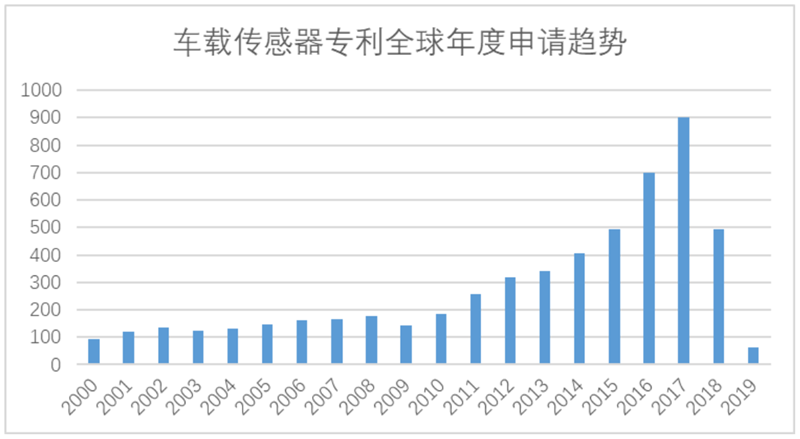 ▲ Global patent application trend for onboard sensor technologyPatent trends for onboard sensors. As of now, the global number of patent applications for onboard sensors has accumulated to 10,550, with a total of 8,799 after merging family patents. The patent application trend for this technology direction was relatively stable before 2010, as traditional onboard sensing technology had entered a relatively mature phase, with annual application volumes below 200 items. After 2010, driven by advancements in assistive driving technology, the technological innovation in this field entered a new phase, with patent application volumes showing a noticeable upward trend. In the future, autonomous driving will demand higher standards for active safety and high-precision positioning, leading to sustained growth in patent applications in the onboard sensor field.
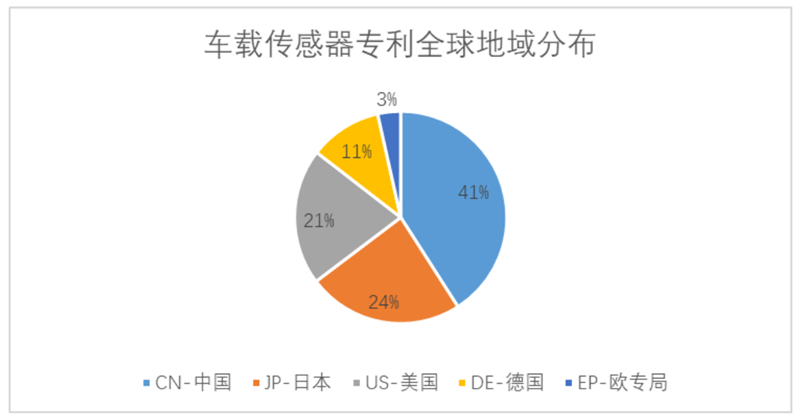 ▲ Global regional distribution of onboard sensor technology patents
From the perspective of regional patent quantity share, the region with the most patents for onboard sensors is China, followed by Japan, the United States, and Europe. China’s patent application volume has reached 40% of the global total, making it the largest patent layout target country for onboard sensor technology. Automotive manufacturers and parts manufacturers in Japan and the United States pay significant attention to patent applications and layouts in the onboard sensor field. Both Japanese and American companies have a large number of applications in China.
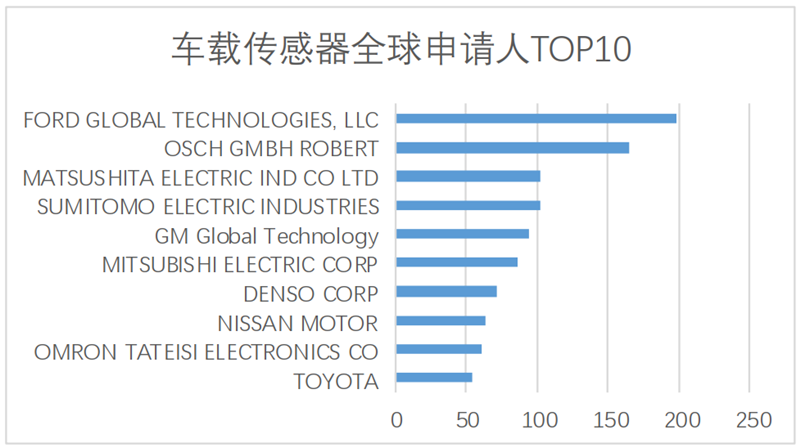 ▲ Distribution of global patent applicants for onboard sensor technology
Globally, the top ten applicants in terms of application volume are Ford, Bosch, Matsushita, Subitomo, GM, Mitsubishi, Denso, Nissan, Omron, and Toyota. The total application volume of the top ten applicants exceeds 1,000 items, accounting for nearly 10% of the total application volume, indicating a relatively dispersed patent holding situation among leading companies in this field. The applicants are mainly composed of automotive manufacturers, parts manufacturers, and sensor companies.As of now, the number of patent applications related to onboard sensors in China has reached 3,076, with a total of 3,057 after merging family patents. This aligns with the global distribution trend, showing a noticeable upward trend in patent applications around 2010.
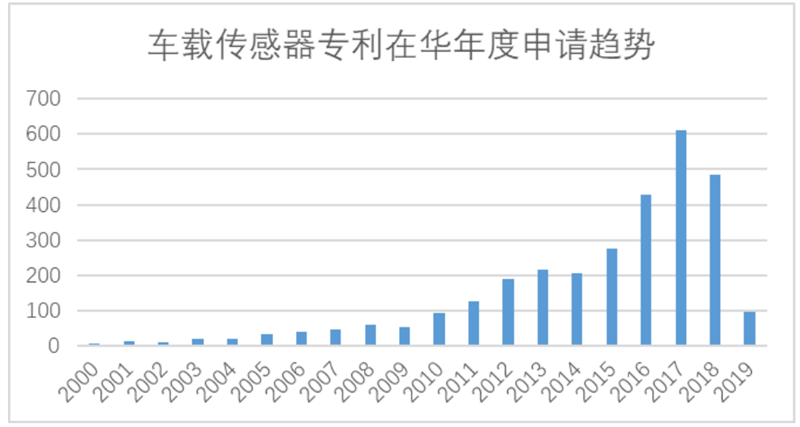 ▲ Annual application trend of onboard sensor patents in China
In the top ten applicants for onboard sensors in China, domestic universities and foreign companies dominate, with Ford having a significant lead in application volume. Following Ford are General Motors and Bosch.
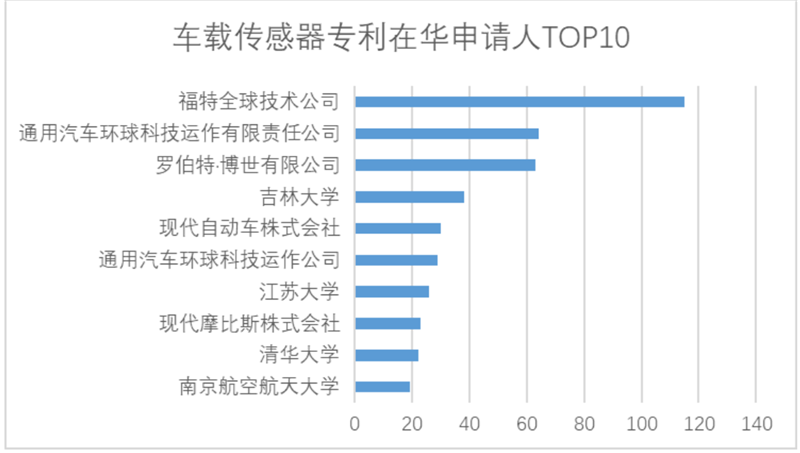 ▲ Distribution of onboard sensor patent applicants in China
As of September 2019, the global number of patent applications for onboard computing devices has accumulated to 18,969, with a total of 16,714 after merging family patents.
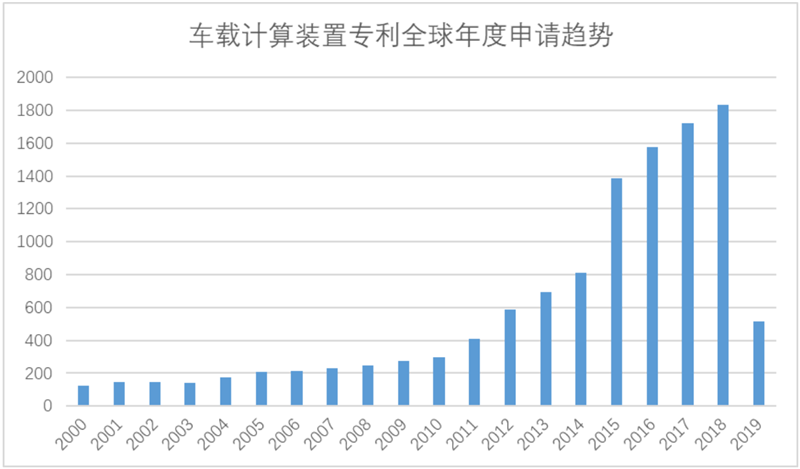 ▲ Global patent application trend for onboard computing devices
The patent applications in this technology direction show a sustained growth trend, especially after 2015, with annual application volumes exceeding 1,000 items. With the continuous innovation of application forms in the automotive IoT, the volume and types of data that onboard computing devices need to process are constantly increasing, creating new innovative spaces in data processing capabilities and business logic control.
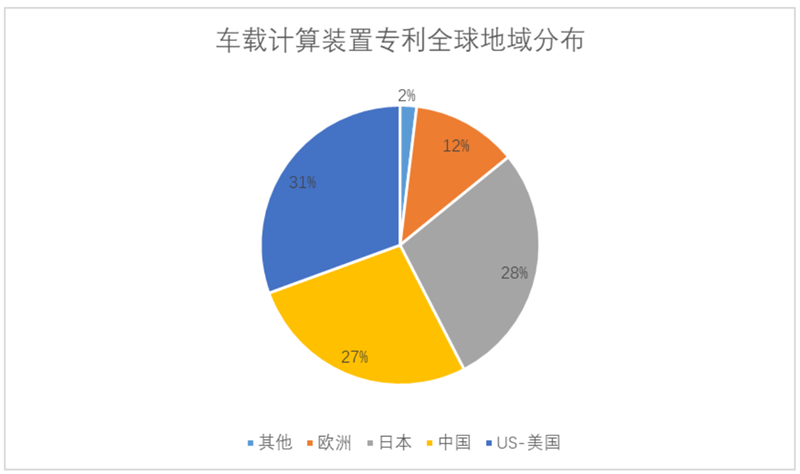 ▲ Global regional distribution of onboard computing device patents
The distribution of patents for onboard computing devices is relatively concentrated. From the perspective of regional patent quantity share, the region with the most patents for onboard computing devices is the United States, followed by Japan, China, and Europe. China’s accepted patent application volume has reached 27% of the global total, making it the third-largest patent layout target country for onboard computing device technology, reflecting China’s important position in the current and future automotive IoT market. As of September 2019, the total number of patent applications for onboard computing devices in China was 5,463, with a total of 5,439 after merging family patents. The number of patent applications for onboard computing devices has shown a sustained and stable growth trend over the past decade, with more than 100 applications per year.
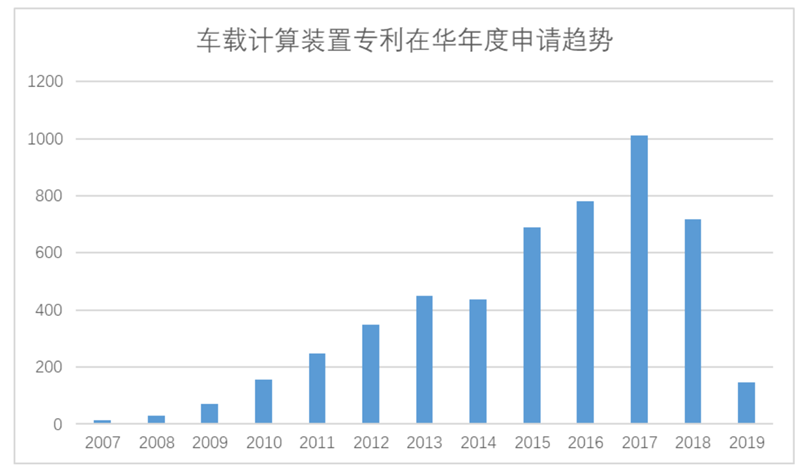 ▲ Annual application trend of onboard computing device patents in China
From a technical distribution perspective, with the rise of intelligent connected vehicles, the data processing and control objects of onboard computing devices have evolved from initial security and navigation to new directions such as multi-sensor data analysis and artificial intelligence.
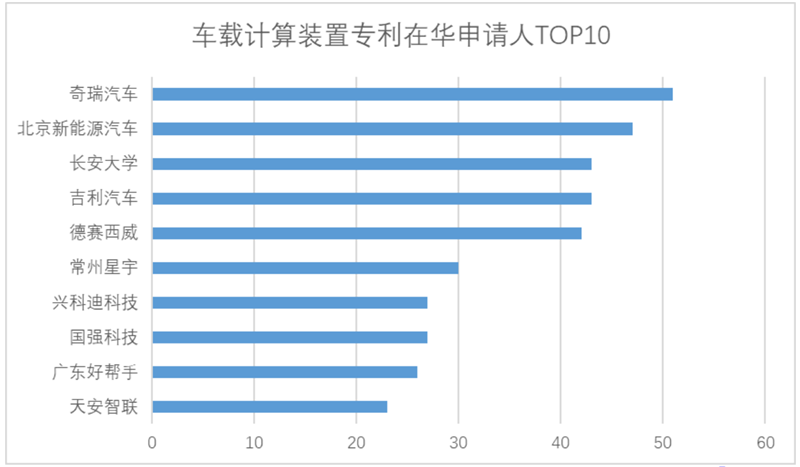 ▲ Distribution of onboard computing device patent applicants in China
The top ten applicants for onboard computing device patents are mainly upstream automotive parts manufacturers, traditional automotive manufacturers, and new automotive manufacturers, with few applicants from universities, and many enterprises with backgrounds in navigation and automotive IoT. The number of authorized patents in this field is considerable, with patents for microcontroller-based computing devices being applied for relatively early, and the technology being at a relatively mature stage. The number of patents under review is low, and the activity level of patent applications related to new technologies is low.
3. Intelligent Driving Technology
Intelligent driving vehicles (Autonomous vehicles; Self-driving automobiles) are also known as unmanned vehicles, computer-driven vehicles, or wheeled mobile robots. They are intelligent vehicles that achieve unmanned driving through computer systems, relying on artificial intelligence, visual computing, radar, monitoring devices, and global positioning systems to collaborate, allowing computers to operate motor vehicles automatically and safely without any human intervention.Intelligent driving technology involves a comprehensive range of automotive intelligence technologies, including environmental perception, precise positioning, decision-making and control, high-precision mapping, and testing and verification of autonomous vehicles.As of September 2019, there were more than 36,200 patents related to intelligent driving globally, with over 23,300 after merging family patents.
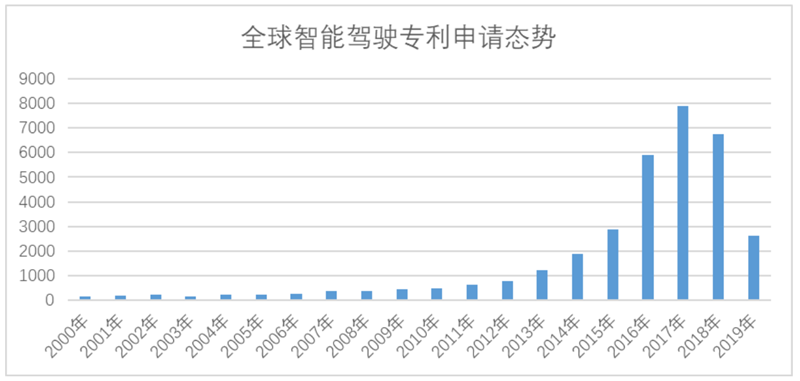 ▲ Global annual distribution of intelligent driving patents
From the perspective of patent application quantity changes, automotive intelligent driving technology entered a period of rapid growth in 2013, and entered a patent application explosion period in 2016. In 2018 and 2019, due to some patents not being disclosed yet, it is predicted that the patent application for intelligent driving technology will remain at a high level in the coming years due to the rapid development and application of foundational technologies such as artificial intelligence, high-precision mapping, and high-precision video processing.From the perspective of global patent acceptance regional distribution, China is an important accepting country for intelligent driving technology patents, accounting for nearly half of the total global applications. Although the overall authorization rate is not high (around 35%), the number of authorized patents is close to 6,000, still ranking first globally.
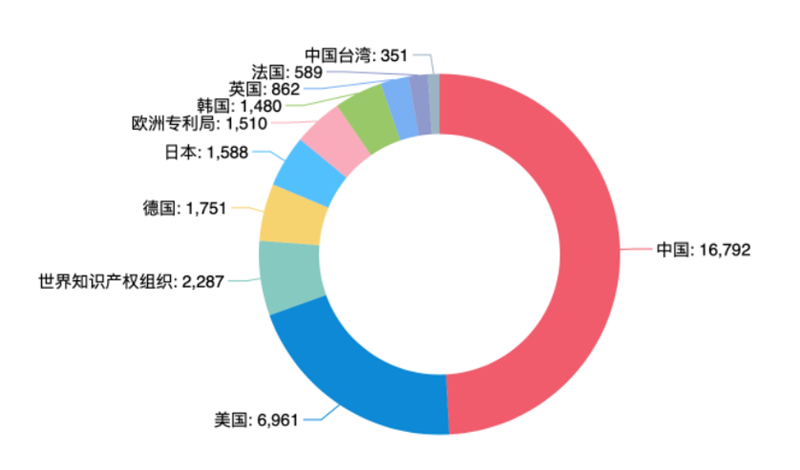 ▲ Distribution of countries accepting global intelligent driving patents
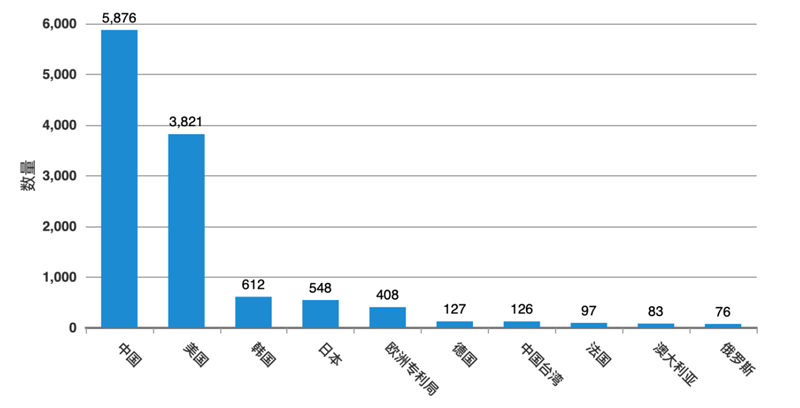 ▲ Distribution of authorized intelligent driving patents globally
From the perspective of the main applicants of patent applications, they are mainly automotive manufacturers and internet companies, especially internet companies like Baidu, Google, and Uber, whose application volumes are second only to Ford, which is noteworthy.
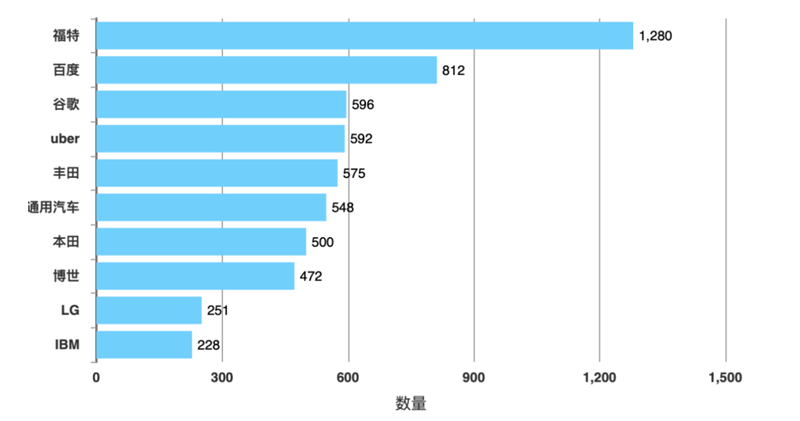 ▲ Distribution of global intelligent driving patent applicants
From the perspective of the distribution of domestic patents for intelligent driving technology, the application trend in China is consistent with the global trend, both entering the application volume explosion period in 2016. Although some patents were not disclosed in 2018 and 2019, it can still be seen that the application volume remains strong.
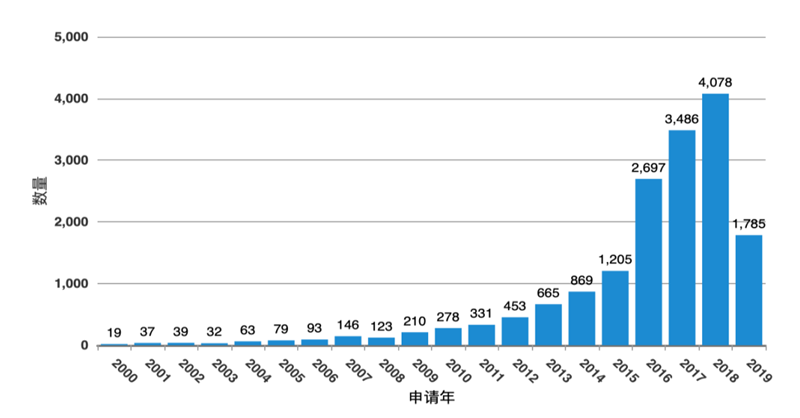 ▲ Status of intelligent driving patents in China
From the perspective of the distribution of patent applicants in China, Baidu ranks first, followed by several universities such as Beihang University, Jilin University, and Tsinghua University, which also make it into the top ten. Notably, among the patents in China, the automotive manufacturers with the largest application volumes are foreign companies like Ford, General Motors, Honda, and Toyota, while domestic manufacturers have a smaller application volume and did not make it into the top ten.
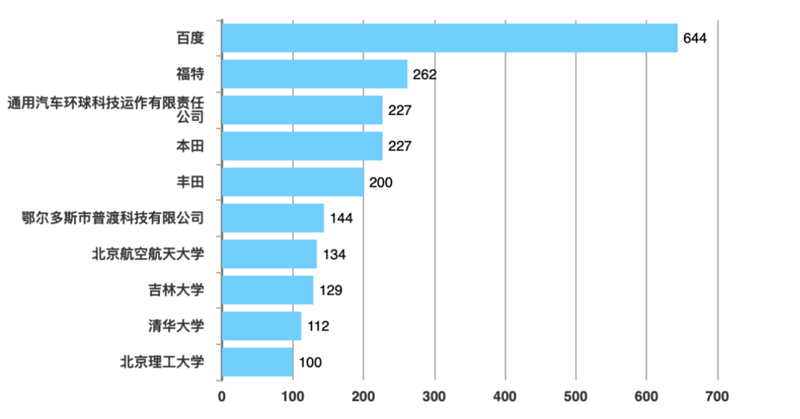 ▲ Ranking of patent applicants in China for intelligent driving

Operational Situation of Automotive IoT Intellectual Property
The AVANCI platform, established in 2016 and headquartered in Dallas, is a patent licensing platform jointly launched by Ericsson, Qualcomm, ZTE, and InterDigital to meet the demand for wireless technology patent licensing in the connected product market. The AVANCI organization aims to enable IoT companies to more easily embed cellular technology in their connected devices. Initially, the AVANCI organization focused on licensing 2G/3G/4G cellular technologies for automotive IoT and smart meters, gradually expanding into other IoT product areas.The AVANCI licensing platform currently brings together 24 patent holders. In addition to the initial five founding companies, Nokia, Conversant, Unwired Planet, Sony, BlackBerry, Sharp, Siemens, and others have successively joined the platform. ZTE is one of the founding companies, and China Mobile Communications Corporation joined the organization in 2019.Currently, the licensees are mainly automotive manufacturers, including the BMW Group, Volkswagen Group, Audi, Porsche, Rolls-Royce, Skoda, Bentley, and others.The AVANCI organization claims that it is committed to ensuring that companies using wireless communication technology in their products can obtain services on terms that meet their needs based on fair, reasonable, and non-discriminatory principles, and that patent holders of wireless technologies can achieve fair returns on their investments. However, as of now, AVANCI has not disclosed charging standards for other industries outside of the automotive sector.The AVANCI organization charges automotive manufacturers based on usage functions, with fees ranging from $3 to $15. For the most basic emergency call connection function, each vehicle pays $3; for 2G/3G wireless connectivity services, each vehicle pays $9; and for network connection services covering 4G, the fee is $15 per vehicle.The AVANCI organization states that the patent licensing fees for the automotive industry will not change due to the increase in the number of holders of standard essential cases that join the organization, nor will the increase in the number of standard essential patents for 2G/3G/4G raise the fees, and the increase in the connection functions used in intelligent connected vehicles will not increase the licensing fees. However, as of now, the organization’s patent licensing scope does not cover 5G patents.At the current stage, cross-industry patent licensing in the automotive IoT field faces several issues, including the existing statistical standards for the licensing of standard essential patents in the communication field.First, there is the calculation of licensing fees. Based on the principle of minimum sales units, the rationality of specific fee calculation methods has gradually reached a certain consensus through years of litigation in the mobile communication terminal field, while cross-industry and cross-field scenarios belong to new situations, and there are differences in understanding between communication and automotive companies across industries.Second, there is the definition of charging objects: the supply chain for vehicle manufacturing is long, from parts to various levels of integrators and finally to the vehicle manufacturers, and there is currently controversy over which link acts as the licensee. On May 10, 2019, Continental AG filed a lawsuit in the U.S. District Court for Northern California, claiming that Nokia, AVANCI (the patent platform company), Conversant Wireless, and PanOptis/Unwired Planet violated FRAND commitments by refusing to license standard essential patents (SEPs) in the automotive communication field;At the same time, the issue of cumulative licensing fees cannot be ignored: onboard devices apply various communication functions, and various communication functions involve different protocol levels, corresponding to different rights holders. Even if each company charges based on reasonable rates, the cumulative effect of multiple holders may become a focal point of controversy regarding the impact on automotive profit margins.Smart Insights believes that patents are often the most direct reflection of a company’s or even a country’s competitiveness. Since 2016, the number of patents in automotive IoT technology in China has shown explosive growth, far exceeding the global average growth rate. The innovation of 5G communication systems has provided objective application conditions for achieving autonomous driving, and the peak of innovations in V2X technology and autonomous driving-related technologies has driven a further surge in patent applications in this field.However, in the high-end segments of the industry, China’s competitiveness remains very weak and still requires a lot of technological incentives.Moreover, the upper-level business models for automotive IoT are still unclear, with traditional automotive manufacturers, internet companies, and other service technology companies all being important participants in the value chain. Successful business models may take different forms.
(This account is a signed account of NetEase News · NetEase’s “Various Attitudes”)
AI Productivity Innovation Award Selection