On September 25, a paper titled “U-Arm: Ultra Low-cost General Teleoperation Interface For Robot Manipulation” was published by Shanghai Jiao Tong University, EvoMind Tech, and the Shanghai Algorithm Innovation Research Institute.
U-Arm is a low-cost, rapidly adaptable master-slave teleoperation framework designed to interface with most commercial robotic arms. The system supports teleoperation through a 3D-printed guiding arm with three structurally different components that share a consistent control logic, achieving seamless compatibility with various commercial robot configurations. Compared to previous open-source master-slave interfaces, it further optimizes mechanical design and servo selection, resulting in a Bill of Materials (BOM) cost of only $50.5 for the 6-degree-of-freedom guiding arm and $56.8 for the 7-degree-of-freedom version. To enhance usability, common challenges associated with controlling redundant degrees of freedom are mitigated through mechanical and control optimizations. Experimental results show that U-Arm achieves a 39% higher data collection efficiency and comparable task success rates in various operational scenarios compared to another low-cost teleoperation interface, Joycon (https://github.com/box2ai-robotics/joycon-robotics). It has open-sourced all CAD models for three configurations and provides simulation support to validate the teleoperation workflow. It has also open-sourced real-world operational data collected using U-Arm.
For a long time, collecting large-scale, high-quality dual-arm robot operation data has been a bottleneck for policy learning. Compared to simulated data or human data, real-world robot data is most directly applicable for training robust policies (Bjorck, 2025). Among various data collection methods, human demonstrations remain the primary means of acquiring such real-world data.
Previous studies introduced a range of demonstration interfaces, broadly categorized into end-effector trajectory recording devices and master-slave teleoperation systems. End-effector trajectory recording devices (e.g., DexCap Wang 2024, UMI Chi 2024, and OpenTelevision Cheng 2024) are typically lightweight and easy to use. However, the collected data may suffer from issues such as motion singularities, exceeding the robot’s workspace, insufficient accuracy, or requiring complex post-processing. In contrast, master-slave teleoperation systems, such as ALOHA Zhao (2023) and GELLO Wu (2024), achieve intuitive and physically constrained demonstrations through mechanically isomorphic master arms. These systems help ensure that the collected trajectories are physically feasible and executable by the robot.
However, adapting master-slave teleoperation systems to different commercial robotic arms often requires significant engineering work, and the cost barrier remains high. ALOHA’s dual-arm system costs over $50,000, while GELLO, although 3D printable and more replicable, still relies on relatively expensive Dynamixel motors, with a single-arm BOM exceeding $270.
Low-Cost Dual-Arm Robot Teleoperation Systems. In recent years, various teleoperation interfaces for dual-arm robot operations have been developed. Common devices include VR headsets Cheng (2024), Xiong (2025), game controllers with joysticks, Spacemouse Liu (2022), multi-camera motion capture systems Handa (2020), Qin (2023), Song (2020), IMU-based controllers Wu (2019), Laghi (2018), and master-slave teleoperation systems Wu (2024), Zhao (2023). Most of these devices control the robot in the end-effector space and then convert it to joint commands through inverse kinematics (IK). In contrast, master-slave teleoperation systems directly map the joint configurations of the master arm to the following robot, thus avoiding singularity issues during motion and physically constraining the operator’s actions to ensure that the collected demonstrations can be executed by the robot.
However, teleoperation systems must balance cost, usability, and control accuracy. The table below summarizes several representative teleoperation setups, comparing their hardware costs and qualitatively assessing their usability in robotic demonstration tasks.
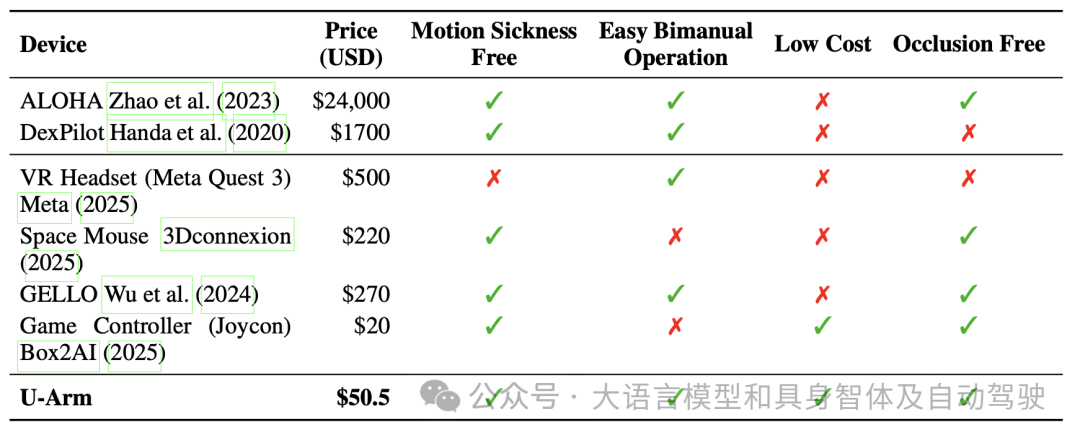
High-cost master-slave teleoperation systems (e.g., ALOHA) benefit from advanced motor drivers and control algorithms that can achieve gravity compensation. This significantly enhances the overall usability of the system and alleviates challenges associated with controlling redundant degrees of freedom. However, the high costs of such systems hinder their scalability and widespread application in the research community. GELLO can be seen as a low-cost alternative to ALOHA, designed to support teleoperation across various commercial robot configurations. While game controllers seem to be a sufficiently cheap interface for simple operational tasks, we will demonstrate in the experimental section that it is less efficient in practical use compared to our device.
Inspired by the LeRobot project Cadene (2024), this paper develops an optimized low-cost general teleoperation interface. The LeRobot project has become a popular teleoperation interface for entry-level researchers. It introduces a low-cost 5-degree-of-freedom desktop robotic arm, primarily manufactured through 3D printing, aimed at enabling users to quickly gain practical experience in the entire process of data collection, model training, and deployment. Although LeRobot is easily accessible and widely popular, its limited size and mechanical configuration hinder the generalization of trained models to more commonly used 6-degree-of-freedom and 7-degree-of-freedom commercial robotic arms. A universal, low-cost teleoperation interface that can seamlessly support various commercial robotic arm configurations is crucial for expanding high-quality robotic demonstration datasets.
Based on GELLO, two key points for further simplification and cost reduction are identified: (1) For the guiding arm, driving each joint is not absolutely necessary. Since the guiding arm only needs to be passively moved by the user while recording joint angles in real-time, there is no need to use relatively expensive Dynamixel motors. (2) Although mechanical isomorphism between the guiding arm and the following arm is not essential, it is necessary to ensure that the motion range of each joint is appropriately limited and that reasonable structural stiffness and durability are maintained for repeated use.
To this end, U-Arm is proposed, a remote operation interface that utilizes ultra-low-cost motors for joint angle sensing and combines mechanical enhancements to address joint range limitations and redundant degrees of freedom issues. Through a series of validation experiments, it is demonstrated that the guiding-following remote operation architecture can be effectively realized, with each arm costing approximately $50. Despite its low cost, the system provides sufficient mechanical compatibility and control fidelity to support teleoperation with most commercial robotic arms on the market. An overview of its system is shown below:
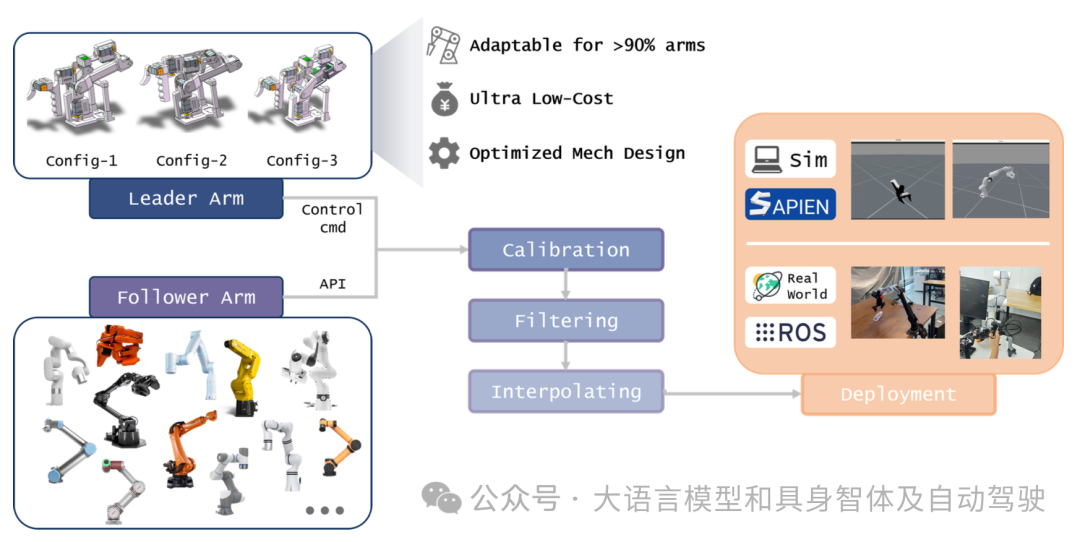
Following the philosophy of GELLO, which utilizes low-cost 3D printed hardware to control commercial robotic arms, the guiding arm is designed to provide sufficient mechanical isomorphism to ensure effective and compatible teleoperation across various commercial robots, while also incorporating redesigned and optimized mechanical structures and components to enhance stability and further reduce the total cost to approximately $50. Through a series of mechanical and control optimizations, challenges posed by redundant degrees of freedom in the guiding arm are addressed. Therefore, operators can achieve intuitive and effective control with just a few attempts.
Hardware Design
Motivation. As shown in the figure, most commercial 6-degree-of-freedom and 7-degree-of-freedom robotic arms adopt one of three standardized joint ordering patterns.
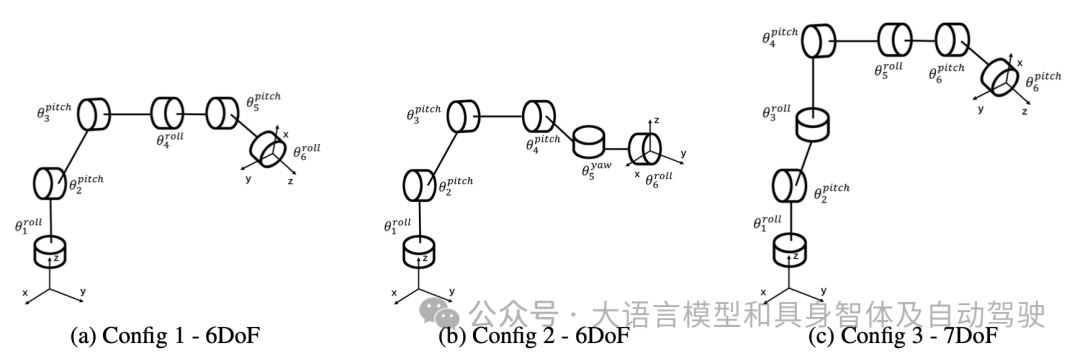
The table below summarizes a set of representative commercial robotic arms compatible with these three configurations. This design consistency arises from practical considerations such as satisfying the Pieper criterion, optimizing dexterous workspaces, and achieving anthropomorphic arm structures. Although the specific link lengths of different arms may vary, their joint types and orderings typically follow one of these three common configurations.

For master-slave teleoperation systems controlling in joint space, the master arm does not need to maintain a fixed link length ratio relative to the following arm. Instead, as long as the joint arrangement (i.e., the order of rotation axes) is the same, intuitive control can still be achieved. This is because during teleoperation, the operator can gain direct visual feedback from the movement of the following arm. Therefore, the master arm only needs to roughly convey the operator’s intended motion without needing to precisely replicate the kinematics of the following arm.
Mechanical Design. Corresponding to the above configurations, an overview of the mechanical design of the U-Arm is shown in the figure. All components in the experiments are printed using PLA material. Considering the strength of PLA, all components of the U-Arm have a wall thickness of at least 4 mm to ensure durability.
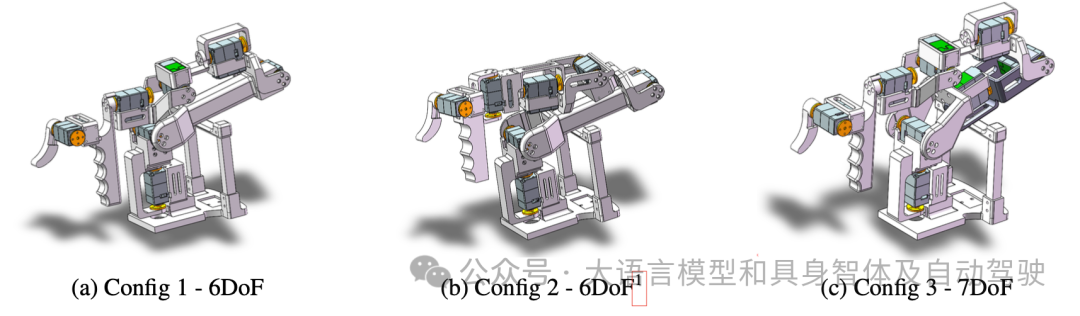
A common issue with low-cost 3D printed guiding arms is the small surface area of the joint connection plates. Over time, these connections may loosen or even break due to the high radial cyclic loads experienced by the initial few joints. To address this issue, all joints in the design employ a dual-axis fixation method, effectively alleviating this problem.
Motor Modification. In master-slave teleoperation systems, joint resistance is a key factor significantly affecting user experience. When the joint resistance of the master arm is too high, the operator finds it difficult to perform smooth continuous movements. On the other hand, if the resistance is too low, while the arm is easy to move intuitively, poor passive motion may occur in certain cases—especially under configurations 1 and 3.
For example, when the master arm is horizontally extended near its workspace boundary, joint 3 in configuration 1 and joint 4 in configuration 3 are prone to suddenly drop under the influence of gravity. Although gravity compensation algorithms and force-controlled motors can address this instability, they significantly increase system costs. GELLO introduces passive resistance by adding rubber bands to selected joints, partially alleviating this issue.
The Zhongling servos used in this study were not originally designed for passive dragging or encoder-only applications. Their built-in gearboxes introduce excessive joint resistance, making smooth motion impractical. To solve this problem, a more flexible mechanical solution is adopted. Since the guiding arm does not require active driving, the servo system is disassembled, and its internal gears are removed, retaining only the encoders for joint angle measurement. Then, damping is introduced by adjusting the tightness of screws fixing each joint axis, allowing for fine control of resistance and stabilizing the arm during teleoperation.
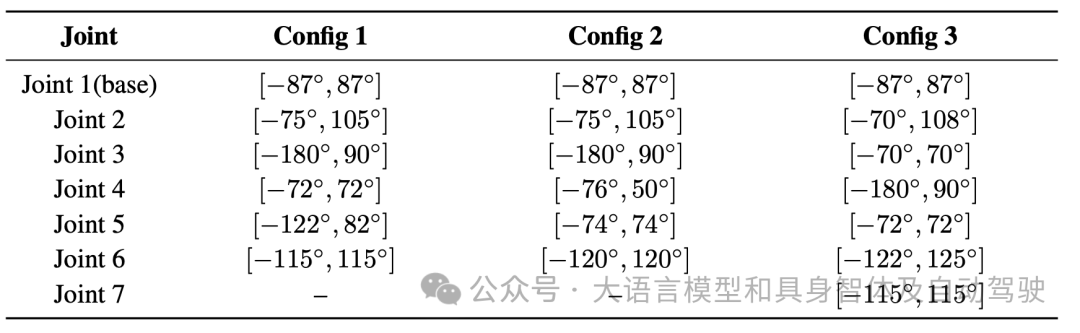
Additionally, although the joint activity ranges of different commercial robotic arms vary, the physical joint limits of the U-Arm (used as the guiding arm) are intentionally designed to be relatively narrow. These limits are sufficient to meet the requirements of typical desktop operational tasks while enhancing the mechanical stability of the system by preventing extreme postures that could compromise structural integrity or lead to poor joint behavior, as shown in the table.
Algorithm Design
Servo Encoder Adjustment and Calibration. This study uses joint angle mapping for teleoperation. The encoder range of the Zhongling servos used in the system is 0-270°, exceeding this range may lead to unpredictable behavior. Since the gearbox has been removed, the servos cannot correct their position through feedback from commands. Therefore, before installation, the servos are manually adjusted to a neutral position of around 135°, ensuring that the guiding arm does not exceed the encoder range during normal operation.
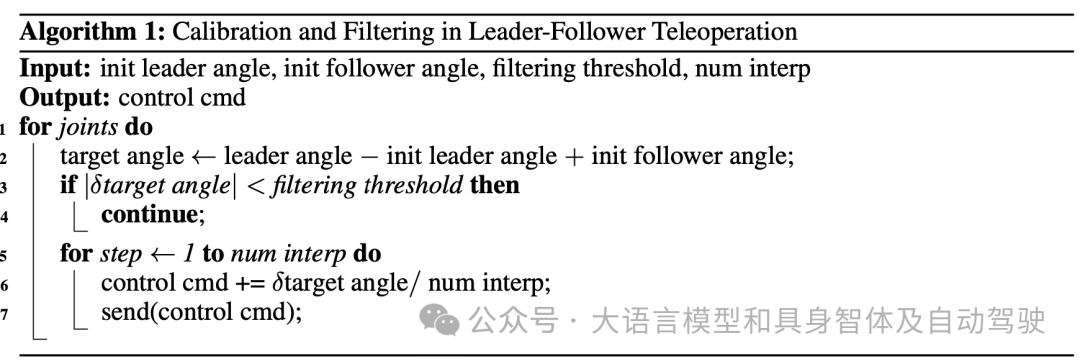
Calibration and Filtering. Even with the same joint configuration, different robotic arms exhibit significant structural differences, making it impossible to specify a unified initial position for all systems. Therefore, during each teleoperation process, the guiding arm is initialized near the predefined initial pose of the following arm. At the start of each demonstration, the following robot first moves to its initial pose, and then the guiding arm module initializes and takes over control. During operation, the joint angle commands sent by the guiding arm are filtered and interpolated to address slight disturbances in the encoder readings, ensuring that motion remains smooth and accurate despite mechanical differences between systems.
The algorithm is summarized as follows:
Simulation Environment Adaptation
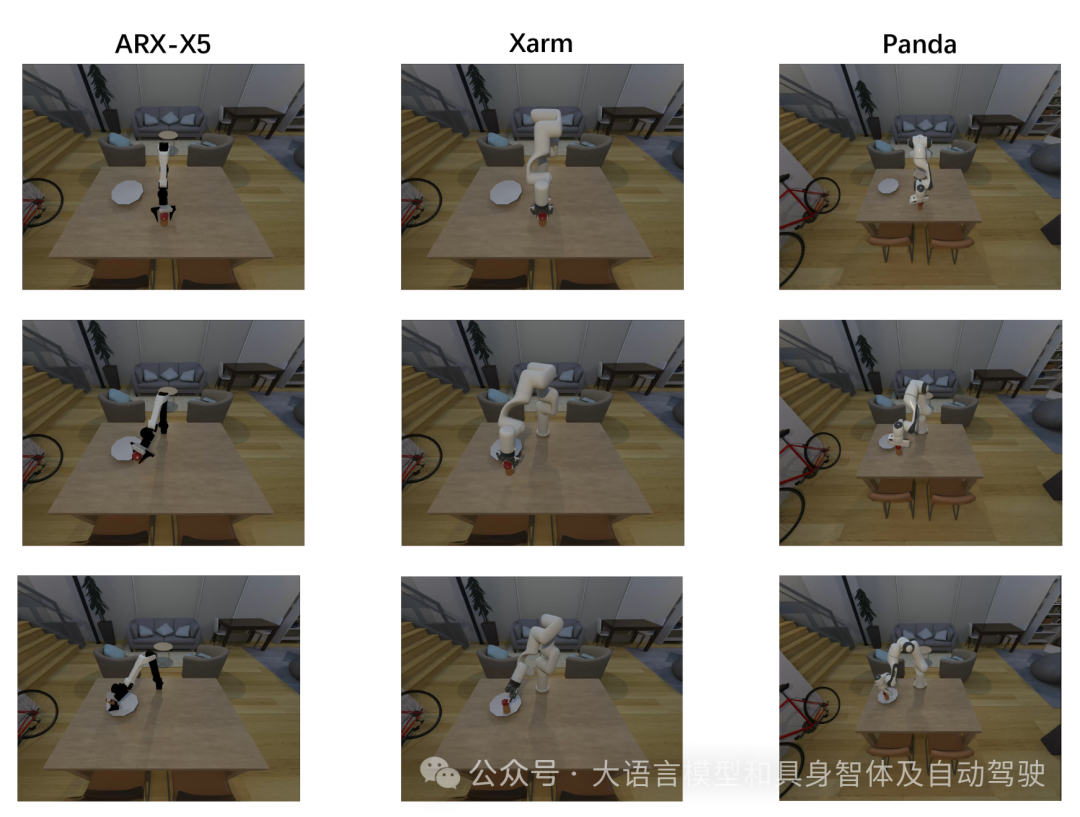
The U-Arm is adapted to the model of ManiSkill Tao (2025), which is built on the model of SAPIEN Xiang (2020). This environment provides users with a safe setting to test the remote operation of U-Arm. Before operating real robots, users can verify potential issues such as joint angle mapping errors. Additionally, users can collect multiple demonstrations in this environment to leverage the emerging data scaling methods proposed by MimicGen Mandlekar (2023).
Control simulation examples for seven different robotic arms, including Arx-x5, Xarm, SO100, and Panda, are provided on the website. Some examples are shown in the figure.
Real-World Task Settings
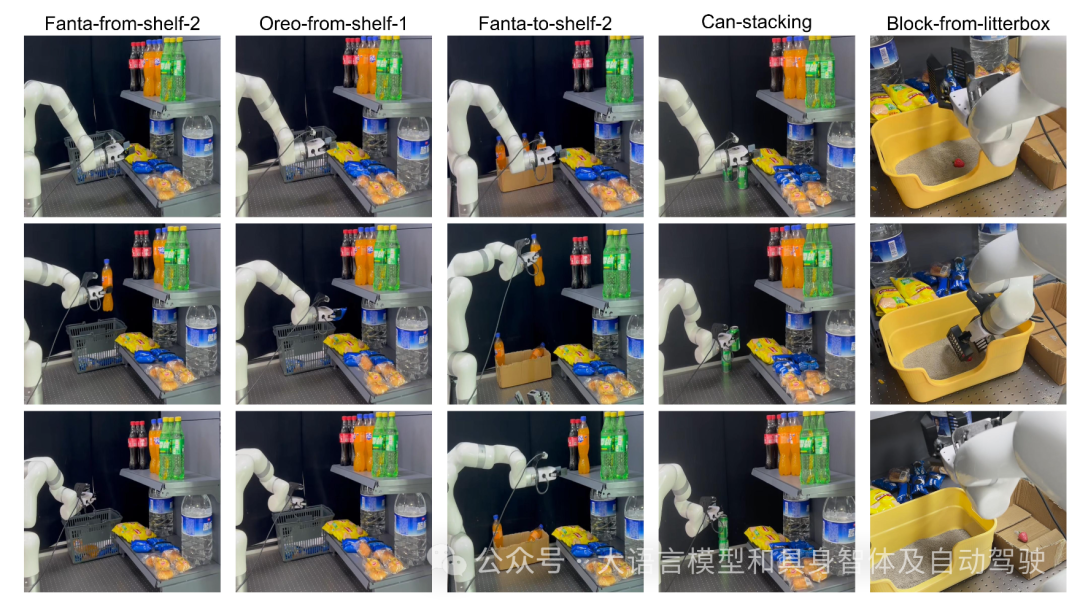
Five representative real-world operational tasks are designed (as shown in the figure):
1. Retrieve Fanta from the second shelf: Move a bottle of Fanta from the second shelf to the basket.
2. Retrieve Oreos from shelf 1: Move a pack of Oreos from the first shelf to the basket.
3. Place Fanta on shelf 2: Take a bottle of Fanta from the box and place it back on the second shelf.
4. Can stacking: Stack one soda can on top of another.
5. Retrieve a block from the litter box: Take a block out of the litter box.