Why Do We Need an Elegant Hierarchical State Machine?
Traditional State Machine Implementation:
// Traditional implementation: 4 function pointers + complex state transition logic
typedef struct {
    void (*entry)();
    void (*exit)();
    void (*work)();
    void (*event)();
    // ... more function pointers
} TraditionalState;
This design not only leads to code redundancy but also has a rigid event handling mechanism that cannot elegantly manage hierarchical state relationships.
Improvements of CUTEHSM
1. Unified Event Handling Model
typedef void (*CuteHandler)(CUTEHSM *hsm, uint32_t event, uint32_t param);

typedef struct CuteState_t {
    const char    *name;
    CuteState       *parent;
    CuteState       *child;
    CuteHandler     handler;  // Unique handler function
} CuteState;- Reduces function call overhead
- Unified event handling process
2. Intelligent State Transition Algorithm
The core of CUTEHSM is the optimized Lowest Common Ancestor (LCA) search algorithm:
static CuteState* Cute_find_lca(CuteState *a, CuteState *b) {
    // Calculate depth difference
    while (depth_a > depth_b) { a = a->parent; depth_a--; }
    while (depth_b > depth_a) { b = b->parent; depth_b--; }

    // Synchronized upward search
    while (a && b && a != b) { a = a->parent; b = b->parent; }
    return a;
}- Time complexity: O(h), where h is the height of the state tree
- No recursive calls, suitable for embedded environments
3. Extreme Memory Efficiency
The memory efficiency of CUTEHSM:
|
Metric |
CUTEHSM |
Improvement over traditional implementation |
|
State structure size |
24 bytes |
40% |
|
Number of function pointers |
1 |
75% |
|
Code size |
~80 lines |
46% |
4. Event Bubbling Handling
5. Transition Between Composite and Simple States
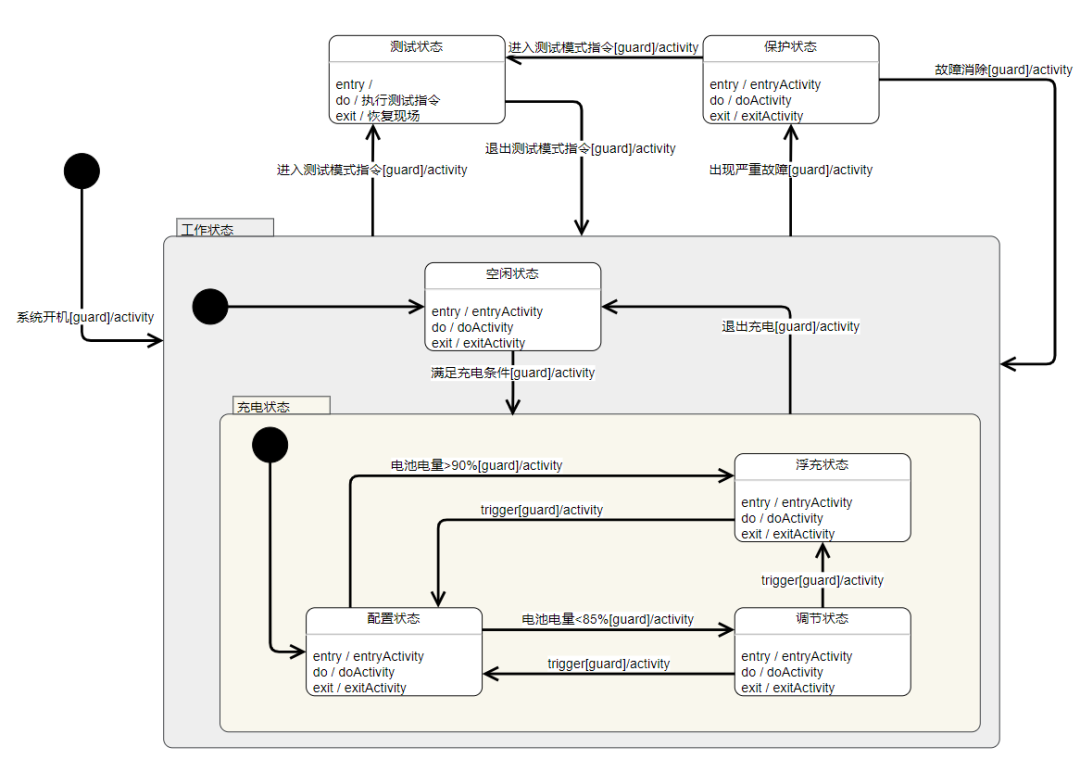
Practical Demonstration: Solar MPPT Charging Management
// State instance definitions
CuteState state_protect = {    .name = "Protect State",    .parent = NULL,    .child = NULL,    .handler = protect_state_handler,};
CuteState state_test = {    .name = "Test State",    .parent = NULL,    .child = NULL,    .handler = test_state_handler,};
CuteState state_config = {    .name = "Config State",    .parent = NULL,    .child = NULL,    .handler = config_state_handler,};
CuteState state_adjust = {    .name = "Adjust State",    .parent = NULL,    .child = NULL,    .handler = adjust_state_handler,};
CuteState state_float = {    .name = "Float State",    .parent = NULL,    .child = NULL,    .handler = float_state_handler,};
CuteState state_charge = {    .name = "Charge State",    .parent = NULL,    .child = &state_config,    .handler = charge_state_handler,};
CuteState state_idle = {    .name = "Idle State",    .parent = NULL,    .child = NULL,    .handler = idle_state_handler,};
CuteState state_normal = {    .name = "Normal State",    .parent = NULL,    .child = &state_idle,    .handler = normal_state_handler,};

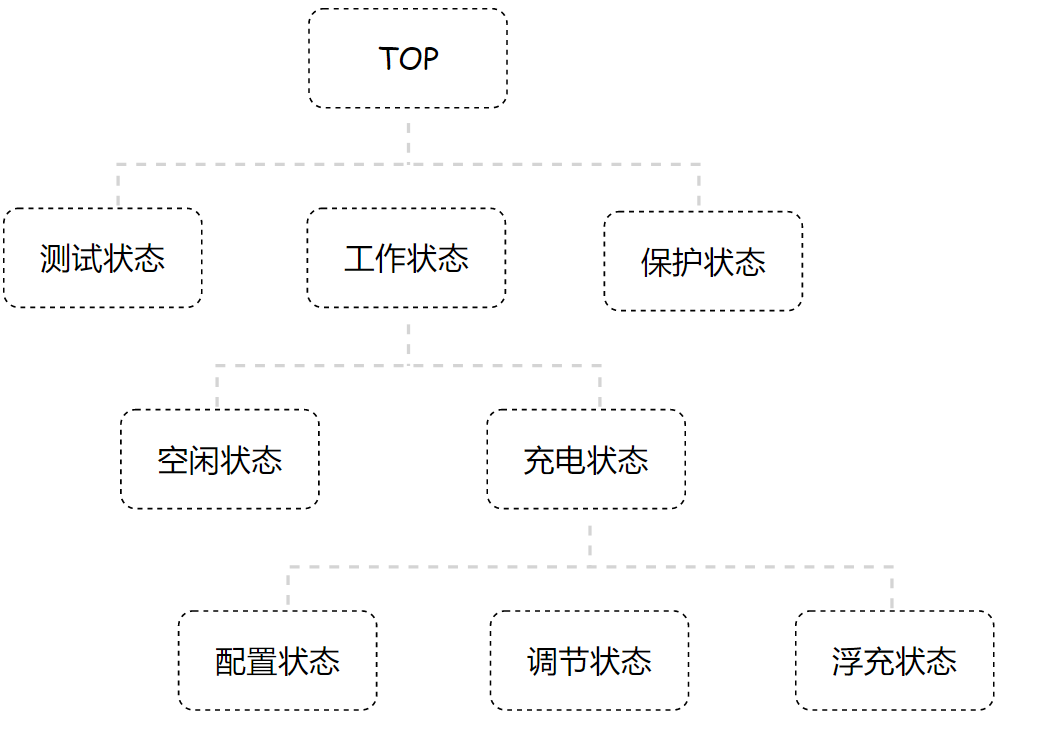
// Set parent-child relationships
void setup_state_hierarchy(){
    state_charge.parent = &state_normal;
    state_idle.parent = &state_normal;
    state_config.parent = &state_charge;
    state_adjust.parent = &state_charge;
    state_float.parent = &state_charge;
    state_test.parent = NULL;    // Top-level state
    state_protect.parent = NULL; // Top-level state
}
Project Address:https://github.com/daxia-hu/cutehsm