 Click the blue text to follow us
Can you believe it? A chip the size of a fingernail, with only a few KB of memory, can now run AI models! Imagine this: a smart bracelet can analyze heart rate anomalies without needing to connect to the internet, drones can identify crop diseases in real-time over fields, and industrial sensors can “predict” equipment failures in advance—functions that previously required cloud computing power can now be achieved with TinyML technology on microcontrollers (MCUs) costing just a few dollars.
Today, let’s delve into this black technology that is revolutionizing embedded development: what exactly is TinyML? How does it enable AI models to be “slimmed down” to just a few KB? What amazing applications have already been implemented? Finally, we have prepared a beginner’s guide for you to get started!
01What is TinyML? – Equipping MCUs with an “Intelligent Brain”
In simple terms, TinyML is the technology that allows AI models to run on “bare-bones” hardware. Traditional AI models often require GBs of memory and GPU power, while TinyML targets devices with extremely limited resources—such as microcontrollers (MCUs) with only a few KB of RAM and a few MHz clock speed. These chips are widely used in smartwatches, sensors, home appliances, and more, costing as little as $2, with power consumption at the milliwatt level (compared to the watt-level power consumption of cloud AI, this saves about 1000 times the electricity cost!).
TinyML’s “Three Major Advantages”:
⚡ Ultra-low Power Consumption: A single AAA battery can last over 30 days, suitable for remote areas or mobile scenarios (like wildlife trackers).
Ultra-small Size: The smallest model requires only 2KB of memory (equivalent to one ten-thousandth of a mobile phone photo), and common MCUs like STM32 and ESP32 can run it.
⚡ Ultra-fast Response: Local inference latency can be as low as milliseconds, eliminating the need to wait for cloud transmission (for example, in collision avoidance for autonomous driving, a delay of just one second could be disastrous!).
For example: the smart bracelet you wear can monitor heart rate in real-time, relying on a TinyML model to analyze sensor data locally—if it depended on the cloud, it would not only consume more power but could also miss anomaly alerts due to network delays.
02Technical Insights: How AI Models are “Slimmed Down” to a Few KB?
Compressing AI models from dozens of MB to a few KB is akin to fitting an elephant into a refrigerator—sounds absurd, but TinyML has “three tricks up its sleeve”:
1. Model Compression: Helping Neural Networks “Lose Weight”
✂️ Pruning: Removing “excess” neurons. For example, Neuton.AI’s technology can compress models by 10 times, like trimming a tree to leave only the essential branches (core parameters).
Quantization: Converting 32-bit floating-point numbers to 8-bit integers. The precision loss is less than 5%, but memory usage drops by 75%! It’s like converting HD video to standard definition; the size is smaller, but the image is still viewable.
Distillation: Using a large model to “teach” a smaller model. For instance, training TinyAerialNet (the student model) with knowledge from MobileNet (the teacher model) allows the smaller model to learn to “focus on the essentials”.
2. Hardware Accelerators: Equipping MCUs with “AI Engines”
Today’s MCUs are no longer “dumb”! For example:
Arm Ethos-U65: 1 TOPS computing power, 90% lower energy consumption, specifically designed for neural networks.
ESP32-S3: Built-in NPU (Neural Processing Unit) that can directly run image/voice inference, costing only a few bucks.
3. Development Toolchains: Even Beginners Can Play with TinyML
Previously, working with embedded AI required expertise in both software and hardware, but now there are user-friendly tools:
Edge Impulse: No coding required, just drag and drop to train models (acquired by Qualcomm in 2025, indicating strong interest from major players!).
TensorFlow Lite Micro: A framework optimized by Google for MCUs, compatible with hardware like Arduino and ESP32.
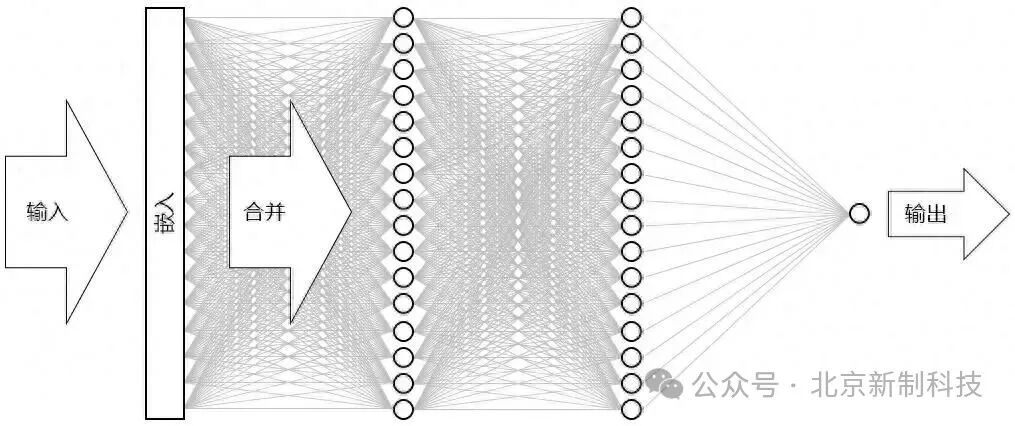



The operation process of TinyML models on MCUs: Input data → Embedded neural network → Local output results, all without internet connection.
032025 Hot Application Cases: TinyML Has Already Entered These Fields!
Don’t think TinyML is still stuck in the lab—by 2025, these applications have quietly changed the world:
1. Healthcare: Affordable Devices with Life-Saving Experiences
Indian Hand Rehabilitation Gloves: Patients wear gloves and say “clench” or “release”; the TinyML model on the Wio Terminal MCU recognizes the voice in real-time, controlling pneumatic devices to assist finger movement, achieving 100% recognition accuracy! (Source: CSDN Blog)
Brazilian Atrial Fibrillation Detector: A device the size of a palm clips onto a finger, using TinyML to analyze heart rate waveforms with an accuracy of 98%, and a single battery can last 30 days, making it affordable for hospitals in remote areas.
2. Smart Agriculture: Drones + TinyML Reduce Pesticide Use by 30%
Indian farmers previously relied on their eyes to identify cashew tree diseases, which was inefficient and prone to misjudgment. Now, using drones equipped with TinyML for inspections, they can achieve an accuracy rate of 95%-99% in identifying diseased plants, allowing for precise pesticide spraying and reducing pesticide use by 30%, cutting costs significantly! (Source: Science 2025)
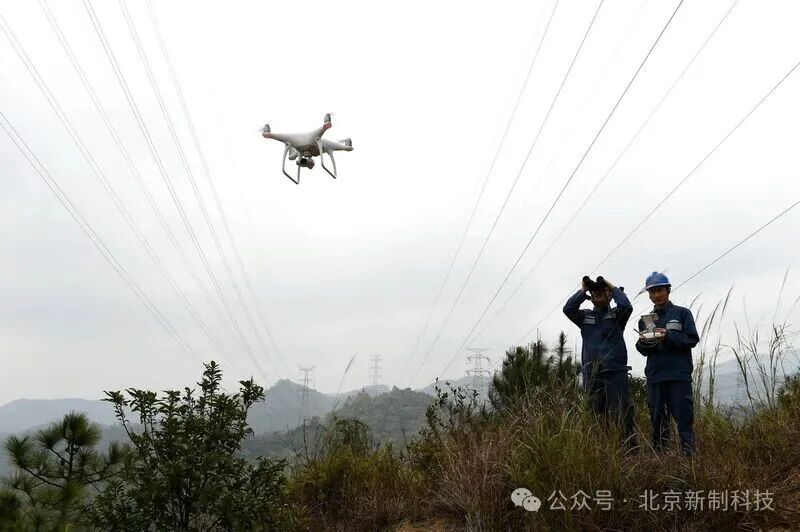



TinyML drones inspecting cashew orchards in India: Camera captures leaf images → Local inference identifies diseases → Marks coordinates, all without relying on the network.
3. Industrial IoT: Reducing Factory Downtime by 45%
In factories, motor vibration data used to be sent to the cloud for analysis, but now with STM32 MCU + TinyML models, abnormal vibrations can be monitored in real-time, providing early warnings for failures. After a pilot project in an automotive factory, maintenance costs dropped by 30%, and downtime decreased by 45%—this is the power of “predictive maintenance”!
4. Consumer Electronics: Gesture-Controlled Fans and Voice-Activated Doors with Latency < 200ms
Gesture-Controlled Fan: The ESP32-CAM camera captures gestures, and the TinyML model recognizes “left-right head shake” and “speed adjustment” within 0.2 seconds, faster than a remote control!
Smart Door Lock: Local voice recognition for the “open door” command, no internet required, with a response time faster than mobile Siri (measured at < 200ms), ensuring maximum privacy.
04Big Players are Going Crazy! Is the TinyML Market About to Explode?
By 2025, tech giants have already cast their votes with real money:
Qualcomm Acquires Edge Impulse (March 2025): Complements the edge AI development platform, targeting industrial and healthcare scenarios.
Nordic Acquires Neuton.AI (June 2025): Integrates 5KB ultra-small models into low-power Bluetooth chips, making wearables “crazy competitive”!
STMicroelectronics Acquires Deeplite (April 2025): Enhances model compression technology, doubling AI performance on STM32 chips.
How explosive is the market size? Look at the data:
In 2024, the TinyML market size reached $1.5 billion, and it is expected to soar to $5 billion by 2028 (annual growth rate of 30%).
By 2030, there will be 2.5 billion devices globally equipped with TinyML technology—equivalent to one device for every three people!
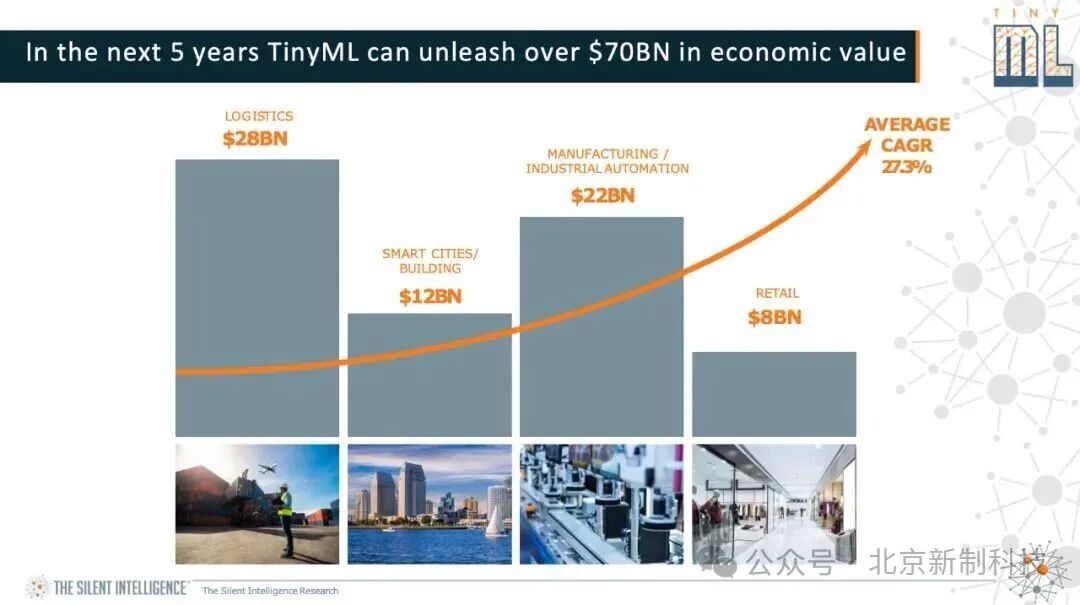



Data Source: ABI Research, 2025 Edge AI Report
05Challenges and Future: How Can TinyML “Evolve” Further?
Of course, TinyML also has its “pain points”:
Balancing Model Accuracy and Resources: For instance, when identifying plant diseases, a model that is too small may misjudge (currently, accuracy is around 95%, which still needs improvement).
High Development Barriers: It requires knowledge of both embedded hardware and AI model optimization, leading to a surge in demand for “full-stack engineers”.
Security Vulnerabilities: Model weights may be cracked, and side-channel attack risks need to be monitored (a Harvard research team discovered related vulnerabilities in 2024).
However, the future trends are even more promising:
On-device Training: In the future, models will not need to be sent back to the cloud for updates; they can learn new data locally (for example, smartwatches adapting to your exercise habits).
RISC-V Open-source AI Chips: Costs could drop by another 50%, making it affordable for small and medium-sized manufacturers.
Federated Learning: Multi-device collaborative training can optimize models without uploading data to the cloud (for example, multiple hospitals jointly training disease detection models without compromising privacy).
Conclusion: TinyML Beginner’s Guide – Get Started with a Kit for Just 129 Yuan!
ABI Research predicts: “By 2030, 80% of IoT devices will achieve local intelligence through TinyML.” If you want to seize this opportunity, getting started is actually quite simple:
Recommended Starter Kit: Seeed XIAO ESP32S3 Sense (¥129), comes with a camera, microphone, and sensors, compatible with the Edge Impulse platform, allowing even beginners to train voice/image recognition models.
Note: The case data in this article comes from the Science 2025 TinyML Application Report; market forecast data from ABI Research’s “2025 Edge AI Technology Report”; technical details reference the official documentation of TensorFlow Lite Micro.

 Beijing Xinjizhi Technology
 Phone: 400-8228-928Email: [email protected]
Source: Echo
This article is shared for communication and learning purposes only, with no commercial intent. If there is any infringement, please contact us for removal.