The ESP32-TinyML project brings powerful micro machine learning capabilities to Internet of Things (IoT) devices, allowing you to run complex machine learning models on the resource-constrained ESP32 microcontroller. This article introduces the project, explores its features, usage, and potential applications.
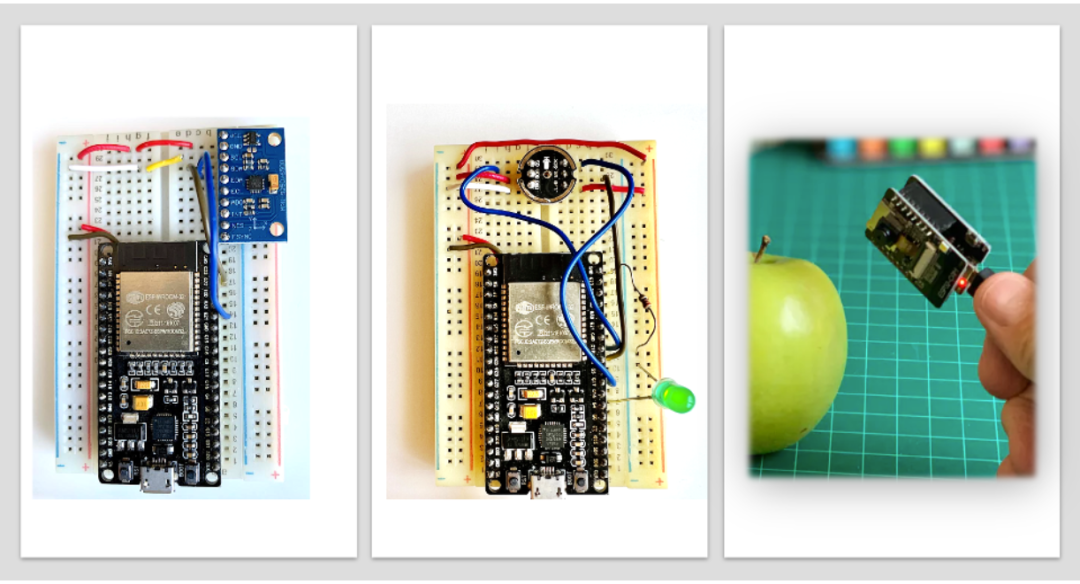
Project Overview: Running TinyML on ESP32
The ESP32-TinyML project provides a complete set of tools and tutorials, making it easy for developers to deploy and run TinyML models on the ESP32 microcontroller. It integrates various machine learning algorithms and pre-trained models, enabling even developers without a machine learning background to easily get started and build ESP32-based smart devices. The project focuses on providing easy-to-understand examples and detailed documentation, lowering the barrier to TinyML development.
Core Features and Characteristics:
- • Support for Multiple Sensors: The project supports various sensors, including cameras, microphones, and accelerometers, allowing you to build TinyML applications based on different sensor data.
- • Pre-trained Models: The project offers a range of pre-trained TinyML models covering common tasks such as image classification, motion classification, and keyword recognition. This enables developers to quickly prototype and experiment without starting from scratch.
- • User-friendly API: The project provides a clean and easy-to-use API that simplifies the process of loading, running, and interpreting model results. Even without a deep machine learning background, you can easily get started.
- • Detailed Tutorials and Examples: The project includes a series of step-by-step guided tutorials and example code covering the entire process from model preparation to deployment. These tutorials are clear and easy to understand, helping developers quickly master how to run TinyML models on ESP32.
- • Scalability: The project is highly scalable, allowing developers to add new sensors, models, and algorithms according to their needs.
Key Application Scenarios:
The application range of ESP32-TinyML is very broad, with some typical application scenarios including:
- • Smart Home: For example, a smart lock based on image classification that recognizes family members and automatically unlocks; a smart speaker based on voice recognition that responds to voice commands; a smart security system based on motion classification that detects abnormal activities.
- • Wearable Devices: For example, a fitness tracker based on motion classification that identifies different types of exercise; a health management device based on heart rate monitoring that tracks heart rate changes in real-time.
- • Industrial Automation: For example, a defect detection system based on image classification that identifies product defects; a fault diagnosis system based on sound recognition that detects equipment failures.
- • Environmental Monitoring: For example, an environmental noise monitoring system based on sound recognition that analyzes environmental noise levels; a wildlife monitoring system based on image classification that identifies different species of wildlife.
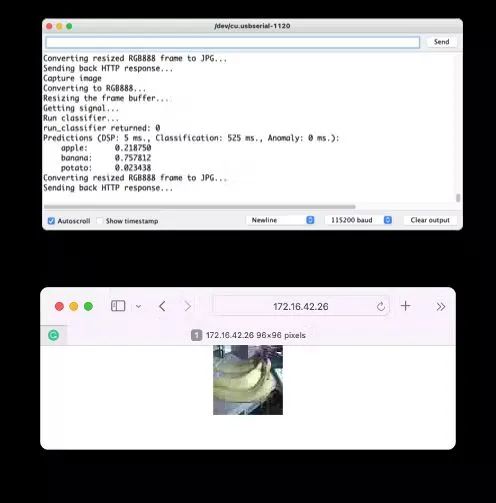
Tutorial Details: Image, Motion, and Sound Recognition
The project provides three main tutorials covering image classification, motion classification, and keyword recognition:
- • Vision – Image Classification: This tutorial demonstrates how to use the ESP32 camera for image capture and classification. It uses pre-trained models capable of recognizing different objects in images, such as digits, letters, or common objects. This tutorial involves model conversion, deployment on ESP32, and real-time image processing.
- • Motion – Motion Classification: This tutorial utilizes the built-in accelerometer of the ESP32 to detect and classify different motion patterns, such as walking, running, and jumping. It uses machine learning algorithms to analyze accelerometer data and recognize different motion patterns. This tutorial focuses on data preprocessing, feature extraction, and model training.
- • Sound – Keyword Spotting: This tutorial demonstrates how to use the ESP32 microphone for keyword recognition. It uses a pre-trained model capable of recognizing predefined keywords, such as “hello” and “stop.” This tutorial involves audio data preprocessing, feature extraction, and model deployment.
Model Conversion and Optimization:
Given the limited computing power of the ESP32, machine learning models need to be optimized for efficient operation. The project provides model conversion tools to convert trained models into ESP32-compatible formats. Model optimization typically includes model compression and quantization to reduce model size and computational complexity, thereby improving efficiency and lowering power consumption.
Development Environment and Tools:
To use the ESP32-TinyML project, you need an ESP32 development board, Arduino IDE, and necessary libraries. The project documentation provides detailed steps and instructions for configuring the development environment.
Conclusion
The ESP32-TinyML project provides developers with an easy-to-use platform for running TinyML models on resource-constrained ESP32 microcontrollers. With its pre-trained models, user-friendly API, and detailed tutorials, developers can easily build various TinyML-based smart devices.
Project Address:https://github.com/Mjrovai/ESP32-TinyML