Word count: 1405, reading time approximately 8 minutes
The Origin and Development of Python: The Most Popular Programming Language in the World
Strongly recommended for Python users and friends who wish to learn Python to take a look at this video, hoping to understand why Python exists and whether you need to learn Python from this video.
Core: Simplicity over complexity, clarity over ambiguity, readability is paramount, interestingly, this is similar to Go’s “less is more” philosophy
Video link: Python: Origin and Development[1]
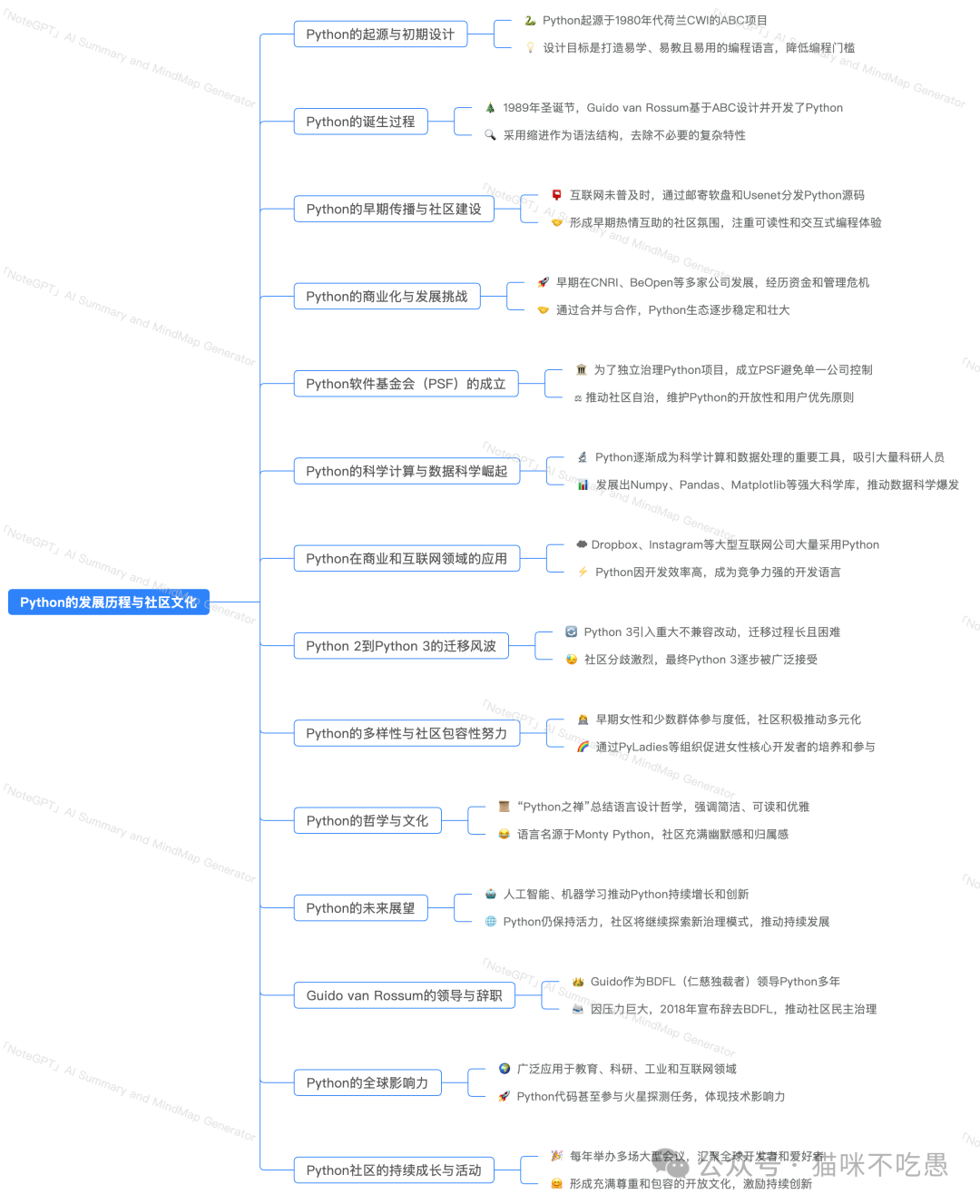
Video Mind Map
Summary
This content delves into theorigin, development history, community culture, and significant impact of the Python programming language in fields such as scientific computing, data science, and artificial intelligence. Python was born in the 1980s at the CWI Institute in the Netherlands, initially created to develop a language that was both easy to learn and practical, addressing the complexity and difficulty of programming languages at that time.Guido van Rossum’s design philosophy was based on the ABC language, combined with his own experiences, led to the creation of Python. Python’s interactivity, concise syntax, and readability quickly made it popular, and through the power of the internet and community, it gradually grew to become one of the most popular programming languages in the world.
Throughout Python’s development, it has experienced several key milestones,including the complex migration from Python 2 to Python 3, the self-organization and governance transformation of the community, and the continuous expansion of its ecosystem. Particularly in the fields of scientific computing and data science, Python has become a mainstream choice due to its rich libraries and tools (such as NumPy, Pandas, TensorFlow, PyTorch), driving the rapid development of artificial intelligence and machine learning. The community culture emphasizes inclusivity, diversity, and collaboration, striving to attract more women and individuals from different backgrounds, forming a vibrant and creative ecosystem.
Despite facing numerous challenges and controversies,Python has maintained openness and innovation, influencing global technological development. Python has not only changed the barriers to programming but also transformed the way people interact with computers, becoming an important bridge connecting science, engineering, the internet, and business.
Highlights
🐍 Python originated from the ABC project at CWI in the 1980s, aiming to create an easy-to-learn and user-friendly programming language.🚀 Python is widely used in scientific computing, data science, and artificial intelligence, driving technological innovation.🌐 The internet and open-source community have accelerated Python’s rapid dissemination and ecosystem development.🔄 The migration from Python 2 to Python 3 took a decade, reflecting the challenges of community governance and technological evolution.🤝 The Python community emphasizes inclusivity and diversity, actively promoting the participation of female developers in core development.💡 The Zen of Python reflects the language’s design philosophy, emphasizing simplicity, readability, and elegance.🏆 Python has become one of the most popular programming languages globally, with a profound and ongoing impact.
Key Insights
🐍 The background of Python’s birth reflects an innovative design philosophyIn the 1980s, computers were expensive and programming was difficult, the ABC project aimed to create a language that non-professional programmers could easily master. Python inherited and improved upon this idea, emphasizing simplicity and ease of use, lowering the entry barrier for programming, and promoting the popularization of programming education.
🌐 The internet and open-source community are key drivers of Python’s successIn an era when the internet was not yet widespread, the dissemination of Python was extremely difficult, but with the rise of the internet and the use of early network platforms like Usenet, Python was able to spread rapidly. The active feedback and contributions from community members formed a strong collaborative network, laying the foundation forthe development of the Python ecosystem.
🔄 The migration from Python 2 to Python 3 reflects dual challenges of technology and communityThis migration was highly controversial due to compatibility issues, leading to community division and slow migration. It highlighted how large-scale open-source projects manage the complex balance of technical debt, user needs, and community governance during evolution, ultimately completing the transition through collaboration and tool support.
🤝 Community diversity and inclusivity are crucial for Python’s continued developmentIn the early Python community, the proportion of women was extremely low, organizations like PyLadies have promoted the participation of women and minority groups, significantly changing the community structure. Guido van Rossum himself has also actively promoted diversity, reflecting the importance of social responsibility and cultural building in the tech community.
💡 The Zen of Python embodies the core values of the languageSimplicity over complexity, clarity over ambiguity, readability is paramount, these principles not only guide language design but also shape developers’ thinking, promoting code quality and maintainability, which is the cultural core of Python’s charm and success.
🚀 Python’s rise in scientific computing and artificial intelligence has driven a technological revolutionWith the support of rich third-party libraries,Python has become the preferred language for AI and data science. It encapsulates complex underlying implementations, lowering the programming barrier for scientists and engineers, promoting the popularization and commercialization of technologies like machine learning and deep learning.
🏆 Python’s future depends on community governance and continuous innovationAfter Guido stepped down from the BDFL position, the Python community adopted a governance model with a steering council, reflecting the democratic transformation of mature open-source projects. In the future, Python needs to find a balance between maintaining language simplicity and meeting diverse needs, continuing to lead the development of programming languages.
Reference Links
<span>[1]</span> Video link: Python: Origin and Development: https://www.bilibili.com/video/BV1Mha1zrErS/?buvid=XU900A99C24679901076D41D6F50C0A979A31&from_spmid=main.later-watch.0.0&is_story_h5=false&mid=pSnMVM3k9LXWmNpMaz3Iiw%3D%3D&p=1&plat_id=116&share_from=ugc&share_medium=android&share_plat=android&share_session_id=636b38cf-c4da-4fa3-b77e-7af59c352bba&share_source=WEIXIN&share_tag=s_i&spmid=united.player-video-detail.0.0×tamp=1758618182&unique_k=2VCV9TI&up_id=3546869640726821