Drones are becoming increasingly common in our lives and serve various purposes: patrolling, agricultural planting, emergency rescue, logistics, and transportation. However, like everything, drones have their pros and cons. When misused by bad actors, they can pose significant threats to society, such as terrorists using drones for attacks, criminals using them to relay information, and obsessive fans using drones to invade celebrities’ privacy. How can we capture these malicious drones?
Blind the “Eyes” of Drones
On the battlefield, military forces have many methods to shoot down drones, including guns, rockets, and laser weapons. However, these high-risk weapons cannot be used in everyday life. Instead, a more common method is to interfere with drones.
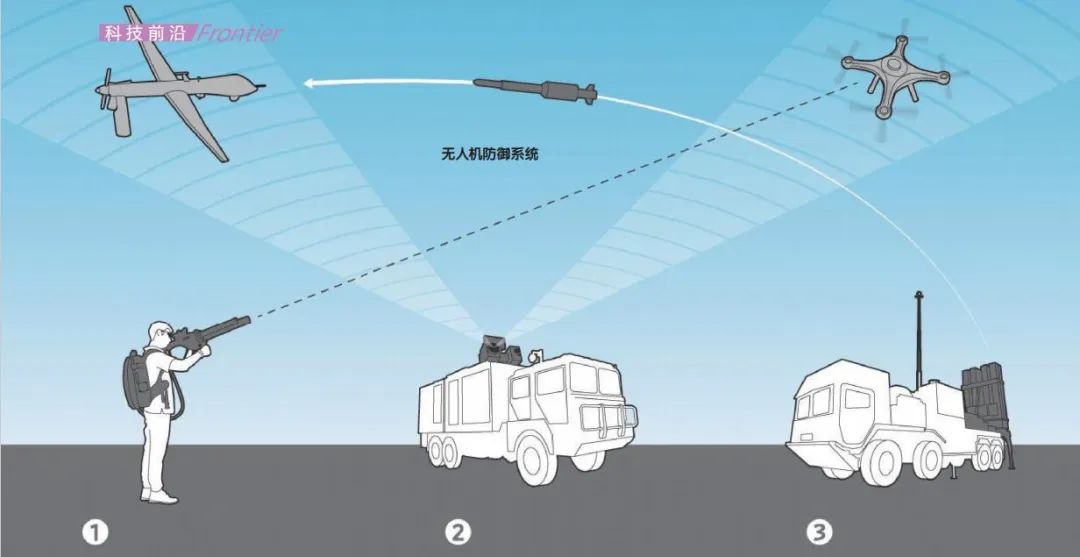
To date, the development of drone jamming systems has become very sophisticated, with various types and powerful functions. The UK’s AUDS anti-drone defense system has a detection range of nearly 10 kilometers and can operate around the clock, day or night. The AUDS system can be deployed at fixed locations or on mobile platforms, using radar to detect drones, tracking them with precision infrared cameras, and then disrupting their flight paths by emitting directional high-power jamming radio frequencies, blocking the radio signals between the drone and its operator. The entire process of detection, tracking, identification, and neutralization takes only 8 to 15 seconds.
Many major countries have equipped themselves with their own drone jamming systems, such as China’s “Eagle Down” anti-drone system, Russia’s “Auto Field” electronic countermeasure system, and the USA’s MEDUSA electronic jamming system.
Infiltrate the “Brain” of Drones
A more advanced method of neutralizing drones is to infiltrate their “brains” and take control of them. This is achieved by hacking into and taking over the drone’s control circuits.
In 2020, Israel released a new anti-drone system called EnforceAir. The system is very simple in structure, consisting of a tripod, radio system, and antenna cover, weighing only about 54 kilograms. The installation and disassembly of this system are straightforward, allowing one person to complete the setup within minutes, and it can be mounted on vehicles, ships, and other platforms. Unlike traditional anti-drone equipment, it does not use radar or optical systems but directly “controls” drones through a radio frequency network from the source. It can identify the most threatening targets among many drones and take over their control systems, cutting off their connection to the operators behind them.
During a demonstration, when two unauthorized unidentified drones entered the protective airspace of the EnforceAir system, it immediately issued an alert and began detecting and locating them. Using the radio frequency network, the connection between the two drones and their control systems was cut off in an instant. Within seconds, the operators of the EnforceAir system gained control of the two drones, guiding them to their controlled area for “arrest”.
Interceptor with a “Fishing Net”
One method chosen by the Russian military is to spread a large net along the path of the drones to capture them all at once. This interceptor developed by the Russian aerospace company Tabel resembles an ice cream cone, with a high-strength nylon intercepting net and rope stored in a metal cylinder. The smaller diameter end is mounted on a large drone or helicopter, while the larger diameter end can open to release the intercepting net.
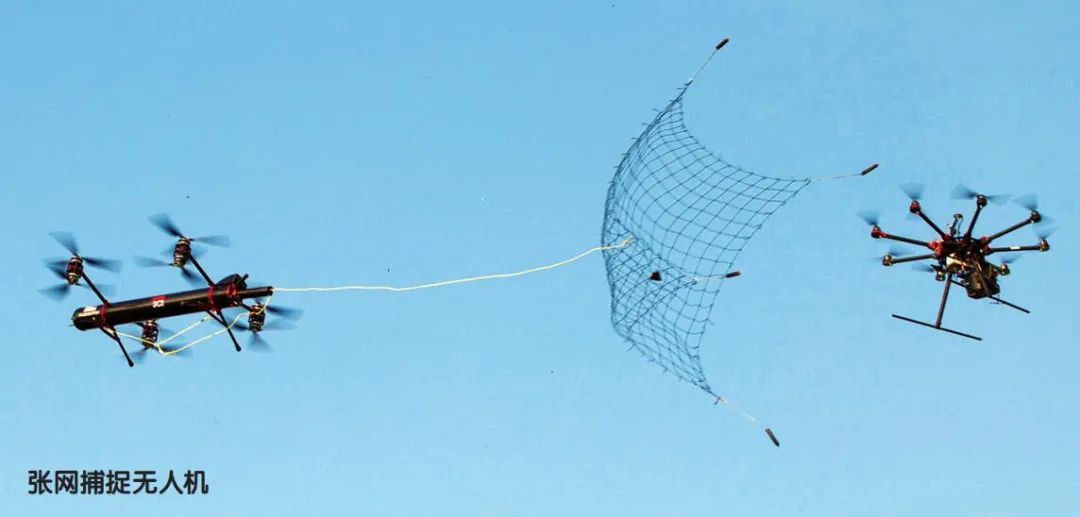
The large drone or helicopter equipped with the interceptor waits in the direction where the small drones are expected to fly. Once it observes a small drone entering its “range”, it can issue an intercept command. The interceptor launches the net, which expands behind the large aircraft, with a longitudinal interception area of 16 square meters. Drones small enough to fit in the palm of a hand, once caught in this intercepting net, are effectively “captured”.
This method has also been adopted by regulatory agencies in other countries. For example, Japan’s urban safety management department uses a drone equipped with an intercepting net that carries a rectangular net measuring 3×2 meters, designed to capture drones attempting to approach important government residences. The UK-based “Open Engineering” company has developed an anti-drone system where the intercepting net can be mounted on the roof of an armored vehicle, with an effective range of 250 meters, capable of capturing drones traveling at speeds of up to 50 meters per second.
Eagle “Police” to the Rescue
For ordinary civilians, the aforementioned methods may be somewhat costly, so the following methods are more suitable for civilian use. A few years ago, the Danish falconry company “Sky Guardian” received an order from the Dutch police to train eagles to capture drones.
Humans have trained birds of prey to help catch aerial prey for thousands of years, and this is the primary business of “Sky Guardian”. However, before receiving this order, the trained birds were mainly used for hunting and performing. The Dutch police believed that since birds of prey have the instinct to catch flying targets, training them to target drones could achieve the goal of intercepting “bad” drones.
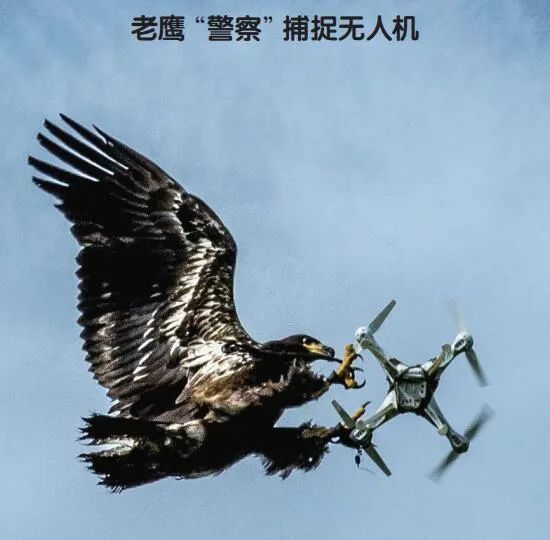
What “Sky Guardian” needs to do is to make the eagles perceive drones as edible prey and improve their accuracy in capturing drones. It has been proven that the efficiency of the eagle “police” is quite good; during several demonstration events in early 2016, the trained eagles quickly brought the target drones to the designated area upon receiving instructions, achieving a success rate of 100%.
Using birds of prey to intercept drones eliminates concerns about harming innocents, insufficient range, and signal interference, achieving higher interception efficiency at a lower cost.
Spinning Silk to Capture Drones
Inspired by spiders, the Air Robotics Laboratory at Imperial College London developed a drone called SpiderMAV, which possesses the incredible ability to shoot silk like Spider-Man.
The SpiderMAV is inspired by a spider known as the Darwin’s bark spider, which can produce silk up to 25 meters long, with strength more than twice that of other silks and is the hardest biological filament known. The research team modified a DJI Matrice 100 drone, installing two silk-spraying devices on the top and bottom of the drone. These devices use compressed gas to launch polystyrene plastic ropes, with a magnet attached to the front end, which can stick to other objects once launched. After capturing the target object, the SpiderMAV stabilizes itself through the drag of the silk and can slow down or directly shut off its motors, allowing it to safely hover or descend slowly.
In addition to using methods such as striking, jamming, and capturing, enhancing the management and monitoring of drones may be the fundamental solution. For instance, countries around the world are formulating drone “traffic regulations” to limit the weight and flight altitude of drones; the US Federal Aviation Administration requires civilian drones to be registered, managing them like automobiles; and NASA has launched a system to manage drone flight paths. In the future, people will have a better grasp of drone management and application.