


Imagine this: It is the year 2040, a 12-year-old child with diabetes throws a piece of gum into his mouth. The temporary tattoo on his forearm detects a rise in blood sugar and sends this information to his phone. The data from this health monitoring tattoo is also uploaded to the cloud, allowing his mother to check it at any time. She herself has a similar temporary tattoo, one for monitoring lactic acid levels in her sweat during exercise, and another that continuously tracks her blood pressure and heart rate.
Currently, this type of tattoo has not yet been released, but numerous laboratories around the world are working on this critical technology, including the lab at the University of Massachusetts Amherst where I work. The advantages of this technology are quite significant: electronic tattoos can help people track complex conditions, including cardiovascular diseases, metabolic disorders, immune system diseases, and neurodegenerative diseases. Nearly half of American adults may be in the early stages of one or more of these diseases, often without realizing it.
If technology can enable early screening and health monitoring before serious symptoms appear, it will significantly improve treatment outcomes. We will be able to track disease-related factors such as diet, exercise, environmental exposure, and mental health. We can also conduct long-term studies to monitor vital signs and environmental parameters of seemingly healthy populations. This data could lead to transformative changes, driving the development of better treatment options and preventive care. However, to achieve continuous monitoring over years (rather than just weeks or months), breakthroughs in manufacturing processes are necessary to create affordable sensors that ordinary people are willing to use regularly in their daily lives.
Developing this technology is precisely what drives my research in the 2D Bioelectronics Lab. We focus on the study of atomically thin materials like graphene. We believe that the properties of these materials make them particularly suitable for developing advanced bio-monitoring devices that are imperceptible to the human body. My team is developing graphene electronic tattoos that anyone can apply to their skin for biochemical or physiological biosensing.
The idea for this “stick-and-use” sensor originates from groundbreaking research by Professor John Rogers and his team at Northwestern University. They developed “epidermal electronic devices” that integrate cutting-edge silicon chips, sensors, light-emitting diodes, antennas, and transducers into super-thin epidermal patches for monitoring various health metrics. One of Rogers’ most famous inventions is a wireless patch sensor designed for newborns in intensive care, which allows nurses to care for these fragile infants while enabling parents to hold their children with peace of mind. Rogers’ wearable devices are typically less than 1 millimeter thick, which is thin enough for many medical applications. However, to develop patches that people are willing to wear continuously for years, we need to find ways to make them even less perceptible to the body.
To develop thinner wearable sensors, Professor Deji Akinwande from the University of Texas at Austin and Ru Nan Shu pioneered a graphene electronic tattoo (GET) in 2017. The first graphene electronic tattoos were only about 500 nanometers thick and were applied in the same way as children’s fun temporary tattoos: users simply wet the polymer backing paper containing graphene to transfer it onto their skin.
Graphene is a remarkable material made of a single layer of carbon atoms, exhibiting exceptional conductivity, transparency, lightness, strength, and flexibility. When used in electronic tattoos, its presence is nearly imperceptible, and users may not even feel it adhering to their skin. Tattoos made from single-atom-thick graphene (combined with a few layers of other materials) are only about one-hundredth the diameter of a human hair. They are soft and pliable, perfectly conforming to the anatomical structure of the body, fitting into every crease.
Some people mistakenly believe that graphene lacks biocompatibility and cannot be used in the field of bioelectronics. Over a decade ago, during the early research phase of graphene, some preliminary studies reported that graphene sheets were toxic to living cells, primarily due to their size characteristics and certain chemical dopants used in the preparation of graphene. However, subsequent research has confirmed that graphene exists in at least a dozen different functional forms, many of which, such as graphene oxide sheets, chemical vapor deposition-grown graphene, and laser-induced graphene, are non-toxic. For example, a 2024 article in Nature Nanotechnology confirmed that inhaled graphene oxide nanosheets did not trigger any toxic or adverse reactions.
We are confident that the single-atom-thick graphene sheets used to manufacture electronic tattoos are fully biocompatible. This type of graphene has been successfully applied in neural implants, showing no toxicity and even promoting the proliferation of nerve cells. We have tested graphene-based electronic tattoos on dozens of subjects, with no side effects reported, not even mild skin irritation.
In 2017, when Akinwande and Ru Nan Shu first created the graphene electronic tattoo, I had just obtained my PhD in bioelectronics from the Jülich Research Center in Germany. I then joined Akinwande’s lab and have recently continued this research in my own lab in Amherst. Through collaboration with partners, we have made significant progress in enhancing the performance of graphene electronic tattoos: in 2022, we released a version 2.0 research report and continue to push this technology forward.
According to the World Health Organization, cardiovascular diseases are the leading cause of death globally, with contributing factors including diet, lifestyle, and environmental pollution. Long-term monitoring of heart activity (especially heart rate and blood pressure) will become the simplest and most direct way to track populations showing signs of disease, and our electronic tattoos are the ideal vehicle for achieving this goal.
Measuring heart rate is a relatively simple task because each heartbeat generates a distinct electrical signal due to the depolarization and repolarization processes of myocardial tissue. To detect these electrocardiogram signals, we place a pair of graphene electronic tattoo sensors on the subject’s skin: either on the chest near the heart or on both arms. Additionally, a third tattoo sensor is placed as a reference electrode in another location. During the differential amplification process, the amplifier receives signals from all three electrodes but automatically filters out the common signals shared between the reference electrode and the measurement electrodes, amplifying only the differential signals between the two measurement electrodes. This way, we can isolate the relevant cardiac activity from the surrounding electrophysiological noise. Currently, we are using ready-made amplifier modules integrated into wireless devices produced by companies like OpenBCI.
Continuously monitoring blood pressure through electronic tattoos is much more challenging. We are collaborating with Akinwande from the University of Texas at Austin and Roozbeh Jafari from Texas A&M University (currently at MIT’s Lincoln Laboratory) on this work. Surprisingly, the blood pressure monitoring devices used by doctors today are not fundamentally different from those used a century ago. You have likely seen such devices: they apply pressure through an inflatable cuff wrapped around the upper arm, temporarily blocking arterial blood flow, and then slowly release the pressure while recording the pulsations of the heart pushing blood through the arteries to measure the systolic (maximum) and diastolic (minimum) pressure values. While cuff-style blood pressure monitors work well in clinical settings, they cannot provide continuous readings and cannot measure while the subject is moving. In hospital settings, nurses need to wake patients at night to measure blood pressure, while home devices require users to actively monitor their condition.
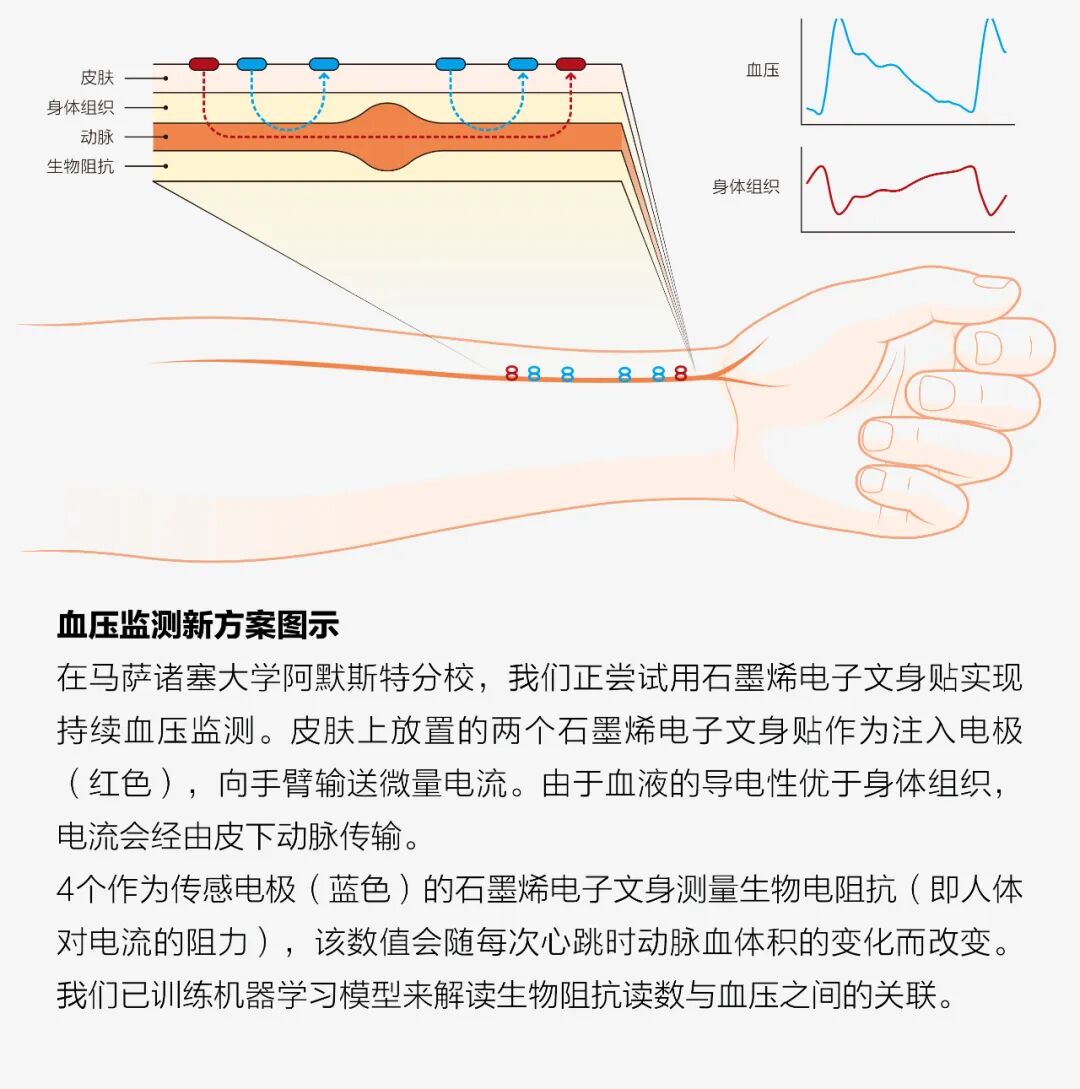
We have developed a new system that can continuously and imperceptibly monitor blood pressure using only adhesive graphene electronic tattoos. As described in our 2022 paper, graphene electronic tattoos do not directly measure blood pressure but instead measure bioelectrical impedance (the body’s impedance to electric current). We use multiple graphene electronic tattoos to inject a weak current (currently 50 microamperes) that travels through the skin to the subcutaneous arteries; next, another set of graphene electronic tattoos placed above the arteries measures the tissue impedance. Since arterial blood is rich in ionic solutions, its conductivity is much higher than that of surrounding fat and muscle tissue, making the artery the path of least resistance for the injected current. As blood flows through the artery, its volume changes slightly with each heartbeat. This change in blood volume alters the impedance level, and we use this to establish a correlation with blood pressure.
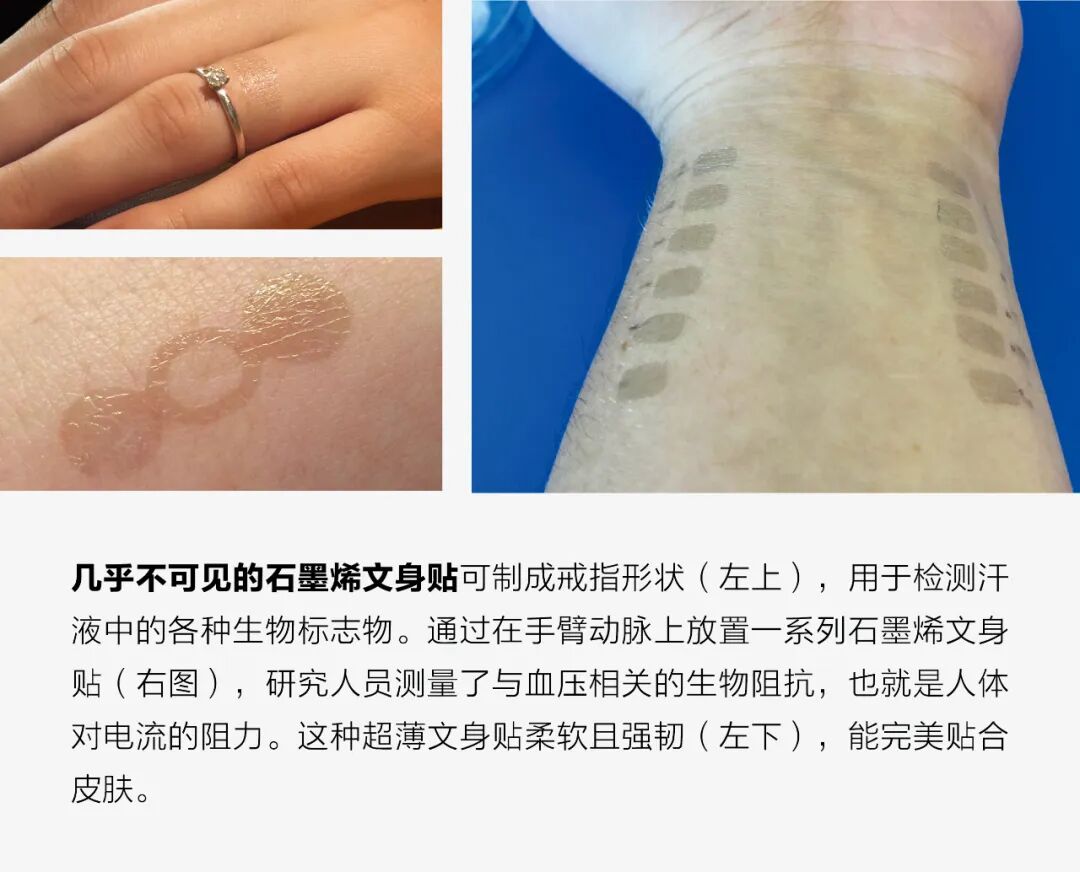
Although there is a clear relationship between bioelectrical impedance and blood pressure, the relationship is not linear, which is where machine learning can play a role. To train the model to understand this relationship, we conducted a series of experiments: using graphene electronic tattoos to accurately monitor the subjects’ bioelectrical impedance while using a fingertip device to monitor their blood pressure. We recorded data from subjects during grip exercises, immersing their hands in ice water, and completing other activities that would alter blood pressure.
In these model training experiments, graphene tattoos have an irreplaceable advantage. Measuring bioelectrical impedance can be done with any electrodes; for example, a wristband equipped with an aluminum electrode array can achieve this. However, the correspondence between the measured bioelectrical impedance and blood pressure is extremely close, so even a few millimeters of electrode displacement (such as a slight slip of the wristband) can render the data completely useless. Our graphene tattoos ensure that the electrodes remain in the same position throughout the recording process.
After completing the model training, we again used graphene electronic tattoos to record the bioelectrical impedance data of the same group of subjects and used this data to derive their systolic, diastolic, and mean arterial pressures. We tested the system by continuously monitoring blood pressure for over 5 hours (this duration is ten times longer than previous studies). The results were encouraging: compared to blood pressure monitoring wristbands, the readings provided by electronic tattoos were more accurate, fully meeting the highest precision requirements of the IEEE standard for cuffless wearable blood pressure monitoring devices.
Despite being pleased with the current progress, we still face many challenges. Each individual’s biological signature is unique, meaning that the correspondence between each person’s bioelectrical impedance and blood pressure is distinct. Therefore, for each subject, we currently must recalibrate the system. We urgently need to develop more advanced mathematical analysis methods that allow machine learning models to describe the universal relationships between these signals.
With the support of the American Heart Association, my lab is exploring another very promising application of graphene electronic tattoos: detecting the degree of arterial stiffness and plaque accumulation, both of which are significant risk factors for cardiovascular diseases. Currently, doctors typically use diagnostic tools such as ultrasound and magnetic resonance imaging to check for arterial stiffness and plaque, which not only require patients to visit medical facilities and use expensive equipment but also rely on trained medical personnel to operate and interpret the results.
With graphene electronics, doctors can easily and quickly conduct tests on multiple body parts while obtaining both local and overall data. Since the tattoo sensors can be applied anywhere, we can assess major arteries (such as the carotid artery) that are difficult to reach with existing devices. Graphene electronic tattoos can also achieve rapid readings of electrophysiological signals. We believe that machine learning can establish a connection between bioelectrical impedance measurements and arterial stiffness and plaque formation—this can currently be achieved by conducting a series of targeted experiments and collecting the necessary data.
Using graphene electronic tattoos for these tests will help researchers delve deeper into how arterial stiffness and plaque accumulation lead to the development of hypertension. By tracking this data in large populations over the long term, clinicians can better understand the pathological mechanisms that ultimately lead to significant heart diseases and perhaps even find ways to prevent these diseases.
In another area of research, my lab has just initiated the development of graphene tattoos for sweat biosensing. When the human body sweats, the sweat brings salts and other compounds to the skin’s surface, and sensors can detect health or disease biomarkers based on this. We are initially focusing on cortisol, a hormone associated with stress, stroke, and various endocrine system diseases. In the future, we hope to use this tattoo to detect other compound components in sweat, such as glucose, lactic acid, estrogen, and inflammatory markers.
Several laboratories have already developed passive or active electronic patches for sweat biosensing. Passive systems use chemical indicators that change color when they react with specific components in sweat. Active electrochemical devices typically come equipped with 3 electrodes, capable of detecting various concentrations of substances and providing precise data, but they require bulky electronic components, batteries, and signal processing units. Both types of patches use cumbersome microfluidic chambers to collect sweat.
In our sweat-detecting graphene electronic tattoos, graphene is used as a transistor. We modify the surface of graphene by adding specific molecules (such as antibodies) that can specifically bind to the target substance. When the target substance interacts with the antibodies, a measurable electrical signal is generated, changing the resistance of the graphene transistor. This change in resistance is ultimately converted into readings indicating the presence and concentration of the target molecule.
We have successfully developed standalone graphene biosensors that can detect food toxins, measure ferritin (a protein that stores iron), and differentiate between the COVID-19 virus and the flu virus. These standalone sensors resemble chips and are placed on a table during experiments, where operators add liquid samples to them. With support from the National Science Foundation, we are integrating this transistor-based sensing technology into wearable graphene electronic tattoos that can be directly applied to the skin for direct contact with sweat.
We are also improving the graphene electronic tattoos by adding microporous structures that allow moisture to pass through, preventing sweat from accumulating beneath the sensor and affecting its function. Currently, we are working to ensure that sufficient sweat can seep from the sweat gland ducts into the tattoo sensor, allowing the target substance to react fully with the graphene.
To transform our technology into user-friendly products, several manufacturing process challenges remain. Most importantly, we need to address how to integrate these smart electronic tattoos into existing electronic networks. Currently, we must connect graphene electronic tattoos to standard electronic circuits to enable current delivery, signal recording, and information transmission and processing. This means that individuals wearing electronic tattoos must connect miniature computing chips via wires, which then wirelessly transmit data. In the next 5 to 10 years, we hope to achieve integration of electronic tattoos with smartwatches. This integration will require hybrid interconnect technology to combine flexible graphene tattoos with the rigid electronic components of smartwatches.
In the long term, I envision that 2D graphene materials will be used to manufacture fully integrated electronic circuits, power supplies, and communication modules. Microelectronics giants like IMEC in Belgium and Intel have already begun developing electronic circuits and nodes based on 2D materials (rather than silicon).
Perhaps in 20 years, we will develop 2D electronic circuits that can integrate with soft tissues in the body. Imagine: electronic devices implanted in the skin that can continuously monitor biomarkers related to health status and provide real-time feedback through user-friendly micro-displays. This breakthrough would offer everyone a convenient and non-invasive way to gain real-time insights and actively manage their health, ushering in a new era of human self-awareness.
Author:Dmitry Kireev

IEEE Spectrum
Official WeChat Public Platform
 Previous RecommendationsHow ultrasound devices achieve miniaturizationHigh-tech transformation in art restorationAI workloads drive larger storage drives