Click on the title below “Guo Xin Nan Fang” for quick follow-up
Source: Semiconductor Chip News
In 2020, the “Several Policies for Promoting High-Quality Development of the Integrated Circuit Industry and Software Industry in the New Era” was issued, marking the first time the Chinese government split testing and packaging companies into separate entities, indicating that the much-needed third-party professional testing companies in mainland China are gradually stepping onto the market stage.In recent years, the chip testing business traditionally completed by packaging manufacturers is increasingly being handed over to independent testing firms.The trend of professional division within the domestic IC industry is continuously developing, and independent IC testing firms are gradually gaining attention from the industry.Automated testing equipment for chips can replace manual labor through computer programming, automatically completing testing sequences, greatly optimizing the detection process and improving efficiency, making it an important part of the global semiconductor equipment industry. However, over 90% of the international chip testing equipment market is dominated by American and Japanese companies, and the domestic mid-to-high-end ATE (Automated Test Equipment) industry urgently needs development.
1. VLCT Widely Applicable Automatic Testing Machine
Chip testing is a complex system engineering process with many different concepts and methods, such as functional testing, performance testing, electrical testing, wafer testing, etc.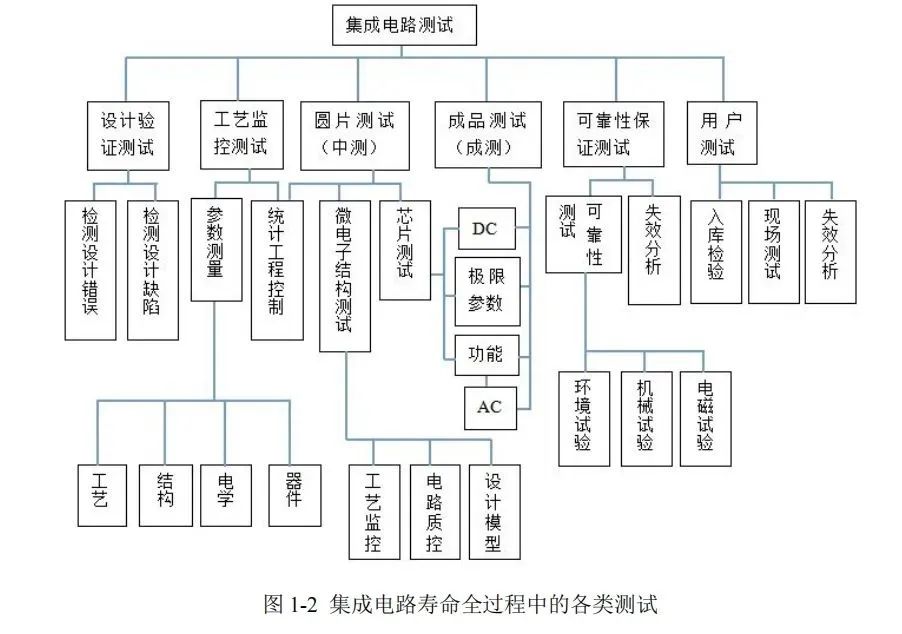 Image source: Liu Ankang “Development and Application of SoC Chip Testing Systems Based on ATE”As we can see, there are many types of tests. But ultimately, testing aims to achieve several objectives: Is there any error in the testing process? Are there defects in the manufacturing process? Are there deviations in the design? Are there contradictions in the design requirements proposed by users, etc.With the increasingly complex development trend of semiconductors and technological evolution, more and more companies have begun to utilize automated testing to enhance cores, using testing to reverse-engineer product development, improve product quality, and accelerate time to market, while optimizing costs. The main detection methods include testing machines, detection platforms, detection cards, and packaging testing, but here we mainly discuss automated testing equipment (ATE).It is well known that in the mid-1990s, Texas Instruments (TI) developed a general-purpose chip automatic testing device, VLCT, for internal use. Since then, VLCT has gone through three development stages, providing important support for product development and company growth.Phase One (Before 2002): VLCT was rapidly promoted within TI, gradually replacing various ATE products such as LTX’s MegaTest, Teradyne’s J750, and Eagle; Phase Two (2003-2008): VLCT was improved into an instrument for ultra-low testing costs for large-scale chips, covering all advanced large mobile terminal chip testing at TI; VLCT also demonstrated the capability to test 90% of TI’s products and almost completely took over wafer testing and high-volume chip testing at TI; Phase Three (2009-2012): Nearly all new product testing development at TI was conducted directly on VLCT, with overall installed capacity exceeding 3,500 units, and VLCT undertook over 80% of internal testing workload.Today, VLCT testing machines can cover most types of SOC chips, mixed-signal chips, and RF chips on the market, with coverage generally above 90%, including amplifiers, audio, data converters, interfaces, logic and voltage converters, microcontrollers and processors, motor drivers, power management, sensors, switches, and multiplexers.
VLCT testing equipment has undergone dual verification of time and practice. It is technologically mature, embodying nearly twenty years of TI’s investment of hundreds of millions of dollars in independent research and development of general-purpose ATE testing equipment, with installed capacity exceeding 3,500 units, undertaking over 80% of TI’s internal testing workload. Furthermore, it is reliable in performance, having undergone large-scale long-term mass production validation of hundreds of billions of chips, meeting mid-to-high-end chip testing requirements. Currently, VLCT continues to serve TI’s products in the market for ATE testing. Additionally, it has strong versatility, with rich testing resource configurations that can cover most types of SOC chips, mixed-signal chips, and RF chip testing. Lastly, it boasts high cost-effectiveness, reducing testing costs by up to 50% compared to similar products, allowing for lower performance and cost configurations to replace mainstream mid-to-high-end ATE brands.
2. Self-owned ATE Equipment, Optional Testing Service Model
Moore Elite deeply understands the needs of chip design companies and is building a new testing service model focusing on the essence of testing industry services and the core ATE equipment required for testing.After completing the acquisition of ATE testing machines and teams at the end of 2020, Moore Elite officially introduced VLCT’s advanced technology to the domestic market, relying on core self-controllable ATE testing equipment to provide one-stop testing services for domestic and international enterprises.Chip testing is not a single processing step; the testing services provided by Moore Elite are the core key throughout the industry chain, including chip testing, product engineering verification, finished product testing, product reliability analysis, and failure analysis. The so-called one-stop testing mass production service allows customers to enjoy a seamless experience at Moore Elite: from solution development (testing hardware and software design) to new product introduction, followed by continuous optimization for stable mass production, helping clients’ products successfully win the market. Among these, mass production maintenance is a major selling point for Moore Elite. This service helps clients continuously optimize testing procedures to resolve issues arising from product sales, such as RMA returns, while utilizing industry-specific software systems to assist clients in yield monitoring and improvement, meticulously managing and optimizing the product supply chain, and providing on-site technical support to resolve clients’ manpower shortages and real-time factory management challenges.Moore Elite offers two main service models: one is a flexible cooperation model, and the other is a Backstage (backend) model.
- Flexible Cooperation Model means that chip design companies completely hand over testing to Moore Elite, which will place orders for mass production with either self-operated or third-party cooperative testing factories. Clients need not worry about testing production, and Moore Elite will deliver finished products that have passed testing. Moore Elite will provide clients with unique continuous mass production services, engineering support, and product testing quality management services, ensuring transparent supply chain data.
- Backend Model primarily targets clients with high testing machine capacity requirements. Clients or designated testing factories rent ATE equipment from Moore Elite, and Moore Elite provides corresponding testing services such as program development and ATE maintenance. The backend model offers clients more flexible testing capacity configuration, higher capital utilization rates, and better cost control.
3. Significantly Improving Chip Testing Efficiency for Clients
Currently, many high-quality Fabless clients at home and abroad are using Moore Elite’s ATE equipment, which has already been put into mass production at the top three chip design companies in China and successfully penetrated the global top three RF international giants.Statistics from years of mass production projects show that Moore Elite can help clients save more than half of their testing costs.
| Chip Type | Chip Content | Testing Services |
| Communication Base Station Chip | 28nm/BGA/10Gbps Serdes | Engineering Verification/Characteristic Analysis/Electrical Reliability/Small Batch Production/Mass Production |
| Baseband Chip | 28nm/SiPB GA/4G Protocol | Engineering Verification/Characteristic Analysis/Electrical Reliability/Small Batch Production/Mass Production |
| IoT Chip | 55nm/BGA/NB-Iot | Engineering Verification/Characteristic Analysis/Electrical Reliability/Small Batch Production |
| 4G Tx Chip | 40nm/BGA | Engineering Verification/Characteristic Analysis/Electrical Reliability/Small Batch Production/Mass Production |
| 3G PA Chip | 40nm/QFN | Engineering Verification/Characteristic Analysis/Electrical Reliability/Small Batch Production/Mass Production |
| 3G RF Switch | 90nm/LGA | Engineering Verification/Characteristic Analysis/Electrical Reliability/Small Batch Production/Mass Production |
| Secondary Power Module | SiP/5.5V/5A | Engineering Verification/Characteristic Analysis/Electrical Reliability/Small Batch Production/Mass Production |
| PMIC Chip | QFN/4A/10bit ADC | Small Batch Production/Mass Production |
| NOR Flash | 16MB/SPI | Engineering Verification/Characteristic Analysis/Small Batch Production/Mass Production |
| 3D SRAM | SOI/4GB | Engineering Verification |
| DDR2 | FBGA/128M | Engineering Verification |
| High-Speed AD/DA | 3GSPS/8bit; 2.5GSPS/14bit | Engineering Verification |
Moore Elite’s self-owned testing machine service model is unique, offering the most flexible choices for both wafer/packaging factories and chip companies, aiming to solve everyone’s pain points.
For wafer/packaging factories, using Moore Elite’s equipment can alleviate cash flow pressure, eliminating the need to spend large amounts of cash upfront to purchase expensive ATE equipment closely related to various types of chip functions, significantly increasing the return on investment (ROI); at the same time, for chip design companies, Moore Elite’s hundreds of available ATE equipment units have ample capacity advantages, allowing for dynamic adjustments between self-operated and third-party cooperative factories, providing complete mass production testing services to replace the traditional “one-time sale” testing equipment sales service model, responding faster to chip design companies’ capacity needs, and optimizing the team structure of chip design enterprises! Providing new experiences for clients through solutions, Moore Elite is relentless in its pursuit.Disclaimer: This article is purely for practical discussion purposes, and the copyright belongs to the original author and related rights holders. The views represent the author’s personal opinions. If there are any issues, please contact us, and we will address them promptly.