
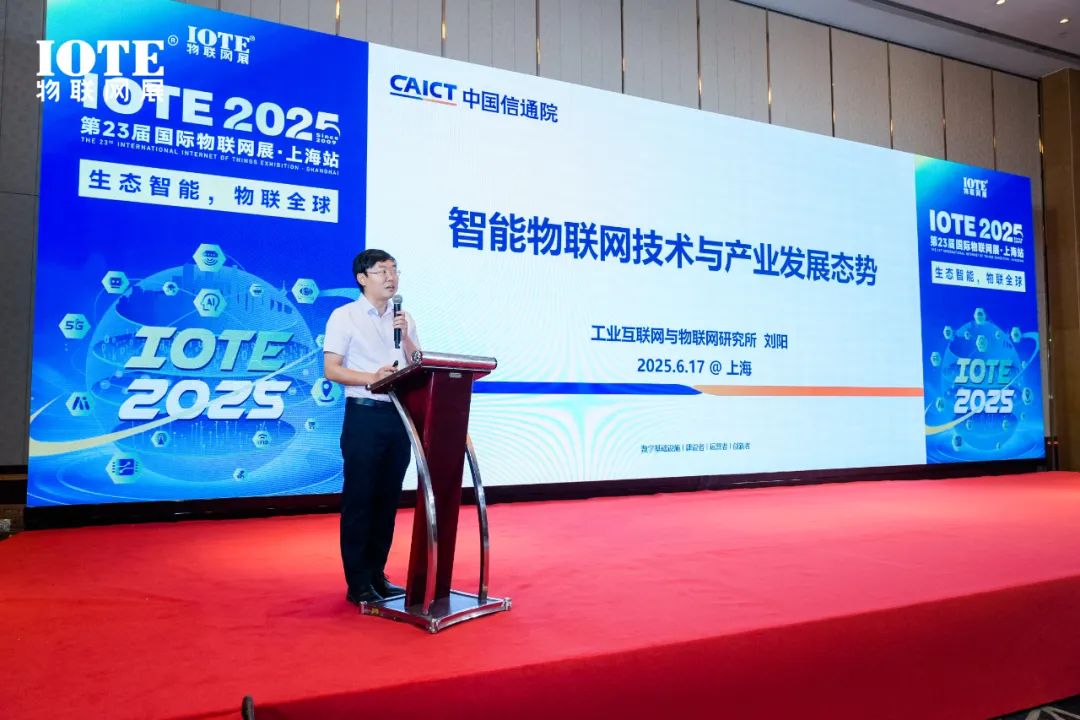
On June 17, 2025, during the 23rd International Internet of Things Exhibition (Shanghai), the China IoT Enterprises Going Global and Innovation Development Summit and the “IoT Star” Award Ceremony were grandly held in Shanghai. Liu Yang, Deputy Director of the Industrial Internet and IoT Research Institute of the China Academy of Information and Communications Technology (hereinafter referred to as “CAICT”), was invited to attend and delivered a keynote speech titled “Trends in Smart IoT Technology and Industry Development,” systematically elaborating on the development trends of smart IoT and proposing thoughts on the future development path of IoT in China.
In the past two years, IoT technology has evolved from perception and connection to platform. Currently, the industry’s focus has shifted to the comprehensive reshaping of the new generation of information and communication fields by AI technology, and smart IoT (AIoT) is accelerating its development in this context. Technologies like TinyML are deploying learning models to controllers and edge gateways, and new IoT terminals such as embodied intelligent humanoid robots are continuously emerging, highlighting the role of intelligent networks in the low-altitude economy. All of this prompts us to consider: Are we at a critical juncture for proposing the concept of “smart IoT”?
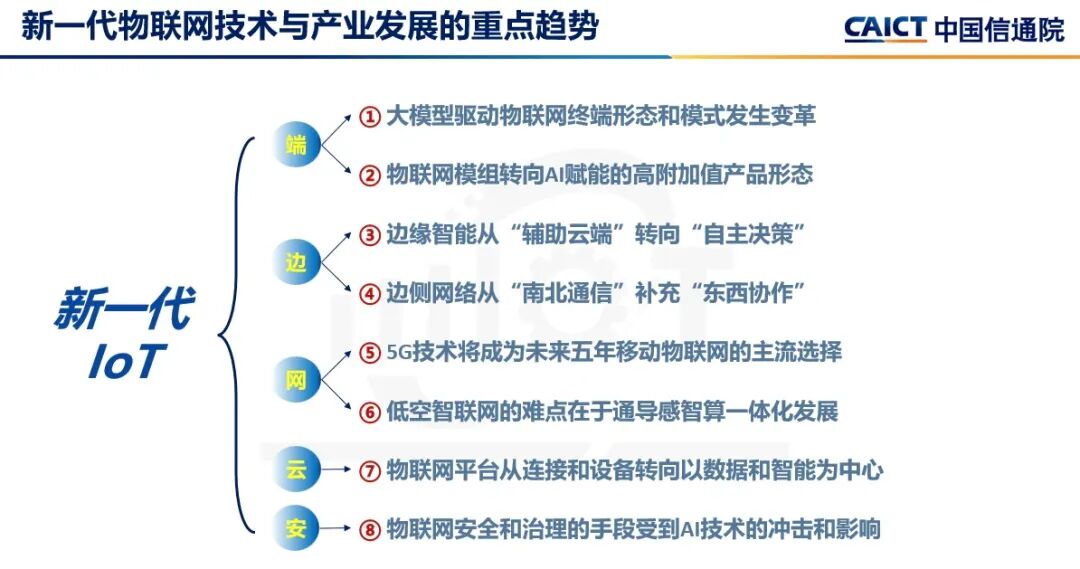
From the terminal perspective, IoT terminals have long been in a primary stage characterized by single functionality and passive interaction, where “intelligence” was merely an added surface feature. Now, general artificial intelligence technologies such as multimodal large models are gradually integrating more deeply with terminal architecture design, showing a trend towards native implementation, achieving continuous user cognition and anticipatory services. The module field is particularly critical, as its functional positioning has upgraded from merely serving as a connection entry point to a communication + AI carrying module. In the future, various IoT module product forms supporting artificial intelligence can be classified based on the different computing capabilities of the modules.
On the edge side, traditional edge positioning has long been confined to the role of a data relay station, mainly executing cloud commands and preprocessing. Now, lightweight AI models are fully migrating to embedded devices, promoting the transition of edge capabilities from execution to autonomous decision-making. In scenarios such as intelligent drone swarm collaboration, intelligent agents can be embedded into edge devices as typical general intelligent products, thereby establishing internal network collaboration between different drones, controllers, and gateways.
From a network perspective, research institutions like IoT Analytics predict that by 2027, the number of 5G connections will surpass 4G to become mainstream, and by 2030, its share is expected to exceed 60%. However, as a representative technology of low-power wide-area networks, NB-IoT is experiencing a structural decline in market share due to multiple factors such as cost and performance constraints. Meanwhile, 5G-native lightweight technologies are gaining significant attention in the industry, with passive IoT and satellite communication becoming key research areas for the 3GPP standards organization.
From the cloud perspective, early centralized IoT platforms often developed parallel to urban monitoring systems or industrial software, leading to shortcomings in operation and maintenance and business models, with many platforms merely serving as auxiliary cognitive tools for managers. In the past two to three years, driven by new data technologies such as general large models of artificial intelligence and data spaces, the concept of IoT platforms has undergone profound changes. A new batch of distributed IoT platforms has emerged, driving the reconstruction of platform architecture and scope.
On one hand, the underlying functions of platforms have transcended simple hardware device management, shifting towards integrating and connecting the descriptive data, lifecycle data, and collected data behind devices. On the other hand, the focus of the PaaS layer has shifted from local or cloud storage of massive data to AIGC content management and knowledge management based on data mining. Especially for upper-layer businesses, past platforms often directly opened APIs or provided SaaS applications. Now, if the platform is repositioned to focus on the collection and connection of “things” and their data, there is no need to directly provide SaaS applications, but rather data can be output as a core element.
For example, new IoT platform forms represented by data spaces are playing a supporting role: by using connectors to achieve edge-side data collection and adaptation, and after unified management by the PaaS platform, they efficiently promote the circulation and utilization of data elements and applications, driving multi-party sharing. This transformation is expected to have a profound impact on the existing platform industry ecosystem.
In the field of security, driven by the evolution of global regional policies and industrial patterns, the security of IoT devices and application systems has become a focus for many countries. The European Union, the United States, Singapore, and other countries and regions are actively promoting IoT security label certification schemes for connected devices. Meanwhile, new network security technologies represented by zero trust are actively exploring new paradigms for IoT security through the core principle of “never trust, always verify.”
Thoughts on the Future Development of AIoT
First, in the context of the rapid development of general large models and embodied intelligence, it is necessary to re-examine the boundaries of the IoT concept, considering whether to enrich the AI technology industry through data collection and transmission from IoT, or to deeply integrate AI’s technical capabilities into the overall vision of IoT.
Second, strengthen the measurement and analysis of the scale of the IoT industry in key cities in China. Only by understanding the current situation can we better target our efforts and promote the comprehensive expansion of IoT perception, connection, and platforms towards the new direction of smart IoT.
Third, fully leverage the inherent advantages of IoT in data collection and transmission, especially viewing the perception industry as a hallmark sector, strengthening research on the IoT edge intelligence technology map, and building public service platforms to enhance mutual trust capabilities.
Fourth, using industrial internet, digital transformation of manufacturing, comprehensive digital transformation of cities, intelligent driving, and smart health as breakthrough scenarios to promote the large-scale development of IoT applications.
In the current rapid iteration cycle of technology and industry, it is necessary to establish an agile response mechanism from demand insight, technological innovation to standard implementation and industrial practice, accelerating the deep integration and mutual empowerment of artificial intelligence and IoT capabilities, forming a resonance effect between technology and industry, and driving IoT towards a higher level of integrated development.