|
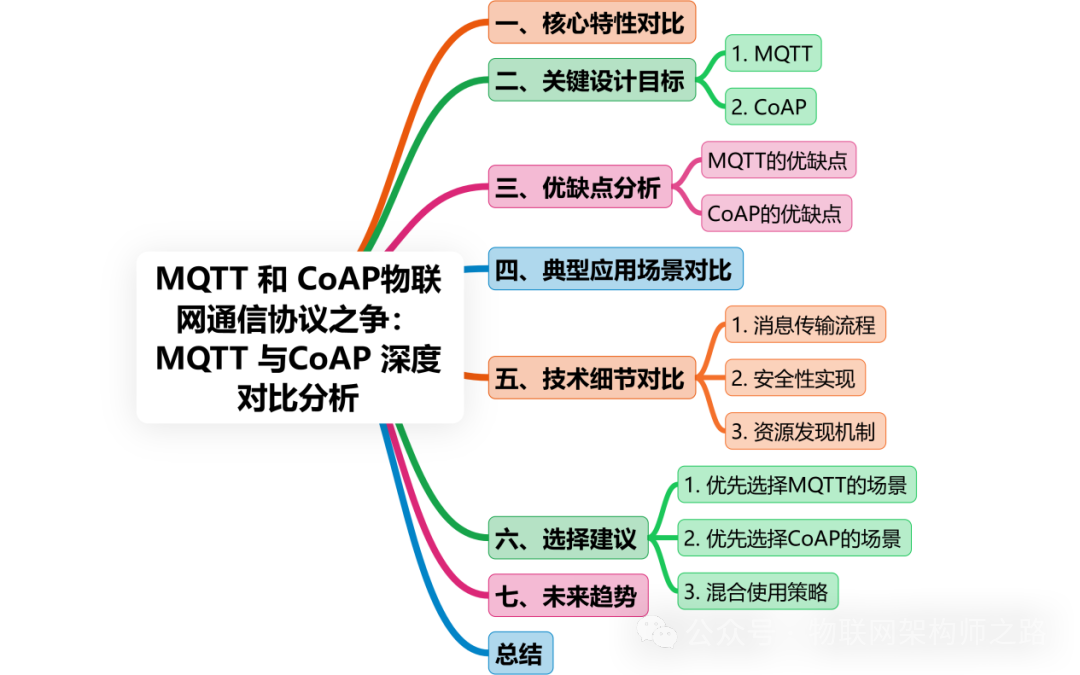
In the field of the Internet of Things (IoT), choosing the right communication protocol is crucial for device performance, battery life, network efficiency, and application reliability. MQTT (Message Queuing Telemetry Transport) and CoAP (Constrained Application Protocol) are two widely used lightweight protocols, each optimized for the characteristics of IoT devices, but they have significant differences in design philosophy and applicable scenarios. |
Below is a detailed comparative analysis of MQTT and CoAP.
1. Comparison of Core Features
|
Feature |
MQTT |
CoAP |
|
Transport Layer Protocol |
Based on TCP (reliable transmission, requires maintaining a connection). |
Based on UDP (connectionless, lightweight and efficient, requires application layer to implement reliability). |
|
Communication Model |
Publish/Subscribe (Pub/Sub): Many-to-many communication, decoupling producers and consumers through a broker server. |
Request/Response (RESTful): One-to-one or one-to-many communication, supports resource discovery and observation mode. |
|
Reliability Mechanism |
Supports QoS 0/1/2 (corresponding to “at most once”, “at least once”, “exactly once”). |
No built-in QoS, basic reliability achieved through Confirmable (CON) messages (requires application layer retransmission). |
|
Data Format |
Custom (e.g., JSON, binary), format needs to be agreed upon. |
Supports JSON/XML, built-in resource description and discovery mechanism (e.g., URI identifies resources). |
|
Network Overhead |
TCP header (20 bytes) + MQTT header (from 2 bytes), total overhead is relatively large. |
UDP header (8 bytes) + CoAP header (from 4 bytes), total overhead is extremely low. |
|
Connection Mode |
Long connection (requires maintaining TCP connection, suitable for frequent communication). |
Connectionless (send on demand, suitable for sporadic communication or low-power scenarios). |
|
Security |
Relies on TLS/SSL encryption. |
Relies on DTLS (UDP’s TLS variant) encryption. |
|
Multicast Support |
Indirectly achieved through Broker. |
Natively supports UDP multicast, can directly send messages to multiple devices. |
2. Key Design Goals
1. MQTT
•Design Goals:
○Optimized for low bandwidth, high latency, unreliable networks (e.g., satellite communication, cellular networks).
○Decouples devices through the publish/subscribe model, supporting large-scale device communication.
○Provides reliability guarantees (QoS 1/2) and persistent sessions (offline message caching).
•Typical Scenarios:
○Smart home (e.g., real-time control of thermostats, cameras).
○Industrial IoT (device monitoring, real-time alerts).
○Cloud big data analysis (e.g., sensor data aggregation).
2. CoAP
•Design Goals:
○Optimized for resource-constrained devices (e.g., sensors, low-power microcontrollers) and low-bandwidth networks (e.g., LoRa, NB-IoT).
○Provides HTTP-like resource operations (GET/POST/PUT/DELETE) through a RESTful architecture.
○Supports lightweight discovery and observation mode (automatic push of resource changes).
•Typical Scenarios:
○Environmental monitoring (e.g., periodic reporting from temperature and humidity sensors).
○Smart buildings (e.g., batch control of lights, air conditioning).
○Narrowband IoT (data reporting from NB-IoT devices).
3. Advantages and Disadvantages Analysis
Advantages and Disadvantages of MQTT
•Advantages:
○High reliability: QoS mechanism ensures messages are not lost or duplicated (QoS 2).
○Strong flexibility: Supports many-to-many communication, suitable for complex scenarios.
○Mature ecosystem: Rich open-source implementations (e.g., EMQX, Mosquitto), extensive community support.
•Disadvantages:
○High resource consumption: TCP connection requires maintaining state, occupying more memory and bandwidth.
○Dependency on Broker: Requires deployment of a broker server, increasing architectural complexity.
○Not suitable for big data: Designed for real-time transmission of small data volumes.
Advantages and Disadvantages of CoAP
•Advantages:
○Extremely low overhead: Suitable for resource-constrained devices (e.g., MCUs with <10KB memory).
○Fast response: Connectionless feature reduces latency, suitable for real-time control.
○Natively supports multicast: Can efficiently control multiple devices in bulk (e.g., synchronized streetlight switching).
•Disadvantages:
○Reliability depends on application layer: Requires self-implemented retransmission mechanism (no QoS).
○Mainly one-to-one: Complex scenarios require additional logic to implement multi-device interaction.
○Newer ecosystem: Open-source toolchain is not as mature as MQTT.
4. Comparison of Typical Application Scenarios
|
Scenario |
Recommended Protocol |
Reason |
|
Smart Home Control |
MQTT |
Requires reliable communication (e.g., light switch commands), and relies on cloud platform Broker. |
|
Industrial Sensor Data Reporting |
MQTT |
Requires QoS 1/2 to ensure data integrity (e.g., production line equipment status monitoring). |
|
NB-IoT Environmental Monitoring |
CoAP |
Low bandwidth, low power requirements, CoAP header is smaller, suitable for narrowband networks. |
|
Batch Device Control |
CoAP |
Utilizes UDP multicast to directly control multiple devices (e.g., smart streetlight systems). |
|
Medical Device Data Transmission |
MQTT |
High reliability requirements (e.g., heart rate monitoring data), requires QoS 2 to ensure “exactly once” transmission. |
|
IoT Device Discovery |
CoAP |
Supports resource discovery and observation mode, simplifying inter-device interaction processes. |
5. Technical Details Comparison
1. Message Transmission Process
•MQTT:
a.The client connects to the Broker via TCP.
b.The publisher sends messages to a specified topic.
c.The Broker distributes the messages to clients subscribed to that topic.
•CoAP:
a.The client sends requests directly to the target device via UDP.
b.The server processes the request and returns a response (e.g., GET/PUT operation).
c.Supports observer mode: The server actively pushes resource changes.
2. Security Implementation
•MQTT:
○Requires overlaying TLS at the TCP layer (e.g., MQTT+TLS).
○Supports client certificates, username/password authentication.
•CoAP:
○Uses DTLS (UDP’s TLS variant) for encryption.
○Supports Pre-Shared Key (PSK) or certificate authentication.
3. Resource Discovery Mechanism
•MQTT:
Requires reliance on custom topic naming conventions or external services (e.g., service registry).
•CoAP:
Built-in CoRE Link Format allows devices to automatically discover resources (e.g., GET /.well-known/core).
6. Recommendations for Selection
1. Scenarios Preferably Choosing MQTT
•High reliability requirements: e.g., financial, medical device data transmission.
•Complex communication scenarios: decoupled communication among multiple devices (e.g., smart home interactions).
•Existing cloud platform support: MQTT Broker (e.g., AWS IoT Core, Alibaba Cloud IoT platform) has a mature ecosystem.
2. Scenarios Preferably Choosing CoAP
•Resource-constrained devices: e.g., sensor nodes, battery-powered devices.
•Low-latency control: e.g., industrial automation, drone control.
•Multicast/broadcast requirements: e.g., streetlights in smart cities, environmental monitoring networks.
3. Hybrid Usage Strategy
•Edge computing architecture:
○Device layer: CoAP reports data (low power, small data).
○Edge gateway: Converts CoAP messages to MQTT for upload to the cloud (e.g., EMQ X Broker supports protocol conversion).
•Hybrid communication mode:
○Critical commands: MQTT (ensuring reliability).
○Status updates: CoAP (fast response).
7. Future Trends
1.Protocol Integration:
○MQTT over QUIC: Achieving TCP-level reliability over UDP, enhancing performance.
○CoAP interoperability with HTTP/2: Enabling cross-protocol communication through gateways.
2.Edge Computing Optimization:
○Edge nodes locally process CoAP requests, reducing cloud load.
3.Advancement of Standardization:
○CoAP’s QoS extension (e.g., IETF draft) may address its reliability shortcomings.
Conclusion
•MQTT is the preferred choice for reliability and complex scenarios, suitable for situations requiring high QoS and cloud platform integration.
•CoAP represents resource efficiency and low latency, suitable for edge devices and narrowband networks.
•A hybrid architecture (e.g., CoAP+MQTT) can balance the advantages and disadvantages of both, meeting diverse IoT needs.