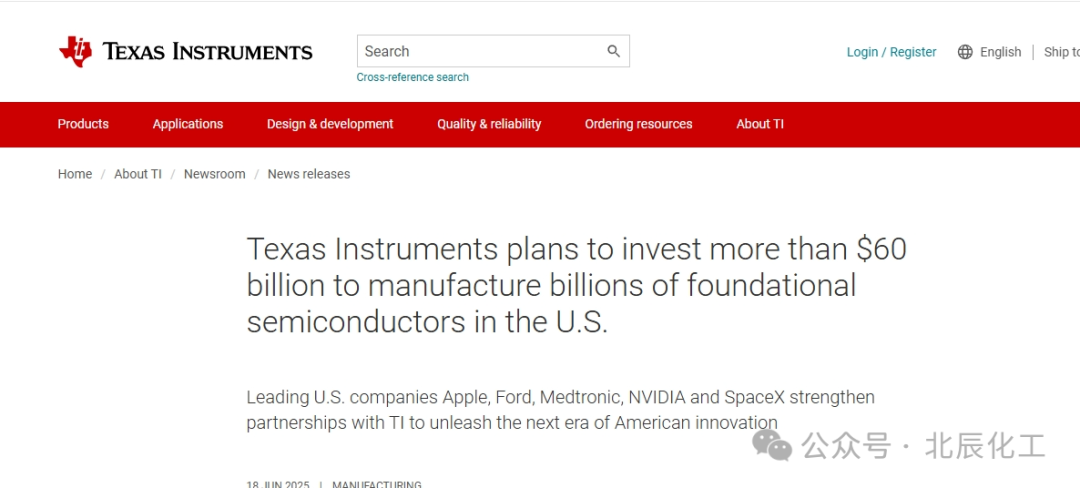
On June 18, 2025, Texas Instruments (TI), a global leader in analog chips, announced an investment of over $60 billion in Texas and Utah, USA, to build seven 300mm wafer fabs. This plan, which sets a record for investment in the U.S. semiconductor manufacturing sector, not only marks the largest capacity expansion in the company’s history but also indicates that the U.S. is attempting to reshape the global semiconductor industry landscape by reconstructing its domestic chip manufacturing capabilities.
Strategic Layout: A Manufacturing Network Across Three States
According to the plan, this investment will be distributed across three major manufacturing bases:
- Sherman, Texas: As the core expansion area, the first new fab, SM1, has entered the production preparation stage, and the main structure of the SM2 fab has been completed. In the future, two additional fabs, SM3 and SM4, will be added, forming a cluster of four fabs.
- Richardson, Texas: Building on the existing RFAB1, the world’s first 300mm analog wafer fab, RFAB2 has achieved full production, continuously consolidating its leading position in the high-performance analog chip sector.
- Lehi, Utah: The expanding LFAB1 and the newly constructed LFAB2 will form a dual-fab structure, focusing on industrial and automotive-grade chip capacity.
“We are building a complete domestic ecosystem covering R&D, manufacturing, and packaging/testing,” said TI President Haviv Ilan. Once all seven fabs are in production, they will achieve a capacity of hundreds of millions of chips per day, covering the full spectrum of demand from consumer electronics to aerospace.
Technical Depth: The 300mm Wafer Capacity Revolution
Unlike chip manufacturers pursuing cutting-edge processes, Texas Instruments focuses its strategic emphasis on mature process “300mm wafer capacity.” This 12-inch diameter wafer increases the single wafer chip yield by 2.3 times compared to traditional 8-inch wafers, with a 30% reduction in unit cost.“The value of analog chips lies in reliability rather than process limits,” Ilan explained. Through self-developed nickel-based catalyst technology and tubular polymerization processes, Texas Instruments has ensured that core indicators such as product weather resistance and impact resistance reach internationally leading levels while compressing production costs to 70% of the industry average.
This technological route has been validated by the market. The Q1 2025 financial report showed that the company achieved revenue of $4.07 billion, an 11% year-on-year increase, with the automotive chip business growing by 25%. According to a report from AVIC Securities, with strong demand in fields such as industrial automation and new energy vehicles, the analog chip market is expanding at an annual rate of 8%, making TI’s expansion timely.
Industry Synergy: Ecosystem Co-construction from Customers to Policies
This plan is backed by a deeply integrated industry alliance. Companies such as Apple, Ford, and Medtronic have committed to transferring some orders to the new fabs:
- Apple CEO Tim Cook stated that TI-manufactured chips in the U.S. will be used for the power management module of the next-generation MacBook;
- Ford plans to use silicon carbide power modules produced at TI’s Sherman fab in its electric pickup F-150 Lightning;
- SpaceX will use chips from the Lehi fab for its Starlink satellite terminals, valuing their wide operating temperature range of -55°C to 125°C.
Government support constitutes another layer of assurance. In December 2024, the U.S. Department of Commerce allocated $1.61 billion in subsidies to TI for environmental facility construction at the Sherman site under the CHIPS and Science Act. Of this investment, 20% will be specifically allocated for employee training, expected to directly create 60,000 engineering and technical jobs and drive employment for 150,000 people in upstream and downstream sectors.
Geopolitical Restructuring: A New Paradigm for Global Semiconductor Manufacturing
This manufacturing return movement is rewriting industrial geography. Texas has formed a semiconductor corridor of “Dallas-Austin-Sherman,” gathering giants like Texas Instruments, Samsung, and Applied Materials, becoming the largest chip industry cluster in the U.S. Meanwhile, in Utah, the LFAB’s zero wastewater discharge system will make it one of the most environmentally friendly wafer fabs in the world.
“This is not just a simple transfer of capacity, but a paradigm upgrade in manufacturing logic,” noted a semiconductor industry analyst. As TSMC’s Arizona plant, Intel’s Ohio plant, and TI’s Texas-Utah network form a synergy, the U.S. is building a complete domestic supply chain covering advanced packaging, specialty processes, and analog chips.
Disclaimer: Some content on this platform is reproduced from the internet for the purpose of conveying more information and does not represent the platform’s endorsement of its views or responsibility for its authenticity; if there are any infringements of your rights or other inappropriate matters, please contact us and provide relevant evidence, and we will handle it promptly.