74 IoT Platform Maps
Linkage Element
In the article “Where Are the Giants in the IoT Era, 3 Types of Platforms, 5 Paths”, Linkage Element categorizes the currently active IoT platforms in the market into three types: infrastructure, development tools, and service operations.
This article will provide a brief analysis of the 72 IoT platforms discovered within these three categories. The infrastructure platforms are distinctly different from the development tools and service operations platforms, so they will be compared separately. Meanwhile, many platforms in the development tools and service operations categories are currently intertwined, so they will not be classified for comparison.
Infrastructure IoT Platforms
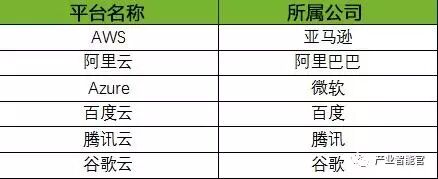
When it comes to infrastructure cloud platforms, there are simply too many. In Shanghai, Linkage Element has surveyed over 30 cloud platform companies of various sizes. However, when it comes to those that have begun to embrace the IoT era, only a few giants stand out.
Among these six clouds, Google Cloud has not entered China. Baidu and Tencent seem to have “no intention in the cloud”, so the competition appears to be between AWS, Alibaba Cloud, and Azure. These three clouds are relatively equal in terms of corporate strength, and there is already a wealth of information online comparing the technologies of these three cloud platform companies, so Linkage Element will not repeat that description. However, from the perspective of information security in the Chinese market, Alibaba Cloud seems to have an advantage.
Development Tools vs. Service Operations IoT Platforms
Linkage Element has encountered 68 platforms in this category (originally 66, but during the organization process, new platforms self-recommended). These 68 platforms can be divided into three categories: the first category consists of large companies making new layouts in the IoT field; the second category includes those favored by capital; and the third category consists of self-reliant companies.
New Explorations by Giants (26 companies):
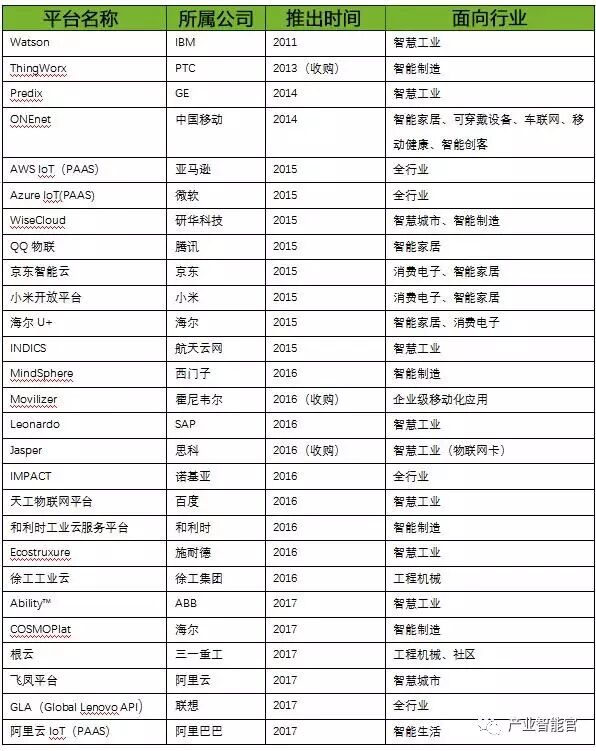
Among these platforms, except for Alibaba Cloud IoT, Azure IoT, and AWS IoT, which are pure PAAS platforms, most of the other platforms integrate both PAAS and SAAS. Among these platforms, GE’s Predix is highly regarded in the industry, at least in the industrial sector, becoming a model that many companies strive to emulate. Many press releases from platform companies often mention “XXX launches an industrial internet/IOT platform, creating China’s Predix”, which has a flavor reminiscent of the entertainment industry where “XXX outshines XXX”.
Capital-Favored Companies (21 companies):
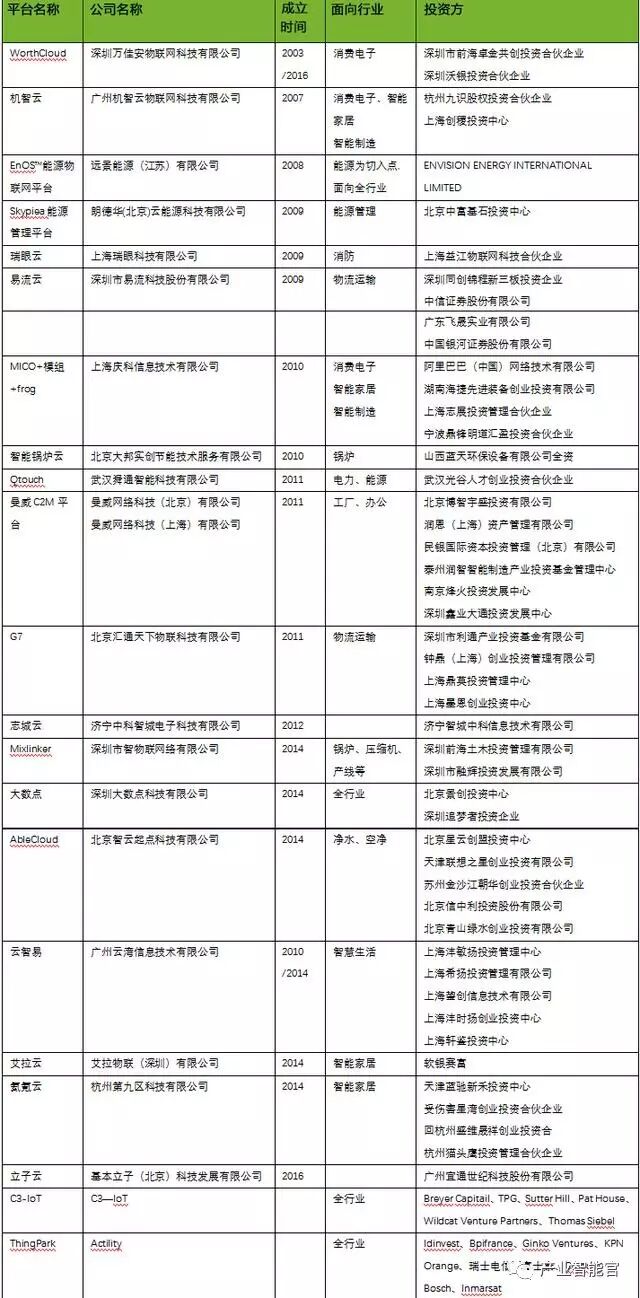
Overall, these companies began exploring intelligent IoT systems earlier than the giants. It is still difficult to determine who will win in the future. However, according to Linkage Element, building an IoT platform requires the accumulation of experience; the longer the time, the more one can “meet the personalized needs of developers or users through standardized and modular back-end solutions”. For example, companies like Smart Cloud, Cloud Intelligence, Qingke, and Envision Energy have been deeply cultivating their respective fields for many years.
In fact, after comparing a large number of companies, Linkage Element found that companies cannot start out too large and comprehensive; they must focus on niche areas, establish a solid foundation, and grow robustly before branching out to ensure longevity. There are many companies in this field that are fleeting.
Self-Reliant Companies (21 companies):
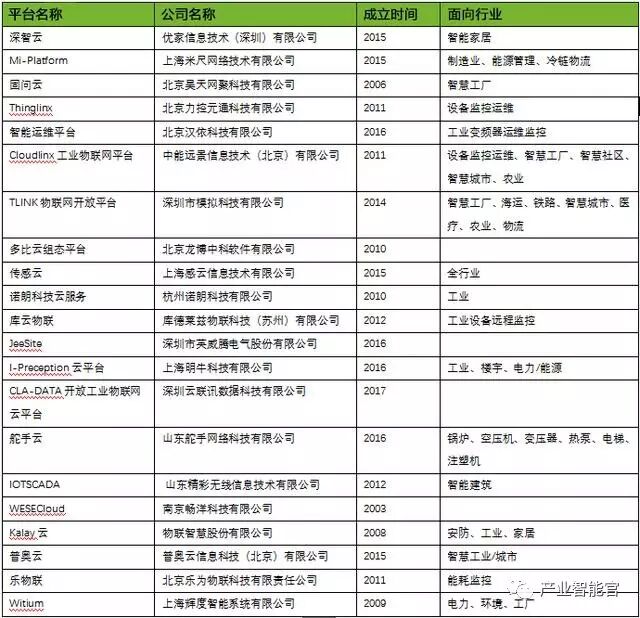
This group of companies, although lacking wealthy backers and not having received investments, have achieved good results in niche areas. For instance, Deep Intelligence Cloud, which is a startup by university students, achieved over ten million in revenue in its first year with a profit margin of around 20%. While this is not much, it is still an excellent seed. Additionally, some companies are not in a hurry to seek funding because they “have business to do”, such as Mi Chi Network.
Of course, each platform has different development strategies. Some aim to become an OS, an engine for connecting billions of devices and enabling intelligent interactions, and build towards this direction from the start; others lean towards solution-oriented approaches, customizing solutions for clients while gradually improving their platforms.
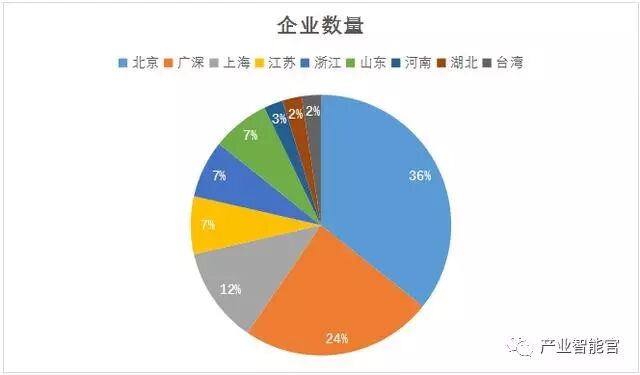
Moreover, among all platforms, Linkage Element found that aside from the giants, among the remaining 43 companies, 14 are in Beijing; 9 in Guangzhou and Shenzhen; 6 in Shanghai; 3 in Jiangsu; 3 in Shandong; 2 in Zhejiang; 1 in Henan; 1 in Hubei; 1 in Taiwan; and 3 overseas (all of which have entered China). Given this situation, Beijing has a clear advantage.
Overall, the IoT is just beginning. Although it has fallen into development pitfalls several times in the past few years, “Though the east is lost, the mulberry and elm are not late; the past cannot be admonished, but the future can still be pursued”. Now is the era of fierce competition, and as long as one survives, there is still an opportunity…
Analysis Report on the Entire IoT Industry Chain
Source: Monita Caixin Think Tank
Analyst: Tang Hang






Next-Generation Technology + Business Operating System:
AI-CPS OS
In the era of Next-Generation Technology + Business Operating System (AI-CPS OS: Cloud Computing + Big Data+IoT+Blockchain+Artificial Intelligence), business leaders must understand how to fully integrate “technology” into the entire company, products, and other “business” scenarios, leveraging AI-CPS OS to form digital power, achieving industry restructuring, corporate reconstruction, and personal rejuvenation, standing out at the industry, corporate, and personal levels.
The intersection of digital power with the industry, enterprise, and individual levels forms a leadership model, embedding digitalization at the core of the leader’s enterprise and leadership style.
-
Resolution Revolution:This power allows individuals to observe and perceive everything happening in the real and digital worlds at a more authentic and detailed level, thereby understanding and controlling products, events, and outcomes more precisely.
-
Complex Uncertainty: Digital changes have disrupted and altered the thinking patterns, structures, and practical experiences that leaders once relied on, resulting in a disruptive force known as complex uncertainty. The main uncertainties lie in three areas: technology, culture, and systems.
-
Blurring Boundaries: The continuous integration of the digital world and the real world into CPS has not only changed the core products, economic theories, and possibilities known in the industry but has also blurred the boundaries between different industries. This effect is rapidly spreading to ecosystems, enterprises, customers, products.
Leaders cannot rely on a single strategic approach to cope with multidimensional digital transformations. As the scope of change expands, everything becomes almost uncertain, and even the most astute leaders may lose direction. In the face of the disruptive digital power of Next-Generation Technology + Business Operating System (AI-CPS OS: Cloud Computing + Big Data+IoT+Blockchain+Artificial Intelligence), leaders must maintain a leading position at the industry, enterprise, and individual levels.
If one cannot maintain a leading position at these three levels, leadership will continue to weaken and become unsustainable:
-
Rearranging Industry Layout: How must your worldview change to be sufficient? What reflections must you have on industry paradigms?
-
Reconstructing Your Enterprise: What changes does your enterprise need to make? How do you plan to redefine your company?
-
Rebuilding a New Self: What kind of person do you need to become? To reshape yourself and maintain a leading position in the digital age, what must you do?
Confucius said: “The gentleman harmonizes but does not conform; the petty person conforms but does not harmonize.” (Analects of Confucius, Zi Lu)
Cloud computing, big data, IoT, blockchain, and artificial intelligence, like gentlemen, integrate together to embody that technology is productivity.
If the last great geographical discovery by Columbus expanded humanity’s physical space, then this time the geographical discovery expands people’s digital space.
In the mathematical space, establishing a new commercial civilization to discover new wealth creation models, bringing new wealth space to human society.
Cloud computing, big data, IoT, and blockchain are the ships entering this digital space, while artificial intelligence is the sail on that ship, Columbus’s sail!
Artificial Intelligence Stimulates Economic Growth in Three Ways:
-
Creating virtual labor that undertakes complex tasks requiring adaptability and agility, known as “intelligent automation”, distinguishing it from traditional automation solutions;
-
Beneficially supplementing and enhancing existing labor and physical assets, improving capital efficiency;
-
The proliferation of artificial intelligence will drive related innovations across multiple industries, opening up new economic growth spaces.
The commercialization progress of next-generation information technologies (cloud computing, big data, IoT, blockchain, and artificial intelligence) is far behind the rapid innovation of the technologies themselves. The reason lies in the unclear service targets of technology suppliers (party B) and the traditional enterprises (party A) not understanding how to effectively utilize next-generation information technologies to innovate business models and enhance efficiency.
The “Industry Intelligence Officer” serves as a bridge through valuable papers, research reports, and commercial cooperation projects involving cloud computing, big data, IoT, blockchain, and artificial intelligence, targeting enterprise CEOs, CDOs, CTOs, and CIOs, serving both next-generation information technology providers and consumers.
Assisting next-generation information technology companies in finding the most valuable potential traditional customers and paths for commercialization, helping traditional enterprises select and develop suitable next-generation information technology products and solutions, eliminating information asymmetry between next-generation information technology companies and traditional enterprises, and promoting the commercialization wave of cloud computing, big data, IoT, blockchain, and artificial intelligence.
Advice for Decision Makers and Business Leaders:
-
Go beyond automation and initiate new innovation models: Utilize dynamic machine intelligence with autonomous learning and self-control capabilities to create new business opportunities for enterprises;
-
Embrace next-generation information technologies and artificial intelligence: Seamlessly integrate human wisdom with machine intelligence, reassessing the types of knowledge and skills needed for the future;
-
Establish ethical standards: Formulate ethical guidelines for the artificial intelligence ecosystem and establish clearer standards and best practices during the development of intelligent machines;
-
Pay attention to redistribution effects: Prepare for the impacts that artificial intelligence may bring, developing strategies to assist populations at higher risk of unemployment;
-
Develop new capabilities required for AI-driven enterprises: Employee teams need to actively master important human-specific capabilities such as judgment, communication, imagination, and creativity. For Chinese enterprises, creating an inclusive and diverse culture is also very important.
Next-Generation Technology + Business Operating System (AI-CPS OS: Cloud Computing + Big Data+IoT+Blockchain+Artificial Intelligence) is the core driving force behind a new round of industrial transformation, further releasing the immense energy accumulated from previous technological revolutions and industrial transformations, and creating a new powerful engine.
Reconstructing economic activities such as production, distribution, exchange, and consumption, forming new intelligent demands across macro and micro fields, giving rise to new technologies, new products, new industries, new business forms, and new models. This will trigger significant changes in economic structure, profoundly altering human production and lifestyle, and achieving an overall leap in social productivity.
Next-Generation Technology + Business Operating System (AI-CPS OS: Cloud Computing + Big Data+IoT+Blockchain+Artificial Intelligence) is undergoing a process from “concept” to “implementation”, ultimately achieving “large-scale application that profoundly changes human life”.
Industry Intelligence Officer AI-CPS
Utilizing Next-Generation Technology + Business Operating System (AI-CPS OS: Cloud Computing + Big Data + IoT + Blockchain + Artificial Intelligence), constructstate perception – real-time analysis – autonomous decision-making – precise execution – learning enhancement cognitive computing and machine intelligence in scenarios; achieving industrial transformation and upgrading, DT-driven business, and value innovation creation in the industrial interconnected ecosystem.

Long press the QR code above to follow the WeChat public account: AI-CPS, for more information reply:
New Technologies:“Cloud Computing”, “Big Data”, “IoT”, “Blockchain”, “Artificial Intelligence”; New Industries:“Intelligent Manufacturing”, “Intelligent Driving”, “Intelligent Finance”, “Intelligent Cities”, “Intelligent Retail”; New Models:“Case Analysis”, “Research Reports”, “Business Models”, “Supply Chain Finance”, “Wealth Space”.
Source: Industry Intelligence Officer (Public Account ID: AI-CPS)