The naming of FPGA models is akin to the “identity card” of chips, containing key information such as architecture, process technology, and performance. Mastering these rules allows for quick identification of device characteristics, helping to avoid pitfalls in selection. This article analyzes the naming logic of four major manufacturers (Xilinx, Intel, Lattice, Microchip), enabling you to understand model intricacies at a glance.
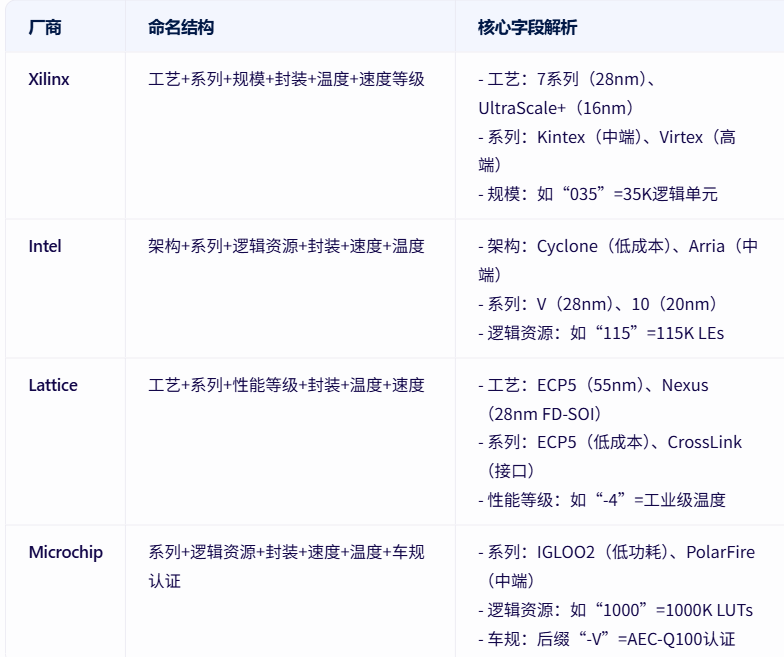
1. Quick Reference Table for Key Fields
① Process Generation:
7nm: Xilinx Versal Premium, Intel Agilex
16nm: Xilinx UltraScale+
28nm: Xilinx 7 Series, Intel Stratix 10
② Performance Grade:
Suffix “-1” to “-3”: Speed grade (1 is the fastest)
Suffix “-I”/”-C”: Industrial grade (-40~100℃) or commercial grade (0~70℃)
③ Package Abbreviations:
BGA: Ball Grid Array (e.g., FBG900=900-ball FCCBGA)
CSP: Chip Scale Package (e.g., Lattice’s MG285=285-ball CSP)
2. Selection Pitfall Avoidance Guide
❌ Do not directly compare Xilinx’s “Kintex” with Intel’s “Cyclone” (different positioning)
❌ Ignore temperature grades (industrial grade requires suffix “-I” or “-M”)
❌ Confuse logic resource units (Xilinx uses “K LUTs”, Intel uses “K LEs”)
This article is an original piece by Yiy Education, please indicate the source when reprinting!