Nobuyuki Sato
Sr. Staff Engineer, Product Marketing
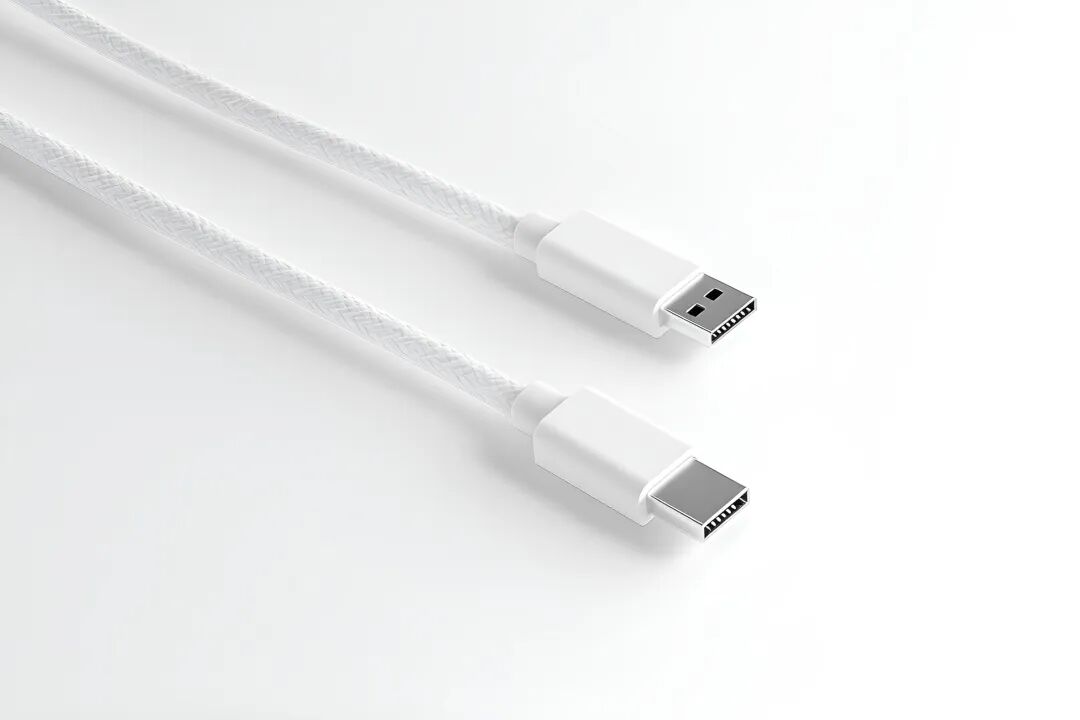
The USB interface facilitates data communication and power transmission in compliance with USB standards. It offers exceptional versatility, suitable for various applications such as PC peripherals, televisions, laptops, and monitors, where USB Power Delivery can achieve power levels of up to 100W or more for faster charging and efficient, flexible operation. Consequently, the USB Type-C connector standard significantly enhances power efficiency and increases data transfer rates, achieving speeds of up to 10Gbps or higher depending on the USB communication version. This wide range of applications makes the USB interface indispensable in modern technology. The USB Type-C interface, standardized as the charging terminal for mobile devices within the EU, further enhances this versatility. This move is expected to drive widespread adoption, improve consumer experience, and promote environmental sustainability.
When introducing the USB Type-C interface into applications, it is important to note that USB communication and power have different connection detection mechanisms. Therefore, state transitions must be made based on their respective statuses and detection results. Traditional USB interfaces detect connections by recognizing VBUS, while USB Type-C detects connections by measuring the voltage on the CC pins. The power capacity is determined based on the state transitions between the source and sink. Once this process is completed, USB communication enumeration is initiated by activating VBUS.
By adhering to the resistance values and precision specified in the USB Type-C standard, the CC pin connection is identified through voltage detection using pull-up and pull-down resistors. When using the USB Type-C interface for the first time in an application, it is necessary to select appropriate external components for CC detection and USB communication, validate the hardware, build the USB application system with software, and test its operation. The RA2L2 provides all the essential functions and tools for the USB Type-C interface as an upstream port (UFP), helping to reduce the need for external components and development time. Additionally, as it has obtained USB Test ID (13501), you can trust its high quality and reliability throughout the development process.
Required USB Functions for UFP
USB 2.0 Full Speed (FS) Module
-
No external crystal oscillator is required for USB slave controller full-speed transmission at 12Mbps.
-
Supports all transfer types: control transfer, bulk transfer, interrupt transfer, and isochronous transfer.
-
5V tolerant VBUS pins.
USB Type-C Interface Module
-
Complies with the Universal Serial Bus Type-C cable and connector specification: version 2.4.
-
USB Type-C sink supports: CC detection circuit (built-in Rd resistor).
-
Detection of source power current capability from default USB/1.5A/3.0A: state detection and transition.
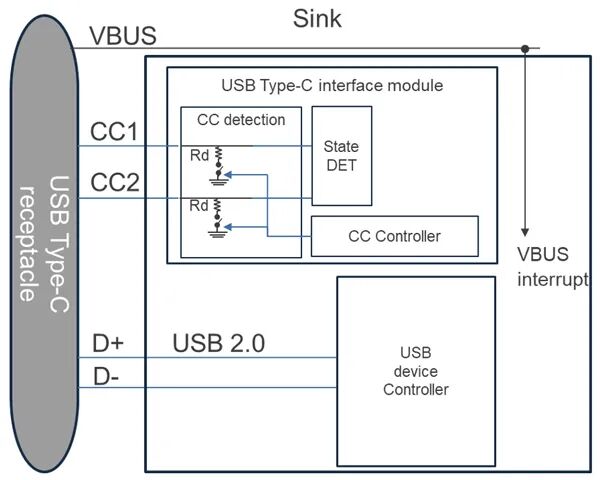
Figure 1: RA2L2 USB FS Module and USB Type-C Interface Module
Development Environment
The EK-RA2L2 evaluation board is ideal for developing USB Type-C interface prototypes. It is equipped with a USB Type-C connector, screw terminals for connecting power loads, and monitoring circuits for detecting VBUS voltage and current, making it an excellent environment for evaluating USB Type-C UFP. It can also serve as a reference design for the USB Type-C interface.
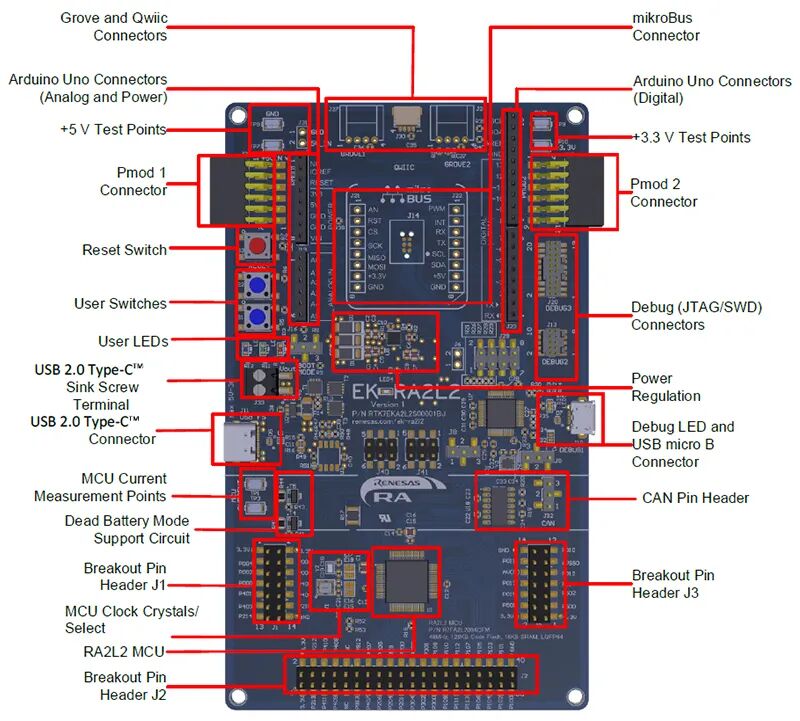
Figure 2: EK-RA2L2 Evaluation Board
To support software development, the RA series provides the RA Flexible Software Package (FSP), which includes board support packages (BSP), peripheral drivers, middleware, connectivity, networking, and security stacks, as well as reference software for building solutions, enabling rapid application development.
QE for USB is a USB-compatible development support tool specifically designed for USB system development, allowing users to check USB connection status, USB descriptor values, and USB Type-C status, and debug communication errors.
Rich Serial Interfaces
The RA2L2 supports peripheral functions optimized for low-power applications (32-bit LP timer, low-power mode) and features a rich set of serial interfaces (I3C, SSI, SCI, SPI, LPUART, CAN, USB FS, and USB Type-C).
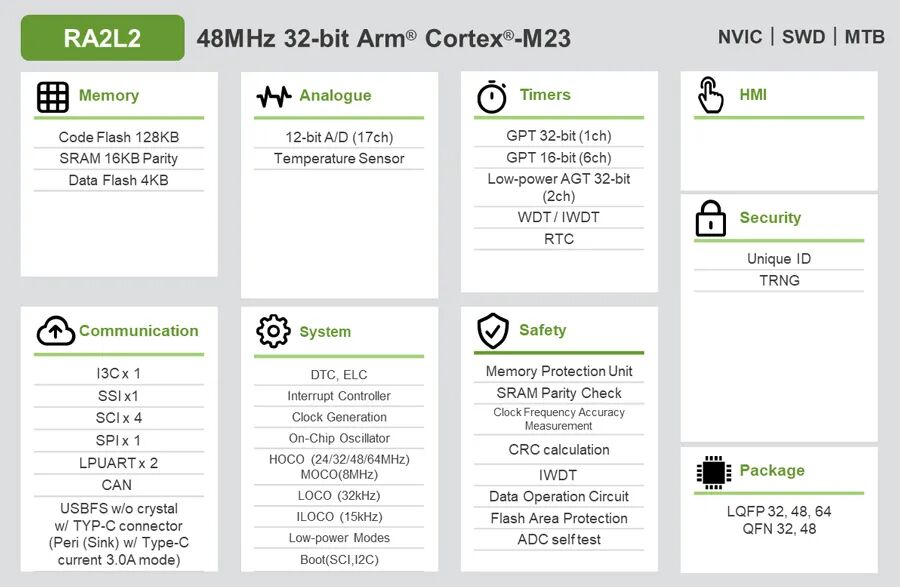
Figure 3: RA2L2 Block Diagram
The features of the RA2L2 make it an ideal choice for a wide range of low-power operation applications, including:
-
Wearable devices
-
Audio streaming devices
-
PC/POS peripherals
-
General systems
-
IoT devices
-
Industrial automation and sensors
-
Consumer products
-
Home appliances
For more information, including documentation and videos, please click Read the Original to visit the RA2L2 product page.
(You can identify relevant information in the article by scanning the QR code below or copying the link into your browser.)
EK-RA2L2
https://www.renesas.cn/zh/design-resources/boards-kits/ek-ra2l2

RA Highly Scalable Flexible Software Package (FSP)
https://www.renesas.cn/zh/software-tool/flexible-software-package-fsp

QE for USB
https://www.renesas.cn/zh/software-tool/qe-usb-dedicated-tool-usb

END
Need Technical Support?
Renesas Engineering Community has a wealth of technical resources. If you have any questions while using Renesas products, you can scan the QR code below or copy the URL into your browser to access the Renesas Engineering Community for answers and online technical support.

https://community-ja.renesas.com/zh/forums-groups/
Renesas Electronics (TSE: 6723)
Technology makes life easier, committed to creating a safer, smarter, and sustainable future. As a global microcontroller supplier, Renesas Electronics integrates expertise in embedded processing, analog, power, and connectivity to provide complete semiconductor solutions. The successful product portfolio accelerates the time-to-market for automotive, industrial, infrastructure, and IoT applications, empowering billions of connected smart devices to improve people’s work and lifestyles. For more information, please visit renesas.com