Introduction
The current domestic chip industry is thriving, with various startups emerging one after another. For example, there are numerous companies in the DPU, GPU, AI, and CPU sectors. However, no startup dares to challenge mobile processor chips; even major mobile manufacturers start by making smaller chips. In 2019, global mobile shipments reached 1.4 billion units, which translates to 1.4 billion mobile processors. This is a business worth over 100 billion RMB. On one hand, there is a huge shipment volume, and on the other hand, there are very few players. This is the distorted reality.
This article systematically interprets the development history of mobile processors, the current state of mobile processor development, and future trends. It is recommended for everyone.
At this moment, a mobile processor is only 0.5 centimeters away from your palm. Although you cannot see it, after reading this article, you will understand that it is indeed the most complex chip in the world that understands you the best. Although I have written countless articles introducing chips, I believe this one is the most challenging.
01
The current domestic chip industry is thriving, with various startups emerging one after another. For example, there are numerous companies in the DPU, GPU, AI, and CPU sectors. However, no startup dares to challenge mobile processor chips; even major mobile manufacturers start by making smaller chips.
In 2019, global mobile shipments reached 1.4 billion units, which translates to 1.4 billion mobile processors. This is a business worth over 100 billion RMB. On one hand, there is a huge shipment volume, and on the other hand, there are very few players. This is the distorted reality.
There are currently a few mobile SoC manufacturers. Apple’s A series, Samsung’s Exynos series, Huawei’s Kirin, Qualcomm Snapdragon, MediaTek, and Unisoc. Where are the others? The reason is simple: the difficulty of mobile processor chips is extremely high, enough to deter the current wave of chip startups. Some may say that mobile processors are just a combination of a bunch of IPs.
Is assembling a chip really that easy? Mobile processor chips are not just processors; they can also be referred to as mobile SoC chips, where SoC stands for System on Chip.
The term SoC more accurately describes the functionality of mobile processor chips; it is a SYSTEM. It includes CPU, GPU, DSP, ISP, 4G/5G baseband, NPU, WIFI, Bluetooth, GPS, Beidou, display systems, and more.
Even this, Hua Shao cannot finish in one breath. Why is this system so complex? It needs to be discussed from the development of mobile processors.
02
If Apple is the king of the smartphone era, then Nokia is the king of the feature phone era. The most famous manufacturer of mobile SoC chips during the feature phone era is TI (Texas Instruments). TI is an old chip design company.
When you mention TI, you certainly won’t feel sleepy. Because this company is closely related to integrated circuit chips, it itself is a history of integrated circuits.
In 1954, TI produced the world’s first transistor; in 1958, TI invented the world’s first integrated circuit. In 1982, TI released the world’s first digital signal processor DSP.
So, which domestic engineers and manufacturers working on digital signal processing have not used TI’s chips? If you haven’t used them, you can’t claim to have done digital signal processing. Later, TI released the OMAP series of mobile processors, which is a classic application processor. This processor was the first to propose the concept of heterogeneity, which is DSP + ARM processor. This processor structure quickly won the favor of mobile manufacturers because it could handle various wireless communication digital signal processing tasks, ensuring call quality; after all, the most important function of mobile phones during the feature phone era was making calls. Targeting core demands, who can match TI’s DSP capabilities?
At the end of 2004, when Nokia launched its first Series60 platform phone – 6630, it used TI’s masterpiece – OMAP1710. The program processor model included in OMAP1710 is ARM926, with a maximum operating frequency of 220MHz. At the same time, the level 1 cache of ARM926 has been upgraded to 32KB, reaching twice that of the previous generation processor, and still supports JAVA hardware acceleration. Therefore, TI claimed that OMAP1710 had a 40% performance improvement over the previous generation processor.
OMAP1710 adopted low-voltage technology, and the reduction in process size also means a decrease in operating voltage, with a standby power consumption of only 10mAh, making it an energy-saving champion.
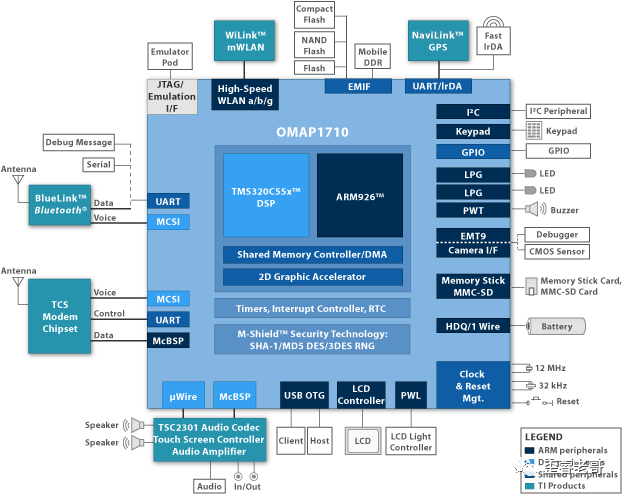
As Nokia’s product line continued to grow, how many Nokia phones used OMAP 1710? The stars in the sky are countless, and it is hard to count the Nokia phones that used OMAP1710, including 6630, 6680, 6681, E50, E60, E61, E62, E65, E70, N70, N71, N72, N73, N80, N90, N91, and N92, etc.
A single SoC running so many product lines and lasting so long is unimaginable for mobile SoCs in the smartphone era. Of course, TI also continuously launched updated generations of SoC processors. TI empowered Nokia, and Nokia also made TI the king of feature phone chips. The king of feature phone chips, TI, occupied more than 60% of the mobile processor market share, a figure that today’s Qualcomm can only look up to. With good call quality and long standby time, TI became the man behind Nokia’s success.
03
Seeing TI’s smooth sailing in the mobile field, other manufacturers also wanted to get a piece of the pie. Who are these manufacturers? The list is long and includes big names like Intel, Freescale, Marvel, Qualcomm, etc. Intel’s XScale series appeared very early. PXA210 is the culmination of this series. PXA210 is a chip based on the ARM instruction set, internally called StrongARM. Who would have thought that Intel would use the ARM instruction set?
Intel entered the mobile field early and had strong performance; it was probably the most powerful mobile processor of that era. But for making a call or sending a text, who needs such a powerful processor? Ah, being early is not as good as being timely. Born at the wrong time. In the end, it was still old friend Bill Gates who came to help. To jointly open up the mobile market, Microsoft simultaneously launched a mobile operating system, WINCE. It was PXA210 + WINCE, trying to replicate the glory of PC X86 + WINDOWS.
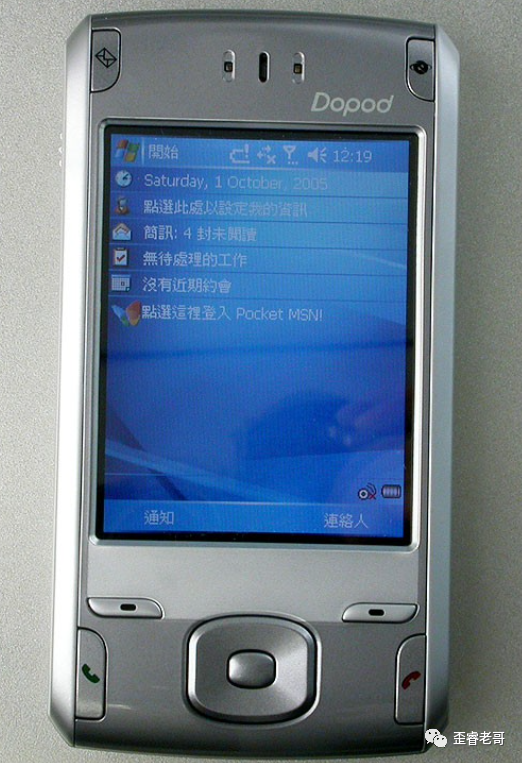
This is a Dopod smartphone product from 2006, featuring the Intel PXA + WINCE combination. To be honest, it didn’t create much of a stir; it was only popular in some small channels for a while. Files on the computer, such as WORD, MP3, MP4, could be opened directly on the phone, and audio and video playback were not a problem, but it did not spark a buying frenzy at the time.
Intel and Microsoft coincidentally saw the embryonic form of future smartphones. The smartphone era is a time for heroes, and sooner or later, a hero will come to save chip manufacturers. Intel and Microsoft guessed the beginning but did not foresee the end. Because another person had guessed it, and that person was Steve Jobs. Although Intel’s products had leading performance, there was not much performance anxiety during the feature phone era. Intel still followed the same approach as its PC business, highbrow and disconnected from reality.
In 2005, the global mobile application processor market totaled $839 million, with Texas Instruments accounting for 69%, Qualcomm for 17%, and Intel only 7% market share. This is because the mobile field was far less profitable than Intel’s PC and server sectors, leading Intel to sell its PXA mobile business to MARVEL and exit the field. The highbrow Intel left, and more grounded chip companies came in.
In 2005, a company that initially developed optical drive chips completed the development of GSM samples and integrated mobile application processors with GSM processors to provide MTK chip solutions, along with a complete SDK. This company is MediaTek, and its founder, Cai Mingjie, is also known as the “father of counterfeit phones.” Before the Android system, every manufacturer had to develop a mobile interface, which was still somewhat difficult for small manufacturers. MediaTek launched a one-stop mobile solution, pre-integrating mobile chips and software platforms, which significantly lowered the manufacturing threshold for mobile manufacturers, making it as easy to make a phone as opening a restaurant.
In 2007, the cancellation of mobile phone licenses in China led to a surge of small mobile manufacturers in Shenzhen. Is it the times that create heroes, or do heroes create the times? From MediaTek and counterfeit phones, both caught the historical trend and created their own era. Manufacturers in Huaqiangbei relied on MediaTek’s solutions to dominate the market and make a fortune. At the peak of counterfeit phones, annual sales reached 100 million units. MTK chips made Huaqiangbei successful and also made MediaTek successful. Heroes and times achieved each other. Although counterfeit phones have faded away, the legends surrounding them have never stopped.
04
In 2007, Steve Jobs launched the first-generation iPhone, with its 3.5-inch all-touch screen, metal body, and iPhoneOS truly opening the door to the smartphone era. This iPhone 3G used Samsung’s SoC processor, S5L8900. S5L8900 was manufactured using a 90nm process, with a frequency of 412-620MHz, and internally used ARM11. Most importantly, it integrated a GPU, PowerVR MBX-lite. The GPU became a standard configuration for smartphones and was even more important than the CPU. Imagination’s PowerVR is the leader in embedded GPUs.
Intel’s PXA series was also licensed to use PowerVR MBX’s GPU. Qualcomm acquired ATI’s mobile GPU division, Imageon, and renamed it Adreno. At this time, they were still in the exploratory stage and had not yet gained a foothold. They were even at a disadvantage compared to ARM’s Mali.
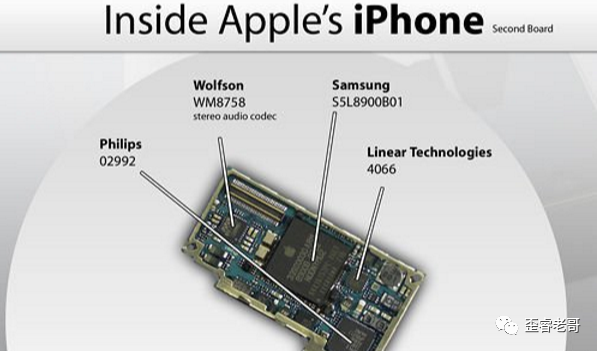
Using Samsung’s processor, Apple created the first iPhone. And Apple also ignited Samsung’s fire to make processors. Seizing the opportunity, Samsung launched the Exynos series, becoming one of the most important players in smartphone SoCs. When the world saw the iPhone, other mobile manufacturers began to feel anxious about how to compete with the iPhone and iOS. WINCE did not create much of a stir; the system was too similar to WINDOWS, both in concept and operation. It was not capable of great use.
Android emerged as a result. In fact, Android was not originally developed by Google; it was developed by the Android company founded by Andy Rubin. Andy Rubin is also known as the father of Android.
Andy Rubin is a legendary technical figure but not an excellent manager. Near the end of development, the company was in severe financial distress and had to rely on debt to survive.
This was not Andy Rubin’s first startup; as early as 2002, he and his friends founded a company called “Danger,” which invented a web-enabled smartphone called Sidekick.
In early 2002, Rubin gave a lecture to Silicon Valley engineers at Stanford University, during which he talked about the development process of Sidekick. Among his audience were two people who, after class, approached Rubin to check out Sidekick and were deeply attracted by this new device that could access the internet. Indeed, who doesn’t like to go online? These two people were Google founders Larry Page and Sergey Brin.
With this background, the Android company was short on funds, and in August 2005, Android was acquired by Google, which became one of Google’s most successful acquisitions.
In 2007, Android quickly launched its first version and established the Open Handset Alliance. Android served global mobile manufacturers in an open-source manner, but at that time, no hardware mobile company supported it. By chance, HTC appeared.
HTC initially started as a smartphone OEM, and its boss was Wang Xuehong. In 2008, it acquired Dopod, but in reality, Dopod and HTC were one family. One was an OEM, and the other had its own brand, both playing with PXA + WINCE. Having experienced WINCE, HTC saw Android as a long-lost friend, a dream lover, and had to make it happen. So, they said goodbye to WINCE.
HTC’s CEO, Zhou Yongming, had previously discussed OEM manufacturing of the Sidekick phone with Rubin when he was at Danger, so they were old acquaintances. New clothes are not as good as old friends. Rubin remembered Zhou Yongming and promised to collaborate with HTC. HTC also sent nearly 50 engineers to work directly at Google headquarters. Ultimately, the world’s first Android phone was born. This Android phone brought HTC a brief glory in the Android era and ignited the era of smartphone SoC kings.
In 2008, HTC launched the world’s first Android phone, T-Mobile G1, becoming the first Android challenger standing opposite Apple’s iOS system. This phone used Qualcomm’s MSM720 processor. Originally, this Qualcomm processor was not specifically developed for Android. It was initially used in WINCE. Familiar with this chip, HTC was the first to use Qualcomm chips to make an Android phone.
Qualcomm MSM7201A adopted a dual-core solution (using ARM11 + ARM9 dual-core architecture), with an internal 3D graphics processing module and a 3G communication module. At the same time, the image module had high-resolution image and video playback capabilities, and streaming media performance was also excellent.
Having come from a communication background, Qualcomm finally figured out how to make smart SoCs. Big and small cores, GPU, integrated communication modules. This approach has been used ever since, leading to the creation of the Snapdragon series. Subsequent manufacturers developing Android smartphones coincidentally chose Qualcomm when selecting mobile SoCs. With its communication roots, Qualcomm excelled in communication, as it held patents for CDMA and other technologies, making it easy to integrate communication processors.
In contrast, the former leader TI had two disadvantages: On one hand: TI processors could not cover all network standards, leading manufacturers using OMAP chipsets to purchase additional baseband chips, which increased production costs and power consumption, resulting in a significant market share decline. On the other hand: Mobile processors update very quickly; TI’s self-manufacturing approach was very similar to Intel’s. If they designed and manufactured themselves, they would face high process technology demands, which TI’s processes could not meet for the insatiable demands of mobile processors. Unable to handle the baseband, they fell behind. Entering the smartphone era, TI’s market share continued to decline.
In 2012, TI decided to abandon the OMAP series processors and shift its investment focus from mobile chips to broader markets, including automotive production and industrial equipment. TI and Nokia, both in a difficult situation, did not part ways. They disappeared together in the smartphone era. This also established Qualcomm’s position as the number one leader in the Android field. HTC made Qualcomm successful but did not achieve its own success.
In 2017, HTC’s mobile business was on the verge of collapse, and Google announced it would spend $1.1 billion to acquire HTC’s mobile business. Besides patents, one important factor was that HTC launched the first Android phone. Additionally, HTC had sent 50 people to work together on development, and those passionate years of collaboration were not in vain.
Ten years ago, I didn’t know you, and you didn’t belong to me; we built our careers together. Ten years later, Android is rising, while HTC has declined; we were together but are now forever apart.
05
After launching the first-generation iPhone, it was like opening the door to the future of smartphones. Soon, Apple began to experience the biggest difference between smartphone SoCs and previous ones: the endless demand for performance from smartphones. Smartphones are not only computers in your pocket but also gaming devices, cameras, and the culmination of all entertainment.
If entertainment frequently stutters at critical moments, the human companion, the phone, will lead to a poor experience. A poor experience will lead to infidelity. Better phones deserve better processors, and Apple’s self-developed processors were put on the agenda. Apple did not have a chip development foundation, but that was not a problem.
In 2008, Apple acquired P.A.Semi, a chip company focused on embedded devices. This was an unremarkable acquisition. However, it brought in a genius, Jim Keller. At that time, Jim Keller was the technical head at P.A.Semi, and the result of this acquisition was his joining Apple.
He is the Jim Keller known as the father of AMD’s ZEN. At that time, he was just an excellent chip designer, not yet the world-renowned chip genius. Jim Keller thus became an employee of Apple. During his time at Apple, he led the design of the A4 and A5 mobile processors, used in iPhone 4/4s, iPad/iPad 2, etc. This marked the beginning of Apple’s journey in self-developing mobile processors.
Jim Keller recalled in an interview that the self-developed processors made Steve Jobs very satisfied. In addition, while at Apple, Jim Keller began designing large core architectures for mobile SoC projects. When a more powerful processor is needed, there are two ways to achieve it: One way is to make the basic structure larger, simply put, a big core. The second way is to adjust functionality, creating a bunch of small cores. Obviously, the former is more challenging and effective because not all programs can be executed in parallel on multiple cores, leading some design manufacturers to create scenarios where “one core struggles while seven cores watch.”
Apple’s SoC processors have always provided users with a stronger performance experience with fewer cores. Since then, Apple’s SoC has become the performance ceiling for mobile SoC chips. It has always been chased but never surpassed. However, Apple’s SoC processors have never integrated communication processors. This has also been a point of criticism. Apple’s phones have always used Intel’s baseband, which has led to complaints about poor signal quality.
But to be fair, poor signal quality is not necessarily due to the separation of the mobile SoC and communication baseband; it is more likely that the design of the baseband chip itself is somewhat lacking. Compared to Qualcomm, which has a strong background in communication, Intel’s reserves are somewhat weaker.
In 2019, Apple acquired Intel’s baseband business, completing the last piece of the puzzle. However, the iPhone 12 still used Qualcomm’s baseband. The puzzle is complete, but when it can be fully integrated still requires some time. Life is often unsatisfactory. Even Apple has its regrets.
06
As a complete machine manufacturer, Apple’s self-developed chips set a good precedent. More manufacturers followed this path. Huawei came along.
In 2011, Yu Chengdong was appointed chairman of Huawei’s terminal business, starting Huawei’s journey into high-end smartphones, with self-developed processors being just one part of it.
In 2012, Huawei released the K3V2, claimed to be the world’s smallest quad-core ARM A9 architecture processor. It integrated a GPU and was manufactured using a 40nm process. This chip received high attention from Huawei’s mobile department and was directly commercialized in Huawei P6 and Huawei Mate1 products, which were positioned as flagship products. However, due to excessive heat generation and poor GPU compatibility, this chip was criticized by many users. Using a self-designed chip, Huawei had to use it in its own phones, but users were not pleased. After several iterations, by the time of the Kirin 9 series, it had gradually improved.
On September 2, 2017, at the International Consumer Electronics Show in Berlin, Huawei released the AI chip Kirin 970. The first Huawei phone to use Kirin 970 was the Mate 10, officially launched in Munich, Germany on October 16 of the same year. Kirin 970 was not Huawei’s most powerful chip, but it marked Huawei’s entry into the intelligent era of mobile SoCs.
Starting with Kirin 970, Huawei was the first to integrate a component that had never been seen before in mobile SoC chips, the NPU. Today, it is a consensus to integrate AI acceleration components within mobile devices, but at that time, very few people could recognize its significance. The first version used Huawei’s IP from Cambricon, and later gradually shifted to the Da Vinci architecture. A few days later, Apple’s A11 Bionic, which also included an NPU, was released.
Heroes see alike; the “artificial intelligence” era of smartphone SoCs began. Huawei’s Kirin 970 NPU, Google’s Pixel2’s built-in IPU (Image Processing Unit), and Apple’s A11 Bionic are all dedicated hardware solutions to achieve the aforementioned functional characteristics. Mobile chip processors now include multi-core CPUs, multi-core GPUs, DSPs, ISPs, basebands, displays, security, etc.
Now, the NPU has joined the ranks. Mobile photography has entered the era of “computational photography,” providing users with better shooting experiences, but it requires more frequent AI computations.
In 2020, Huawei HiSilicon was banned by the US from producing chips at TSMC in Taiwan, and the Kirin 9000 became a swan song. Huawei’s SoCs were the first to introduce NPU, leading smartphones into the true “artificial intelligence” era. The “artificial intelligence” in mobile phones is still developing, but Huawei’s processors can no longer innovate. Where have the people gone? The peach blossoms still smile in the spring breeze. Huawei people often say: The bird that cannot be burned is the phoenix, and they look forward to the phoenix’s rebirth.
07
To this day, mobile SoC chips have reached 5nm, facing three major issues: design complexity, increased costs, and difficulty in controlling power consumption. The earliest mobile SoCs were just CPUs, but now they have far exceeded the concept of CPUs. Various manufacturers are continuously adding features. TI added DSPs.
Qualcomm and MediaTek integrated communication processors (CP), while Samsung, Qualcomm, and Intel each added GPUs, and Huawei and Apple brought in NPUs. Multiple ISPs were introduced, supporting 2, 3, or 4 CMOS cameras in a competitive manner.
CPUs have also evolved from single-core to dual-core, big.LITTLE, quad-core, six-core, and now eight-core. ARM architecture has progressed from A8A9 to A78, A79, and now X1; from dual-issue in ARM A8 to quad-issue in A78, and five-issue in X1.
These subsystems, including CPU, GPU, imaging, AI, storage, wireless, security, etc.; are usually presented as isolated entities in chip introductions or manuals. However, the most critical aspect of an SoC is the interconnection of IPs and data flow, which is generally achieved through buses and various DMA modules. These connect various IP subsystems, while general-purpose or custom DMA modules facilitate data flow exchange. This constitutes the entire complex SoC system.
It is a significant test of integration capabilities and also leads to increased costs. These cost increases are due to both increased area and the fact that after 7nm, the cost of individual transistors has actually increased.
One-time investments, IP fees, and MASK costs are all rising, while global mobile sales are decreasing.
A mobile SoC is close to 80-90 square mm2, calculated at 7nm or 5nm. Such a large chip, if compared to AI chips, is expected to consume dozens of watts. However, the power consumption of mobile SoC chips is in the few watts, and the standby power consumption is even lower.
How to control the power consumption of mobile SoCs is a core issue, mainly through clock control, power shutdown, voltage regulation, and even dynamic voltage frequency adjustment, among other methods.
The following figure is a typical triple power performance analysis chart, with green representing small cores, blue representing medium cores, and red representing large cores. The horizontal axis represents performance improvement, while the vertical axis represents energy consumption increase.
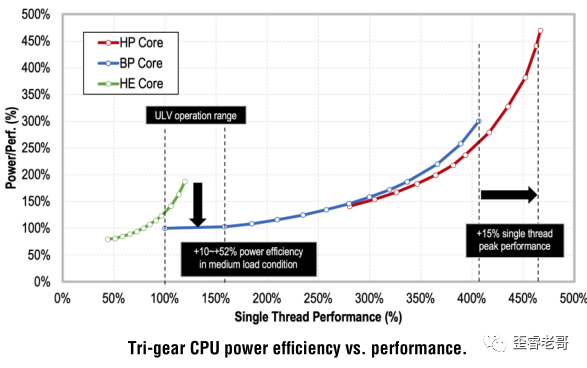
By using a qualified power consumption table, running different cores under different loads, and shutting down other cores, there is some basis for this. Engineers know that under light loads, they run on small cores; as the load increases, they switch to medium cores, and under higher loads, they can only run on large cores. In single-threaded mode. However, determining which core to run under which load is more economical, and this chart can illustrate that.
With the improvement of single-thread performance, there is also an increase in performance; how to ensure that performance increases while running at a reasonable power consumption is related to adjustments in chip firmware. This is also a test of each manufacturer’s optimization capabilities at the bottom level.
Currently, several 5nm processors have received user feedback that their power consumption is relatively high, being referred to as “fire dragons.” It appears that as integration increases, under low process technology, more power consumption issues may arise. The user experience of “smooth and silky” brings about performance anxiety and battery anxiety. While performance issues are gradually being resolved, battery issues have become more prominent. The era of not being satisfied with benchmark scores has not yet passed. The demand to avoid being a “fire dragon” still exists.
08
Mobile SoCs lead the development of mobile phones. Apple, Samsung, Qualcomm, Huawei, MediaTek, etc., release chips every year, showcasing the top talents in chip design. The three elements of a showdown among experts are speed, courage, and intelligence.
In the chip industry, missing a moment means missing a generation of mobile phones. A showdown among experts requires courage; 7nm and 5nm are driven by the demands of mobile SoCs, with complex integration but also strict low power consumption; low process technology is an inevitable yet unknown choice, a pathfinder in the unknown territory of chip process technology.
Expert showdowns require intelligence; multi-path ISPs and integrated NPUs have never completed the definition of mobile SoC products. How to maintain uniqueness while gaining user recognition in performance, power consumption, and experience is crucial to becoming the chip that understands users the best. Mobile processors, as the brain of mobile phones, are constantly evolving, becoming humanity’s closest assistants. Meanwhile, humans addicted to mobile phones are continuously regressing, becoming increasingly dependent on them.
This is an interesting yet ironic reality.
—END—
Click the card below
Follow us now